 Stanza / Audio guide
Content & sources
Stanza · Audio guide
Castillo de San Felipe de BarajasAudio guide
A place to remember. A story to take with you.
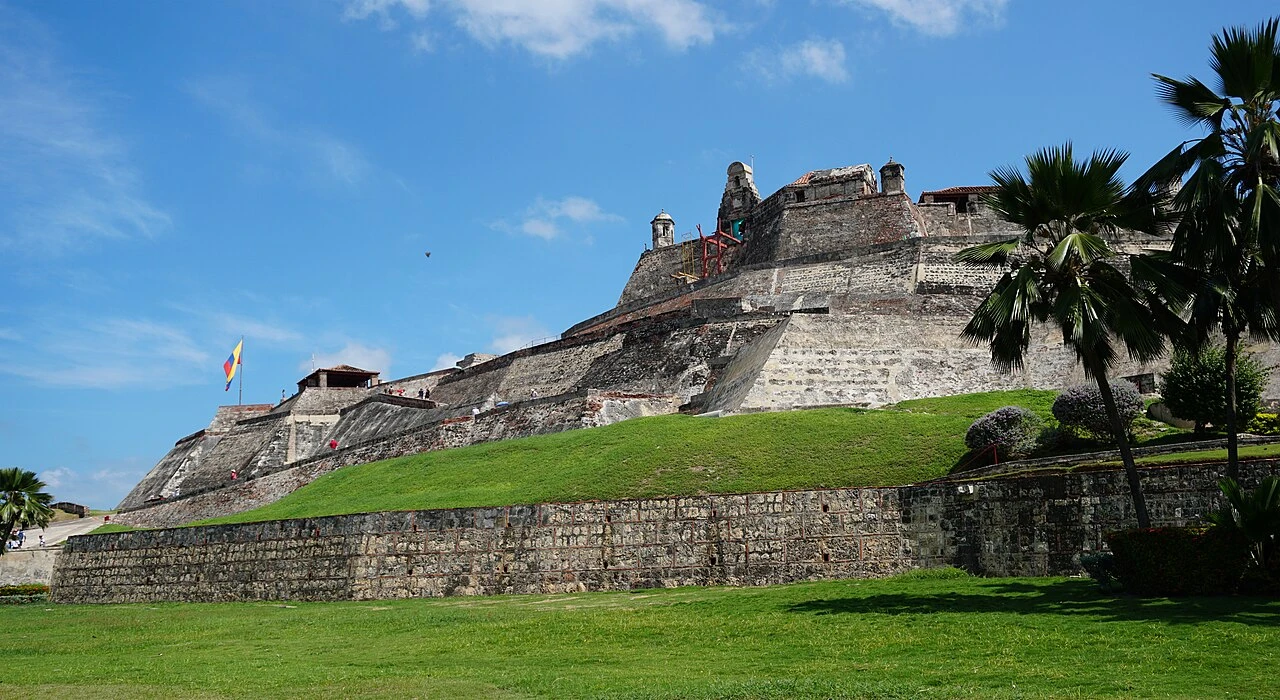
This historic fortress is a UNESCO World Heritage site and represents the greatest Spanish military architecture in the Americas. It was constructed in the 17th century to defend Cartagena from pirate attacks…
Download Stanza, then search for “Castillo de San Felipe de Barajas”.
About the tour
One guide. Your kind of visit.
This historic fortress is a UNESCO World Heritage site and represents the greatest Spanish military architecture in the Americas. It was constructed in the 17th century to defend Cartagena from pirate attacks and naval sieges.
Ready when you are.
- 01Get the free Stanza app.
iOS & Android
- 02Find your guide.
“Castillo de San Felipe de Barajas”
- 03Download before you go.
Works offline
Audio guide / 14 narrated stops
Inside the guide
Get to know a few of the stories before you go. Open a stop to read more.
01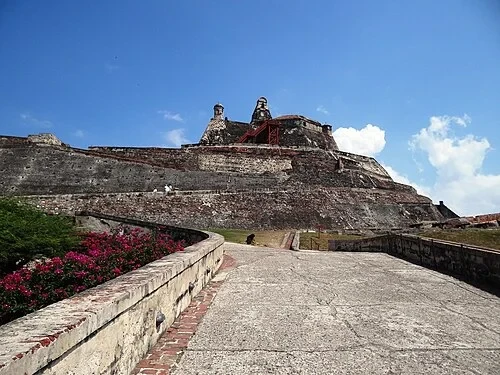 Arrival and the Blas de Lezo MonumentThe Main Entrance and Ramp
Welcome to one of the most imposing military structures ever built by the Spanish empire. Construction on this formidable complex began in 1639, situated strategically atop San Lázaro Hill at an elevation of 41 meters above sea level. From this vantage point, Spanish forces could spot incoming threats from both land and sea. Recognizing its exceptional preservation and historical value, UNESCO designated the fortress as a World Heritage Site in 1984. As you begin your ascent, look up at the massive, stepped stone walls that rise dramatically above the modern entrance. These sheer fortifications were designed to intimidate any approaching enemy. The ramp beneath your feet reveals the raw, durable craftsmanship of colonial builders. Take a moment to examine the rough, weathered texture of the grey-and-red stone blocks that compose the ramp in the foreground. These massive, hand-cut segments have withstood centuries of tropical heat, torrential rains, and military assaults, serving as the foundational pathway into the heart of the stronghold.
Photo: Petruss · CC BY-SA 3.0
02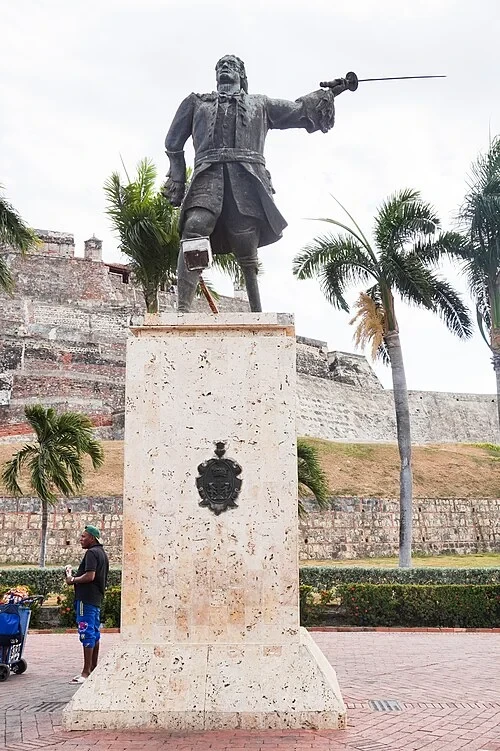 Arrival and the Blas de Lezo MonumentStatue of Admiral Blas de Lezo
High on its pedestal, this statue honors Admiral Blas de Lezo, the legendary commander who defended Cartagena during the Battle of Cartagena de Indias in 1741. This conflict was a defining moment for the city. British Admiral Edward Vernon arrived with a massive fleet of 186 ships and over twenty thousand men, fully expecting a swift victory. Defending the city was Blas de Lezo, who possessed just six ships and a small force of around three thousand soldiers and locals. Despite these overwhelming odds, his brilliant tactics repelled the British assault. Looking up at the statue, you can see the toll of his long military career. He was known as "Half-Man" due to his numerous battle scars, which left him with a peg leg, a missing left eye, and a useless right arm. Yet, the figure stands defiantly, holding a sword high in his remaining hand. If you trace the angle of that sword, you will notice it points directly toward the fortress he successfully defended, marking his eternal connection to this stone monument.
Bernard Gagnon · CC BY-SA 4.0
03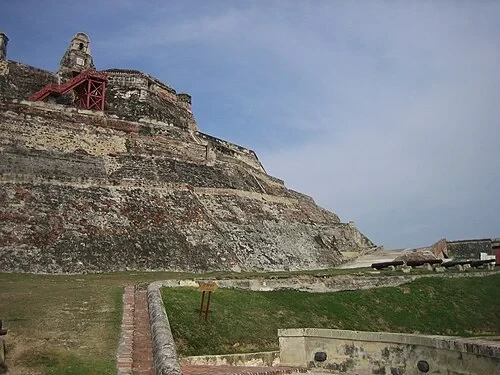 The Great Walls and Access RampThe Great Sloping Walls
Standing before the towering flanks of the fortress, the engineering genius of the outer defenses becomes clear. These massive walls were significantly expanded in 1763 under the direction of the prominent military engineer Antonio de Arévalo, with the project reaching final completion in 1767. Unlike typical vertical castle walls, these barriers slope inward, being much wider at the base than at the top. This deliberate incline served two critical purposes: it absorbed the impact of heavy artillery fire far better than flat surfaces and made it nearly impossible for attackers to scale them using ladders. The tiered, layered design along the hillside allowed defenders at different levels to fire their weapons simultaneously, creating a multi-layered wall of defense. Any enemy attempting to approach the base had to scramble up the steep grassy slope below. This open, green incline offered absolutely no cover, leaving attackers completely exposed to gunfire from the batteries above.
Listen in the appPhoto: Moyogo · CC BY-SA 3.0
04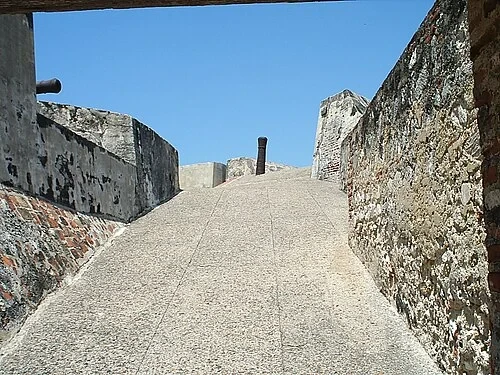 The Great Walls and Access RampThe Upper Access Ramp
Ascending the fortress, you follow the steep, narrow ramp that served as the primary route for transporting heavy artillery, gunpowder, and supplies to the upper battlements. This pathway was designed with strict military strategy in mind. The narrow corridor, flanked by high stone walls on either side, created a highly effective choke point. Any invading forces attempting to charge up this ramp would find themselves funneled into a tight space, completely exposed to a direct, unobstructed line of head-on fire from defenders stationed at the top. The surface underfoot is deliberately rough and slip-resistant. Engineers constructed this textured paving to ensure that heavy pack animals and soldiers dragging multi-ton iron cannons would not lose their footing, especially during the sudden, torrential tropical downpours common to Cartagena. Looking closely at the top of the ramp, a dark cannon barrel peeks over the left wall, serving as a silent reminder of the firepower once concentrated along this corridor.
Listen in the appPhoto: Nelsonc · CC BY-SA 3.0
05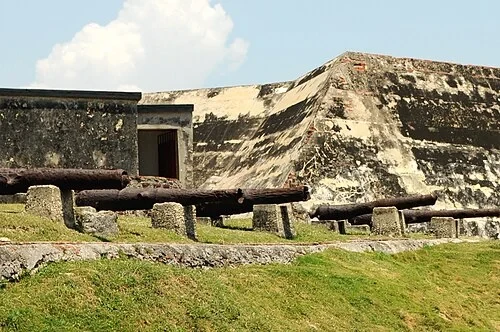 The Lower Defensive BatteriesThe Lower Cannon Batteries
Eight distinct batteries defend the different levels of this military complex, with notable sections including Santa Barbara and San Carlos. In total, these batteries once housed sixty-eight heavy guns positioned specifically to cover the landward approaches to Cartagena. Looking closely at these platforms, you will see a row of heavy, black iron cannon barrels resting on sturdy stone supports. The cannons are aimed directly through deep embrasures cut into the parapet walls. This layout allowed the Spanish gunners to reload and fire upon enemy troops while remaining almost completely protected from incoming musket and cannon fire. The weathered, pitted texture of the black metal tells a story of exposure to the salty sea air and intense humidity over several centuries. Each barrel stands as a solid, functional piece of historical artillery, illustrating the intense firepower that kept invading forces at bay.
Listen in the appPhoto: Munigarro · CC BY-SA 3.0
06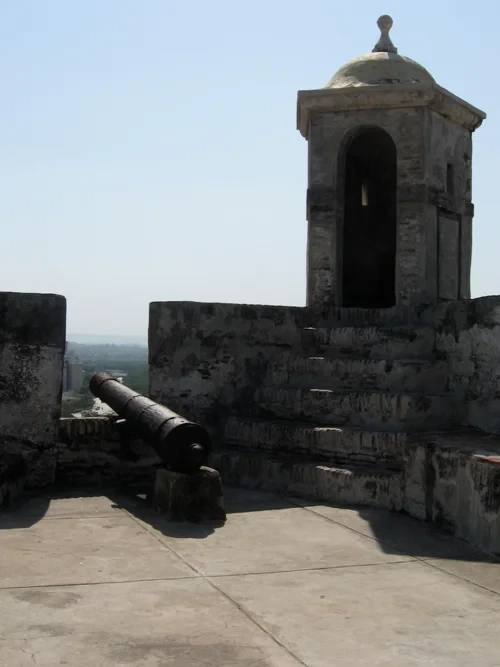 The Lower Defensive BatteriesThe Harbor Sentry Box
Perched at the edge of the ramparts stand the "garitas," the iconic sentry boxes that are characteristic of Spanish colonial military architecture. These compact stone structures functioned as vital lookout posts, sheltering sentries who kept watch over the surrounding land and sea approaches. The layout features a narrow, domed stone cubicle with thin viewing slits and a single arched entrance, situated right next to a heavy iron cannon. From inside this small, protected space, a guard could observe movement while remaining safe from sniper fire. If an enemy fleet or an advancing land column was spotted, the guard would instantly shout warnings down to the lower batteries or ring a signal bell to alert the entire garrison. The open sky and distant landscape, framed beautifully by the arched opening of the sentry post, offer a clear view of the tactical advantage this high position provided.
Listen in the appho visto nina volare from Italy · CC BY-SA 2.0
07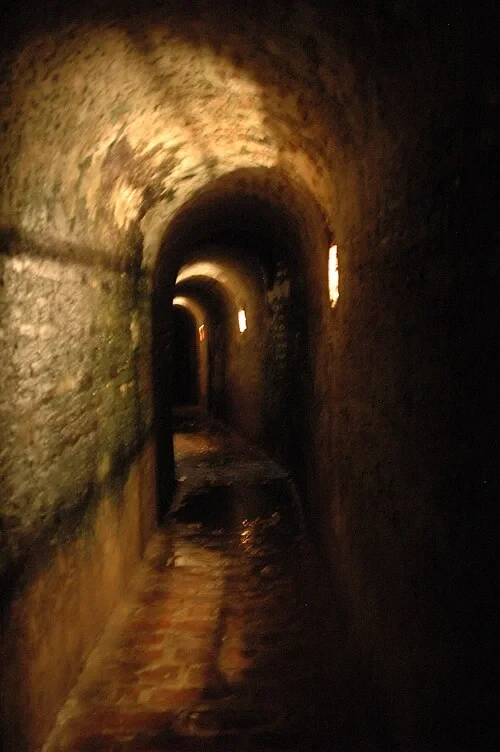 The Underground Tunnel LabyrinthThe Main Tunnel Vault
Beneath the massive stone walls lies a complex labyrinth of subterranean tunnels running throughout the entire structure. These hidden galleries provided a secure network for moving troops and gunpowder quickly from one battery to another without being exposed to enemy artillery fire or sniper observation. Beyond simple transit, these tunnels feature remarkable acoustic engineering. The arched, vaulted ceilings were designed to reflect sound so efficiently that a guard standing at one end of a tunnel could easily hear the whispers of anyone entering from the other side. This extreme sensitivity also allowed defenders to listen for the vibrations of enemy miners attempting to tunnel beneath the fortress walls. The narrow, damp brick floors and low-ceilinged vaulting are illuminated by modern safety lights, casting long shadows along the stone. The corridor stretches deep into the hillside, disappearing into absolute darkness.
Listen in the appO--o · CC BY 3.0
08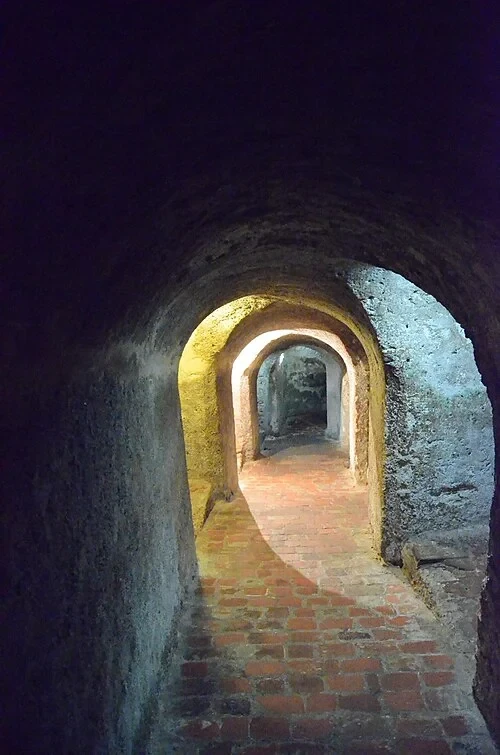 The Underground Tunnel LabyrinthThe Subterranean Junction
Deep within the subterranean network, the tunnels intersect at complex junctions designed for emergency defense. The brilliant military engineer Antonio de Arévalo designed these specific chambers to be packed with gunpowder. If invading forces managed to breach the outer walls and enter the tunnels, the garrison could detonate these charges, deliberately collapsing the stone ceilings to trap or crush the intruders. The visual layout reveals multiple brick arches branching off into different directions, forming a highly confusing maze designed to disorient any enemy unfamiliar with the layout. The rough, moisture-stained stone walls bear the mineral deposits of centuries of water seepage, contrasting sharply with the warm orange glow of the modern safety lighting. This illumination helps visitors navigate the damp corridors that once served as a silent, lethal labyrinth.
Listen in the appJoe Ross from Lansing, Michigan · CC BY-SA 2.0
09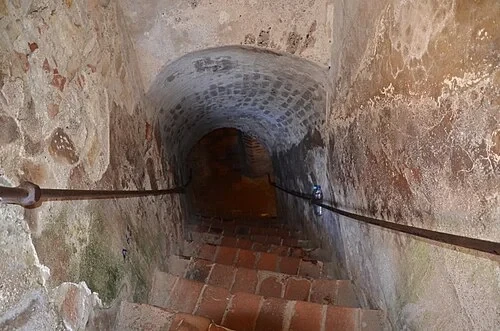 The Underground Tunnel LabyrinthThe Brick Tunnel Stairs
Descending into the deepest chambers of the fortress reveals the grueling physical reality faced by colonial soldiers. The steep, narrow brick steps, combined with intense tropical humidity, made these subterranean passageways exhausting and claustrophobic. Spanish engineers intentionally constructed the stairs with uneven heights and widths. In the pitch black of a battle, attacking soldiers who did not know the exact layout would easily trip, stumble, and fall, making them easy targets for waiting defenders. Looking down this steep, arched staircase, you can see how the tight space forces a slow and careful descent. Moisture glistens on the ancient plaster walls, a constant presence in these poorly ventilated depths. Today, modern metal handrails run along the walls to assist visitors on their journey through these historic defenses.
Listen in the appJoe Ross from Lansing, Michigan · CC BY-SA 2.0
10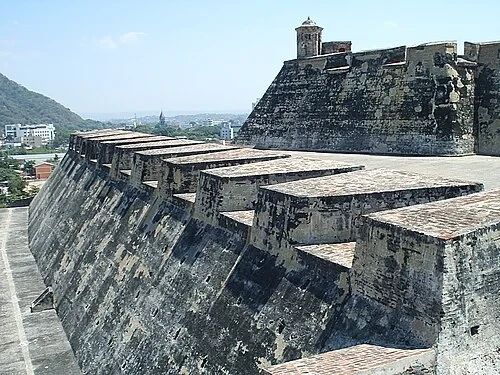 The Upper Fortress and Rainwater SystemsThe Tiered Parapets
Looking across the upper sections of the fortress, the "mutually defending" architecture of the design is fully apparent. The fortress was engineered as a series of nested defense systems. If an attacking force managed to overwhelm and capture a lower battery, they would find no respite, as they would immediately come under heavy, direct fire from the batteries positioned directly above them. The jagged, tooth-like battlements lining the sloping outer walls are called crenellations. These stone projections provided crucial cover, protecting the gunners from enemy fire while they went through the slow process of reloading their weapons. Crowning the top corner of the massive wall is a small, elevated sentry tower, offering a wide view of the surrounding terrain and reinforcing the strategic dominance of this high position.
Listen in the appPhoto: Nelsonc · CC BY-SA 3.0
Castillo de San Felipe de Barajas
Frequently asked questions
How much does the guide cost?
Free app download. Listed guide price: $3.99. Guide price shown in the app. Audio guide only. Venue admission is separate.
Can I listen without internet?
Yes. Download the guide’s audio, images, and maps in the app before your visit. Your downloaded content is then available offline.
Can I listen in my language?
Stanza supports 15 languages. Check the app for the languages available for this guide.
Do I need to follow a schedule?
No. This is a self-guided experience. Choose your stops, pause whenever you like, and return to a story at your own pace.
At your own pace
Explore Castillo de San Felipe de Barajas.
Download Stanza, then search for “Castillo de San Felipe de Barajas”.
Free app download · Guide price shown in the app