Stanza · Audio guide
Monolithic Churches of LalibelaAudio guide
A place to remember. A story to take with you.
A renowned UNESCO World Heritage Site, this complex features a group of eleven medieval monolithic churches carved directly out of living rock. These impressive structures are a testament to ancient Ethiopian…
Download Stanza, then search for “Monolithic Churches of Lalibela”.
About the tour
One guide. Your kind of visit.
A renowned UNESCO World Heritage Site, this complex features a group of eleven medieval monolithic churches carved directly out of living rock. These impressive structures are a testament to ancient Ethiopian religious architecture.
Ready when you are.
- 01Get the free Stanza app.
iOS & Android
- 02Find your guide.
“Monolithic Churches of Lalibela”
- 03Download before you go.
Works offline
Audio guide / 32 narrated stops
Inside the guide
Get to know a few of the stories before you go. Open a stop to read more.
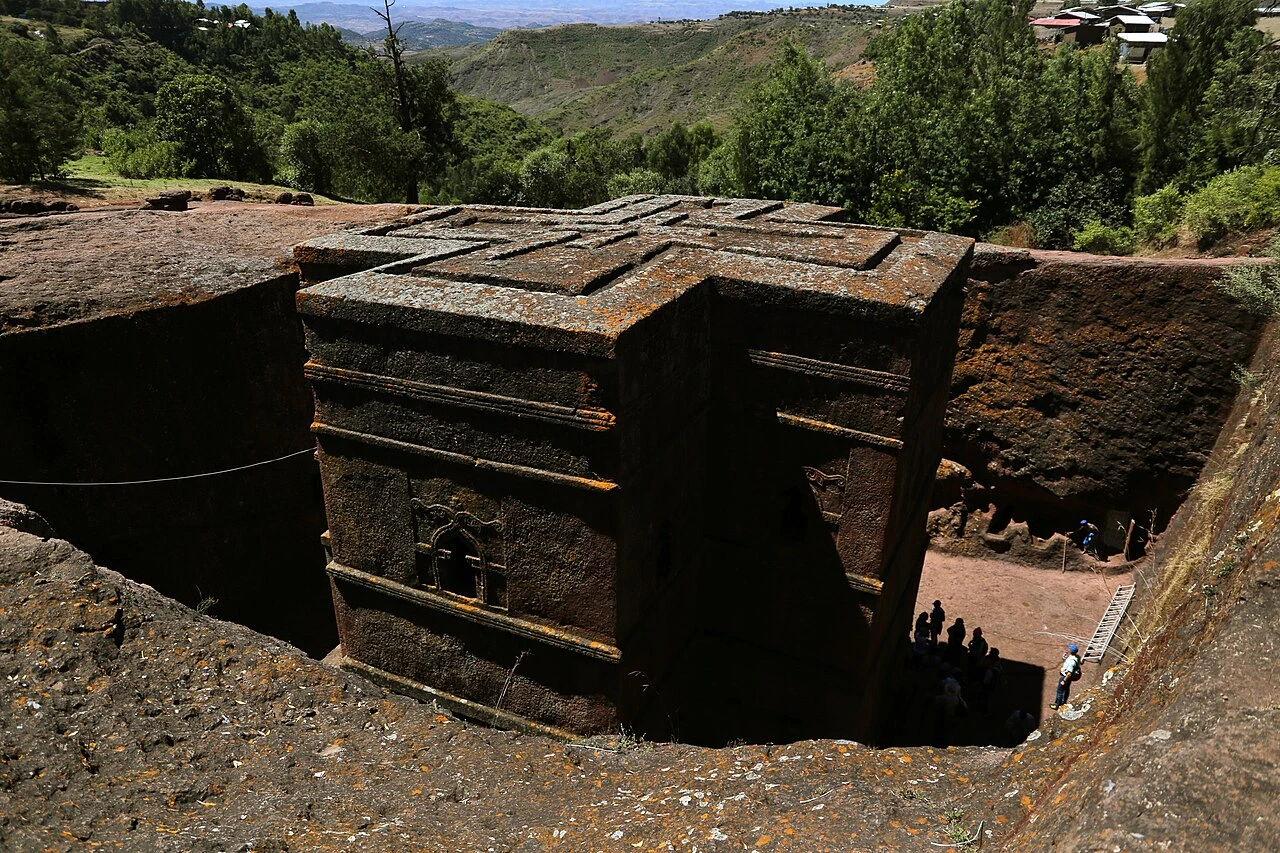
01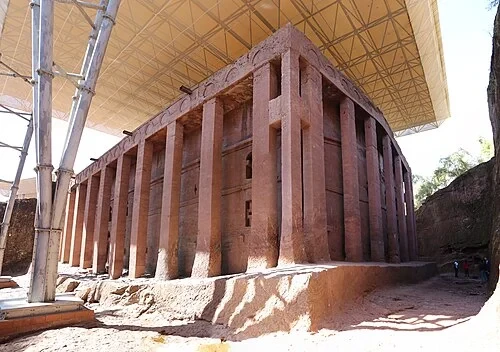 House of the Savior of the World (Biete Medhani Alem)House of the Redeemer of the World
Welcome to the House of the Redeemer of the World, or Biete Medhane Alem. Standing before this structure, the sheer scale is overwhelming—it is the largest monolithic church on the planet. Its creation involved a staggering feat of subtractive engineering; rather than hauling stones to this site, 12th-century laborers carved deep into the earth, removing over 800 cubic meters of volcanic rock to leave this structure standing isolated in its own pit. Surrounding the exterior are 34 massive rectangular pillars. These weren't built upward; they were left behind as the mountain was chiseled away. Their design purposefully mimics the ancient Aksumite Church of Our Lady Mary of Zion, creating a powerful visual link to Ethiopia's 4th-century Christian roots. Look above to see the modern metal roof. Added recently by UNESCO, this structure protects the porous and fragile volcanic tuff from the erosive power of seasonal rains. This church serves as a monumental introduction to the 'New Jerusalem' envisioned by King Lalibela, combining political legitimacy with spiritual devotion in a scale that remains unmatched centuries later.
Photo: Sailko · CC BY 3.0
02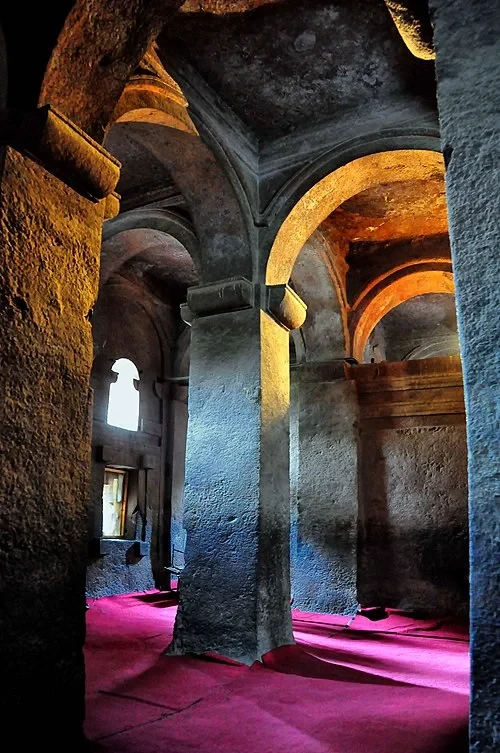 House of the Savior of the World (Biete Medhani Alem)The Main Nave
The atmosphere inside these monolithic spaces is hushed and heavy with history. As you observe the pillars and arches stretching toward the ceiling, keep in mind that they do not support a separate roof. Because the entire building is carved from one living block of stone, these features are simply part of the original mountain, sculpted into architectural forms. The soft red carpet beneath your feet covers the original stone floor, while the lighting is kept low by design to protect the ancient, porous surfaces from damage. Every inch of this interior was hollowed out by hand using only hammers and chisels. Carvers worked from the top down, a process that required incredible foresight and precision. Look closely at the ceiling; you will see where the builders even replicated the appearance of structural wooden beams. While these aren't functionally necessary in a stone monolith, they were included to mimic traditional building styles of the era. This attention to detail creates an environment of profound permanence, where the very rock serves as both the medium and the structure for communal worship and silent contemplation.
Rod Waddington from Kergunyah, Australia · CC BY-SA 2.0
03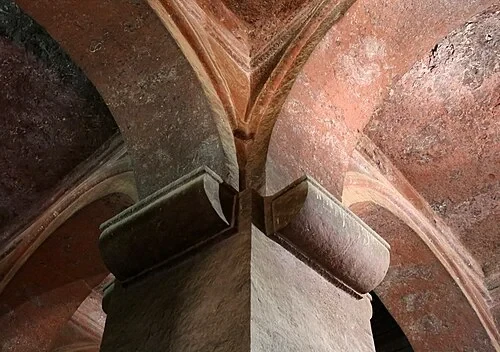 House of the Savior of the World (Biete Medhani Alem)Interior Pillar Capitals
Direct your eyes to the tops of the pillars to find the carved capitals. These brackets are executed in a distinct style characteristic of Northern Ethiopian architecture. The precision of the right angles and the smooth, uniform finish are particularly impressive when you consider they were achieved using primitive iron tools. The stone itself has a notable reddish hue, a result of the iron-rich volcanic tuff from which the entire complex was born. If you look closely at the surface, especially where the light catches the stone, you can still see the faint marks left by chisels centuries ago. These grooves provide a silent map of the carvers' movements, showing how they worked their way methodically from the ceiling down toward the floor. Each stroke was deliberate, as any mistake in this subtractive process would be permanent. The capitals serve as more than just decorative transitions; they demonstrate the high level of technical mastery attained by the Zagwe dynasty’s masons. Their work turned a rugged mountain into a refined place of worship, where even the smallest details reflect a deep commitment to architectural excellence.
Listen in the appPhoto: Sailko · CC BY 3.0
04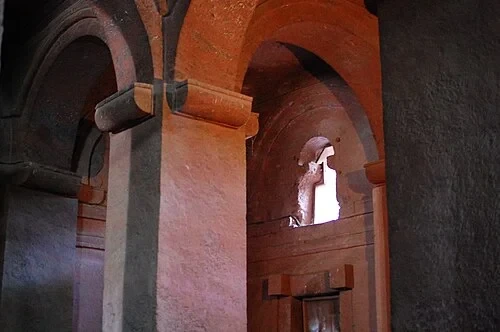 House of the Savior of the World (Biete Medhani Alem)The Aksumite Windows
The windows carved into the upper sections of the walls feature a 'step-and-bracket' design, a signature element of the ancient Aksumite Empire. This empire flourished nearly a thousand years before these churches were created, and by reviving their architectural style, King Lalibela was making a profound political and religious statement. He intended to show that his dynasty was the legitimate successor to the legendary kings of Ethiopia’s past. These openings are intentionally narrow, designed to limit the amount of harsh sunlight that enters the sanctuary. This architectural choice keeps the interior cool and dark, even during the heat of the day, fostering the focused and contemplative environment necessary for religious services. Within these dim spaces, priests still conduct the same ancient liturgies that have been observed here for over eight centuries. The windows act as small portals for light and air while maintaining the church's fortress-like seclusion. Their geometry is a record of the continuity of Ethiopian culture, bridging the gap between the monumental monoliths of the 12th century and the grand stelae of the Aksumite period.
Listen in the appKatie Hunt from St Albans, UK · CC BY 2.0
05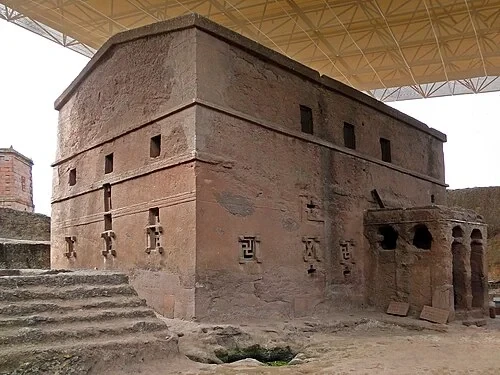 House of Mary (Bete Maryam)House of Mary
Biete Maryam, or the House of Mary, is widely held to be the oldest and most beloved church within the entire complex. While the nearby House of the Redeemer is massive and austere, this church feels more domestic and welcoming, featuring three separate porches that invite visitors inside. It is dedicated to the Virgin Mary, who holds a central place in the devotions of the Ethiopian Orthodox Church. As you examine the windows, you will notice a fascinating array of cross designs. These include Greek and Roman crosses, as well as the swastika-style cross. It is important to remember that the swastika was an ancient Christian symbol of peace and prosperity long before its 20th-century associations. At the base of the church, you can see a small pool of water. Local tradition holds that this pool has special properties, and it is frequently used for fertility blessings by pilgrims who travel from across the country to seek Mary’s intercession. The structure’s intimate scale and intricate carvings make it a highlight of the site, reflecting a softer, more ornate side of the monolithic architectural tradition.
Listen in the appBernard Gagnon · CC BY-SA 3.0
06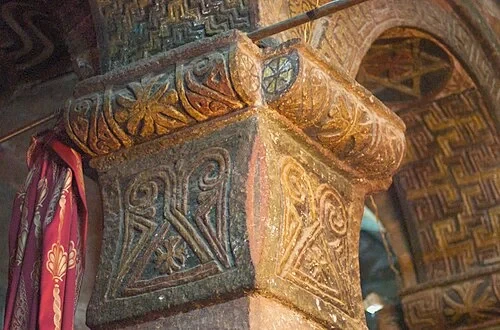 House of Mary (Bete Maryam)Painted Capitals of the House of Mary
The pillar capitals inside the House of Mary are unique because they retain their original, colorful decorations. While many other carvings in the complex remain the natural color of the rock, these were treated with mineral-based pigments that have survived for nearly nine hundred years in the cool, stable environment of the church. The designs are rich with symbolism, featuring the 'Tree of Life' and complex geometric knots that represent the interconnectedness of faith and eternity in Ethiopian Orthodox Christianity. Look closely at the details, and you might spot carvings of local animals, including leopards and camels. These figures provide a rare glimpse into the daily lives and natural surroundings of the medieval artists who worked here. The combination of relief carving and vivid painting creates a layered aesthetic that is quite different from the more rugged exteriors. These patterns were not merely decorative; they were intended to educate and inspire the faithful, turning every surface of the sanctuary into a visual sermon. The survival of these colors against the porous volcanic stone is an indicator of the sophistication of early Ethiopian chemistry.
Listen in the appA. Davey from Where I Live Now: Pacific Northwest · CC BY 2.0
07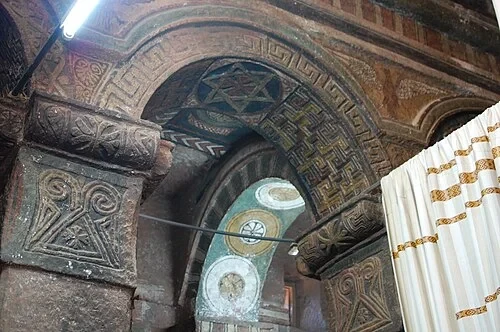 House of Mary (Bete Maryam)The Star of David Arch
Look up at the underside of the central arches to see a prominent six-pointed star, known as the Star of David. In the context of Ethiopia, this symbol carries deep political weight, representing the Solomonic dynasty. The royal family claimed direct descent from King Solomon of Israel and the Queen of Sheba, a lineage that was central to their identity and right to rule. This church interior is a riot of color and complex shapes, designed to overwhelm the senses. Almost every available surface of the rock-hewn ceiling and the archways is covered in either detailed frescoes or intricate relief carvings. The intent was to transform this subterranean space into a metaphorical heavenly palace on earth. By surrounding the congregation with sacred symbols and royal markers, the architects created a space where the earthly and the divine seemed to overlap. The Star of David serves as a focal point in this narrative, anchoring the building in both biblical history and national legend. It is a reminder that for the Zagwe kings, building these churches was an act of both profound faith and strategic political messaging.
Listen in the appKatie Hunt from St Albans, UK · CC BY 2.0
08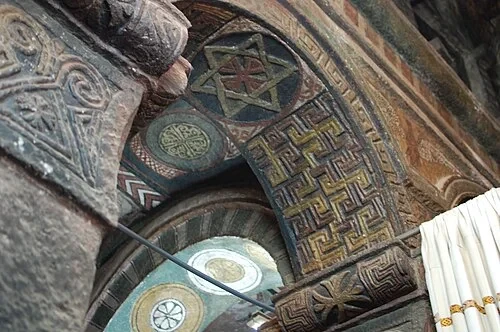 House of Mary (Bete Maryam)Celestial Symbolism
The circular designs painted onto the arches represent the sun and the moon, recurring motifs in Ethiopian religious art that signify God's dominion over time and the cosmos. The palette used here consists of red, yellow, and green. While these are the colors of the modern Ethiopian flag, their use here predates the flag by centuries and carries specific spiritual meanings: red symbolizes the blood of martyrs, yellow represents the wealth and fertility of the land, and green stands for the hope of the Holy Spirit. To create these lasting images, artists used a mixture of ground mineral stones combined with egg whites or plant resins, which helped the paint bond to the porous volcanic rock. This celestial symbolism turned the church's ceiling into a map of the heavens, reminding worshippers of the eternal order existing beyond the stone walls. The durability of these mineral paints is remarkable, considering the humidity and age of the site. These simple geometric forms carry the weight of centuries of theology, grounding the celestial in the very stone of the mountain.
Listen in the appKatie Hunt from St Albans, UK · CC BY 2.0
09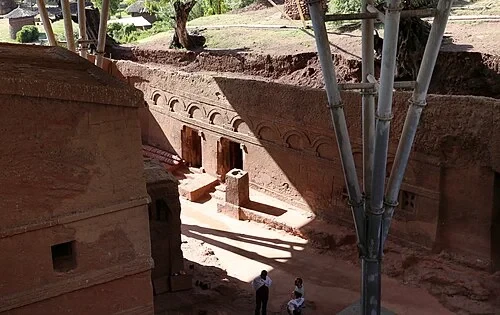 House of the Cross (Bete Meskel)House of the Cross
Biete Meskel, or the House of the Cross, is not a standalone building but a gallery carved directly into the side of the trench wall surrounding the House of Mary. Its facade is defined by a row of ten arches that open into a cavernous interior. The name 'Meskel' translates to Cross, and this space traditionally served as a dedicated area for monks to engage in private prayer and meditation. Observe the walkway leading across the front; it is purposefully narrow. This architectural choice was intended to emphasize the humble and restricted nature of a religious life, where the path is often difficult and requires constant focus. Inside, the church is known for its collection of beautiful hand crosses, which priests use during various ceremonies and blessings. These crosses, often made of brass or iron, feature intricate designs that are unique to each artisan. The House of the Cross represents the more monastic and secluded side of the Lalibela complex, offering a contrast to the grander, more public churches nearby. It remains a quiet corner of the 'New Jerusalem,' still used by the local clergy.
Listen in the appPhoto: Sailko · CC BY 3.0
10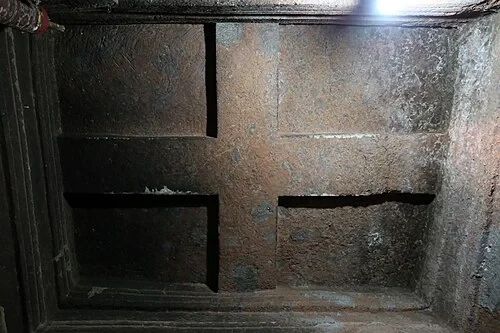 House of the Cross (Bete Meskel)Ceiling Cross Relief
If you look directly above you inside this small chapel, you will find a large, raised cross carved directly out of the stone ceiling. This is a common architectural feature throughout the Lalibela complex. In a subterranean environment where the humidity is naturally high, traditional wooden icons or paintings would often rot or fade. By carving the cross into the very structure of the building, the masons created a permanent 'icon' that would endure as long as the church itself. The relief is carved with considerable depth, creating shadows that make the symbol stand out even in the dim light of flickering candles or narrow windows. The rough, highly textured surface of the surrounding rock suggests that this chapel was part of the earlier, more rustic excavations at the site. It lacks the refined, smooth finish seen in the later churches, giving it a more primal and ancient feel. This ceiling cross serves as a constant reminder of the building’s sacred purpose, literally hanging over the heads of those who come here to pray, and showcasing the ingenuity of using the mountain as a canvas.
Listen in the appPhoto: Sailko · CC BY 3.0
Monolithic Churches of Lalibela
Frequently asked questions
How much does the guide cost?
Free app download. Listed guide price: $1.99. Guide price shown in the app. Audio guide only. Venue admission is separate.
Can I listen without internet?
Yes. Download the guide’s audio, images, and maps in the app before your visit. Your downloaded content is then available offline.
Can I listen in my language?
Stanza supports 15 languages. Check the app for the languages available for this guide.
Do I need to follow a schedule?
No. This is a self-guided experience. Choose your stops, pause whenever you like, and return to a story at your own pace.
At your own pace
Explore Monolithic Churches of Lalibela.
Download Stanza, then search for “Monolithic Churches of Lalibela”.
Free app download · Guide price shown in the app