Languages
15Copán Archaeological Site Audio Guide
Copán Archaeological Site is an archaeological site in Copán Ruinas, Honduras. Explore it with Stanza's guided offline audio tour — narrated in 15 languages.
Quick Facts
31
Stops
15
Languages
100%
Offline
📍 Copán Ruinas, Honduras · 14.8380°N, -89.1424°E
About Copán Archaeological Site
Copán is an extensive Maya archaeological site in western Honduras. It is renowned for its well-preserved stelae, altars, and hieroglyphic staircase.
This self-guided audio tour features 31 narrated stops organized across 7 sections. As a archaeological site, Copán Archaeological Site offers a unique cultural experience in the heart of Copán Ruinas, Honduras.
The Stanza audio guide is available in 15 languages and works entirely offline — download the complete tour including audio narration, maps, and images before your visit. As you walk through Copán Archaeological Site, GPS-triggered narration plays automatically at each point of interest.
Last updated:
What you will hear
Mayan Sculpture Museum
Essential for protecting the original monuments from erosion, this museum houses the site's most precious carvings and a stunning full-scale replica of the Rosalila Temple.
Altar Q (Original)
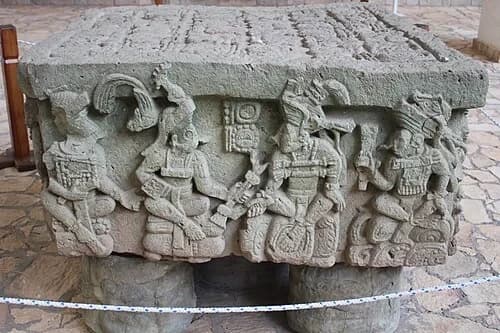
This monument was the "smoking gun" that allowed researchers to finally piece together the city's complex political history. The carving depicts the sixteen kings of the Copán dynasty, with each ruler sitting upon a stone glyph that spells out his specific name. The central scene shows the dynastic founder, Yax K'uk' Mo', handing the scepter of power to the sixteenth king, Yax Pasaj Chan Yopaat. You can identify the founder by the goggles he wears over his eyes—a style of war gear associated with Teotihuacan, a massive superpower located over a thousand miles away in modern-day Mexico. This visual link suggests the royal line had prestigious international connections from its very beginning. The elaborate turbans and heavy jewelry worn by each figure further signify their high status. By deciphering the text and images on this single stone, archaeologists successfully reconstructed the chronological narrative of one of the most important cities in the Maya world. It essentially functions as the city's legal deed, etched forever into the rock.
The Chorcha Figure
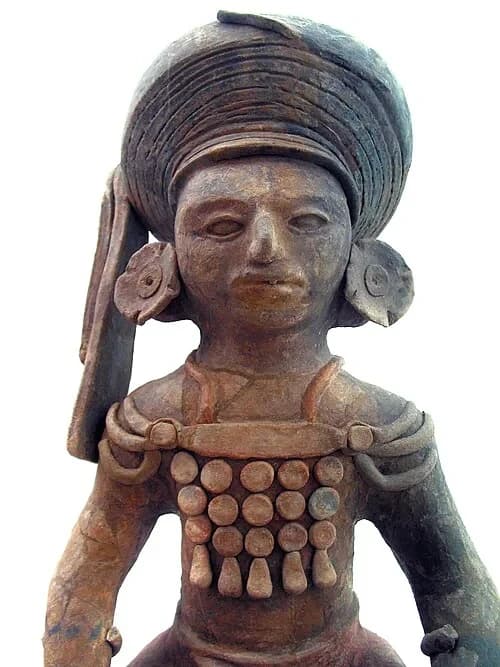
The figure provides a detailed look at the fashion and beauty standards of the Maya elite. Notice the massive, multi-layered turban and the heavy, circular "earflares" that pull at the ears. The intricate bead necklace suggests the high value placed on jade, a material the Maya considered far more precious than gold. Beyond the clothing, the figure reflects specific physical ideals, such as the high, sloping forehead and the prominent bridge of the nose, which were hallmarks of aristocratic beauty. These features were often accentuated from birth through the use of binding boards. Crafting such detailed ceramic figures was a specialized art form, and their inclusion in burials highlights the belief in a continued social hierarchy in the world beyond. The figure captures a sense of quiet dignity, reflecting the status of the individual it was buried with. This specific artifact was found in the tomb of a noble, intended to provide service or companionship in the transition between life and the ancestral realm.
Skull and Bone Reliefs
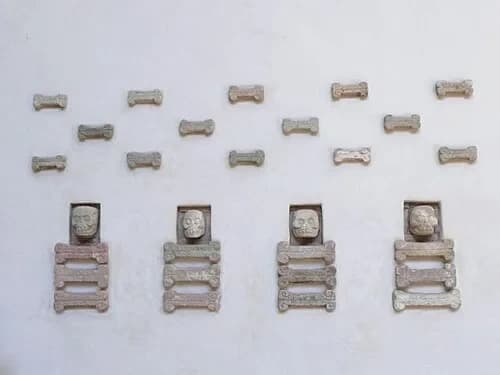
This morbid decoration once adorned a "Popol Na," or council house, where the city’s nobles gathered for meetings. In the Maya worldview, bones were viewed as "seeds"—the ancestral remains from which the current generation grew. Therefore, these images represent the foundation of the community rather than simple death. Look closely at the skulls and notice the large, hollow eye sockets. Archaeological evidence suggests these were originally filled with obsidian or polished shell inlays, which would have caught the light and given the carvings an unsettlingly lifelike appearance. By placing these symbols on a public building, the ruling class reinforced the importance of their bloodlines and the sacred duties they owed to their predecessors. It serves as a reminder that for the inhabitants of Copán, the past was never truly gone but remained a living presence in their daily governance. The rows of human femurs create a rhythmic pattern along the wall, emphasizing the continuity of the lineage through time.
Stela D
Located at the far northern end of the Great Plaza, this stela depicts the ruler Waxaklajuun Ub'aah K'awiil in his most elaborate ceremonial attire.
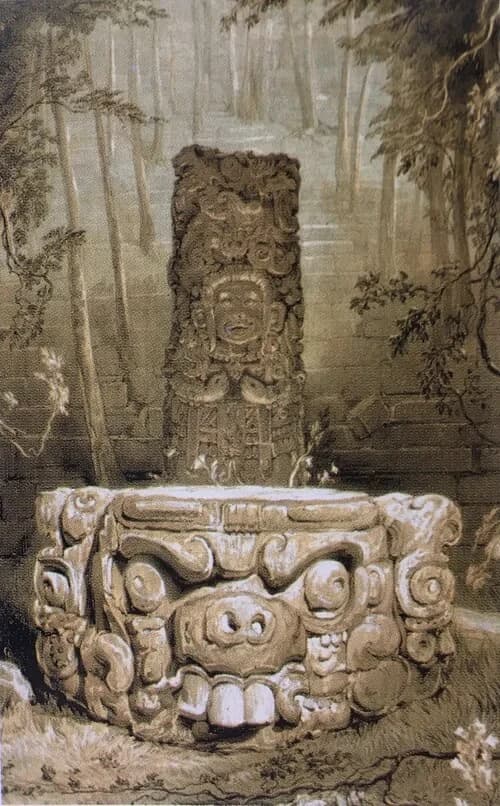
Stela D
The ruler is shown wearing a massive, heavy mask that appears to be carved almost independently of his face, as if he is physically wearing a stone covering. This attire signifies his role as the Sun God, prepared to make the perilous journey through the underworld at night. In front of the stela sits an altar carved in the shape of a double-headed sky monster, often interpreted as a giant toad. These stone platforms were the sites of intense bloodletting rituals. In such ceremonies, the king would offer his own blood as a sacrifice to communicate with the gods and ensure the continued prosperity of his people. The depth of the relief here is characteristic of the Copán style at its peak, where the stone seems to disappear behind the complex layers of ceremonial regalia. Each element, from the mask to the toad-like altar, was designed to emphasize the king's central role in the cosmic balance of the universe. The king's hands are folded in a posture that indicates the summoning of divine energy.
Stela C
This rare double-faced stela still shows faint traces of the original red pigment that once covered all monuments in the Great Plaza.
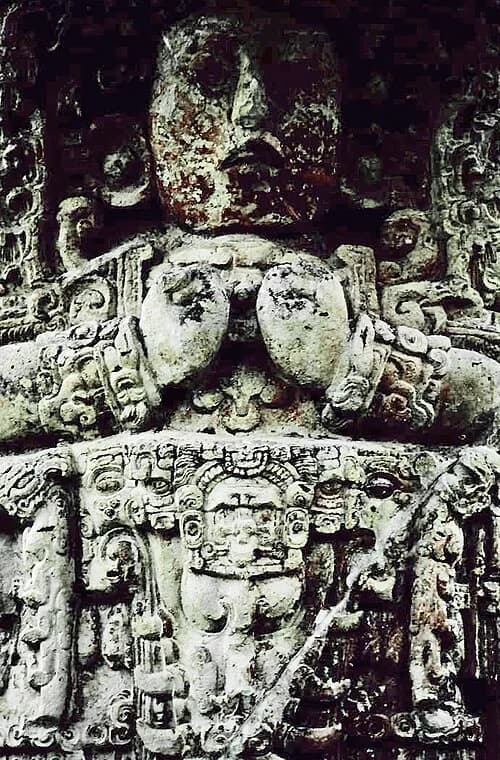
Stela C
Dedicated in 736 AD, this monument shows the king in a standard royal pose with his hands held up against his chest. If you look closely into the deeper recesses of the carving, you can still see faint traces of the red pigment that once covered the entire sculpture. While the front shows a formal portrait, the back of the stone is a calligraphic masterpiece. Instead of using standard abstract symbols, the scribes used rare full-figure glyphs. In this system, every number and sound is represented by a complete human or animal body, making the text look like a group of figures interacting with one another. The king’s costume is equally detailed; his elaborate belt features small human heads hanging from the fringe. These served as trophies or symbols of rank, representing either defeated enemies or significant ancestors. This stela stands as a testament to the high level of literacy and artistic sophistication achieved by the royal court during the 8th century. The carving of the hands is particularly delicate, showing the individual fingers and joints.
Stela B
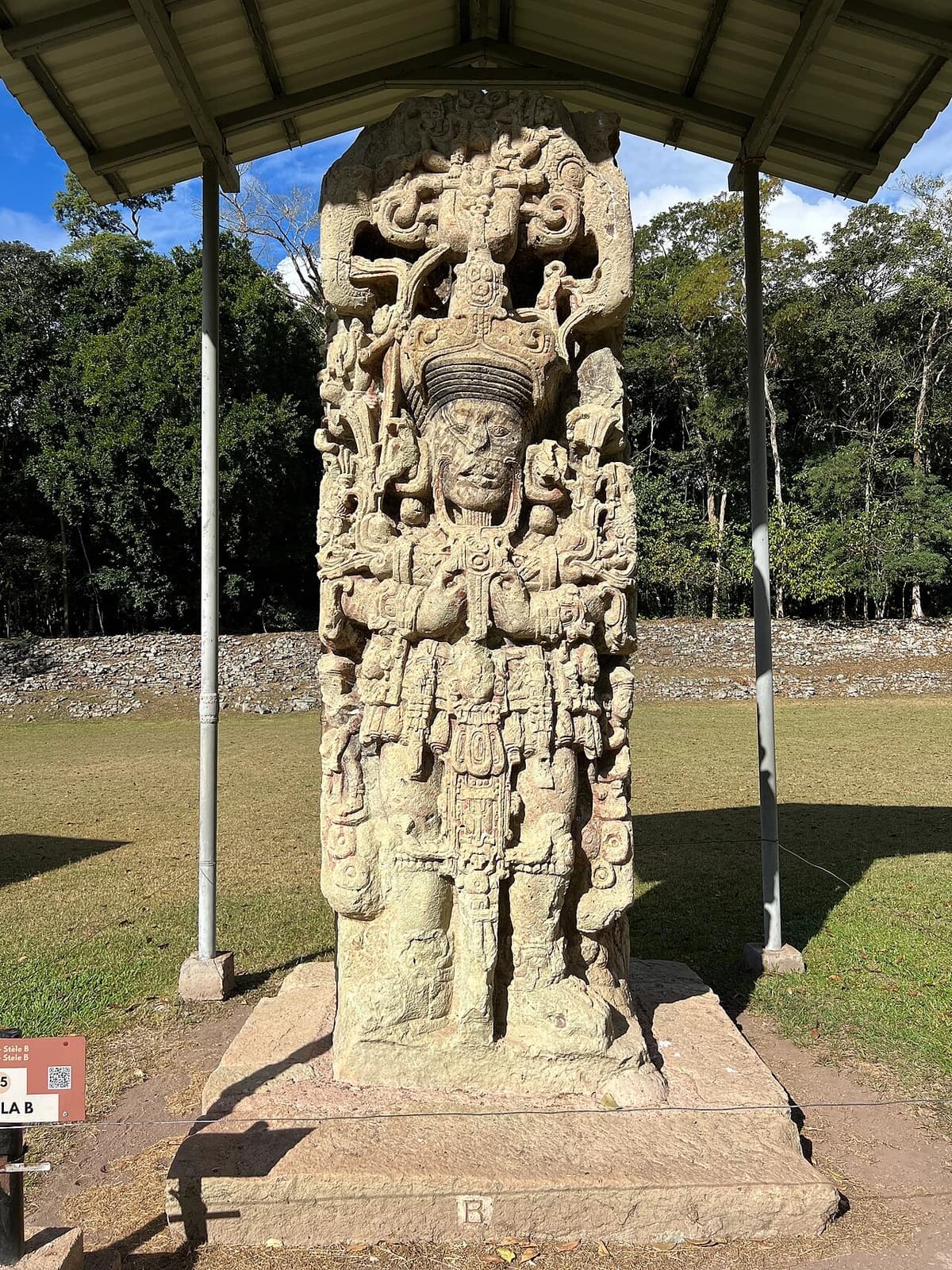
One of the most impressive sculptures in the plaza, featuring the king's face emerging from the mouth of a cosmic monster.
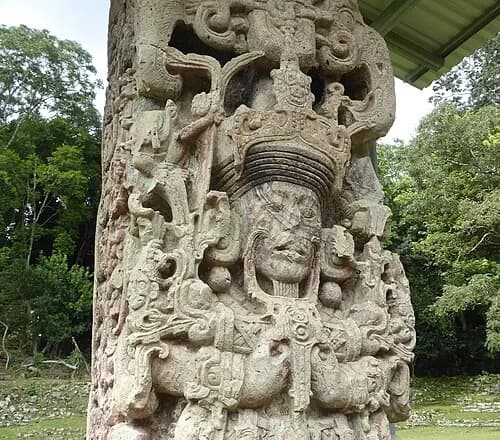
Stela B
The figure on this stela is once again King Waxaklajuun Ub'aah K'awiil, recognizable by the small, goatee-like beard on his chin—a very rare feature in Maya portraiture. At the top corners, you will see the large figures that fueled the "elephant" theory in the 1800s. Today, scholars identify these as stylized scarlet macaws or cosmic monsters, not pachyderms from across the ocean. The king is depicted emerging from the gaping mouth of a "mountain monster," which symbolizes the sacred earth. This imagery positions the ruler as a spiritual bridge between the human world and the powerful forces of the natural and supernatural realms. Early explorers were so stunned by the detail and foreign aesthetic of these carvings that they often invented elaborate stories to explain them. However, the true significance lies in how the king used these massive stone monuments to define his divine status and his deep connection to the local landscape of the Copán Valley. The macaw heads are highly stylized, with the beaks forming the shapes once thought to be trunks.
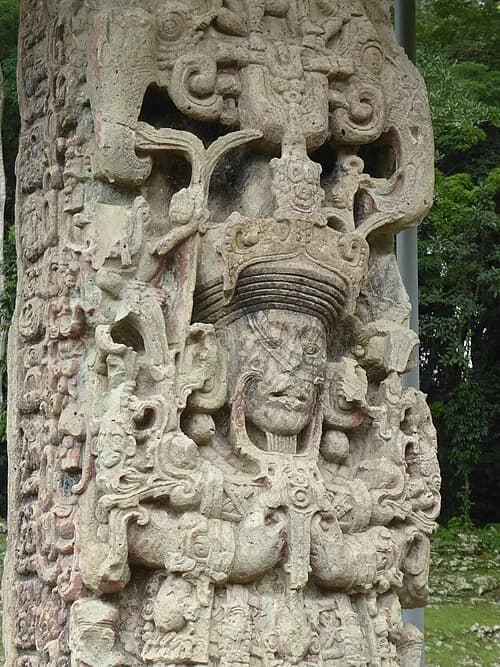
Royal Regalia of Stela B
The king’s face is framed by an incredibly complex headdress shaped like a turban, which is topped with a small figure representing the "Jester God"—a primary symbol of royal authority. If you examine the ruler’s face, you may notice that his eyes are slightly crossed. To the Maya, this was a mark of supreme beauty and divinity. Parents would often hang a bead between a baby’s eyes to permanently achieve this look. His status is further emphasized by a heavy jade pectoral on his chest and massive "earspools" that would have significantly stretched his earlobes. These ornaments were symbols of wealth and high social standing. The stone used for this monument is a local volcanic tuff. When it was first quarried, it was soft enough to allow for this level of microscopic detail, but it has gradually hardened over the centuries of exposure to the air. This natural process helped preserve the incredibly busy textures of the royal costume against the passage of time. You can see the individual beads of the necklace, each carved with perfect symmetry.
Stela H
Unlike the other stelae which depict kings, Stela H depicts a queen or a king in feminine attire, representing the moon goddess.
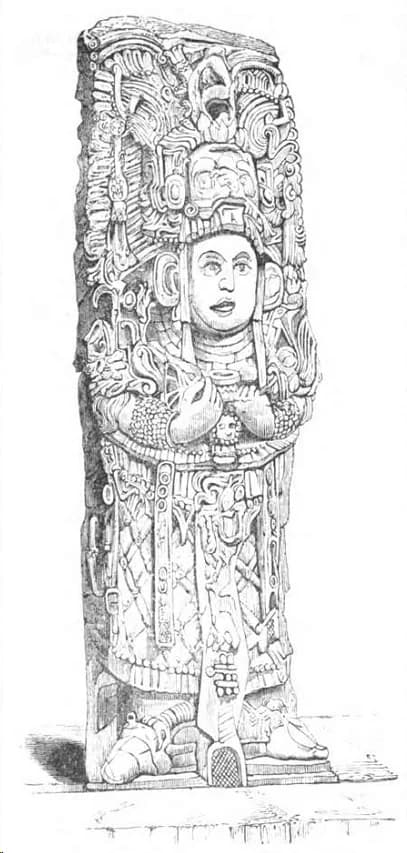
Stela H
While most Maya stelae emphasize the warrior-king, Stela H reveals a different aspect of royal duty. King 18 Rabbit appears here in a tiger-skin skirt, an outfit traditionally associated with the Moon Goddess and female power. By donning this attire, the king symbolically took on the role of creator and nurturer, channeling the divine feminine to ensure fertility and a bountiful maize harvest for his people. Look closely at the headdress, where intricate corn decorations reinforce this connection to agricultural abundance. This monument holds a special place in the history of archaeology; it was among the first Copán ruins documented by explorer Frederick Catherwood in the 1840s. His detailed illustrations were the first window for many in the West into the sophisticated world of the Maya. The king stands here not just as a political leader, but as a ritual specialist bridging the gap between genders and the natural world. The blend of masculine authority and feminine creative force was a key component of Maya kingship, reflecting a worldview where balance was essential for the cosmos to function. Today, the worn surface still carries the legacy of those early explorers who introduced these silent giants to the world.
Stela J
Located slightly east of the main plaza, Stela J is covered in a 'mat' pattern of hieroglyphs that must be read in a specific woven sequence.
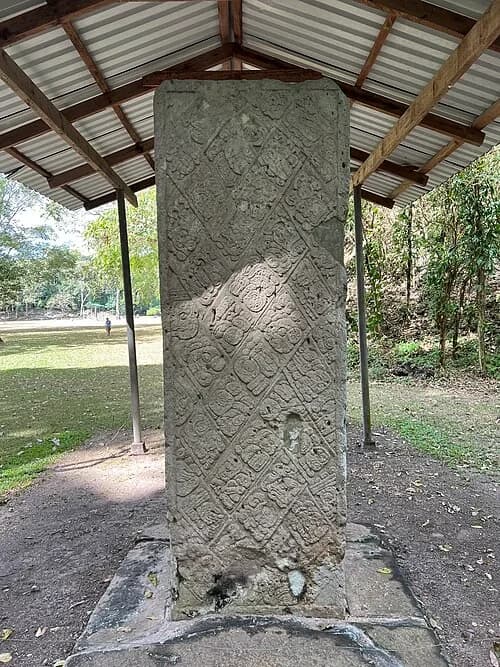
Stela J
Stela J is widely considered one of the greatest intellectual achievements of Maya calligraphy. Instead of standard vertical columns, the text on this side is designed like a woven reed mat. To read it, a scribe would have to zigzag their eyes over and under the interlocking stone bands. In Maya culture, the mat was the ultimate symbol of kingship; rulers did not sit on wooden chairs, but 'sat on the mat,' a metaphor for their governing authority. This stela is also unique for its orientation; it faces east to greet the rising sun, standing apart from the main plaza. The text within the woven pattern details the founding of the city and the sacred rituals conducted by the 13th king. The sheer complexity of the layout suggests it was intended for an elite audience capable of decoding such sophisticated visual puns. It stands as a reminder that for the Maya, writing was not just a way to record information, but a sacred art form that integrated physical symbols of power directly into the historical narrative. Each crossing of the stone bands represents a layer of history, woven together to form a permanent record of the city's spiritual origins.
Stela 1
This stela depicts the ruler Chan Imix Kʼawiil and serves as a vital marker for understanding the site's mid-dynastic expansion.
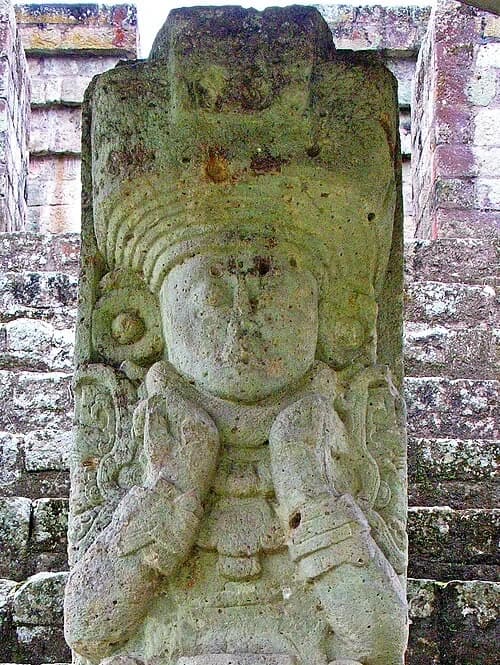
The Grand King's Face
The calm, stoic expression of King Chan Imix K’awiil offers a glimpse into the idealized beauty of the Maya elite. Notice the small stone beads on his cheeks; these represent actual jade plugs that were inserted into the skin, a mark of high social status. Surrounding his face is an incredibly dense arrangement of carved feathers. These represent the plumage of the quetzal bird, which was considered more valuable than any metal and was reserved strictly for royalty. Even in the hard stone, the ancient artist managed to capture the soft, overlapping layers and flowing nature of the tassels hanging from the headdress. This carving dates to Copán’s 'Golden Age,' a period of peak prosperity when the city's population reached approximately 20,000 people. The precision of the work suggests a society with enough wealth to support full-time master artisans. The king's crossed eyes, a feature often achieved in infancy by hanging beads between a baby's eyes, were considered a sign of divine beauty. Every detail of this face was designed to communicate that the ruler was not merely a man, but a being of semi-divine status, reigning over a bustling and powerful tropical metropolis.
Want to hear the rest?
Download the Stanza app to unlock all 31 stops and the complete guided audio tour.
Frequently Asked Questions
How long does the Copán Archaeological Site audio tour take?
The Copán Archaeological Site audio guide includes 31 narrated stops. Most visitors spend 45 minutes to 1.5 hours exploring the complete tour, though you can listen at your own pace and skip or revisit any stop.
Is the Copán Archaeological Site audio guide available in my language?
Stanza supports 15 languages: English, Spanish, French, German, Italian, Portuguese, Russian, Japanese, Chinese, Korean, Arabic, Hindi, Polish, Dutch, Hebrew. Check the guide in the app to confirm the languages currently available for this tour.
Can I use the audio guide offline at Copán Archaeological Site?
Yes! Download the complete Copán Archaeological Site tour — including all audio, maps, and images — before your visit. The Stanza app works completely offline, so you don't need WiFi or mobile data at the venue.
How much does the Copán Archaeological Site audio guide cost?
The Stanza app is free to download. The current listed price for the Copán Archaeological Site audio guide is $1.99; app-store region and currency may affect the final price.
How do I use the Stanza audio guide at Copán Archaeological Site?
Download the free Stanza app, search for "Copán Archaeological Site", and download the tour. When you arrive at the venue, the app uses GPS to detect your location and automatically plays the relevant narration as you move between points of interest — completely hands-free.
What makes the Stanza audio guide different from other Copán Archaeological Site tours?
Stanza offers GPS-triggered narration that plays automatically as you walk through Copán Archaeological Site — no need to manually select stops. The tour is available in 15 languages, works fully offline, and includes 31 expertly narrated stops with images and historical context.
What other audio guides are available near Copán Archaeological Site?
Stanza offers multiple audio guides in Copán Ruinas, Honduras and nearby areas. After downloading the app, browse the map to discover all available tours near Copán Archaeological Site. Each guide can be downloaded for offline use.