Languages
15Basilica Cistern Audio Guide
Basilica Cistern is an archaeological site in Istanbul, Turkey. Explore it with Stanza's guided offline audio tour — narrated in 15 languages.
Quick Facts
10
Stops
15
Languages
100%
Offline
📍 Istanbul, Turkey · 41.0084°N, 28.9779°E
About Basilica Cistern
An ancient Roman cistern of Byzantine Constantinople, this vast underground water reservoir was constructed in the 6th century to supply water to the Great Palace.
Basilica Cistern is also known as Yeraltı sarnıcı, Yerebatan Sarayı, Yerebatan Sarnıcı.
This self-guided audio tour features 10 narrated stops organized across 6 sections, including The Descent into the Sunken Palace, The Subterranean Forest of Columns, The Weeping Hen's Eye Column, The Mystery of the Medusa Heads, Modern Engineering and Digital Light, A Cinematic Farewell. As a archaeological site, Basilica Cistern offers a unique cultural experience in the heart of Istanbul, Turkey.
The Stanza audio guide is available in 15 languages and works entirely offline — download the complete tour including audio narration, maps, and images before your visit. As you walk through Basilica Cistern, GPS-triggered narration plays automatically at each point of interest.
Last updated:
What you will hear
The Descent into the Sunken Palace
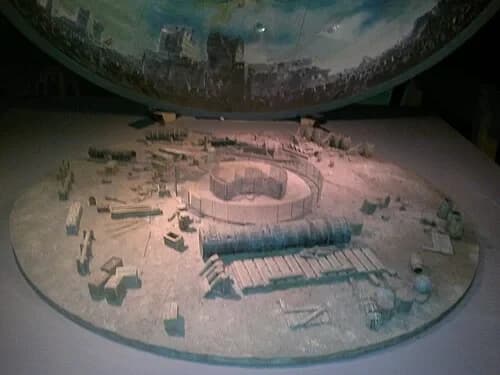
Start the tour at the visual threshold where visitors first descend the 52 stone steps to witness the scale of the reservoir. Use a wide establishing shot and a model to explain the overall layout and the 7,000 workers involved in its construction.
The Labor of Slaves
Looking at this model, it is easier to grasp the monumental effort required to carve out and construct this space in the mid-6th century. Construction began in 526 and was remarkably finished by 527 AD. This rapid pace was achieved through the forced labor of approximately 7,000 slaves. Their task was backbreaking, involving the removal of vast quantities of earth and the transport of massive columns into the deep pit. Beyond the chamber itself, the cistern was part of a much larger, sophisticated water management system. A complex network of aqueducts channeled water from the Belgrad Forest, nearly 20 kilometers away, into the city. Once the water reached this site, the cistern acted as a vital filtration and storage system. The sediment would settle at the bottom, providing clear water for the imperial household and the residents of the city's First Hill. This model helps visualize how the structure functioned as a hidden engine for the city, showing the arrangement of support structures and the specialized piping required to move such a high volume of water.
The Sunken Palace
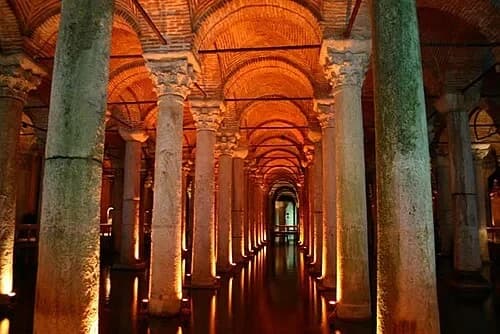
Welcome to one of the most remarkable engineering feats of the Byzantine Empire. Leaving the noise and heat of modern Istanbul behind, you have descended 52 stone steps into a cool, shadowed world known locally as Yerebatan Sarayı, or the Sunken Palace. This 9,800 square meter space was commissioned by Emperor Justinian I in 526 AD to address a critical urban need: water security. In a city prone to sieges, having a reliable source of fresh water was essential for survival. This cistern could hold up to 80,000 cubic meters of water, primarily intended for the Great Palace and surrounding buildings on the city’s First Hill. As your eyes adjust to the dim light, you can begin to appreciate the sheer scale of this subterranean cathedral. The air is heavy with moisture, and the sound of dripping water provides a constant background rhythm to the site’s quiet atmosphere. The orange glow highlights the massive pillars that stretch into the darkness, creating a perspective that seems almost endless. This was not a place of public gathering, but a strictly functional utility, hidden away from the world for centuries.
The Subterranean Forest of Columns
Focus on the architectural heart of the cistern: the 336 marble columns. Explain their diverse origins (spoliation) and their role in supporting the brick-vaulted ceiling to store 80,000 cubic meters of water.
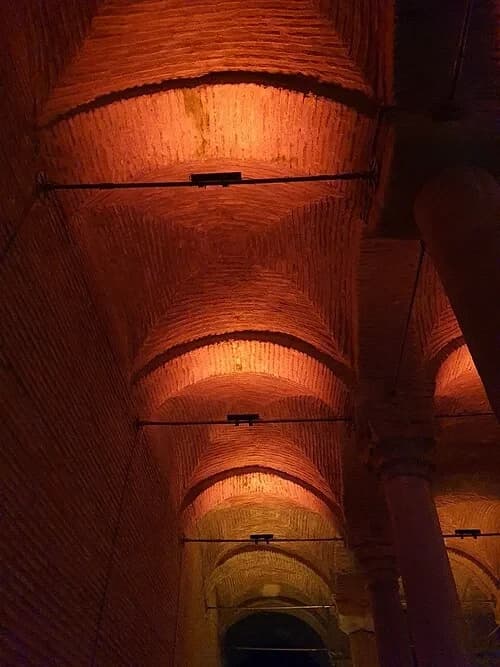
Byzantine Brick Vaults
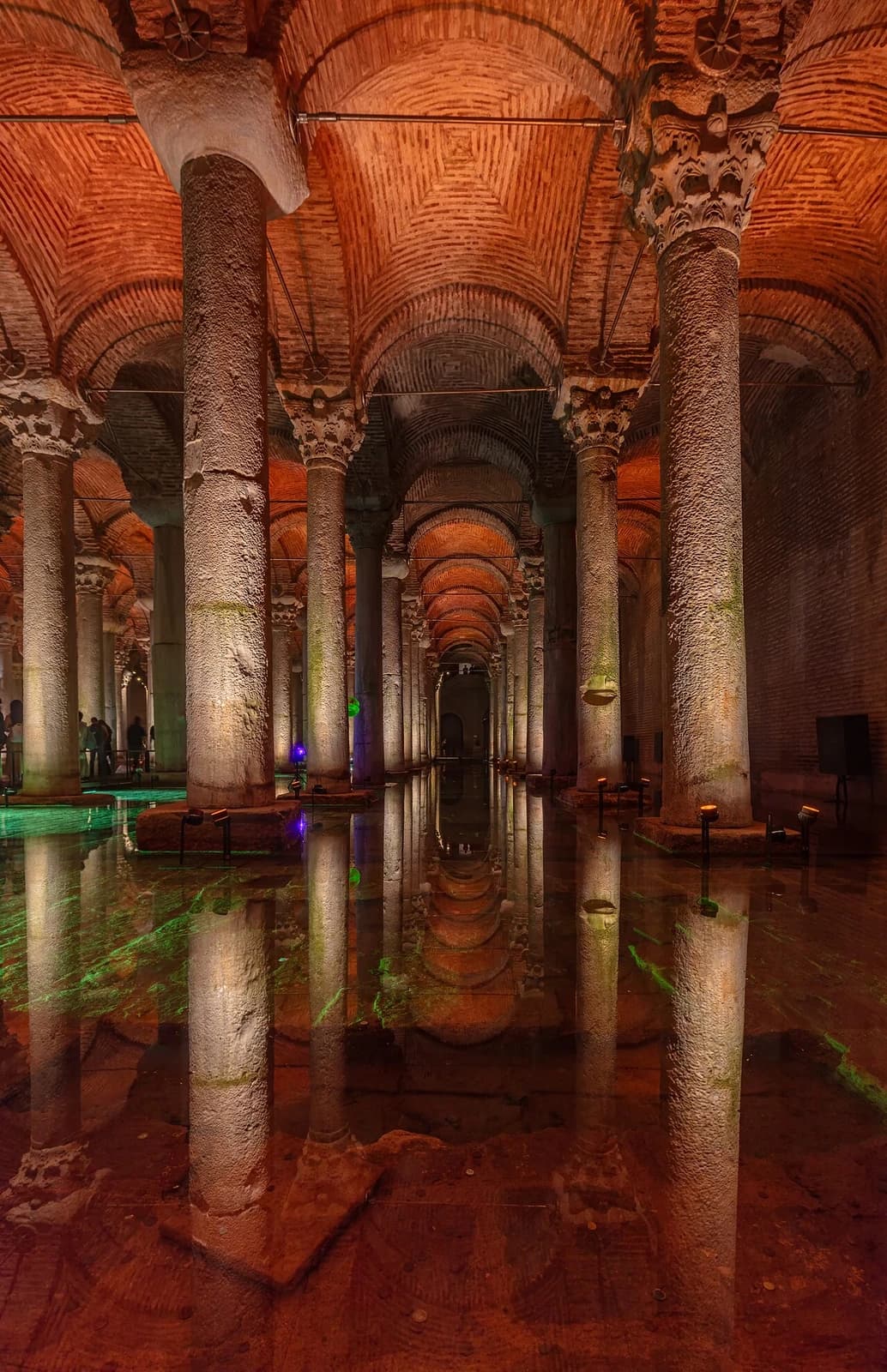
Look upward at the rhythmic patterns of the ceiling. The entire structure is held together by a series of cross-vaulted brick arches. These aren't just decorative; they are a masterpiece of load-bearing engineering. Each arch distributes the massive weight of the ground and buildings above outward toward the columns. This design also allowed the structure to withstand the internal pressure of the water when the cistern was at full capacity. Byzantine engineers utilized a specialized waterproof mortar between the bricks to ensure the surfaces remained sealed against the constant moisture. The red hue of the bricks, often highlighted by the modern lighting, provides a warm contrast to the gray and green tones of the columns below. In the 6th century, these vaults would have been obscured by darkness and water, visible only to the few officials who occasionally inspected the reservoir. Today, they remain largely intact, showcasing the durability of Byzantine masonry. The consistent geometry of the vaults helps create the cavernous acoustic environment you hear now, where even a whisper can travel quite far across the water’s surface.
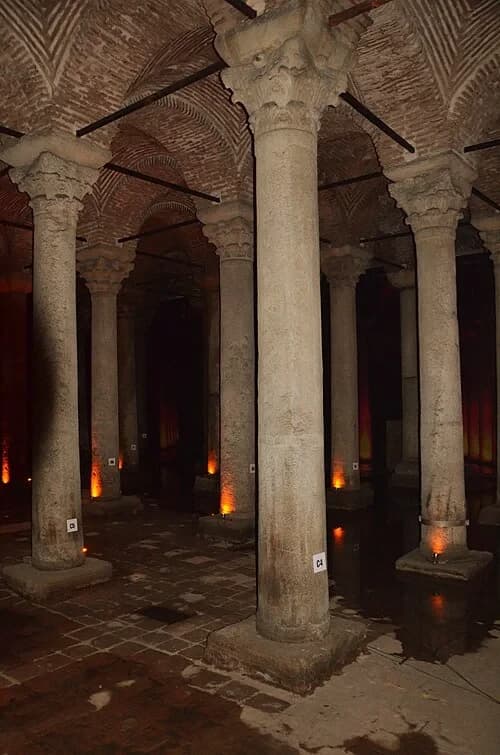
Forest of Columns
Standing among these pillars, the mathematical precision of the Byzantine engineers becomes apparent. There are 336 columns in total, each standing 9 meters tall, arranged in 12 rows of 28. If you look closely at the tops of the columns, you will notice they aren't uniform. Some feature the scrolls of the Ionic style, while others display the leafy carvings of the Corinthian order. This variety exists because the architects practiced 'spoliation'—the reuse of building materials from older Roman ruins. Rather than carving new pillars for a project that would be hidden underwater, they salvaged high-quality materials from defunct temples and public buildings. This gives the cistern an accidental museum-like quality, as pieces from different eras and locations were brought together in a new, functional configuration. The symmetry was essential for structural integrity, ensuring that the heavy ceiling was perfectly supported across the entire 140-meter length of the hall. The rows create long, clear vistas through the water, emphasizing the incredible volume of space that was once filled to the brim.
The Weeping Hen's Eye Column
Highlight the most unique column in the forest, featuring 'teardrop' or 'peacock-eye' carvings. This stop explains the folklore surrounding the workers and the artistic variety among the reused Roman materials.
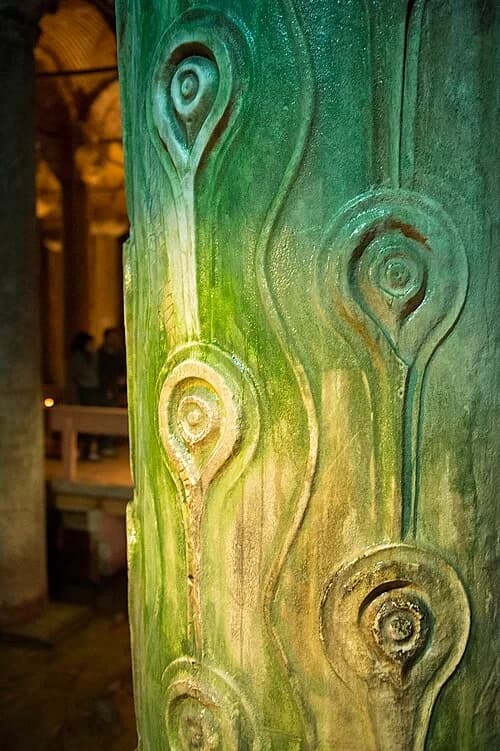
The Hen's Eye Column
One pillar stands out from the rest due to its unique decorative motifs. Known as the Hen's Eye or the Weeping Column, its surface is covered in carvings that resemble teardrops or the eyes of a peacock. These motifs are quite different from the classical styles seen on the other columns nearby. According to local folklore, these 'tears' were carved to honor the hundreds of workers and slaves who died during the intense one-year construction period. The column often appears darker and more saturated than its neighbors. Because it is made of a different type of stone that is more porous, it tends to stay damp, giving it a mossy, green texture that stays wet even when the water levels are low. This constant moisture adds to the 'weeping' effect described in the legends. While the other marble pillars in the forest were chosen for their structural strength, this one serves as a visual anomaly and a point of reflection within the vast space. It reminds us that behind the grand imperial vision lay a significant human cost that is still remembered in the stories of the city.
The Mystery of the Medusa Heads
Located in the northwest corner, these two massive Roman heads are the cistern's most famous artifacts. Discuss the practice of 'spoliation' and the mythological theories behind their sideways and upside-down placement.
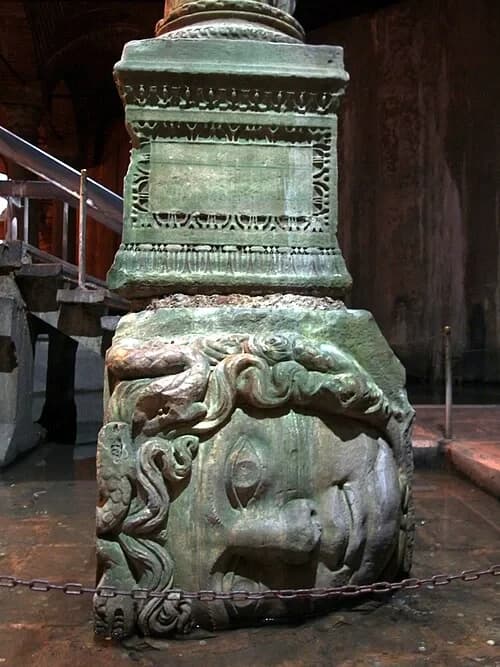
Sideways Medusa Head
In the northwest corner of the cistern, you will find one of the site's most famous and mysterious features. Resting at the base of a column is a large, carved head depicting Medusa, the Gorgon of Greek mythology. Her hair is a writhing mass of snakes, and her expression is frozen in stone. Curiously, the head is positioned on its side. Historians generally believe these heads were salvaged from an older Roman building and brought here for a purely pragmatic purpose: they were the right size to serve as heavy foundations for the columns. However, the specific orientation has sparked centuries of speculation. One popular theory suggests that the head was placed sideways to neutralize Medusa's legendary power. According to myth, anyone who looked directly into her eyes would be turned into stone. By placing her face horizontally, the Byzantine builders may have sought to render her gaze harmless. Even in this dark, utilitarian reservoir, the presence of such a potent symbol suggests a lingering respect for ancient superstitions, or perhaps just a clever way to repurpose pagan art for a Christian imperial project.
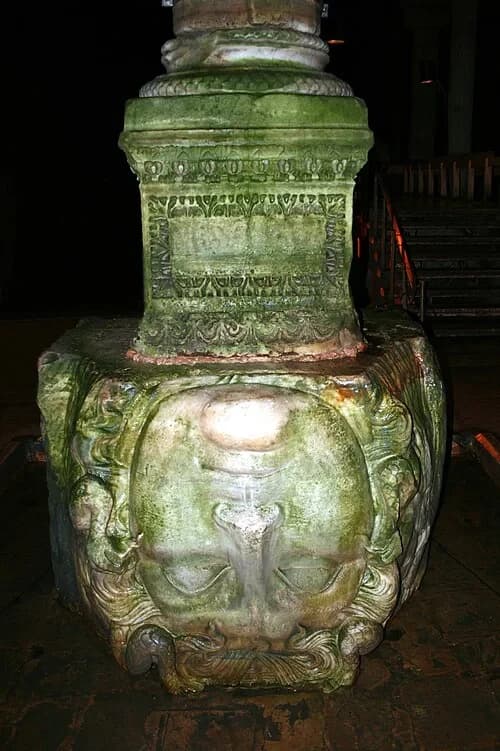
Upside-Down Medusa Head
Near the sideways Medusa, a second Gorgon head sits completely upside down at the base of another pillar. Like its neighbor, it was likely repurposed from a Roman-era structure. From a purely architectural standpoint, the upside-down position might have been the most stable way to level the block and reach the necessary height for the column it supports. Yet, the intentionality of the placement is hard to ignore. Local legends offer a more mystical explanation, suggesting that inverting the face was the ultimate way to ward off evil spirits and protect the cistern from the Gorgon’s petrifying gaze. If you look closely, you can see the intricate detail of the serpents and the characteristic furrowed brow. The fact that these two heads are tucked away in the furthest corners of the cistern, far from the entrance, adds to their enigmatic aura. They were never meant to be seen by the public; for over a millennium, they remained submerged in the dark, silent water. Their discovery in later centuries transformed them into icons of the cistern, representing the intersection of ancient myth and Byzantine engineering.
Modern Engineering and Digital Light
Examine the impact of the 2020-2022 restoration, which revealed the original brick floors and added seismic-resilient steel walkways. This area also showcases how the space is used today for contemporary art and light installations.
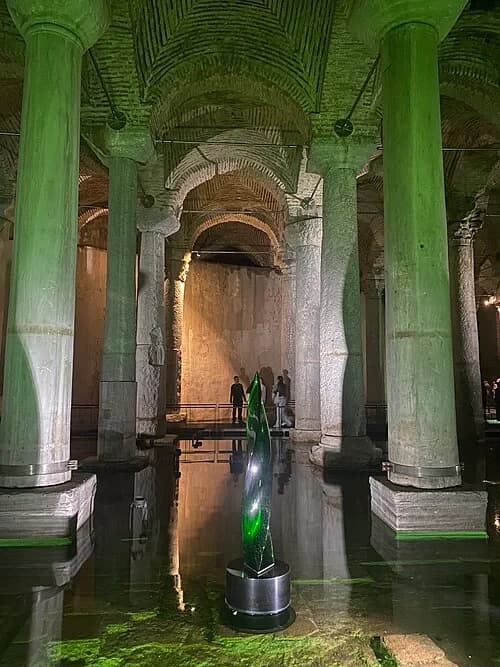
Water and Light
The atmosphere you see today is a careful blend of ancient architecture and contemporary design. A newly installed lighting system uses warm tones to highlight the vertical lines of the columns and the curves of the vaulted ceiling. These lights were specifically designed to prevent the growth of algae and to avoid damaging the aged stone surfaces. Throughout the cistern, you may notice contemporary art installations, including sculptures that seem to emerge from the water. These pieces are intended to interact with the environment, playing with the symmetry and the stillness of the space. The reflections on the shallow water create a mirror effect, making the columns appear to extend deep into the earth. This visual trick doubles the height of the chamber and adds to the sense of being in a subterranean palace. In its original life, this was a dark, functional machine for the city, but it has now been reimagined as a cultural venue. The space is frequently used for concerts and art exhibitions, where the unique acoustics and the timeless setting provide a backdrop that connects the modern city to its Byzantine past.
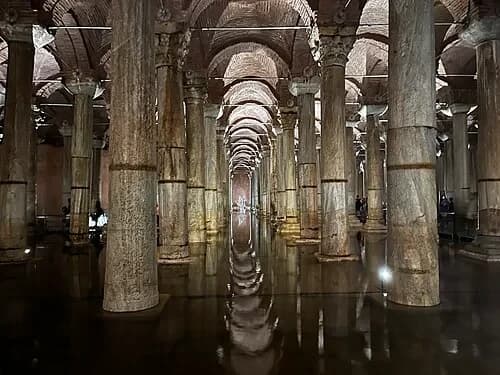
The 2022 Restoration
The appearance of the cistern changed significantly following a major restoration project conducted between 2020 and 2022. During this time, historians and engineers worked to return the site to a state that more closely resembles its original form. One of the most noticeable changes is the new network of modular steel walkways. These platforms sit much lower to the floor than the previous wooden ones, bringing you closer to the water's surface and allowing for a more intimate view of the column bases. The restoration team also removed layers of modern concrete that had been added in the mid-20th century, finally revealing the original 6th-century Byzantine brick floors. Beneath the surface, the work was even more critical. Seismic reinforcements were carefully hidden within the columns to protect the ancient structure from the earthquakes that occasionally affect Istanbul. This delicate balance of preservation and modernization ensures the cistern remains stable for future generations while providing a more authentic atmosphere. The goal was to let the original architecture speak for itself, removing distractions so that the 1,500-year-old masonry and the play of light on the water take center stage.
A Cinematic Farewell
As visitors prepare to exit, this stop provides a final perspective on the cistern's atmosphere, which famously served as a location for James Bond's 'From Russia with Love'.
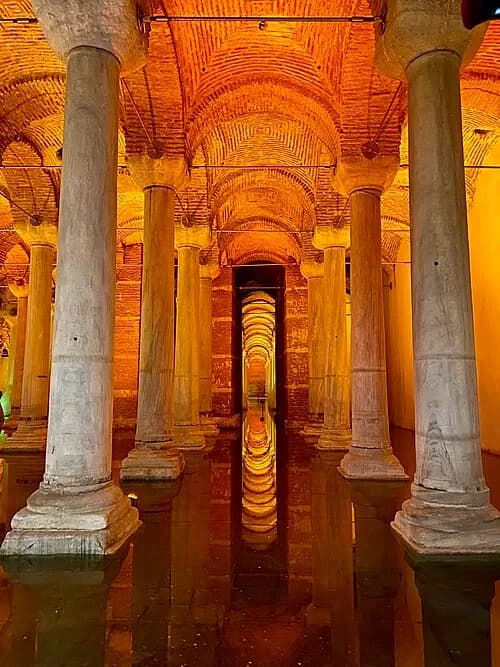
Cinema in the Deep
As you move toward the exit, consider how this space has lived many lives. For centuries after the fall of the Byzantine Empire, the cistern was largely forgotten by the outside world. It was 'rediscovered' in 1565 by the French scholar Petrus Gyllius. He had heard stories of locals who could lower buckets through holes in their basement floors to draw fresh water, and sometimes even catch fish. Following their leads, he found a way inside and documented the site for Europe. In more recent times, the cistern's mysterious atmosphere has made it a favorite location for filmmakers. You might recognize these columns from the 1963 James Bond film 'From Russia with Love', where Bond rows through the forest of pillars. It also played a central role in Dan Brown’s novel 'Inferno'. This transition from a hidden utility to a global icon highlights the enduring fascination with Istanbul’s underground history. The cistern is more than just a water tank; it is a repository of the city’s layers, where Roman ruins, Byzantine engineering, and modern culture overlap. The cool air you feel now is the same that has circulated through these vaults for fifteen centuries.
Frequently Asked Questions
How long does the Basilica Cistern audio tour take?
The Basilica Cistern audio guide includes 10 narrated stops. Most visitors spend 45 minutes to 1.5 hours exploring the complete tour, though you can listen at your own pace and skip or revisit any stop.
Is the Basilica Cistern audio guide available in my language?
Stanza supports 15 languages: English, Spanish, French, German, Italian, Portuguese, Russian, Japanese, Chinese, Korean, Arabic, Hindi, Polish, Dutch, Hebrew. Check the guide in the app to confirm the languages currently available for this tour.
Can I use the audio guide offline at Basilica Cistern?
Yes! Download the complete Basilica Cistern tour — including all audio, maps, and images — before your visit. The Stanza app works completely offline, so you don't need WiFi or mobile data at the venue.
How much does the Basilica Cistern audio guide cost?
The Stanza app is free to download. The current listed price for the Basilica Cistern audio guide is $2.99; app-store region and currency may affect the final price.
How do I use the Stanza audio guide at Basilica Cistern?
Download the free Stanza app, search for "Basilica Cistern", and download the tour. When you arrive at the venue, the app uses GPS to detect your location and automatically plays the relevant narration as you move between points of interest — completely hands-free.
What makes the Stanza audio guide different from other Basilica Cistern tours?
Stanza offers GPS-triggered narration that plays automatically as you walk through Basilica Cistern — no need to manually select stops. The tour is available in 15 languages, works fully offline, and includes 10 expertly narrated stops with images and historical context.
What other audio guides are available near Basilica Cistern?
Stanza offers multiple audio guides in Istanbul, Turkey and nearby areas. After downloading the app, browse the map to discover all available tours near Basilica Cistern. Each guide can be downloaded for offline use.