Languages
15Ōkōchi Sansō Audio Guide
Ōkōchi Sansō is a landmark in Kyoto, Japan. Explore it with Stanza's GPS-triggered offline audio guide — available in 15 languages.
Quick Facts
19
Stops
15
Languages
100%
Offline
📍 Kyoto, Japan · 35.0173°N, 135.6693°E
About Ōkōchi Sansō
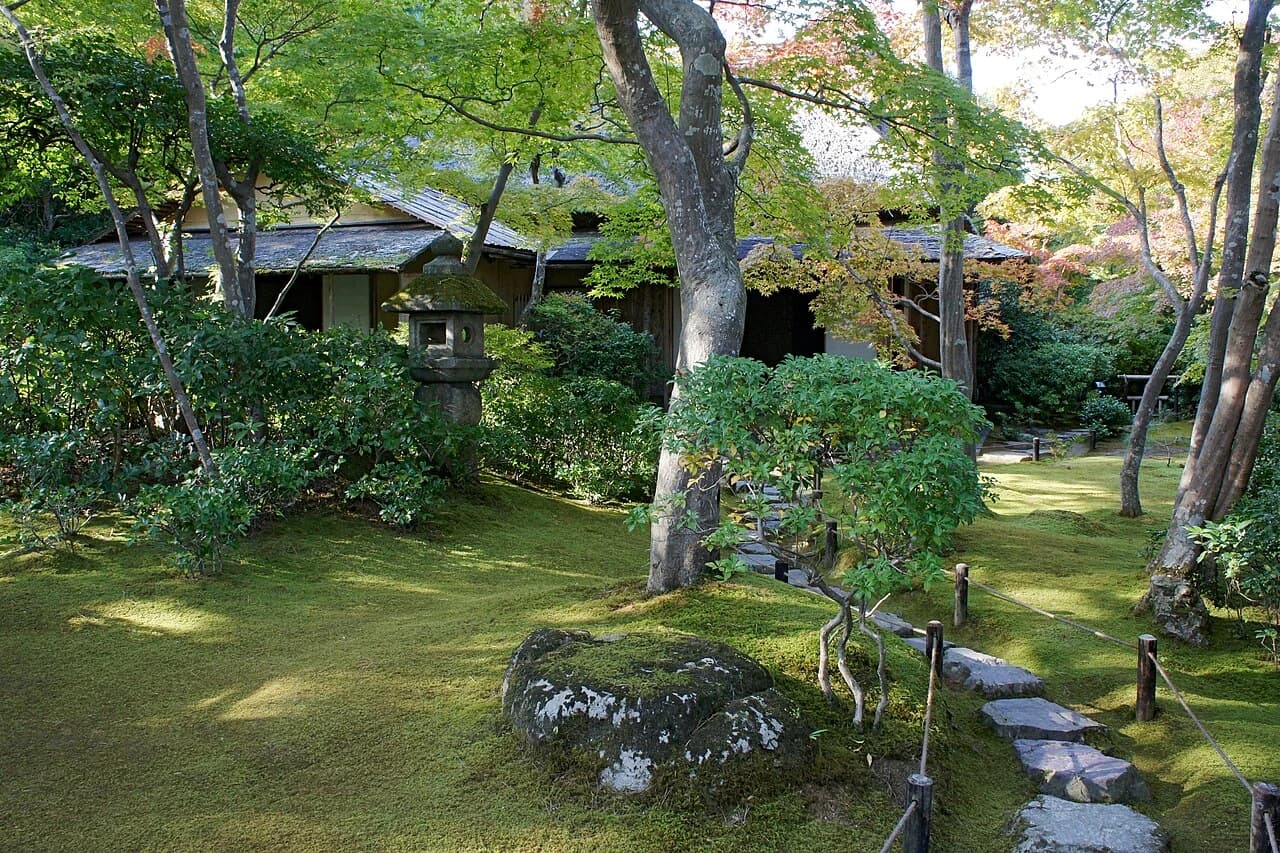
Ōkōchi Sansō is a historic Japanese strolling garden and villa in Kyoto, Japan. It was once the home of silent film actor Denjirō Ōkōchi.
Ōkōchi Sansō is also known as 大河内山荘.
This self-guided audio tour features 19 narrated stops organized across 8 sections. As a formal garden, Ōkōchi Sansō offers a unique cultural experience in the heart of Kyoto, Japan.
The Stanza audio guide is available in 15 languages and works entirely offline — download the complete tour including audio narration, maps, and images before your visit. As you walk through Ōkōchi Sansō, GPS-triggered narration plays automatically at each point of interest.
Last updated:
What you will hear
Arrival at Arashiyama Station
Establishes the location context near the scenic Torokko Arashiyama Station, which serves as the primary gateway for many visitors arriving from the Sagano Scenic Railway.
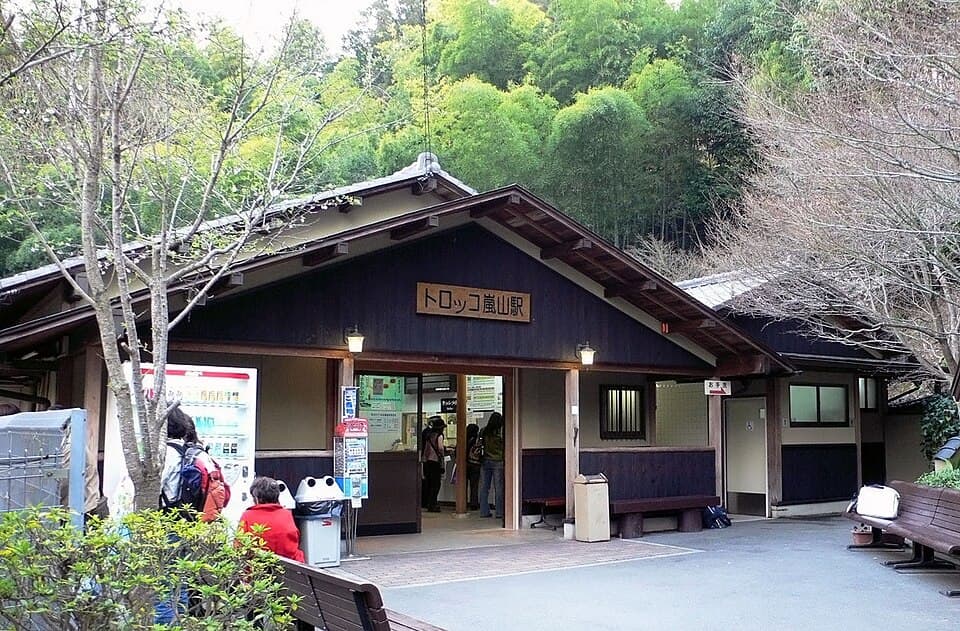
Arashiyama Torokko Station
Welcome to the starting point of a journey into one of Kyoto's most serene environments. Arashiyama Torokko Station serves as the primary gateway for the Sagano Scenic Railway, a retro-style train that winds through the rugged Hozu River gorge. This station functions as a threshold between two very different worlds. Just a short walk away, you may have been navigating the crowded streets and busy souvenir shops of central Arashiyama, but at this point, the atmosphere begins to shift noticeably. You are transitioning into the quieter, more contemplative atmosphere of the hills. The noise of the city fades, gradually replaced by the wind through the trees and the rhythmic rumble of the tracks. This station marks the boundary of an experience that emphasizes natural seasonal changes and the rugged topography of the Mt. Ogura area. Many visitors arrive here looking for a scenic ride, but the station itself represents the beginning of a slower pace of exploration, where the curated beauty of the hillsides becomes the main focus of your visit.
The Main Entrance and Bamboo Path
Introduces the transition from the public bamboo groves into the private sanctuary of the actor, highlighting the rustic thatched entrance gate.
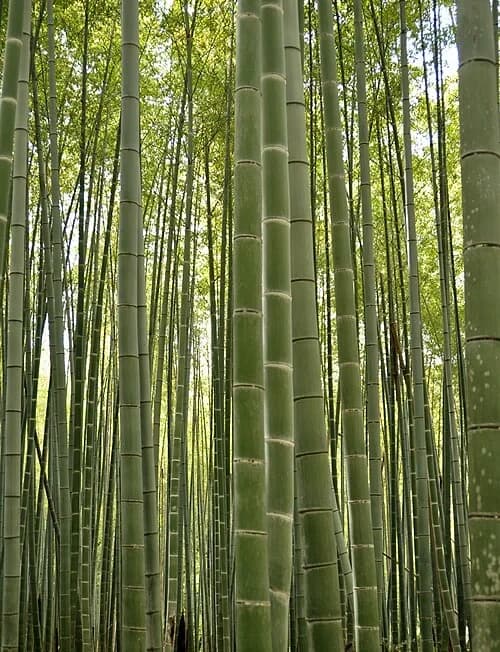
The Sagano Bamboo Grove
The slender trunks rising toward the sky here create a familiar silhouette for any visitor to Arashiyama, yet these garden paths offer a distinctively different experience than the famous public bamboo groves located just outside the villa walls. While the public paths are often densely packed with visitors, Denjirō Ōkōchi intentionally designed his private landscape to preserve specific, curated views of the bamboo in total silence. Within these walls, he could control the relationship between the vertical lines of the bamboo and the surrounding garden elements, such as stone lanterns and mossy slopes. The private grove serves as a living screen, filtering the sunlight into a soft, dappled green glow that shifts with the breeze. This section of the garden highlights the actor's desire for a space that offered the iconic beauty of the region without the distractions of the outside world. By incorporating the bamboo so directly into his villa's design, he ensured that the rhythmic swaying and whispering of the leaves would provide a constant, natural soundtrack to his contemplative life here on the mountain.
The Chumon Middle Gate
Focuses on the Middle Gate, one of the officially registered tangible cultural properties, which serves as a threshold to the inner garden.
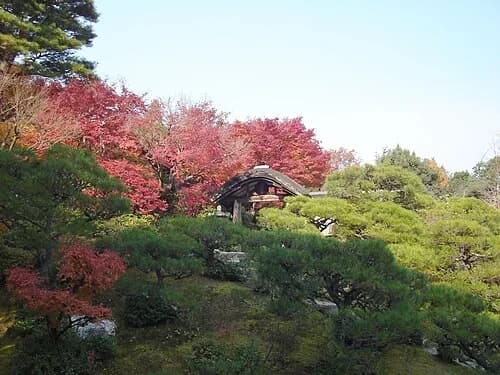
The Middle Gate
Known as the Chumon, or Middle Gate, this structure is officially registered as a tangible cultural property of Japan. Within the careful layout of the garden, its primary role is to signal a transition from the outer paths into the inner sanctuary where the main residential buildings are located. Traditionally in Japanese architecture, a middle gate serves to pause the visitor and focus their attention before they approach the heart of the home or a tea pavilion. The design of this gate reflects the sophisticated yet humble aesthetic that permeates the entire estate. Its presence indicates that you have moved past the initial landscape and are now entering the more intimate and refined core of Denjirō’s retreat. Every detail, from the joinery in the timber to the slope of the roof, was chosen to harmonize with the surrounding greenery. The gate does not just mark a boundary; it invites a change in mindset, encouraging a slower pace and a more observant eye as the path leads toward the primary residence. It stands as a well-preserved example of the architectural standards the actor demanded for his lifelong project.
Daijōkaku - The Actor's Masterpiece
Explores the main residential building, a fusion of traditional styles that took Denjirō Ōkōchi 30 years to perfect.
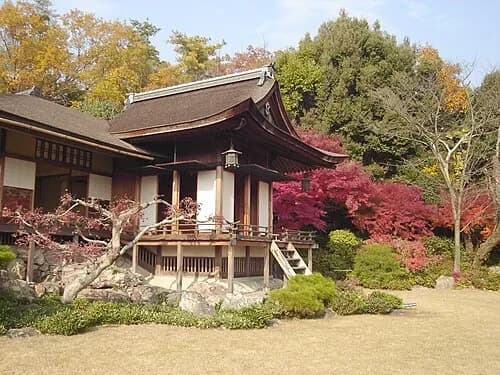
The Floating Veranda
Extending from the side of the Daijōkaku is an elevated wooden deck that seems to project out into the canopy of the surrounding trees. This veranda is one of the most iconic features of the villa, offering an expansive view of the meticulously maintained garden and the distant landscape. The construction of this specific building and the complex arrangement of the garden around it was a lifelong project for Denjirō Ōkōchi. From the time he broke ground in the early 1930s until his death in 1962, he was in a state of continuous development, constantly refining the heights of walls, the angles of paths, and the placement of trees. For thirty years, this hillside was his obsession. Standing on this deck, one can appreciate the fruit of that long labor. The veranda acts as a viewing platform from which the actor could survey his creation in different lights and seasons. It reflects the Japanese concept of living within the landscape rather than merely observing it from afar. The height and position of the deck were calculated to provide the optimal vantage point as the garden matured.
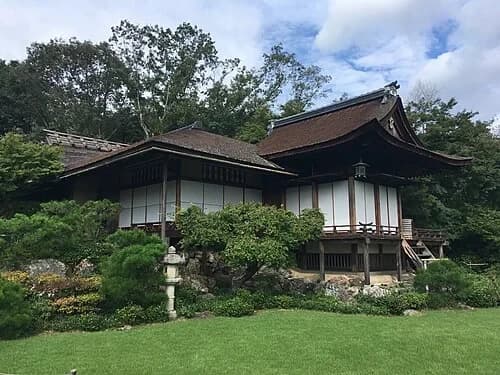
The Daijokaku Villa
The Daijōkaku Villa stands as the centerpiece of the estate and is considered a masterpiece of Sukiya-zukuri architecture. This style is characterized by refined simplicity and the use of natural materials to create a harmonious living space. To realize his vision, Denjirō Ōkōchi collaborated closely with the master carpenter Kaichiro Fuefuki. Together, they worked to blend the formal elements of traditional palace architecture with the more rustic, unpretentious aesthetic of a mountain tea house. The result is a structure that feels both grand and deeply grounded. Large sliding panels allow the interior to open completely to the surrounding garden, effectively erasing the boundary between the home and nature. The rooflines and the wooden supports are designed to integrate with the trees and the hillside rather than stand apart from them. The villa was intended to be more than just a home; it was an architectural expression of Denjirō’s spiritual and artistic ideals. The craftsmanship involved in the joinery and the selection of woods reflects a standard of quality that was rare even during the era of its construction, making it one of the most significant residential buildings of its kind.
The Art of Borrowed Scenery
Demonstrates the 'shakkei' technique where the Arashiyama mountains and Hozu River are visually integrated into the garden's layout.
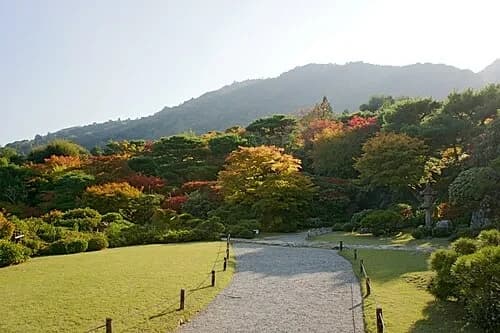
The Borrowed Scenery
At this point in the garden, you can see an execution of 'shakkei,' or the concept of borrowed scenery. Rather than creating a self-contained world, Denjirō Ōkōchi designed his garden to incorporate the natural beauty beyond its borders. By carefully positioning trees and paths, he brought the rugged walls of the Hozu River gorge and the massive slopes of the Arashiyama mountains into the viewer's direct line of sight. This technique makes the private twenty-thousand-square-meter garden feel as vast as the entire mountain range itself. The distant peaks become an extension of the garden's own geography, providing a monumental backdrop that changes with the clouds and the light. It requires a sophisticated understanding of perspective to align the foreground elements—like a stone lantern or a branch—with the distant mountain ridges so precisely. This integration ensures that the viewer feels connected to the larger world while remaining within the quiet sanctuary of the villa. The result is a landscape that feels expansive and infinite, demonstrating how a private space can honor and celebrate the wild beauty of the surrounding region through thoughtful architectural and botanical alignment.
Jibutsudō - The Actor's Sanctuary
Highlights the oldest structure on the estate, a small Buddhist hall where the actor practiced Zen meditation.
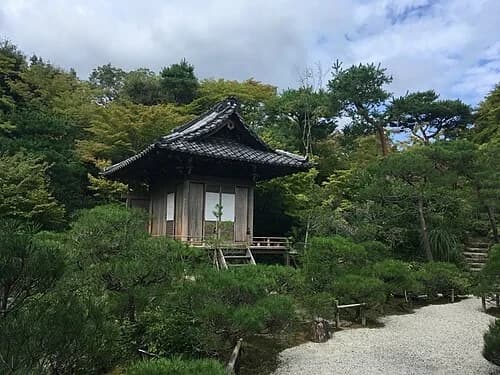
The Jibutsudo Shrine
The Jibutsudo Shrine is a significant historical structure, being the oldest building on the estate. It was originally built elsewhere and was carefully moved to this site during the Meiji era to serve as part of Denjirō’s retreat. While the main villa was a place for living and entertaining, this small Buddhist hall was dedicated to the actor’s spiritual life. Away from the bright spotlights and cameras of the movie studio, Denjirō would spend hours here practicing Zen meditation. The simple, weathered exterior of the hall reflects the somber and disciplined nature of his practice. Its presence within the garden highlights a side of the man that many of his film fans never saw—a deeply philosophical person who sought peace and clarity in traditional ways. The shrine is tucked away in a quiet corner, surrounded by dense foliage that emphasizes its role as a place for solitary reflection. By preserving such an ancient structure, the actor anchored his modern sanctuary in the religious and cultural history of Japan. The hall remains a quiet location for the inward journey Denjirō took alongside the physical construction of his vast hillside garden.
Tekisuian and the Moss Garden
Focuses on the tea house and the lush moss-covered ground, representing the traditional wabi-sabi aesthetic of the estate.
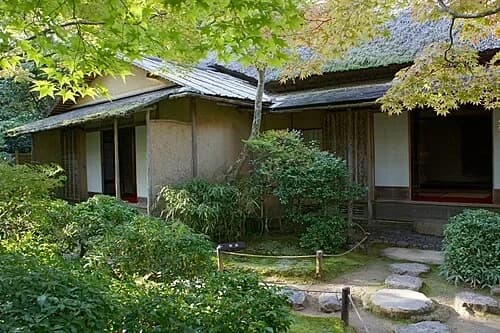
The Tekisuian Pavilion
Known as the Tekisuian, this tea house is another of the estate's registered tangible cultural properties. Its design is a deliberate study in the Japanese aesthetic of wabi-sabi, which finds beauty in the imperfect, the impermanent, and the humble. Observe the way the thick, thatched eaves hang low over the building and the moss-covered stones that form its base. These elements are meant to look as though they have grown naturally out of the hillside over centuries, rather than being constructed by human hands. The tea house is intended for the traditional tea ceremony, an act that emphasizes mindfulness and an appreciation for the present moment. The rustic materials—unpolished wood, rough-textured thatch, and earthy stone—were chosen to harmonize with the surrounding forest and moss. There is a sense of quiet dignity in the way the structure has aged, with the moss and the weathering of the wood adding to its character. For Denjirō, the Tekisuian was a place to host guests in an environment that prioritized spiritual connection and natural beauty over ostentatious display, making it a vital part of his sanctuary’s overall atmosphere.
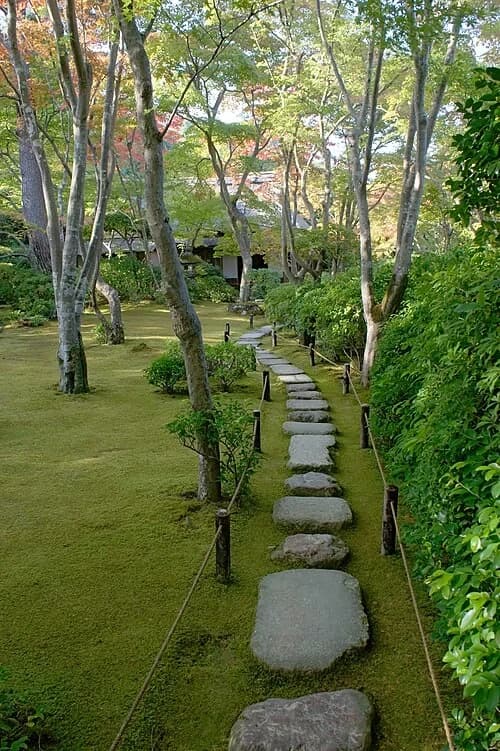
The Moss Garden Path
The lush, green carpet under the trees here is the result of a partnership between the actor and the master gardener Rihei Hirose. Together, they cultivated a variety of moss species, each with its own texture and shade of green, to create a rich and varied floor for the garden. The stepping stones that wind through this area were positioned with extreme care. Their spacing and uneven surfaces are designed to force you to look down and move with a slower, more deliberate pace. This is a common technique in Japanese garden design; by controlling the visitor’s speed, the gardener ensures that they take the time to notice the small details—the pattern of light through the leaves, the dampness of the stones, and the subtle variations in the moss. Each stone acts as a rhythmic beat in the walk, turning a simple stroll into a meditative exercise. This path represents the meticulous planning that went into every square inch of the estate, ensuring that the natural world is experienced at a human scale. The soft, damp environment created by the moss also helps to cool the air and dampen sound, further isolating the garden from the noise of the outside world.
The Tea Room and Matcha Experience
Concludes the visit with the traditional ritual of matcha tea, served with a view of the bamboo grove through perfectly framed windows.
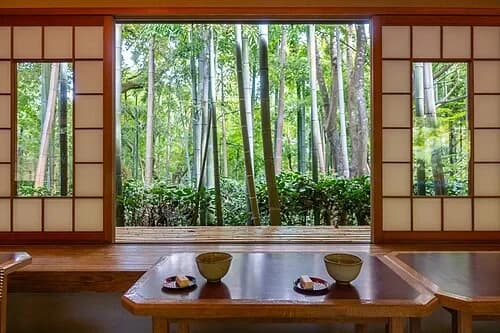
The Framed Bamboo View
Architecture in a traditional Japanese villa often serves as more than just shelter; it is a tool for seeing. From within this room, the large windows and sliding shoji screens perform a specific artistic function. They act as literal picture frames for the dense bamboo grove outside. By restricting the view, the wooden frames force the eye to appreciate the verticality and rhythm of the bamboo stalks, turning the landscape into a living screen painting. This technique creates a dynamic work of art that changes with the light and the movement of the wind. The green of the bamboo appears more intense when contrasted with the dark wood and translucent paper of the interior. Denjirō Ōkōchi designed these openings with extreme precision to ensure that any guest sitting here would experience the garden as a sequence of composed masterpieces. Unlike the wide-open views found on the outdoor verandas, these framed vistas offer a more intimate, meditative connection with nature. This intentional cropping reflects the Japanese aesthetic of finding beauty in a controlled perspective. The gentle rustle of leaves against the paper screens adds a sensory layer to the visual composition, completing the immersive experience.
Want to hear the rest?
Download the Stanza app to unlock all 19 stops and full GPS-guided navigation.
Frequently Asked Questions
How long does the Ōkōchi Sansō audio tour take?
The Ōkōchi Sansō audio guide includes 19 narrated stops. Most visitors spend 45 minutes to 1.5 hours exploring the complete tour, though you can listen at your own pace and skip or revisit any stop.
Is the Ōkōchi Sansō audio guide available in my language?
Stanza supports 15 languages: English, Spanish, French, German, Italian, Portuguese, Russian, Japanese, Chinese, Korean, Arabic, Hindi, Polish, Dutch, Hebrew. Check the guide in the app to confirm the languages currently available for this tour.
Can I use the audio guide offline at Ōkōchi Sansō?
Yes! Download the complete Ōkōchi Sansō tour — including all audio, maps, and images — before your visit. The Stanza app works completely offline, so you don't need WiFi or mobile data at the venue.
How much does the Ōkōchi Sansō audio guide cost?
The Stanza app is free to download, and the Ōkōchi Sansō audio guide is currently listed as free.
How do I use the Stanza audio guide at Ōkōchi Sansō?
Download the free Stanza app, search for "Ōkōchi Sansō", and download the tour. When you arrive at the venue, the app uses GPS to detect your location and automatically plays the relevant narration as you move between points of interest — completely hands-free.
What makes the Stanza audio guide different from other Ōkōchi Sansō tours?
Stanza offers GPS-triggered narration that plays automatically as you walk through Ōkōchi Sansō — no need to manually select stops. The tour is available in 15 languages, works fully offline, and includes 19 expertly narrated stops with images and historical context.
What other audio guides are available near Ōkōchi Sansō?
Stanza offers multiple audio guides in Kyoto, Japan and nearby areas. After downloading the app, browse the map to discover all available tours near Ōkōchi Sansō. Each guide can be downloaded for offline use.