Languages
15Teotihuacán Audio Guide
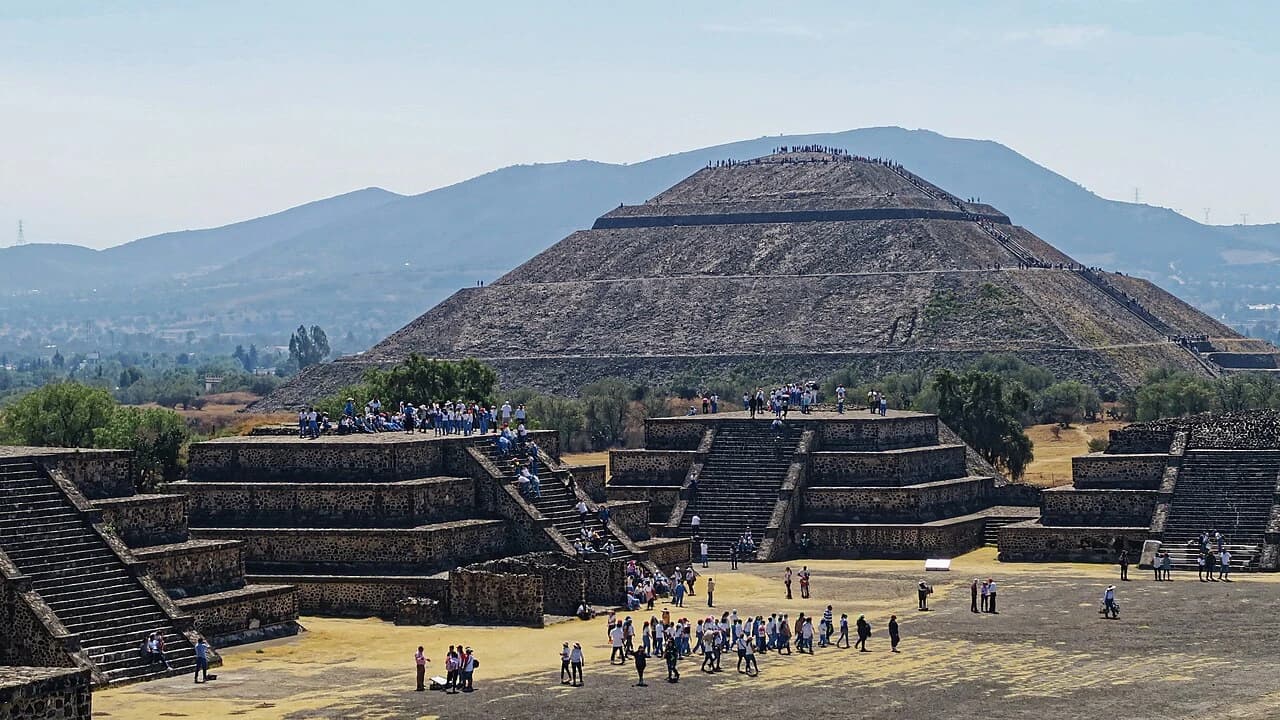
Teotihuacán is an archaeological site in San Francisco Mazapa, Mexico. Explore it with Stanza's guided offline audio tour — narrated in 15 languages.
Quick Facts
42
Stops
15
Languages
100%
Offline
📍 San Francisco Mazapa, Mexico · 19.6925°N, -98.8439°E
About Teotihuacán
Teotihuacan is a vast ancient Mesoamerican city, known for its large pyramids and residential complexes. It is a significant archaeological and historic site.
This self-guided audio tour features 42 narrated stops organized across 8 sections. As a archaeological site, Teotihuacán offers a unique cultural experience in the heart of San Francisco Mazapa, Mexico.
The Stanza audio guide is available in 15 languages and works entirely offline — download the complete tour including audio narration, maps, and images before your visit. As you walk through Teotihuacán, GPS-triggered narration plays automatically at each point of interest.
Last updated:
What you will hear
The Citadel (La Ciudadela)
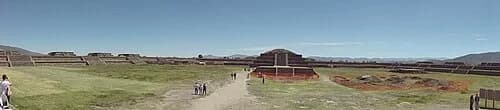
A massive sunken plaza that served as the political and religious heart of the city, capable of holding nearly the entire population.
The Citadel Plaza
The 'Ciudadela,' or Citadel, is a vast sunken plaza that could once accommodate up to 100,000 people for public rituals and state events. Although Spanish explorers gave it a military name, this space was primarily a ceremonial and political theater rather than a fortress. Around the perimeter, you can see symmetrical platforms that define the edges of the square. These structures likely served as stages or viewing areas for the city's elite during massive gatherings. Standing in the center of this expanse, the scale of Teotihuacán’s public life becomes clear. The layout ensured that every inhabitant could witness the grand spectacles performed by priests and rulers. This plaza anchors the southern end of the city's main axis, acting as a massive courtyard for the Temple of the Feathered Serpent located at its rear. The precision of the surrounding walls and the sheer volume of space reflect a society capable of organizing immense labor forces to create a landscape of awe and order.
The Citadel
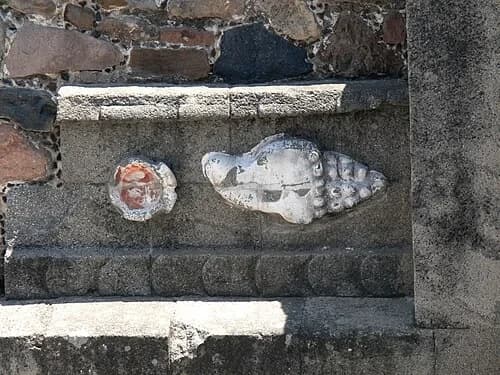
Notice the transition from the rough, weathered stone of the wall to the smooth, detailed carving of the conch shell. These shells were not merely decorative elements in Teotihuacán; they were transformed into powerful ritual trumpets known as 'quiquiztli.' Priests and leaders would blow into them to announce important ceremonies or to communicate with the divine, their deep resonance echoing across the stone plazas. The inclusion of such a marine motif here hints at the city’s extensive reach and its connection to the distant ocean, hundreds of kilometers away. These carvings are part of the elaborate decorative program found within the Citadel, the city's primary administrative and religious center. The level of craftsmanship required to achieve such fluid, organic shapes in hard volcanic stone is remarkable. Each shell stands out against the geometric patterns of the architecture, serving as a reminder of the symbolic importance of water and the sea in a valley that relied so heavily on unpredictable seasonal rains.
Teotihuacán Site Museum
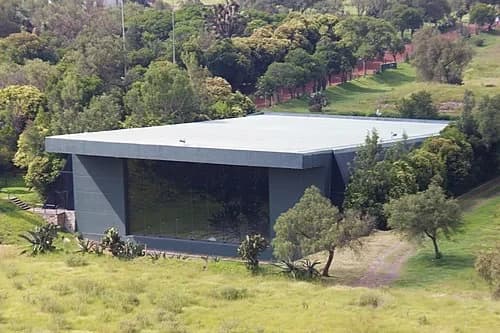
This museum houses the most significant artifacts found on-site, including a massive scale model of the city at its peak.
Teotihuacán Site Museum
As we approach the Site Museum, we consider the primary driver of Teotihuacán’s wealth. In an era without metal tools, obsidian—a natural volcanic glass—was effectively the 'steel' of Mesoamerica. It could be chipped to create edges sharper than a modern surgical scalpel. This material was used for a vast range of items, from utilitarian scrapers and blades to elite status symbols like ritual mirrors and intricately carved figurines. Teotihuacán’s regional dominance was fueled by its control of the nearby Pachuca mines, which produced a rare and highly prized green variety of obsidian. This resource was exported as far away as the Maya Lowlands and the Gulf Coast, making the city a hub of international trade. The museum houses many examples of this craftsmanship, showing the incredible skill required to work such a brittle material. The production of obsidian tools was a massive industry that supported thousands of specialized artisans within the city. Controlling the source and the production of this vital resource gave Teotihuacán a level of economic and political influence that few other ancient cities could match.
Botanical Garden
A modern garden showcasing the semi-arid flora that was vital to the Teotihuacano economy, including agave and prickly pear cactus.
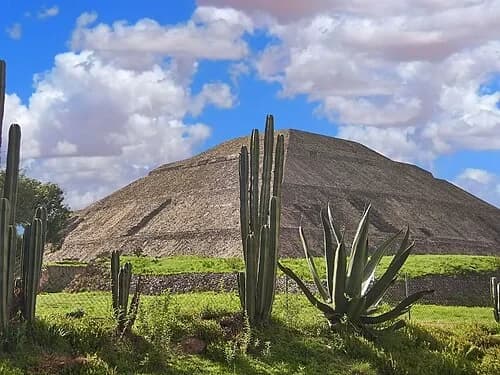
The Botanical Garden
Identify the distinct flora in the foreground, particularly the broad-leaved agave and the flat-jointed prickly pear cactus. These plants were not merely part of the landscape; they were essential to every aspect of life in the valley. The agave, or maguey, provided strong fibers for weaving clothing and sandals, while its sap was fermented into a nutrient-rich beverage known as pulque. The prickly pear provided edible fruit and pads, but perhaps its most valuable contribution was hidden. Tiny cochineal beetles inhabit these cacti, and when crushed, they produce a brilliant, permanent crimson pigment. This natural resource provided the city with the famous red dye used in textiles and the vibrant murals seen throughout the ruins. Even today, these hardy plants define the semi-arid environment, standing as living links to the agricultural knowledge that allowed a population of over 100,000 people to thrive in this high-altitude valley.
Pyramid of the Sun
One of the largest structures in the Western Hemisphere, built over a natural cave that was likely considered the birthplace of the sun and moon.
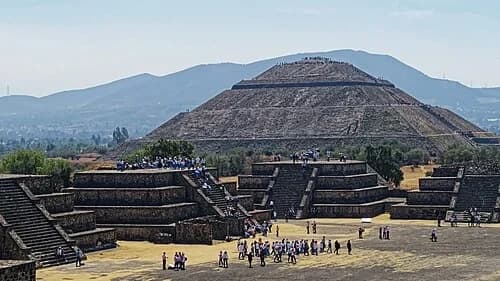
Pyramid of the Sun
The Pyramid of the Sun is a feat of ancient engineering, completed around 200 CE. Its construction required a massive coordinated effort, using approximately three million tons of stone, brick, and earth. The structure rises 65 meters from a base nearly as large as the Great Pyramid of Giza. Its location was not accidental; the pyramid sits directly over a natural clover-shaped cave. For the people of Teotihuacán, this cave likely represented a 'chicomoztoc,' or a place of emergence where human creation began. By building their largest monument directly over this portal to the underworld, they physically anchored their city to their origin story. Unlike the pyramids of Egypt, which served as tombs, this was a temple base designed for activity. The wide staircases allowed priests to ascend toward the sky, visible to the entire population below. Over centuries, the outer stone casing has weathered, but the sheer mass of the core remains a dominant feature of the landscape.
Mural of the Puma
A rare, well-preserved open-air mural depicting a stylized feline, showcasing the vibrant red pigments used throughout the city.
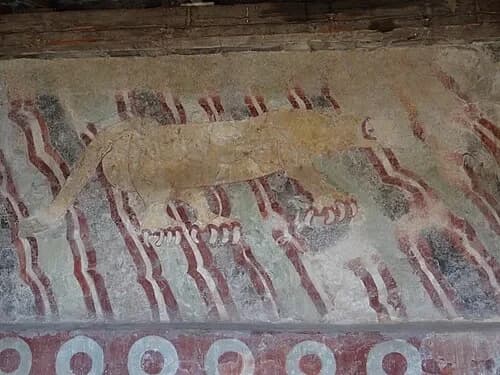
Mural of the Puma
Examine this rare outdoor mural depicting a stylized feline, often identified by scholars as a puma. The figure is rendered using a vibrant red mineral pigment derived from ground iron oxide, or hematite. While much of the site today appears as weathered gray stone, murals like this prove that Teotihuacán was once a city of brilliant, saturated color. Nearly every building, from the largest temple to the humblest residence, was covered in a layer of lime plaster and decorated with vivid fresco paintings. The feline is a common motif in the city's art, representing power, the night, and the earthly realm. The use of iron oxide was a deliberate choice; not only was it abundant, but it chemically bonded with the wet plaster, allowing these images to withstand the elements for over 1,500 years. This fragment provides a window into the aesthetic experience of the ancient inhabitants, for whom the city was a continuous gallery of religious and symbolic storytelling.
Tepantitla (Paradise of Tlaloc)
A residential compound famous for the 'Tlalocan' mural, depicting a lush afterlife filled with butterflies, flowers, and singing people.
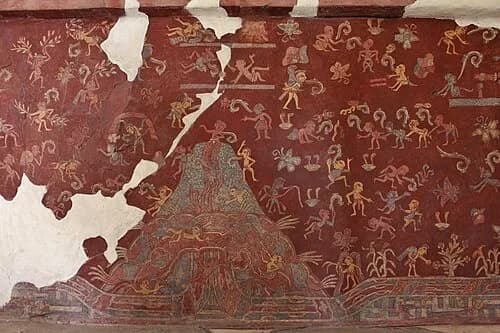
Songs and Spirits
Look closely at the curly, vine-like shapes emerging from the mouths of the figures in this mural. These are known as speech scrolls, a standard Mesoamerican convention used to represent singing, chanting, or speaking. The scrolls are often decorated with small symbols, such as flowers or shells, to indicate the 'precious' or sacred nature of the words being uttered. Surrounding the figures, you can spot tiny, delicate details like butterflies and water droplets. These elements are not just decorative; they are part of a sophisticated system of visual storytelling where every symbol carries a specific meaning. The mastery of fine lines in these frescos shows a high level of artistic training and a shared iconographic language understood by the city's residents. By including these details, the artist transformed a flat wall into a dynamic scene filled with the imagined sounds of ritual and the vibrant presence of the natural world, allowing the viewer to 'hear' the activity depicted in the paint.
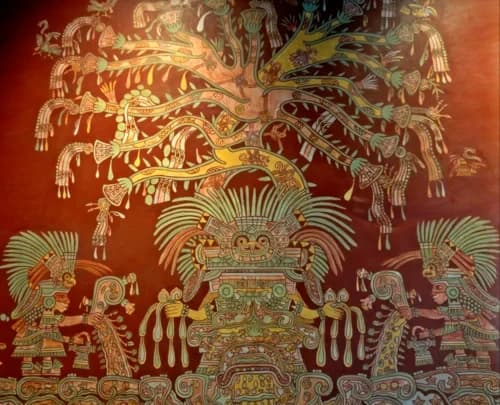
The Great Goddess
This mural focuses on the Great Goddess, considered by many archaeologists to be the primary female deity of Teotihuacán. She is depicted as a source of fertility, with streams of water and seeds pouring from her outstretched hands. These symbols directly connect her to the agricultural survival of the city, representing the bounty of the earth and the rains. The figure wears an elaborate headdress featuring bird-mask elements, a common trait in the city's divine iconography. Behind her head, a stylized 'World Tree' grows, its branches laden with flowers and birds, symbolizing the axis of the cosmos. The symmetry and scale of the goddess emphasize her power and stability. Her presence in murals throughout the city highlights a religious focus on the cycles of nature and the divine forces required to maintain balance in a precarious environment. The intricate patterns on her clothing and the surrounding symbols form a complete theological statement about the origins of life and food.
Temple of Agriculture
Located near the Moon Pyramid, this temple is known for murals depicting offerings of seeds and plants to the gods.
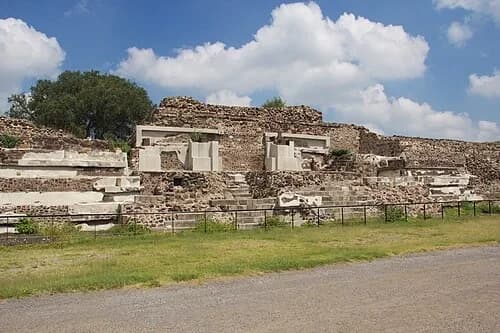
Temple of Agriculture
Explore the multi-layered ruins of the Temple of Agriculture. This site earned its name from murals discovered here that depicted people making offerings of food and plants to the gods. One of the most interesting features visible in these ruins is the evidence of superimposed construction. Like many other Mesoamerican cultures, the Teotihuacanos did not always demolish old buildings; instead, they often filled them in and built a new, larger structure directly on top. This practice created 'nested' buildings, preserving earlier architectural styles and ritual spaces beneath the surface. You can see the distinct layers of stone and plaster that mark different phases of the city's growth. These renovations were often timed with significant calendar cycles or political shifts, renewing the sacred power of the site. The temple served as a focal point for rituals intended to ensure the success of the harvest, a central concern for a city whose survival depended on the unpredictable seasonal rains of the high valley.
Palace of the Jaguars
A high-status residential complex featuring murals of jaguars blowing feathered conch shells and wearing elaborate headdresses.
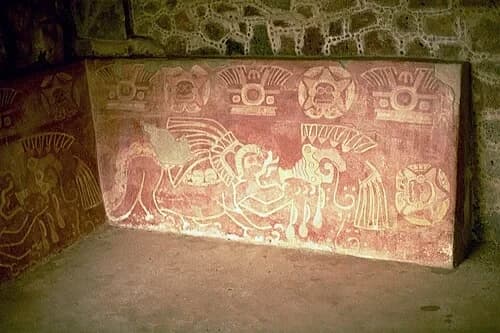
Pigments of Power
The saturated red seen in these wall paintings is the defining color of the ancient city. This specific shade, known as 'Teotihuacán Red,' was created using ground hematite, a form of iron oxide. The artists used a true fresco technique, applying the mineral pigments onto a layer of wet lime plaster. As the plaster dried, the color became chemically bonded to the surface of the wall, rather than just sitting on top of it. This process is why so many murals have managed to survive the humidity and exposure of over 1,500 years. The color was more than just an aesthetic choice; it carried deep symbolic weight, often associated with blood, life, and the sun. By coating their entire world in this deep crimson, the people of Teotihuacán created an immersive environment that was perpetually vibrant. The technical skill required to prepare the plaster and apply the pigments quickly before it dried shows the presence of a professional class of highly trained artists.
Want to hear the rest?
Download the Stanza app to unlock all 42 stops and the complete guided audio tour.
Frequently Asked Questions
How long does the Teotihuacán audio tour take?
The Teotihuacán audio guide includes 42 narrated stops. Most visitors spend 45 minutes to 1.5 hours exploring the complete tour, though you can listen at your own pace and skip or revisit any stop.
Is the Teotihuacán audio guide available in my language?
Stanza supports 15 languages: English, Spanish, French, German, Italian, Portuguese, Russian, Japanese, Chinese, Korean, Arabic, Hindi, Polish, Dutch, Hebrew. Check the guide in the app to confirm the languages currently available for this tour.
Can I use the audio guide offline at Teotihuacán?
Yes! Download the complete Teotihuacán tour — including all audio, maps, and images — before your visit. The Stanza app works completely offline, so you don't need WiFi or mobile data at the venue.
How much does the Teotihuacán audio guide cost?
The Stanza app is free to download. The current listed price for the Teotihuacán audio guide is $5.99; app-store region and currency may affect the final price.
How do I use the Stanza audio guide at Teotihuacán?
Download the free Stanza app, search for "Teotihuacán", and download the tour. When you arrive at the venue, the app uses GPS to detect your location and automatically plays the relevant narration as you move between points of interest — completely hands-free.
What makes the Stanza audio guide different from other Teotihuacán tours?
Stanza offers GPS-triggered narration that plays automatically as you walk through Teotihuacán — no need to manually select stops. The tour is available in 15 languages, works fully offline, and includes 42 expertly narrated stops with images and historical context.
What other audio guides are available near Teotihuacán?
Stanza offers multiple audio guides in San Francisco Mazapa, Mexico and nearby areas. After downloading the app, browse the map to discover all available tours near Teotihuacán. Each guide can be downloaded for offline use.