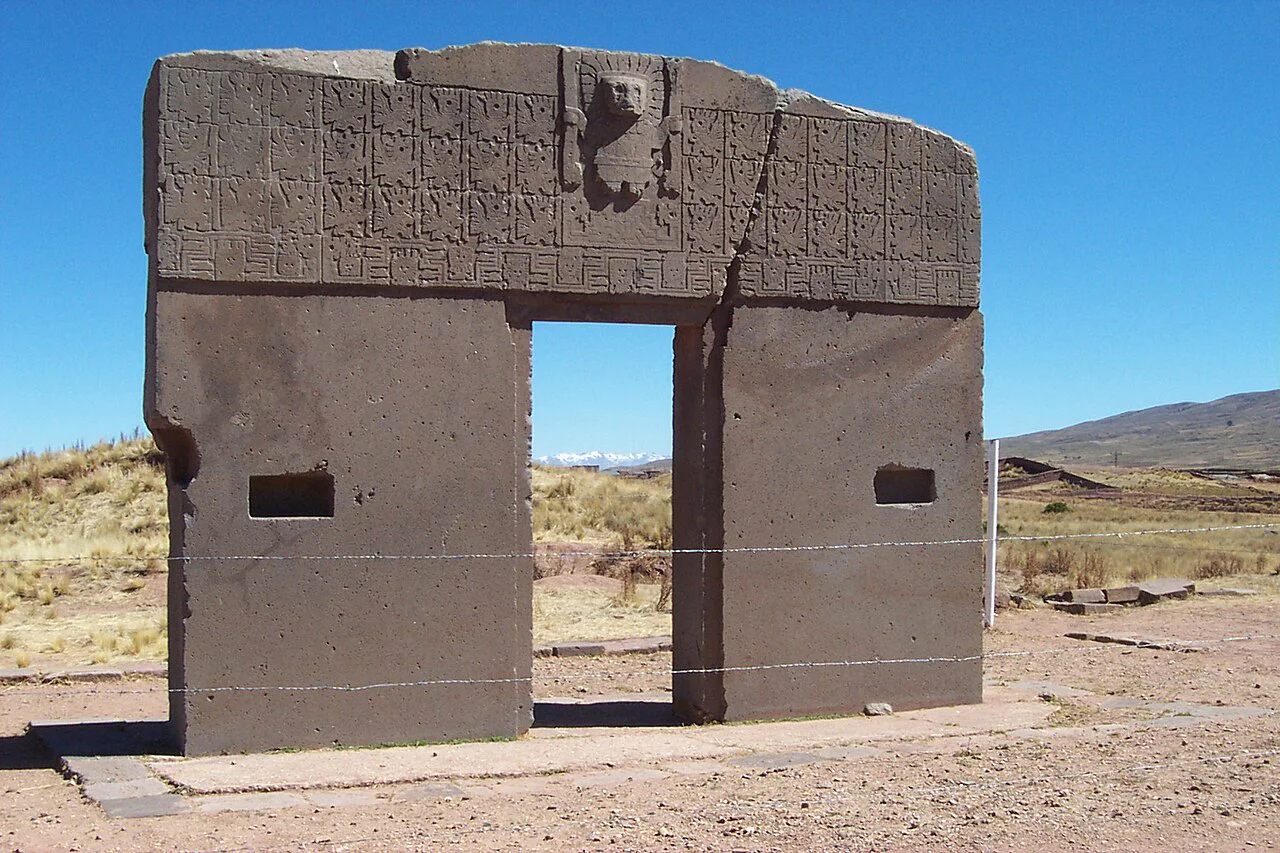
Stanza · Audio guide
Tiwanaku Audio Guide
A place to remember. A story to take with you.
Tiwanaku is a Pre-Columbian archaeological site in western Bolivia near Lake Titicaca. It is one of the largest sites in South America and contains monumental structures and megalithic blocks.
Download Stanza, then search for “Tiwanaku”.
About the tour
One guide. Your kind of visit.
Tiwanaku is a Pre-Columbian archaeological site in western Bolivia near Lake Titicaca. It is one of the largest sites in South America and contains monumental structures and megalithic blocks.
Ready when you are.
- 01Get the free Stanza app.
iOS & Android
- 02Find your guide.
“Tiwanaku”
- 03Download before you go.
Works offline
Audio guide / 24 narrated stops
Inside the guide
Get to know a few of the stories before you go. Open a stop to read more.
01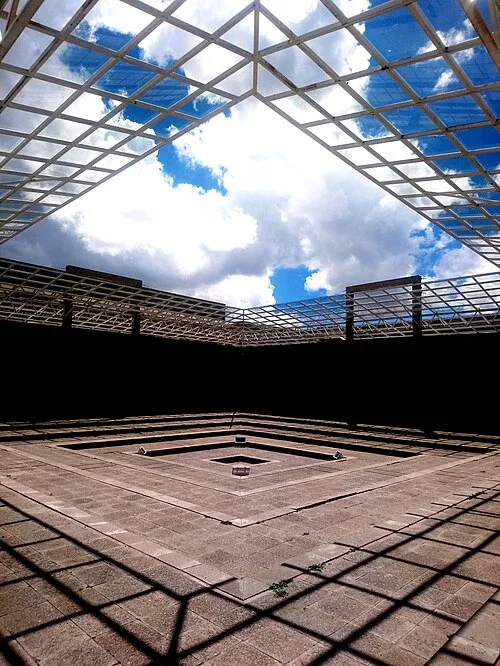 Regional Archaeological Museum of Tiwanaku
Tiwanaku was a ceremonial capital built on the Altiplano, the high plain of western Bolivia, not far from Lake Titicaca. At its height, perhaps ten to twenty thousand people lived here. A Jesuit chronicler, Bernabé Cobo, reported that the site was once called taypiqala, an Aymara phrase meaning stone in the center. The idea was that this valley, between two sacred mountains, lay at the middle of the world. The original inhabitants left no writing, so their own name for the city may be lost. A later folk tale says the name came from an Inca who told a running messenger, Tiai, wanaku. That means sit down, guanaco, and it is an affectionate legend rather than history. The age of the place was argued for decades. Arthur Posnansky claimed it was more than eleven thousand years old, a view no one holds today. Radiocarbon dating now points to a founding around AD 110. UNESCO listed the ruins in 2000 as the spiritual and political centre of the Tiwanaku culture. The monuments sit in two zones, the main complex here and Pumapunku about a kilometre to the southwest.
Photo: Caleidoscopic · CC BY-SA 4.0
02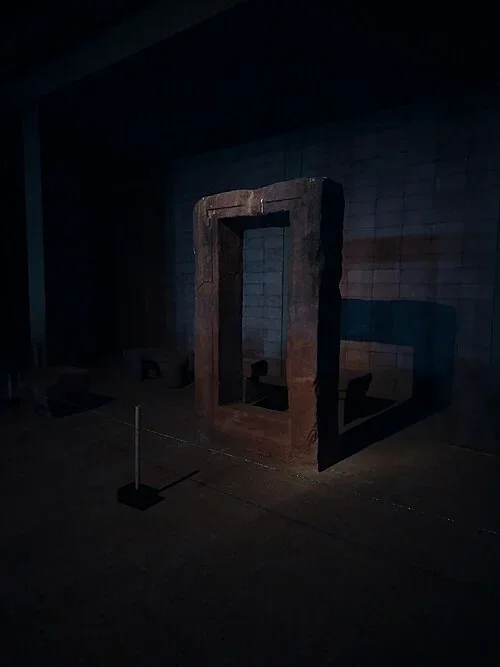 Regional Archaeological Museum of Tiwanaku
Monolithic Portal in the Lithic Museum
A gateway carved from one block of stone is Tiwanaku's signature. Here one stands under a dark roof, lit from one side, its frame cut into a single mass of andesite. The builders placed these portals on artificial mounds, on platforms, and inside sunken courts. The great ones were never just doorways. They carried recessed doorframes, a form architects call a chambranle. Look at the inner edges of the frame and the cuts step back in clean, deliberate recesses. Those recesses hold sockets, cut to receive clamps. The clamps anchored later additions, so a portal like this was designed to grow. Many of the site's famous gateways survive incomplete, missing part of that frame. What does survive shows stone-cutting of very high skill, with a working knowledge of descriptive geometry. The regularity of the elements suggests the carvers followed a system of proportions, repeating the same design at every scale.
Photo: AquilaTh · CC BY-SA 4.0
03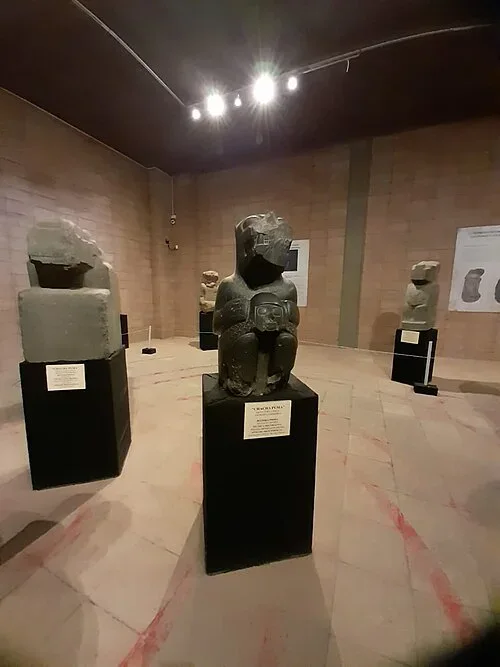 Regional Archaeological Museum of Tiwanaku
Gallery of Stone Sculptures
Tiwanaku's religious images did not stay carved in stone. The same designs, which scholars call the Southern Andean Iconographic Series, appear across the Titicaca basin. They turn up on stone sculptures like these, on oversized vessels, on qirus, the ceremonial drinking cups, and on snuff trays. The Wari, a neighbouring culture with close ties to Tiwanaku, shared the very same imagery. This gallery holds ceramics, stone pieces, metalwork and bone artifacts recovered from scientific excavations at the site. But anything found here comes with a warning. Tiwanaku was looted and dug into almost from the moment it fell. People quarried its stones for buildings and for railroad construction. Soldiers used the ruins for target practice. So archaeologists work with materials that were jumbled and destroyed long before they arrived, and every interpretation carries that caution with it.
Listen in the appPhoto: ElGotito · CC0
04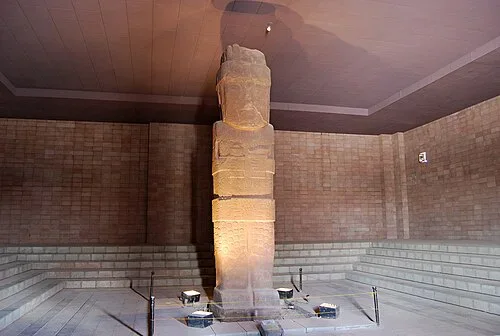 Bennett Monolith
The largest stone sculpture ever found in the Andean world spent decades standing in someone else's city. An American archaeologist, Wendell C. Bennett, found it in 1932 at the centre of the Semi-Subterranean Temple. It stands seven point three metres tall, and it fills this chamber from floor to ceiling. A year after its discovery, workers loaded the monolith onto the railway and sent it to La Paz. There it was erected in a public plaza, where city air and city traffic worked on it for decades. In 2002 it came home to Tiwanaku, to a museum built for it, and its return was celebrated with major indigenous festivities. The red sandstone giant had been away for nearly seventy years.
Listen in the appPavel Špindler · CC BY 3.0
05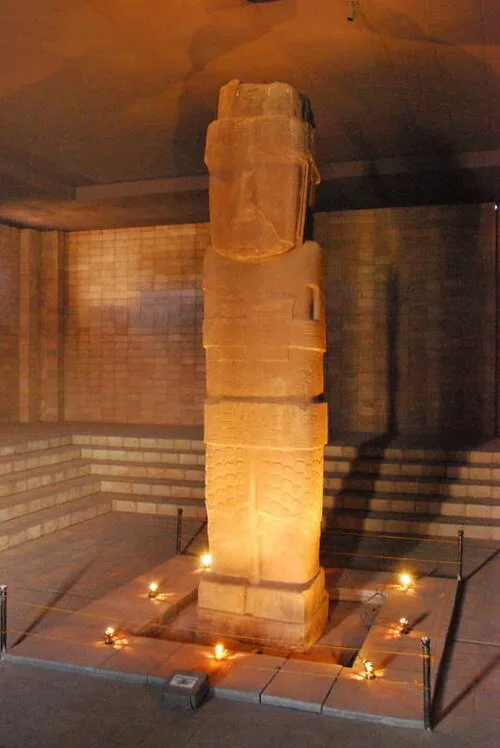 Bennett Monolith
: Carving and Provenance
The carving on the Bennett stela runs in stacked panels down the body, a face at the top and bands of figures and symbols below. But the sculpture itself tells a political story. During Tiwanaku's classic period, revered sculptures were brought in large numbers from the northern basin of the lake, from places like Pucará, to the capital. This was no casual traffic. It was a great state project, promoted by the ruling elites and carried out by organised workforces. The workers were directed by the learned men of the day, specialists who might fairly be called engineers. Moving stones of this size across the altiplano took that kind of planning. The Bennett monolith was found in 1932 beside a smaller companion, the Bearded Monolith, and both had been brought to stand together in the sunken temple.
Listen in the appDiego Tirira from Quito, Ecuador · CC BY-SA 2.0
06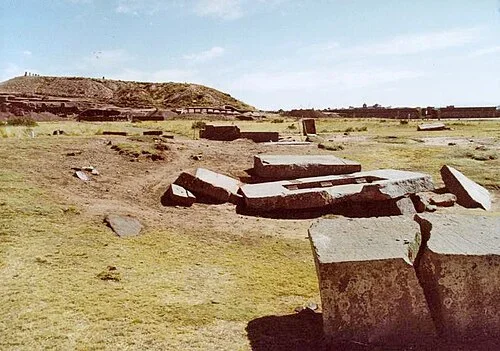 Kantatallita
East of the Kalasasaya lies Kantatallita, a name often translated as Dawn Light. It is one of the quieter corners of the site, and one of the most puzzling. Slabs of finely worked andesite lie here toppled on the ground, some carved with recessed panels and stepped designs. The workmanship is delicate, closer to a workshop's trial pieces than to rough construction. Whether these blocks were part of a finished building that fell, or an experiment never completed, is an open question. Archaeologists have not settled it. Much of the city now lies scattered like this, and no standing building has survived anywhere at Tiwanaku. Only the stone foundations of public structures remain. The low earth mound rising in the distance belongs to Akapana, the great platform pyramid at the heart of the old ceremonial centre.
Listen in the appPhoto: Tiwanaku · CC BY-SA 4.0
07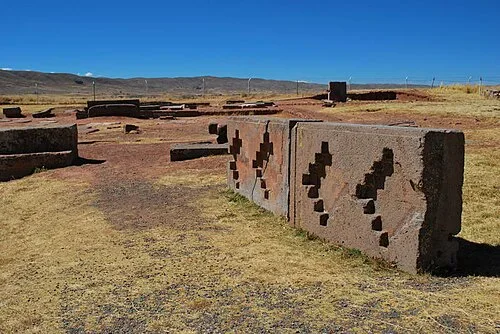 Kantatallita
: Stepped Carvings
The stepped motif carved into this andesite slab is one of the most persistent shapes at Tiwanaku. It repeats on blocks, on gateways, on portable objects, a zigzag profile of steps climbing and descending. The same silhouette appears in the architecture at large, in the terraced sides of the pyramids and the profiles of the platforms. Design and building echo one another. What the steps meant to the people who carved them, no source says plainly, and scholars have not settled on a single reading. What is clear is that it was a shared language. The same vocabulary of steps runs through the sacred imagery of the whole culture, repeated at every scale from a hand-sized carving to a pyramid face.
Listen in the appDiego Tirira from Quito, Ecuador · CC BY-SA 2.0
08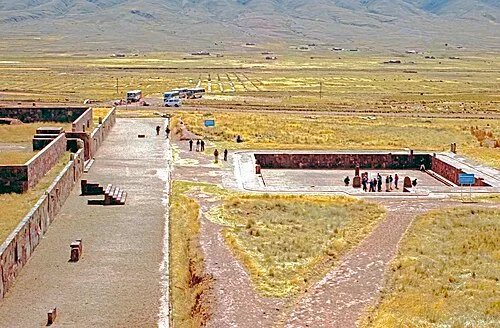 Semi-Subterranean Temple
The Semi-Subterranean Temple drops more than two metres below the surrounding plain. That descent is the point. In Andean thought the world has layers, an upper world of celestial beings, this middle world of the living, and a lower world below. A sunken court brought worshippers down into that lower realm, at a site believed to mark the centre of the world. The court is nearly square, and it breaks the site's own rule. Almost every major structure at Tiwanaku runs east to west. This one is laid out on a north-south axis, unique among the site's buildings. Its walls are built of fifty-seven supporting pillars of red sandstone, with smaller ashlar blocks between them. The many different styles of head set into those walls suggest the court was put to different uses over the course of its long life.
Listen in the appDennis G. Jarvis · CC BY-SA 2.0
09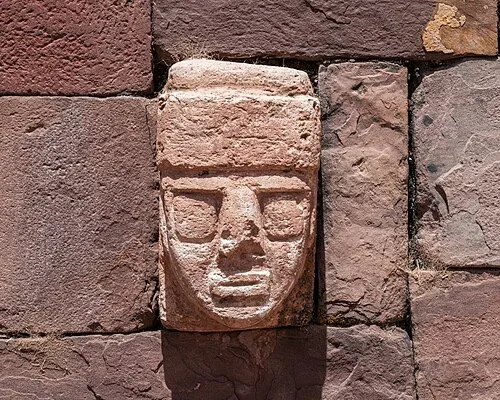 Semi-Subterranean Temple
Tenon Head
The walls of the sunken court are set with stone heads, each one pegged into the masonry on a tenon, projecting outward toward the courtyard below. There are one hundred and seventy-five of them, most worked in limestone. Not one repeats another. The faces differ in shape, in headdress, in the slant of the eyes and the set of the mouth, and their features are read as those of different ethnic groups. The usual interpretation is that they represent the peoples drawn to Tiwanaku from all around the Titicaca basin. The city drew worshippers as a centre of religious ceremonies, and the court gathered its world in stone. Whether any single head portrays a real person, an ancestor, or something taken in war, no one can say for certain.
Listen in the appPhoto: CLAUDIOLD · CC BY-SA 4.0
10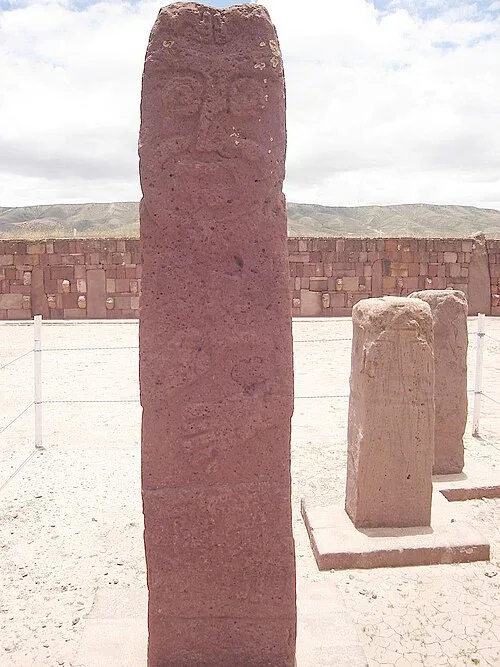 Bearded Monolith
The deep grooves of this figure's face are not only the carver's work. Soft sandstone weathers fast, and this stela is far older than the polished andesite around it. It is known as the Bearded Monolith, stela fifteen, a bearded figure in a long tunic, sometimes called KonTiki Wiracocha, Lord of the Waters. It was found with the giant stela that now carries Bennett's name, and two smaller stelae. The figure belongs to the Middle Formative, centuries before Tiwanaku's own classical age. That is what makes it remarkable. Tiwanaku's elites collected sculptures like this one, gathering the older, sacred stones of earlier cultures to their capital and venerating them there. The city honoured a past deeper than its own. Why its face wears a beard, and who the figure was meant to be, remain unanswered.
Listen in the appAlexson Scheppa Peisino(AlexSP) · Public domain
- 11
Akapana: Terraces and Ritual
Sacrificial offerings buried in the terraces of the great mound, and its possible alignment with the turning Milky Way.
- 12
Akapana Pyramid: The Collapse
The stepped silhouette of Akapana, and the drought around AD 1000 that likely played a role in the civilisation's collapse.
- 13
Kalasasaya Temple
A temple built as a solar instrument, tracking the sun's turning points across the altiplano year.
- 14
Kalasasaya: Walls and Reconstruction
How early travellers saw an American Stonehenge here, and how the walls were rebuilt in the 1960s.
- 15
Ponce Monolith
A three-metre stone figure in the courtyard, read as a portrait of priestly or chiefly power.
- 16
Ponce Monolith: Face and Regalia
A close reading of the Ponce stela's headdress and the textile-like panels carved on its body.
- 17
Monolith of the Frail
A weathered sandstone figure still holding a ritual cup and snuff tablet against its chest.
- 18
Gate of the Sun
The famous carved gateway: a Staff God, rows of winged attendants, and a disputed calendar.
- 19
Gate of the Sun: The Deity and the Move
Who is the figure above the doorway, and why the great gate may not stand where it was made to.
- 20
Putuni Palace Ruins
An elite palace courtyard, and the living city of ten to twenty thousand around it.
- 21
Gate of the Moon
A small, delicately carved portal in the northwest, one of many gateways across the site.
- 22
Pumapunku
The vast platform of Pumapunku, its record-holding stone block, and its ruined, scattered state.
- 23
Pumapunku: The H-Blocks
The H-shaped andesite blocks, their perfect angles, and the geometry behind Tiwanaku's masonry.
- 24
Pumapunku: Clamps and Joints
The T-shaped sockets and channels cut to hold metal clamps, Tiwanaku's hidden joinery.
Tiwanaku
Frequently asked questions
How much does the guide cost?
Free app download. Listed guide price: $3.99. Guide price shown in the app. Audio guide only. Venue admission is separate.
Can I listen without internet?
Yes. Download the guide’s audio, images, and maps in the app before your visit. Your downloaded content is then available offline.
Can I listen in my language?
This audio guide is available in 15 languages, including English.
Do I need to follow a schedule?
No. This is a self-guided experience. Choose your stops, pause whenever you like, and return to a story at your own pace.
At your own pace
Explore Tiwanaku.
Download Stanza, then search for “Tiwanaku”.
Free app download · Guide price shown in the app
Keep exploring
Audio guides — Bolivia
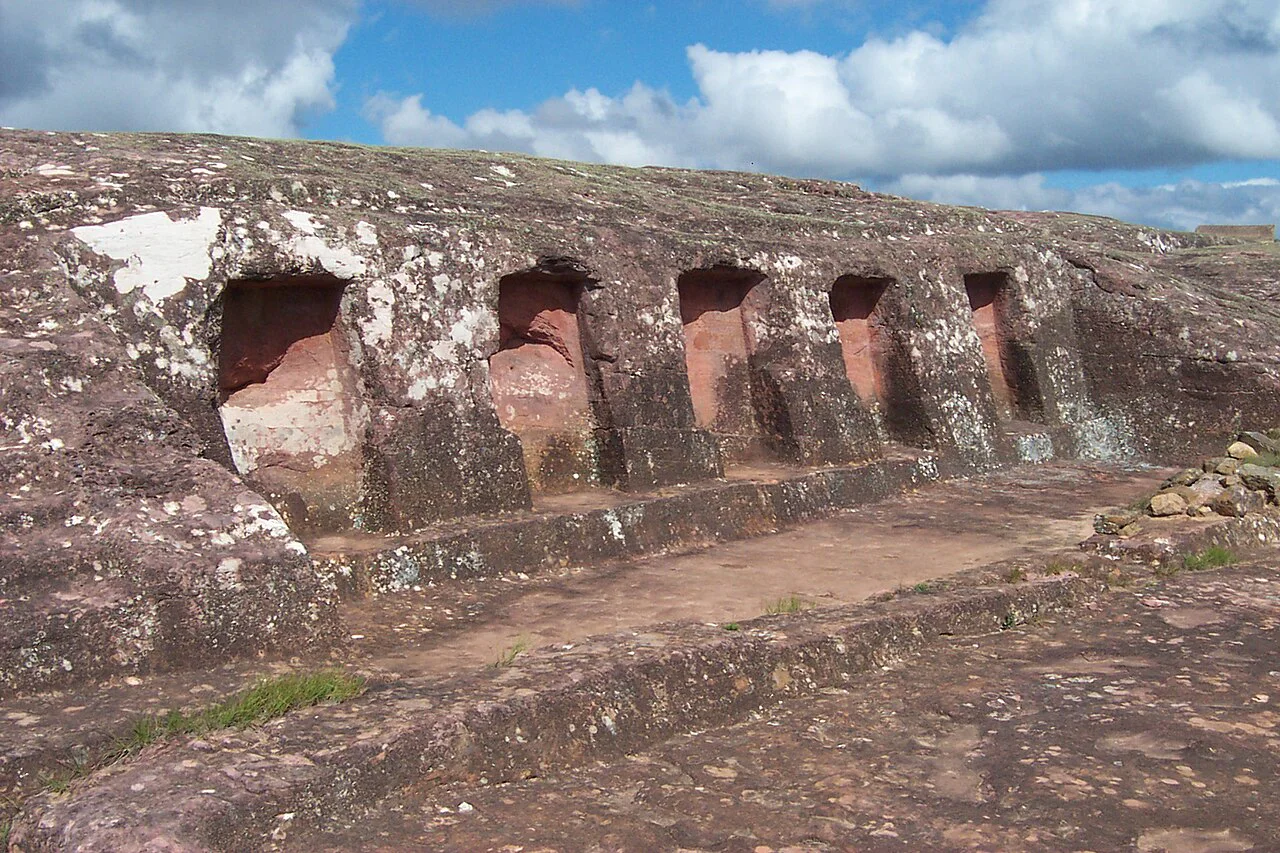
Municipio Samaipata
El Fuerte de Samaipata
Content & sources
Mhwater at Dutch Wikipedia · CC BY-SA 3.0