Stanza · Audio guide
Omar Ali Saifuddien Mosque Audio Guide
A place to remember. A story to take with you.
The Omar Ali Saifuddien Mosque is a mosque located in Bandar Seri Begawan, the capital of Brunei. Completed in 1958, it is considered one of the biggest and most striking mosques in the Far East.
Download Stanza, then search for “Omar Ali Saifuddien Mosque”.
About the tour
One guide. Your kind of visit.
The Omar Ali Saifuddien Mosque is a mosque located in Bandar Seri Begawan, the capital of Brunei. Completed in 1958, it is considered one of the biggest and most striking mosques in the Far East.
Ready when you are.
- 01Get the free Stanza app.
iOS & Android
- 02Find your guide.
“Omar Ali Saifuddien Mosque”
- 03Download before you go.
Works offline
Audio guide / 8 narrated stops
Inside the guide
Get to know a few of the stories before you go. Open a stop to read more.
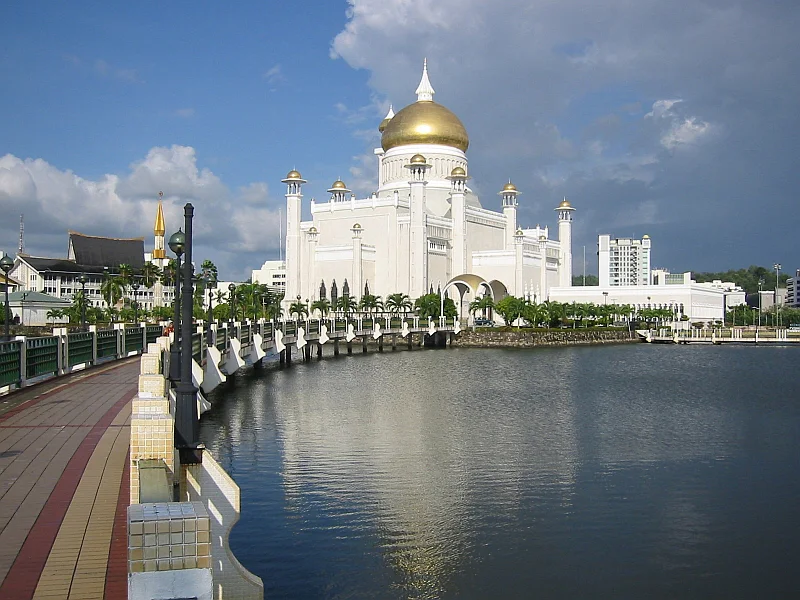
01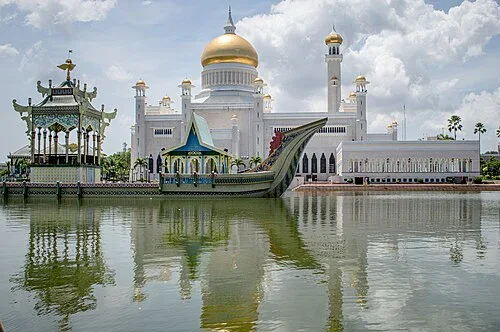 Lagoon Promenade and Water Basin
The Mosque in Its Lagoon
Welcome to the Omar Ali Saifuddien Mosque, the state mosque of Brunei in the capital, Bandar Seri Begawan. It was conceived by Omar Ali Saifuddien the Third, the twenty-eighth Sultan, as a monument to the Islamic faith. The building opened on the twenty-sixth of September, 1958, a date chosen to coincide with the Sultan's birthday celebrations. The project cost five million American dollars, an enormous sum for the country at the time. What makes the setting unusual is the water. The lagoon around the mosque is man-made, an engineered basin dug on purpose. It lets the mosque appear to float, its white walls and gold dome doubled in the still water. That floating look also ties the mosque to the river and the water village beyond it, which is no accident. There is a story behind that choice of site, and it comes next.
Philip Nalangan · CC BY 4.0
02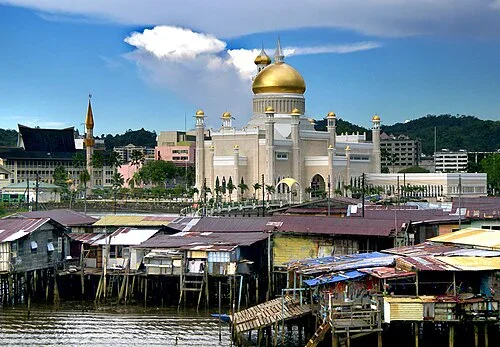 Lagoon Promenade and Water Basin
The Mosque Above Kampong Ayer
The stilt houses in the foreground belong to Kampong Ayer, Brunei's old water village, and the mosque rises just behind them. That closeness was the Sultan's doing. When planning began, a committee formed in 1952 to find a site, chaired by Pengiran Bendahara Pengiran Anak Muhammad Yasin. Its first proposal was Padang Besar, the town's parade ground, already used for large public gatherings. Omar Ali Saifuddien the Third rejected the idea. He asked instead for a spot beside the Brunei River, so that the people of Kampong Ayer would have their house of worship close at hand, within sight and reach by boat. The decision came as the Sultan launched his first National Development Plan, and it fixed the mosque at the water's edge, where the village could look up at it every day.
Bernard Spragg. NZ from Christchurch, New Zealand · Public domain
03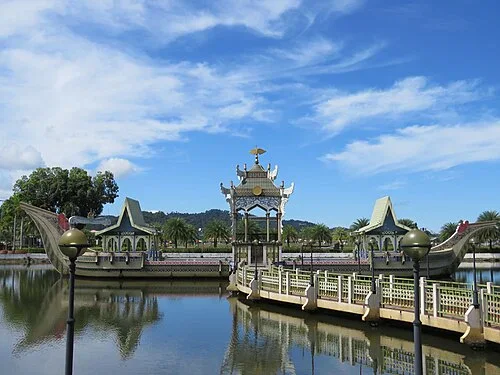 Bahtera Mahligai Royal Barge
The Bahtera Mahligai Stone Barge
Across the lagoon lies a ship that never sails. It is the Bahtera Mahligai, a full-scale concrete replica of a sixteenth-century royal barge said to belong to Sultan Bolkiah. The builders modelled it on the traditional longboats of Borneo's indigenous people, vessels that once served for warfare, memorial services and royal celebrations. It was inaugurated on the eighteenth of December, 1967, timed to mark the fourteen-hundredth anniversary of Nuzul Al-Quran, the revelation of the Quran. The bill came to half a million Brunei dollars. Since then the barge has stayed moored in the lagoon, and it still works as a stage. National competitions of Tilawah, the art of Quran recitation, are performed on its deck. Its decoration carries its own story, told at the next stop.
Listen in the appPhoto: Calistemon · CC BY-SA 4.0
04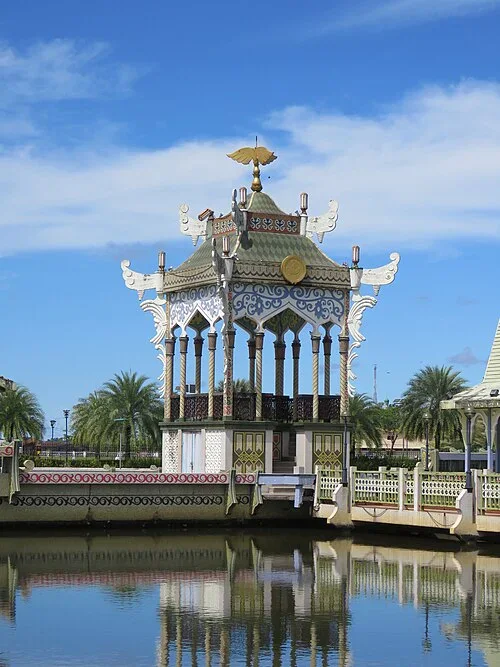 Bahtera Mahligai Royal Barge
Reading the Barge's Ornament
The barge speaks in the old language of Brunei's royal boats. Its bow and stern are shaped like birds, and the roof of the central pavilion rises in a pyramid. The pavilion is a hypostyle hall, its roof held up by rows of columns, open on every side. Over the whole structure runs floral and vegetal ornament drawn from Bruneian textile weaving and royal regalia, the same patterns that adorn court dress and ceremonial cloth. Even the lagoon joins in. The edges of the water basin are ridged in a pattern that mimics the kelasak, an ancient shield. And at the very top of the main pavilion sits a finial bearing the royal emblem of Sultan Sharif Ali. The whole vessel is a floating bridge to Brunei's maritime royal past.
Listen in the appPhoto: Calistemon · CC BY-SA 4.0
05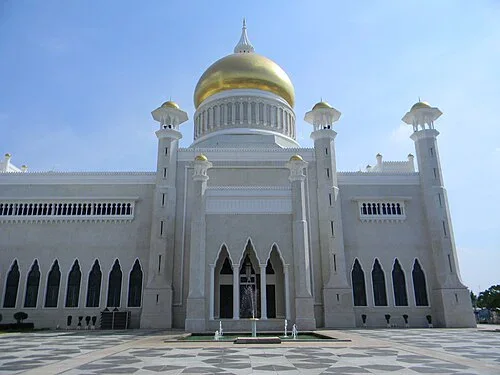 Outer Courtyard and the Golden Dome
Courtyard, Fountain and the Mughal-Bruneian Synthesis
The mosque's general style is Mughal, the imperial architecture of India, with its domes and pointed arches. But the detail is Bruneian, and the blending was deliberate. The Sultan himself supplied the first concepts for the design, which a draughtsman named Haji Besar bin Sagap put down on paper. The Italian artist and architect Rudolfo Nolli then shaped the building's elements, including its most distinctive motif: a thick rope, called kalat, carved around the pillars. That pattern echoes the columns of the Lapau, Brunei's royal ceremonial hall. In the courtyard, a square fountain pool is tiled in green and yellow in a songket weave pattern, like the prized handwoven cloth of the court. The luxury runs through every surface: Italian marble on floors and columns, Shanghai granite, English chandeliers and stained glass.
Listen in the appLucas Migliorelli · CC BY 3.0
06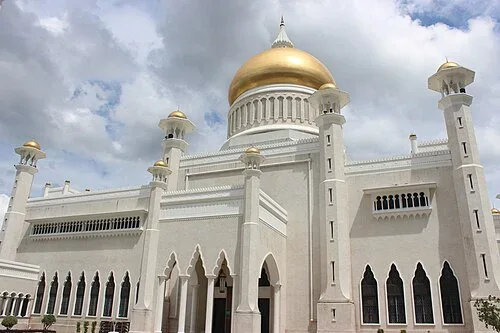 Outer Courtyard and the Golden Dome
The Golden Dome
The dome is the landmark of the whole country, dominating the skyline of Bandar Seri Begawan. It rises fifty-two metres above the cream-coloured building, and the prayer hall sits directly beneath it. Its curved surface is clad in a mosaic of more than three million pieces of Venetian glass, fitted together in shimmering bands. There is also a tale about gold. The writer Anthony Burgess recorded in his memoirs that the dome was coated in gold leaf, and that it flaked away as the building expanded and contracted with the heat. The story goes that fishermen from the water village, seeing the flakes glinting on the water, took the gold for a gift from Allah. That is Burgess's account rather than a settled fact, but it has travelled with the dome ever since.
Listen in the appPhoto: Uhooep · CC BY-SA 4.0
07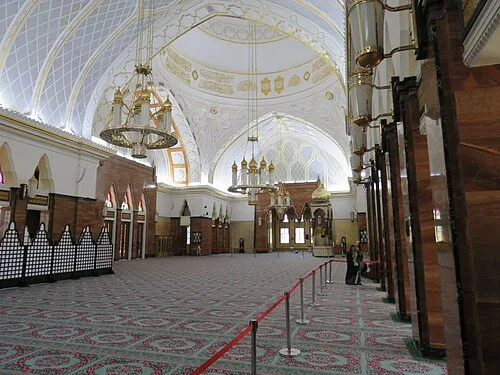 The Grand Prayer Hall
Inside the Prayer Hall
The great hall beneath the dome can hold three thousand worshippers at prayer. They enter through copper doors into a space dressed in Arabic calligraphy, trefoil arches and passages from the Quran, and walk on handcrafted carpets from Saudi Arabia and Belgium. Overhead hangs the central chandelier, an English piece nearly five metres across and weighing more than three tonnes. At the far end of the hall stands the mihrab, gilded and set with floral designs. It marks the qibla, the direction of Mecca, and it is there that the imam leads the assembly. Beside it rises the mimbar, the pulpit for sermons, which the Sultan designed himself. It has two levels: the caller to prayer uses the first step, the imam the upper one. This hall has held the country's great moments. At midnight on the thirty-first of December, 1983, thousands filled it for the mass thanksgiving prayer on the declaration of independence.
Listen in the appPhoto: Calistemon · CC BY-SA 4.0
08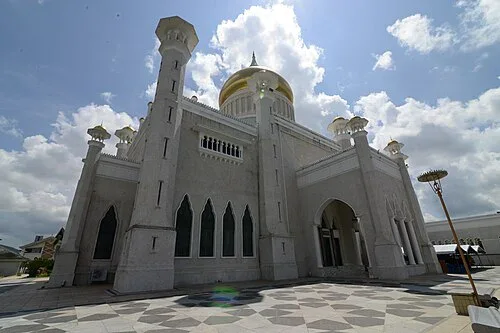 The Great Minaret and Foundations
The Main Minaret and What the Mosque Means
Five minarets rise from the mosque, and together they represent the five pillars of Islam, amplifying the call to prayer across the city. The main one climbs to fifty-one metres, the tallest minaret in the nation, and an elevator was built into it from the start, a rare thing in the nineteen-fifties. The engineering below is just as serious. The construction used fourteen hundred tonnes of concrete and six hundred and forty tonnes of steel. Its foundation piles reach down between twenty-four and thirty-seven metres, anchored deep beneath the soft ground by the river. That depth is fitting. The mosque was conceived by one Sultan as a statement of faith, craftsmanship and national identity, and it represents a bridge between Brunei's past and its present, raised at the water's edge for all his people to see.
Listen in the appJorge Láscar from Melbourne, Australia · CC BY 2.0
Omar Ali Saifuddien Mosque
Frequently asked questions
How much does the guide cost?
Free app download. Listed guide price: $0.99. Guide price shown in the app. Audio guide only. Venue admission is separate.
Can I listen without internet?
Yes. Download the guide’s audio, images, and maps in the app before your visit. Your downloaded content is then available offline.
Can I listen in my language?
This audio guide is available in 15 languages, including English.
Do I need to follow a schedule?
No. This is a self-guided experience. Choose your stops, pause whenever you like, and return to a story at your own pace.
At your own pace
Explore Omar Ali Saifuddien Mosque.
Download Stanza, then search for “Omar Ali Saifuddien Mosque”.
Free app download · Guide price shown in the app