Stanza · Audio guide
Anakena Audio Guide
A place to remember. A story to take with you.
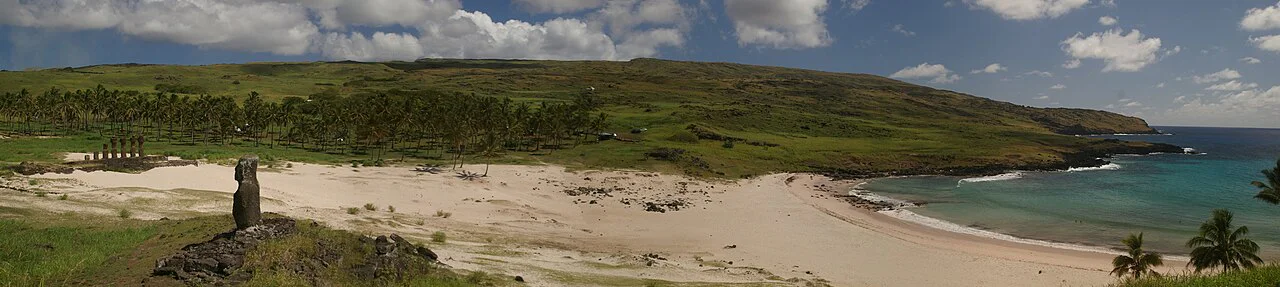
Anakena is a white coral sand beach located in Rapa Nui National Park on the island of Rapa Nui. The site is significant for its two ahus, which feature ancient moai statues.
Download Stanza, then search for “Anakena”.
About the tour
One guide. Your kind of visit.
Anakena is a white coral sand beach located in Rapa Nui National Park on the island of Rapa Nui. The site is significant for its two ahus, which feature ancient moai statues.
Ready when you are.
- 01Get the free Stanza app.
iOS & Android
- 02Find your guide.
“Anakena”
- 03Download before you go.
Works offline
Audio guide / 7 narrated stops
Inside the guide
Get to know a few of the stories before you go. Open a stop to read more.
01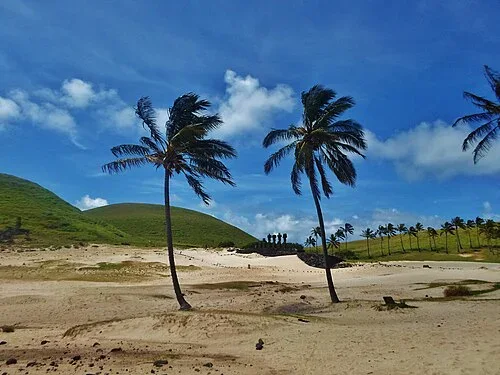 The Coconut Palm Grove and Arrival
Arrival at Anakena: Palm Grove and Shore
Welcome to Anakena, on the north coast of Rapa Nui, the island many people know as Easter Island. This is one of only two sandy beaches on the whole island, in a coastline that is otherwise black volcanic rock. The sand is white coral, ground down by the sea, and it shines against water that turns pale turquoise in the shallows. Tall coconut palms lean over the dunes, bent by the trade winds. Behind the beach rise two smooth green hills, old volcanic slopes clothed in grass. This is Rapa Nui National Park, and the beach is more than a place to swim. It was a landing bay and a chief's residence, and it holds two restored stone altars, called ahus, where the famous moai statues stand. People have been here a very long time. Archaeologists have found traces of settlement at Anakena from as early as 1200 CE. Language and other evidence suggest the first settlement of Rapa Nui itself happened anywhere between 300 and 1200 CE, and Anakena was among the earliest places. Few corners of the Pacific carry so much story into so small a bay.
Claire Provost · CC BY-SA 3.0
02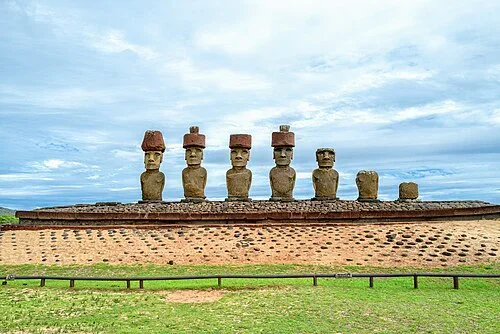 Ahu Nao-Nao Ceremonial Platform
Ahu Nau Nau
Seven moai stand in a row on the great stone altar of Ahu Nau Nau, the finest monument at Anakena. Two of the seven have suffered badly over the centuries, their features worn away by rain and time. The other five still show the long ears, the deep eye sockets and the proud brows the carvers gave them. Look at their heads and you will see red stone crowns, the topknots called pukao. Each one is carved from red scoria, a light, porous volcanic rock that comes from a quarry far inland, not from the coast. The largest of these topknots weigh several tons apiece. Somehow people moved them across the island and raised them onto heads standing several metres above the ground. Nobody has left a record of exactly how they did it, and the precise dates of the altar's building are unknown. What is certain is the care: both of Anakena's ahus have been restored in modern times, and this row of seven is the result.
Otávio Nogueira from Fortaleza, BR · CC BY 2.0
03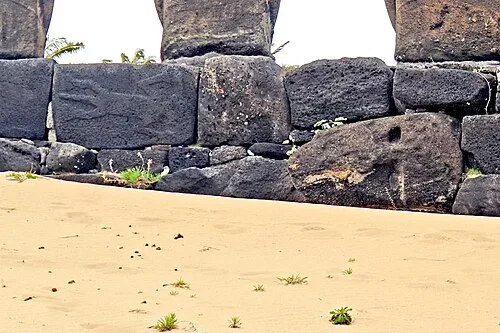 Ahu Nao-Nao Ceremonial Platform
Behind the Altar: Ahu Stonework and Ceremony
Behind the statues, the altar itself is a wall of enormous fitted stones, set together with astonishing skill. The blocks meet along clean, tight joints, without mortar, and the whole platform rises in sloped terraces above the sand. An ahu was built as a ceremonial stage. The moai stood with their backs to the sea, facing inland, so that they looked out over the people gathered before them. Ceremonies, offerings and gatherings all happened on the flat ground in front of the platform. Anakena was also a place of the spoken word. This beach later served as a ceremonial centre where islanders read aloud from Rongorongo boards, the wooden tablets incised with the island's mysterious script. The reading of those boards was a performance of knowledge, handed down and recited for an audience. Only a handful of the tablets survive anywhere in the world today, and their script has never been fully deciphered.
Listen in the appDennis G. Jarvis · CC BY-SA 2.0
04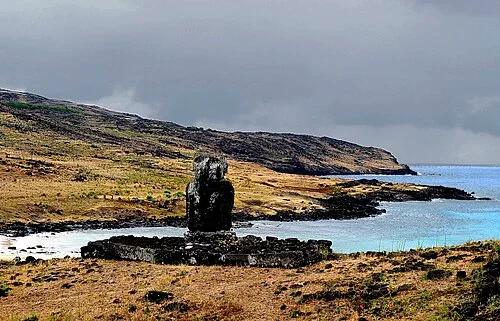 Ahu Ature Huki and the First Restoration
Ahu Ature Huki
A single moai stands alone on a low platform at the edge of the bay, with the headland and the open ocean behind it. This is Ahu Ature Huki, and its story belongs to the modern age. Anakena has drawn archaeologists for over a century. Katherine Routledge, an English explorer, came here to dig in 1914, recording what she could of the monuments and their fallen statues. Decades later, in the 1950s, two more expeditions arrived: the American William Mulloy and the Norwegian Thor Heyerdahl. Their work led to the restoration of both of Anakena's ahus. The moai that had lain face down in the sand, toppled in some earlier upheaval, were lifted and set upright on their platforms again. That is why the figures at Anakena stand as they do today, rather than lying where they fell.
Listen in the appPhoto: LBM1948 · CC BY-SA 4.0
05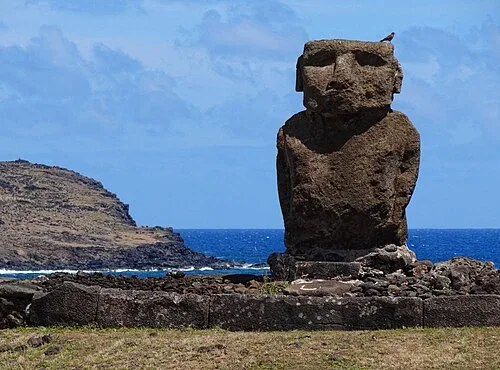 Ahu Ature Huki and the First Restoration
The Solitary Moai and the Seabird
There is often a seabird perched on the head of this solitary moai, and the sight suits the place better than it might seem. Anakena plays a part in the Tangata Manu, the Birdman cult, the great ritual competition of late Rapa Nui life. Each year, competitors swam out to risky islets offshore to retrieve the first egg of the season, and the winner's sponsor became the new Birdman, a sacred champion for the year ahead. The new Birdman came from one of the island's clans, and the celebrations that followed moved across the island. In years when he came from the western clans, his celebrations ended here, at Anakena. The bird at the centre of it all was the kena, the masked booby, a white sea bird that still nests on the island today. It holds a firm place in the local spiritual and natural landscape, and its name reaches further into this beach's story than you might expect.
Listen in the appBjørn Christian Tørrissen · CC BY-SA 3.0
06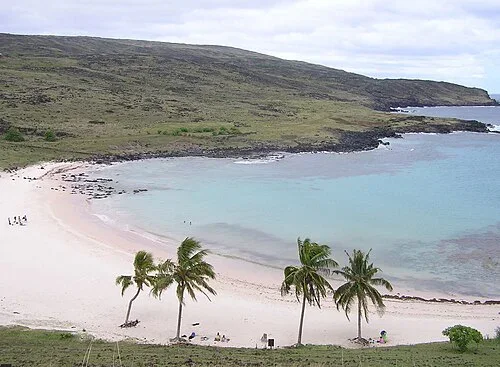 Anakena Bay and Hotu Matu'a's Landing
Hotu Matu'a's Landing Bay
This crescent of sand sits inside a sheltered bay, the kind of landing a voyaging canoe would seek out after weeks at sea. And this, according to the island's oral tradition, is exactly where it happened. The story tells of Hotu Matu'a, a Polynesian chief who led a settlement party of two canoes across the ocean and made landfall here. He founded the first settlement on Rapa Nui, and from this beach the story of the island's people begins. Oral tradition places his arrival here around the eighth century. Archaeology, as heard earlier, finds traces of settlement at Anakena from 1200 CE, so the two accounts do not agree, and the legend is memory rather than excavation. The bay itself carries the honour of the story. It was known as Hanga Rau Ariki, Kings Bay, named for the first founder. Where exactly within the bay his canoes are said to have come ashore, the tradition does not say.
Listen in the appOtávio Nogueira from Fortaleza, BR · CC BY 2.0
07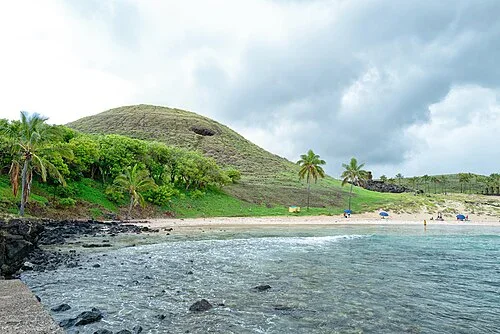 Anakena Bay and Hotu Matu'a's Landing
The Cave of the Booby: Closing the Story
The name everyone uses for this beach, Anakena, may not be its original one at all. In the Rapa Nui language, ana means cave, and kena is the masked booby. So Anakena could mean the cave of the kena, named for a cave near the shore where tradition says Hotu Matu'a stayed while a house was being built for him. The true name of the beach and its small bay is said to be Hanga Mori o One. The old names survive, and the bay keeps drawing storytellers. In 1994 the beach appeared in Rapa Nui, a Hollywood film about the island's past, shot here among the palms and the statues. From the landing of the first canoes to the cinema camera, this small bay has been the image people reach for when they picture the island.
Listen in the appOtávio Nogueira from Fortaleza, BR · CC BY 2.0
Anakena
Frequently asked questions
How much does the guide cost?
Free app download. Listed guide price: $0.99. Guide price shown in the app. Audio guide only. Venue admission is separate.
Can I listen without internet?
Yes. Download the guide’s audio, images, and maps in the app before your visit. Your downloaded content is then available offline.
Can I listen in my language?
This audio guide is available in 15 languages, including English.
Do I need to follow a schedule?
No. This is a self-guided experience. Choose your stops, pause whenever you like, and return to a story at your own pace.
At your own pace
Explore Anakena.
Download Stanza, then search for “Anakena”.
Free app download · Guide price shown in the app