Stanza · Audio guide
Hallgrímskirkja Audio Guide
A place to remember. A story to take with you.
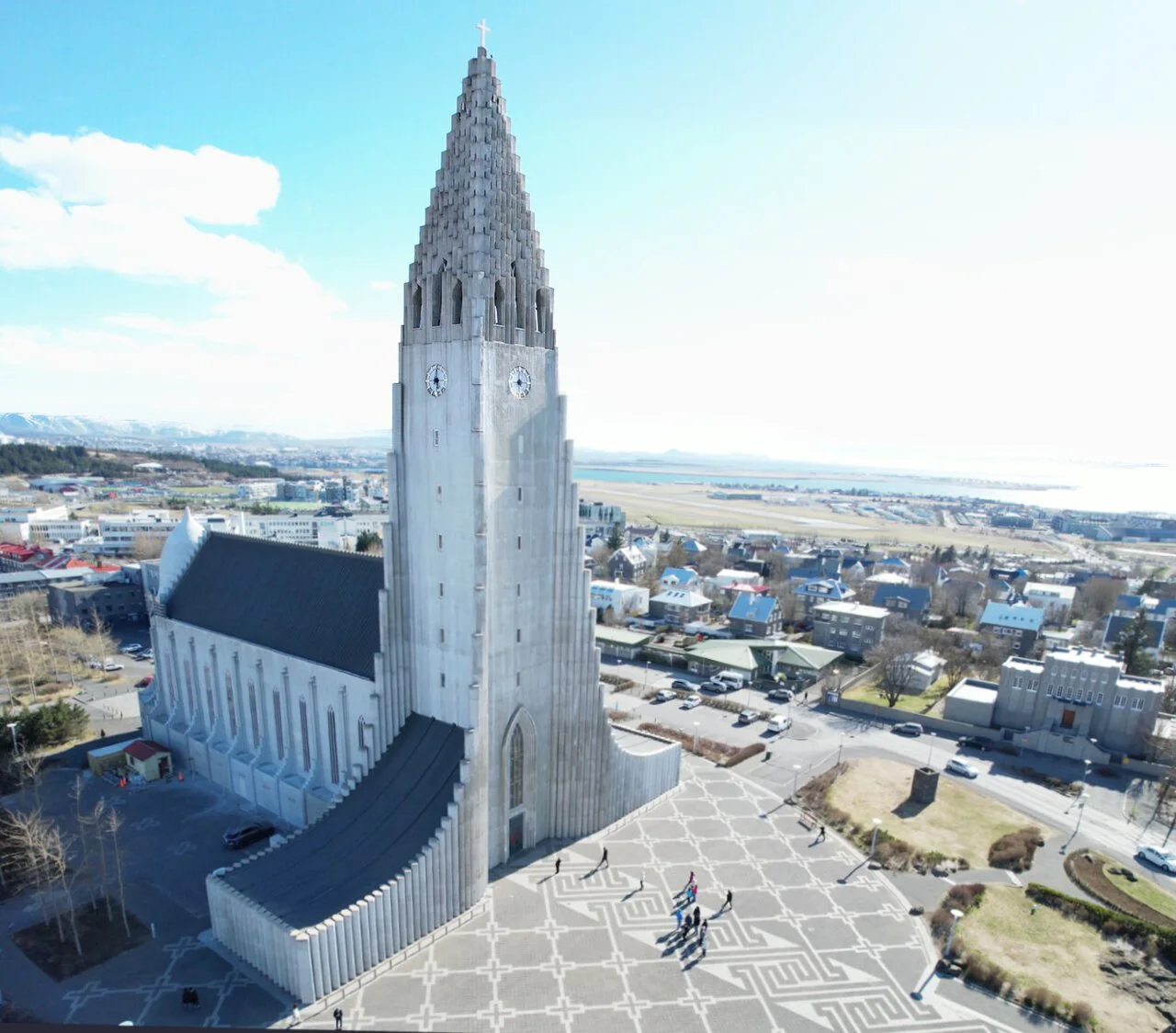
Hallgrímskirkja is a Protestant Lutheran parish church in Reykjavík, Iceland. It is the largest church in Iceland and serves as an important symbol for the country's national identity.
Download Stanza, then search for “Hallgrímskirkja”.
About the tour
One guide. Your kind of visit.
Hallgrímskirkja is a Protestant Lutheran parish church in Reykjavík, Iceland. It is the largest church in Iceland and serves as an important symbol for the country's national identity.
Ready when you are.
- 01Get the free Stanza app.
iOS & Android
- 02Find your guide.
“Hallgrímskirkja”
- 03Download before you go.
Works offline
Audio guide / 8 narrated stops
Inside the guide
Get to know a few of the stories before you go. Open a stop to read more.
01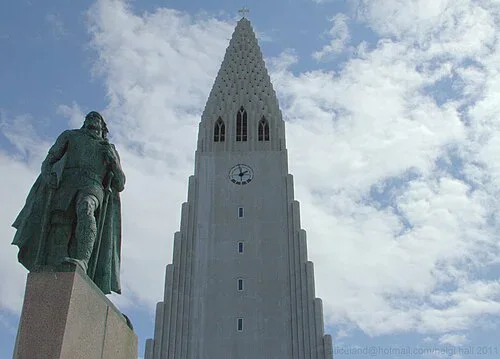 Skólavörðuholt Plaza and Leif Erikson Monument
Leif Erikson Statue
Welcome to Hallgrímskirkja, the great church on Skólavörðuholt hill in the heart of Reykjavík. Before the church itself, there was this statue. Leif Erikson, the Norse explorer, stands in bronze on his stone pedestal, cloak about his shoulders. The American sculptor Alexander Stirling Calder made him. The United States gave the statue for the 1930 Althing Millennial Festival. That festival marked a thousand years since Iceland's parliament first convened at Þingvellir, in the year 930. The statue arrived fifteen years before the church broke ground. So the church rose on ground already charged with national meaning. Behind the statue, its grey tower climbs into the sky, the largest church in Iceland and a symbol of the country's identity.
Helgi Halldórsson from Reykjavík, Iceland · CC BY-SA 2.0
02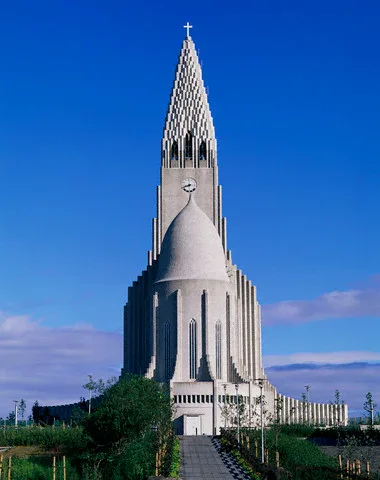 Basalt-Inspired Expressionist Façade
The Basalt-Inspired Facade
The facade of this church is one of the most unusual in Europe. The state architect Guðjón Samúelsson received the commission in 1937. He is said to have shaped the building after Iceland's own landscape: trap rocks, mountains and glaciers, and especially the columnar basalt formations that rise like organ pipes at waterfalls such as Svartifoss. The stepped concrete wings climbing toward the tower echo those stone columns. Style experts call the design Expressionist, a rejection of traditional church architecture in favor of something dynamic and sculptural. A likely influence was Grundtvig's Church in Copenhagen, finished in 1940, which has a similar organ-like shape. The Kirche am Hohenzollernplatz in Berlin may also have played a part. And there was rivalry in the design. The church was first meant to be shorter, but the leaders of the Church of Iceland wanted a spire to outshine Landakotskirkja, the Catholic cathedral across the city.
Photo: Pitersongm · CC BY-SA 3.0
03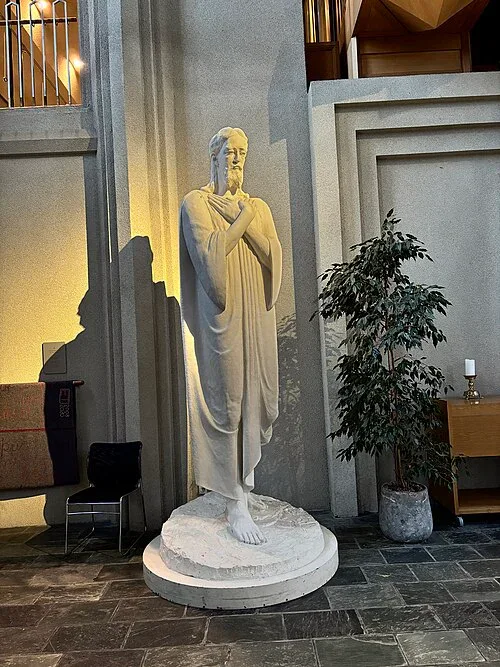 Narthex and Einar Jónsson's Christ
Einar Jónsson's Christ
Beside the entrance to the nave stands a tall white figure of Christ. His arms are crossed over his chest, his gaze turned upward, one foot bare on the rock at his feet. The Icelandic sculptor Einar Jónsson, a pioneer of his art in this country, donated the statue to the church in 1948. It shows Jesus receiving the Holy Spirit after his baptism in the Jordan. The gift is a quiet reminder that this building is no monument only. Hallgrímskirkja is an active parish church of the Church of Iceland, a Lutheran congregation that gathers here week by week.
Listen in the appPhoto: Manuelarosi · CC BY-SA 4.0
04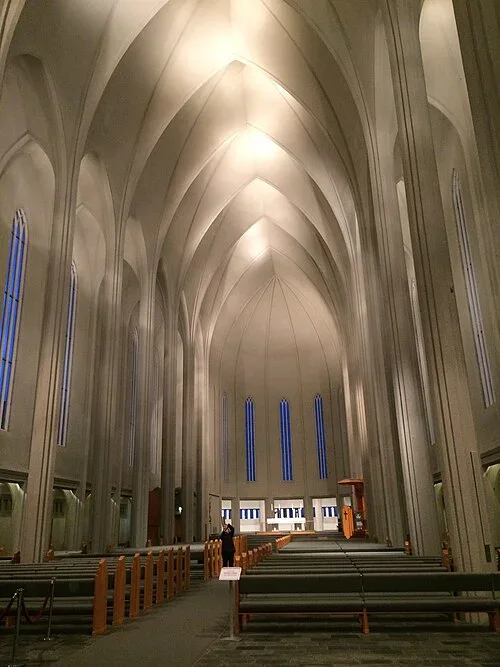 The Nave and Soaring Concrete Vaults
The Nave and Concrete Vaults
The nave is vast, about sixteen hundred square metres of floor beneath soaring vaults. The ribs overhead are concrete, shaped in a Neo-Gothic style, though the material is modern. The whole church took forty-one years to build. Construction began in 1945 and advanced in phases, as money allowed. The crypt beneath the choir was consecrated in 1948. The steeple and the side wings were finished in 1974. Only then came the nave, consecrated on the twenty-sixth of October, 1986. Not everyone approved along the way. Critics of the day called the design too old-fashioned, and a blend of different architectural styles. The space they doubted is now the heart of the building.
Listen in the appPhoto: Kallerna · CC BY-SA 3.0
05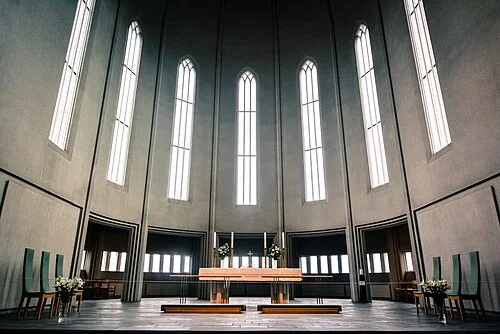 Eastern Chancel and Cylindrical Sanctuary
The Cylindrical Sanctuary
Architecturally, the church falls into three parts. There is the tower with its curved side wings, the more traditional nave, and at the far end, the sanctuary. That eastern room is cylindrical, its walls curving around the altar, with narrow lancet windows drawing the eye upward. Some have described its rounded shape as evoking a Viking war helmet. That is an interpreter's comparison rather than the architect's stated plan, but it suits the place. This is where worship happens, at the altar beneath the tall windows. It is the reason the whole structure exists.
Listen in the appKoushik C koushikc · CC0
06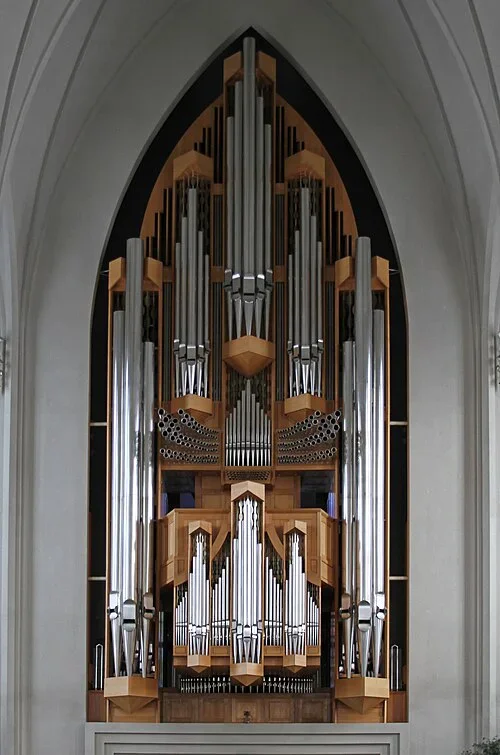 Organ Loft and the Grand Klais Organ
The Grand Klais Organ
The great organ fills the arched opening above the nave like a wall of silver. Getting there took some doing. A Rieger-Kloss organ was installed in 1946, and later moved to the South Wing when a new one was built. The next instrument came from the Danish firm Frobenius in 1985. Soon after, in 1988, the church council decided it simply was not big enough. They commissioned another from Johannes Klais of Bonn in Germany. His finished instrument stands fifteen metres tall and weighs about twenty-five metric tons. It holds five thousand two hundred and seventy-five pipes, played from a console of four manuals and pedals, connected by electric action. Construction was completed in December 1992.
Listen in the appTony Hisgett from Birmingham, UK · CC BY 2.0
07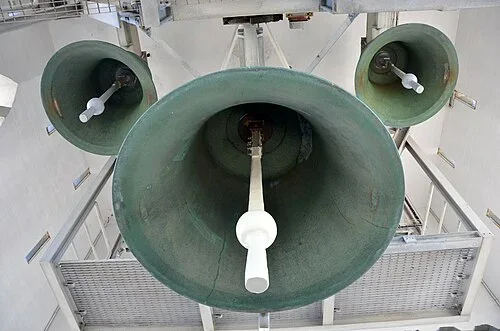 Tower Belfry and Musical Carillon
The Carillon Bells
High in the tower hang the green bells, three of them larger than the rest. The church takes its name from Hallgrímur Pétursson, a poet and cleric who lived from 1614 to 1674. His Passion Hymns remain central to Iceland's spiritual and literary life. The three largest bells carry family names: Hallgrímur for the poet himself, Guðríður for his wife, and Steinunn for their daughter. Together with the others they form a carillon of twenty-nine bells, an instrument played from a keyboard rather than swung. On weekdays the bells ring every fifteen minutes from nine in the morning until nine at night. On weekends and holidays they begin at noon. The largest bell, Hallgrímur, also sounds on the hour.
Listen in the appPhoto: Olga Ernst · CC BY-SA 4.0
08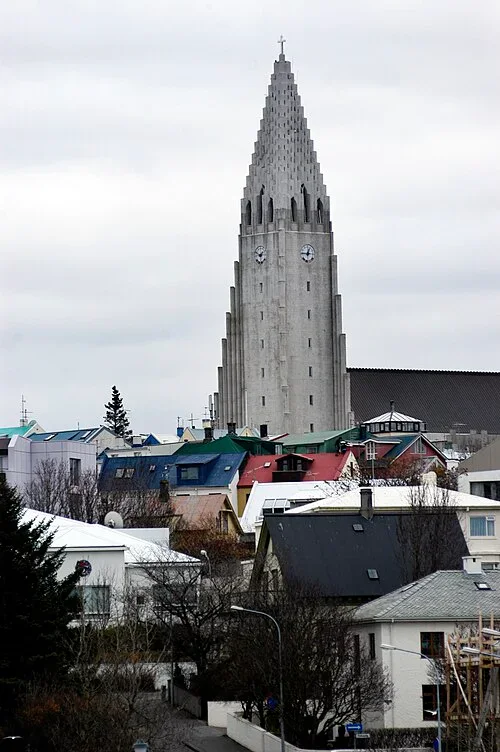 Tower Observation Deck and City Vista
Tower Observation Deck
The tower rises seventy-four and a half metres, making this the largest church in Iceland and the second tallest building in the country. A lift carries visitors up to the viewing deck, with views over Reykjavík and the surrounding mountains. From the top, the city spreads out in every direction, its colorful rooftops and the bay beyond. The church is visible from throughout the city, a landmark by day and night. That prominence is exactly what the enlarged spire was meant to secure.
Listen in the appJohannes Jansson · CC BY 2.5 dk
Hallgrímskirkja
Frequently asked questions
How much does the guide cost?
Free app download. Listed guide price: $0.99. Guide price shown in the app. Audio guide only. Venue admission is separate.
Can I listen without internet?
Yes. Download the guide’s audio, images, and maps in the app before your visit. Your downloaded content is then available offline.
Can I listen in my language?
This audio guide is available in 15 languages, including English.
Do I need to follow a schedule?
No. This is a self-guided experience. Choose your stops, pause whenever you like, and return to a story at your own pace.
At your own pace
Explore Hallgrímskirkja.
Download Stanza, then search for “Hallgrímskirkja”.
Free app download · Guide price shown in the app