Stanza · Audio guide
Grand Mosque of Kuwait Audio Guide
A place to remember. A story to take with you.
The Grand Mosque is the largest mosque in Kuwait. It is located in Kuwait City and features a main prayer hall with teakwood doors and 144 windows.
Download Stanza, then search for “Grand Mosque of Kuwait”.
About the tour
One guide. Your kind of visit.
The Grand Mosque is the largest mosque in Kuwait. It is located in Kuwait City and features a main prayer hall with teakwood doors and 144 windows.
Ready when you are.
- 01Get the free Stanza app.
iOS & Android
- 02Find your guide.
“Grand Mosque of Kuwait”
- 03Download before you go.
Works offline
Audio guide / 11 narrated stops
Inside the guide
Get to know a few of the stories before you go. Open a stop to read more.
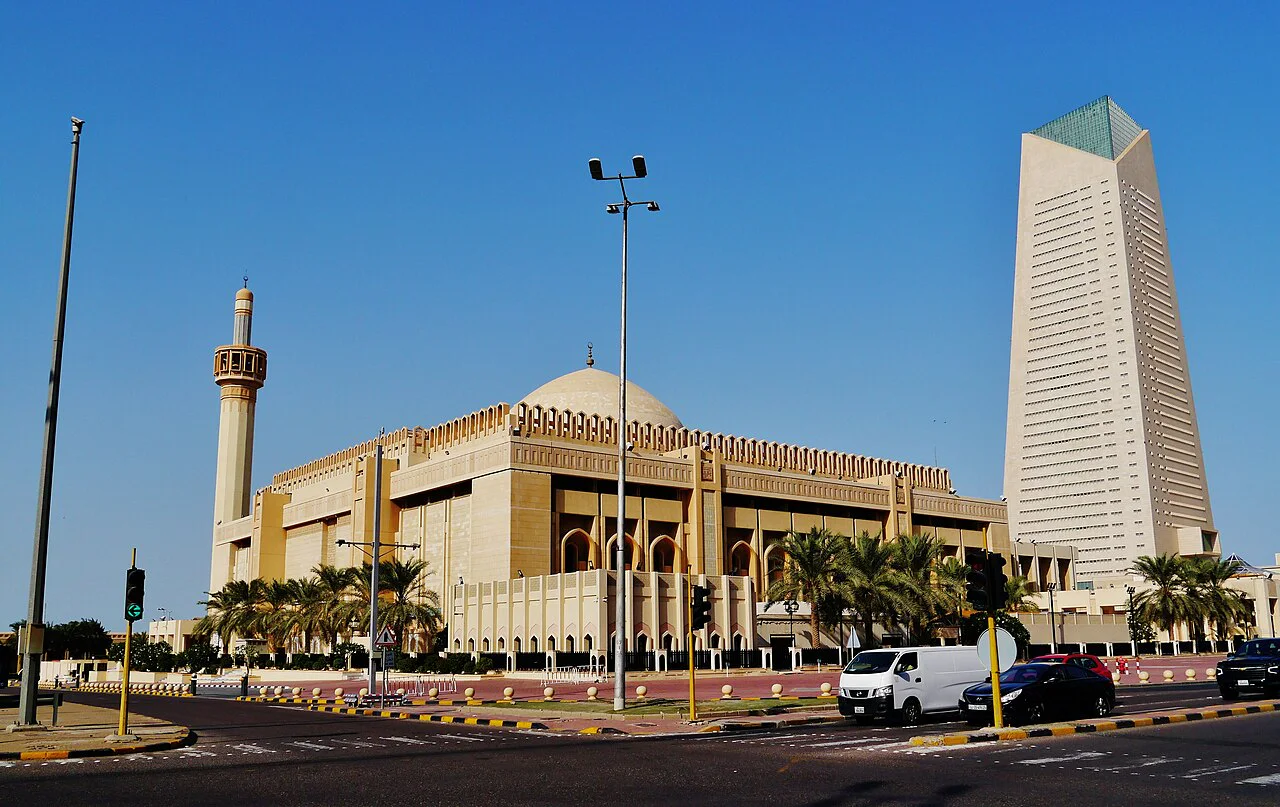
01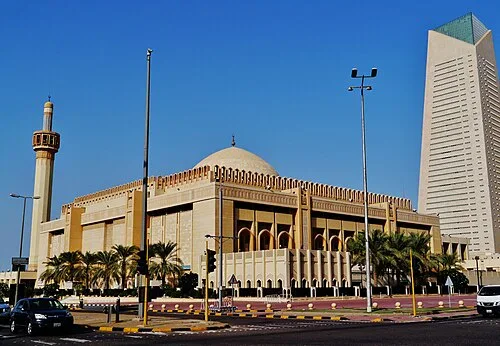 Main Courtyard and the Andalusian Minaret
The Grand Mosque of Kuwait: A State Mosque for a Modern Nation
Welcome to the Grand Mosque of Kuwait, the largest mosque in the country and its official State Mosque. This tour follows it from the courtyard through the great doors, into the prayer hall, and up into the dome. Construction began in 1979, and the mosque was finished in 1986. It opened on Eid ul-Fitr, the feast that ends the fasting month, in the year 1407 of the Islamic calendar. The opening came at the request of the Amir, Sheikh Jaber Al-Ahmad Al-Sabah. The design was the work of the Iraqi architect Mohamed Saleh Makiya. The grounds cover about 45,000 square metres, and the mosque stands among the towers of Kuwait City by the shore of the Gulf. A state as young as Kuwait wanted a house of prayer that could speak for the whole nation, and this was its answer.
Photo: Zairon · CC BY 4.0
02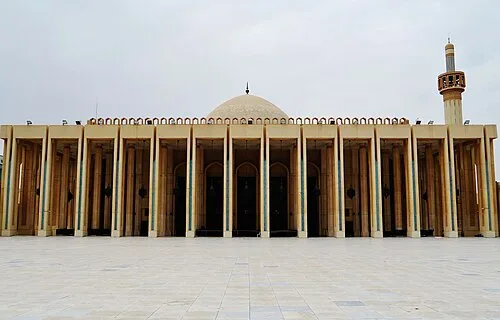 Main Courtyard and the Andalusian Minaret
The Grand Courtyard and the Andalusian Minaret
One minaret rises from the northwest corner of the mosque, seventy-four metres tall. It is built in the Andalusian style, the square-towered manner of the great mosques of Spain and North Africa. In a modern Gulf mosque, that shape is a deliberate homage to an older Islamic world. The tower carries no bells. Instead, the call to prayer sounds from loudspeakers at its top, as in mosques everywhere today. The courtyard below is the mosque's largest gathering space, paved in pale marble and ringed by arcades. On the twenty-seventh night of Ramadan, the night known as Laylat al-Qadr, it fills to capacity. Worshippers pack the courtyards and the halls for the night prayers, about 170,000 people in all. For one night each year, the whole mosque is full.
Photo: Zairon · CC BY 4.0
03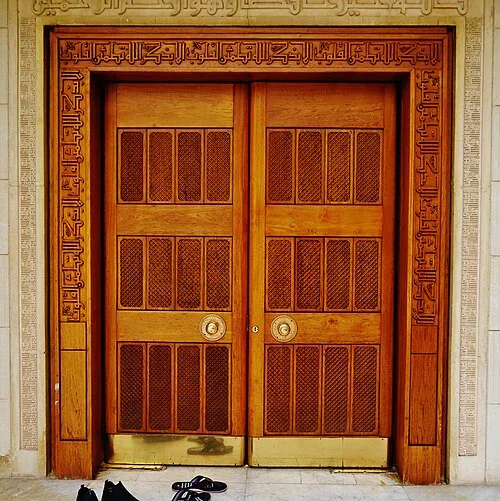 Outer Arcades and Teakwood Portals
Teakwood Doors and the Visitor's Threshold
The entrance doors are teak, thick and hand-carved, set in a frame carved with Arabic lettering. Visitors reach them through the eastern courtyard, coming in from Gulf Street along marble arcades. The carved script is no decoration chosen at random. It belongs to a single programme of writing that runs through the whole mosque, all from the hand of one calligrapher. Before the doors, the customs of the threshold take over. Shoes come off at the step, left neatly at the entrance, because the floors inside are covered with prayer rugs. Modest dress is expected, and the visitor office keeps robes ready for anyone who arrives without. It works less like a rule and more like hospitality, a threshold that prepares every guest the same way before the hall beyond.
Listen in the appPhoto: Zairon · CC BY 4.0
04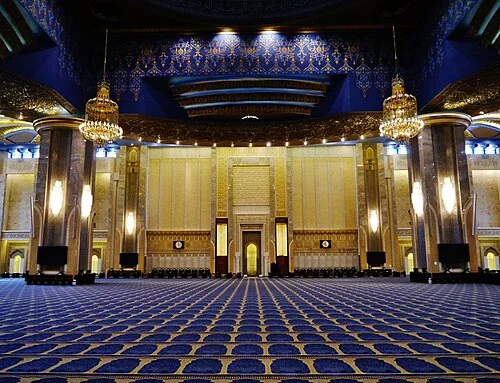 The Main Prayer Hall and Mihrab
The Main Prayer Hall
The main prayer hall is a perfect square, seventy-two metres on every side. Its floor is one continuous carpet, laid out in rows for worship, and great columns carry the roof high overhead. On ordinary days the space feels empty beyond belief. It was built for fullness. This is where the congregation gathers for Friday prayers, for the two Eid prayers, and for the major religious occasions of the year. Up to 10,000 men can pray here at once. A separate hall serves the women of the congregation, holding up to 950. Together the two halls were planned for exactly the crowds that fill them on the high days of the Islamic year.
Listen in the appPhoto: Zairon · CC BY 4.0
05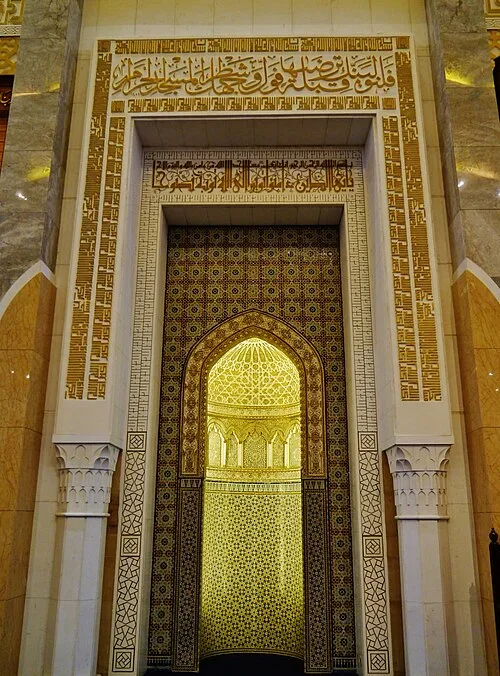 The Main Prayer Hall and Mihrab
The Mihrab: Facing Mecca
Every mosque in the world is built around one direction, called the qibla, the way toward Mecca. The niche that marks it is the mihrab, and this one glows in gold against the pale marble of the wall. When the imam leads the congregation, he stands facing this niche, and the whole hall prays behind him in one direction. The hood above the niche steps inward in tiers, a honeycomb of small carved cells. Its surface is dense with geometric pattern, and bands of gold lettering run above the arch. That lettering belongs to the same script programme as the carved doors, the work of a single calligrapher. The gilding itself is unsigned, but the effect needs no signature.
Listen in the appPhoto: Zairon · CC BY 4.0
06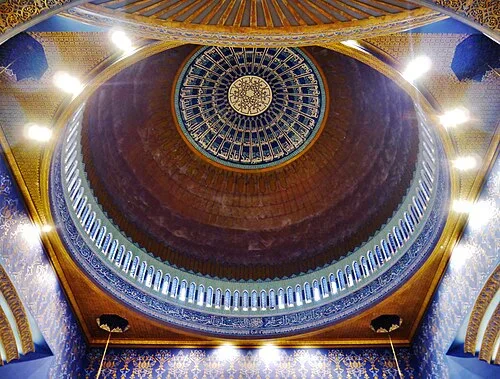 The Calligraphic Grand Dome
The Central Dome from Below
The dome rises forty-three metres above the prayer hall floor. It measures twenty-six metres across, wide enough to cover the heart of the hall below. Four massive columns carry it, each of them twenty-two metres tall. Around its base runs a ring of windows, 144 of them, and they light the hall by daylight alone. On a clear morning the whole space glows without a single lamp. The mosque's own Arabic account claims the dome can stand beside the grandest domes of the world's great mosques. That was the ambition: a crown worthy of a state mosque.
Listen in the appPhoto: Zairon · CC BY 4.0
07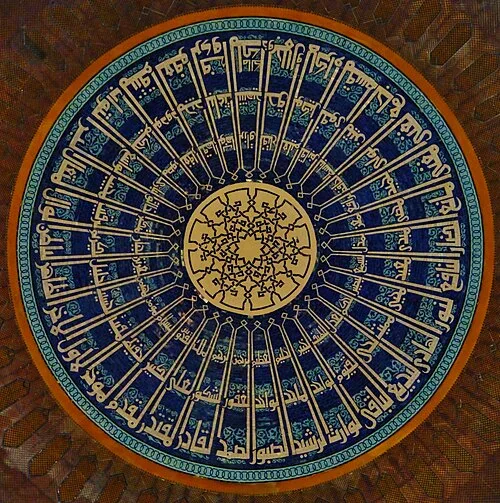 The Calligraphic Grand Dome
The Ninety-Nine Names: Calligraphy of the Dome
At the centre of the dome, the tiles form a great disc that radiates like a sun. Its rays carry the Asma al-Husna, the 99 Names of God, the names by which Muslims speak of the divine qualities. Each name is written in white foliated Kufic, an ornate early Arabic script with leafy flourishes, set against a ground of blue ceramic. The rays spread outward from a golden knot at the centre, so the names read like light leaving a sun. The master calligrapher Muhammad Haddad wrote the script for the dome, the walls and the archways of the entire building.
Listen in the appPhoto: Zairon · CC BY 4.0
08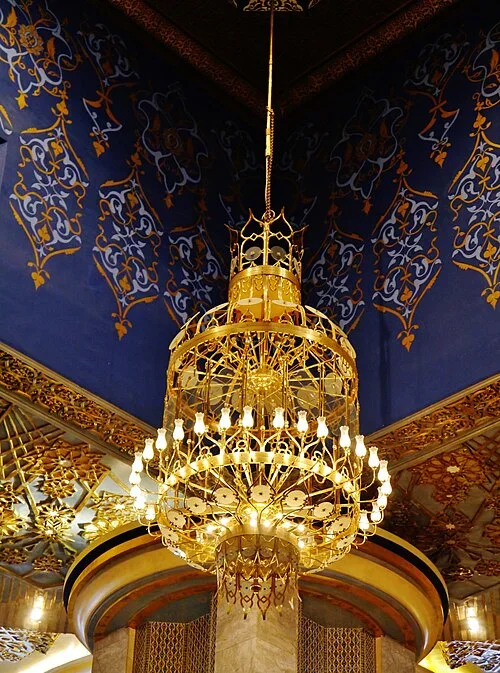 Italian Crystal Chandeliers and Moroccan Domes
Italian Chandeliers beneath the Moroccan Domes
Four small domes cap the sides of the great hall, carved from gypsum in the Moroccan manner. From each one hangs a chandelier of crystal and gold-plated copper, made in Italy. Each carries more than a hundred lights. Each is seven and a half metres long. And each weighs a full 1,000 kilograms, hung from its dome by a long central stem. Against the deep blue-and-gold painting of the ceiling, the gilded frame and the lit crystal read almost regal. Daylight comes from the dome's windows, but at night these four chandeliers take over, and the hall turns to gold.
Listen in the appPhoto: Zairon · CC BY 4.0
09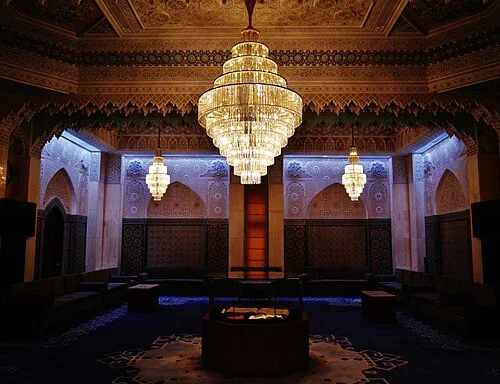 The Amir's Reception Suite
The Amir's Reception Room
Within the mosque, one suite is kept apart for the ruler of Kuwait. This is the Amiri Room, reserved for the Amir and for official state receptions on national and religious occasions. Its purpose follows from the mosque's public role. On Eid and other great gatherings, the ruler comes here to pray among his people, and visiting dignitaries are received in this room. Crystal chandeliers hang from a coffered ceiling, and arched niches line the walls in soft blue and cream. Low sofas run along the sides, arranged for conversation rather than ceremony. It is the one corner of the mosque where its two roles, house of prayer and house of state, meet in a single room.
Listen in the appPhoto: Zairon · CC BY 4.0
10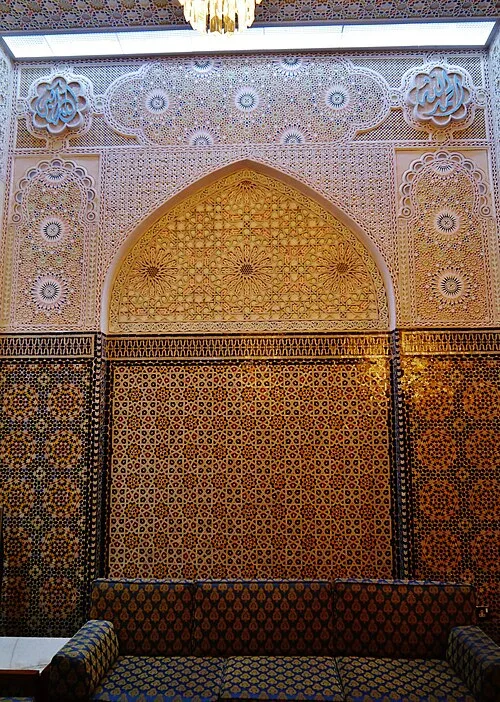 The Amir's Reception Suite
Craft of the Reception Hall: Stucco and Pattern
The walls of that reception room are where the craft shows itself. The surface is carved stucco in the Andalusian-Moroccan tradition, worked by hand while the plaster was still soft. The great arch is filled with interlacing geometric stars, and its edges bloom into honeycomb detailing of the kind called muqarnas. Below, panels of tile carry the same star patterns in warm gold and brown, bordered in deep blue. Round calligraphic medallions sit high in the corners of the wall. This is a classical Islamic craft continued into a modern building, the same family of work as the Moroccan gypsum domes elsewhere in the mosque. The craftsmen who carved this wall are not named, but the tradition it speaks from is centuries old.
Listen in the appPhoto: Zairon · CC BY 4.0
- 11
Gardens of the Inner Courtyard: What the Mosque Means
Palms, marble fountains and quiet paving, and what the Grand Mosque was built to say about Kuwait.
Grand Mosque of Kuwait
Frequently asked questions
How much does the guide cost?
Free app download. Listed guide price: $0.99. Guide price shown in the app. Audio guide only. Venue admission is separate.
Can I listen without internet?
Yes. Download the guide’s audio, images, and maps in the app before your visit. Your downloaded content is then available offline.
Can I listen in my language?
This audio guide is available in 15 languages, including English.
Do I need to follow a schedule?
No. This is a self-guided experience. Choose your stops, pause whenever you like, and return to a story at your own pace.
At your own pace
Explore Grand Mosque of Kuwait.
Download Stanza, then search for “Grand Mosque of Kuwait”.
Free app download · Guide price shown in the app