Stanza · Audio guide
Ambohimanga Audio Guide
A place to remember. A story to take with you.
Ambohimanga is a hill and traditional fortified royal settlement in Madagascar. It is located approximately 24 kilometers northeast of the capital city of Antananarivo.
Download Stanza, then search for “Ambohimanga”.
About the tour
One guide. Your kind of visit.
Ambohimanga is a hill and traditional fortified royal settlement in Madagascar. It is located approximately 24 kilometers northeast of the capital city of Antananarivo.
Ready when you are.
- 01Get the free Stanza app.
iOS & Android
- 02Find your guide.
“Ambohimanga”
- 03Download before you go.
Works offline
Audio guide / 10 narrated stops
Inside the guide
Get to know a few of the stories before you go. Open a stop to read more.
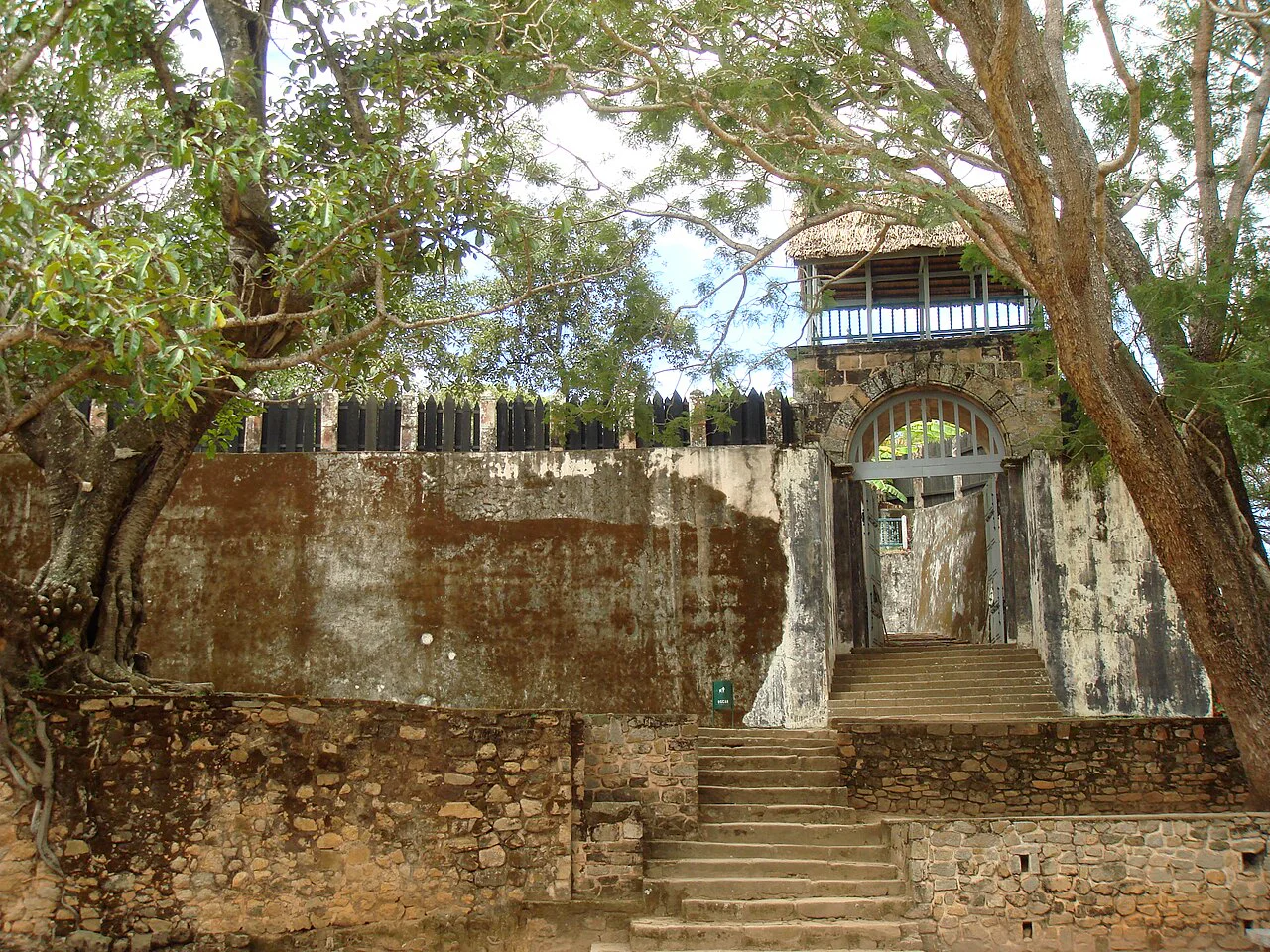
01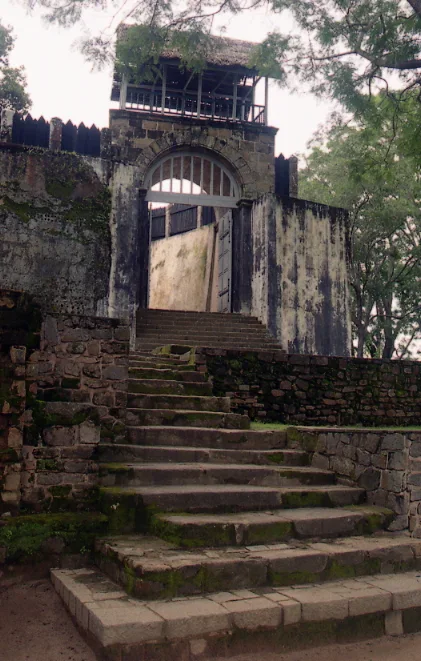 Ambatomitsangana Gate
Welcome to Ambohimanga, a fortified royal settlement on a hill about twenty-four kilometers northeast of Antananarivo. While Antananarivo held the kingdom's political power, this hill was its sacred counterpart, and it remains the best-preserved monument of the precolonial Merina kingdom. Fourteen stone gateways protect the royal compound. The principal one is Ambatomitsangana, a name that means standing stone. Every morning and every evening, a team of twenty soldiers rolled a huge stone disc across its opening. The disc measures about four and a half meters across and weighs roughly twelve tons. Such gates, called vavahady, were typical of the walled royal villages of Imerina built between the fifteen-twenties and the eighteen-nineties, shielding villagers from marauders. An observation post sits on top of the gateway, keeping watch over the approaches. This gate had a strict rule: it was a gateway of the living. Corpses could not pass through it, and neither could anyone who had recently touched the dead. The dead traveled by other paths, through gateways named Miandrivahiny and Amboara.
Robin.elaine (Robin Taylor) · CC BY 2.0
02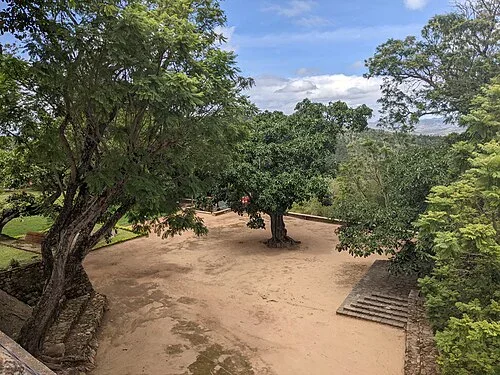 Fidasiana-Bevato Esplanade
Around the year seventeen hundred, a dethroned prince named Andriamborona climbed this hill with his nephew, his wife, and his mother, Ratompobe. The hilltop was empty then, and he settled it. Twenty-four kilometers away, King Andriamasinavalona saw the family's bonfire burning on the southern face of the hill. The spot was so visible from his capital that he decided he wanted it as a residence for his son, Andriantsimitoviaminiandriana. Andriamborona agreed to move three times, each time to a different part of the hill, including the place where the Bevato compound later stood. In the end he left for the distant village of Ambatolampy, and the king brought his family's bodies back for burial here. The name Ambohimanga joins two Malagasy words: ambohi, meaning hill, and manga, which can mean sacred, blue, beautiful, or good. The hill had earlier been called Tsimadilo, then Ambohitrakanga, the hill of the guinea fowls. Bevato, whose name means many stones, was the earliest of the royal compounds. The French later razed its buildings and put up a school, then a town hall, which was itself torn down after independence. The sacred aviavy fig trees still shade this esplanade, where pilgrims come to make sacrifices to the ancestors.
Photo: Artvill · CC BY-SA 4.0
03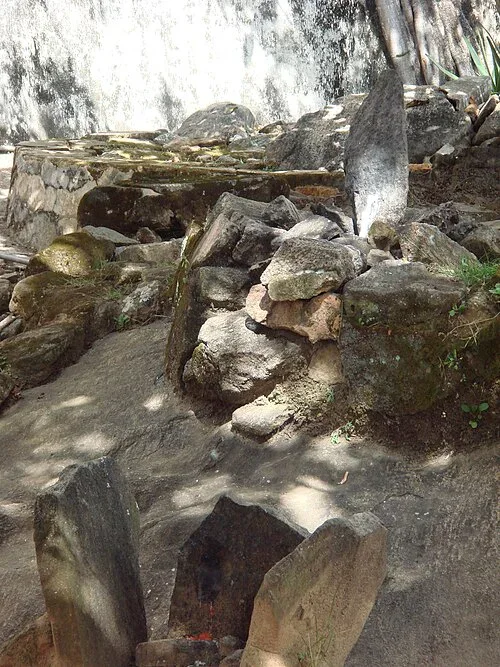 Sacred Stone of Enthronement
Sacred Stones of Enthronement
Here, on these standing stones, the Merina sovereigns stood to address their people. Andrianampoinimerina was enthroned standing on one of them before he set out on the campaigns that made him the greatest of its kings. The stones bound three things together: the king, the people who acclaimed him, and the ancestors whose blessing legitimized his power. A traditional verse keeps that role alive. Ambohimanga is the source of all goodness, it runs. Antananarivo, the vessel that stores it. Ambohimanga gave birth to our kings. Antananarivo, the city that united their people. That is why the hill is remembered as the kingdom's spiritual source, even after the capital moved to Antananarivo. The stones are still an active focus of worship today.
Listen in the appOlivier Lejade · CC BY-SA 2.0
04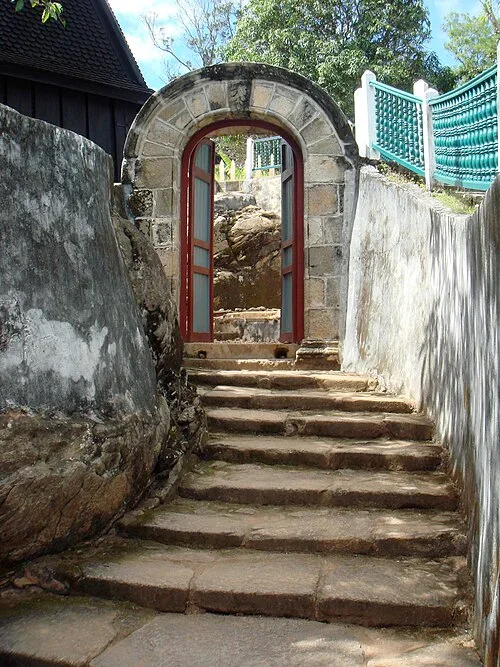 Mahandrihono Compound Entrance
Gateway into the Inner Compound
Crossing this arched gateway meant leaving the outer world behind. For most of the nineteenth century, and especially under Queen Ranavalona the First, Ambohimanga was forbidden to visiting foreigners. That exclusion fed the hill's reputation as a forbidden city, and it lasted until the French colonial administration took over in eighteen ninety-seven. The sacred grounds carried standing royal prohibitions of their own. No pigs were allowed on the site, and neither pork, tobacco, alcohol, nor cannabis could be brought in. The stone stairways linking the terraced compounds carried whoever climbed them deeper into that restricted and spiritually potent precinct.
Listen in the appOlivier Lejade · CC BY-SA 2.0
05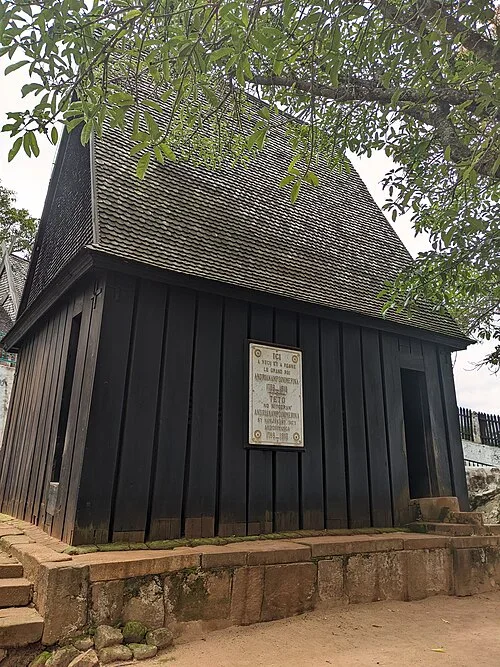 Mahandrihono Palace
Of all the buildings that stood in the royal city in the time of King Andrianampoinimerina, only this one remains intact. Mahandrihono was his home before he moved the political capital to Antananarivo. It is built the traditional way, in the style of the Imerina aristocracy: walls of solid rosewood, a peaked roof, and a central rosewood pillar about ten meters tall holding it all up. The original thatch has been replaced with wooden shingles, but everything else is preserved as it was built. The roof horns at each end of the peak were once silver-plated, and a silver eagle sat at the middle of the roof peak. Inside are objects that belonged to the king himself: weapons, drums, talismans, a fanorona game board, and a bed raised on stilts. His wives could visit the house, but they were never allowed to sleep in it overnight. From Rasoherina onward, the queens sat on the stepping stone at the threshold to address their audiences. Pilgrims still come here hoping to connect with the spirit of Andrianampoinimerina.
Listen in the appPhoto: Artvill · CC BY-SA 4.0
06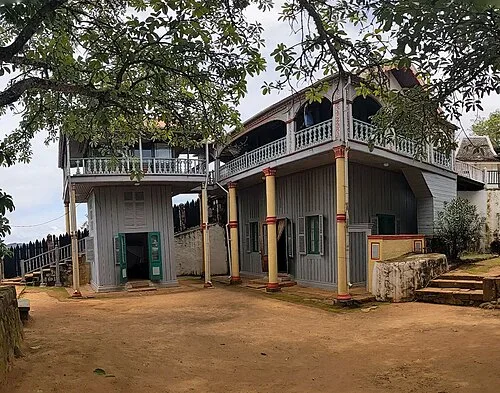 Royal Pavilions of Ranavalona II
Next to the plain rosewood palace, these two pavilions show how quickly Europe arrived at the Merina court. Both were built of rosewood in eighteen seventy-one, on the former site of the house that held the royal idol Manjakamiadana. The larger one, Fandriampahalemana, held reception rooms and a large salon on the ground floor, with the bedrooms of Queen Ranavalona the Second and her serving lady above. Its original European furnishings are preserved, along with the many gifts foreign dignitaries gave the queen. Her bedroom is considered sacred, and visitors still come on pilgrimage to pray to her spirit. The smaller pavilion is the Tranofitaratra, the house of glass. Here the queen gathered her ministers for counsel, and the large windows on all four sides gave her a view over the countryside below, so she could judge the security of her surroundings for herself. The glass was imported by an Englishman named Parrett.
Listen in the appPhoto: Artvill · CC BY-SA 4.0
07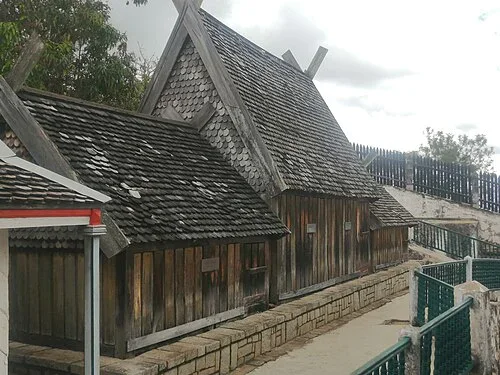 Reconstructed Royal Tombs
Tradition builds the houses of the living from wood and vegetation, and the tombs of the dead from stone, a cold and inert material. That is why these stone bases are topped by small wooden houses, the tranomasina. In March eighteen ninety-seven, French colonial authorities destroyed those wooden houses and exhumed the sovereigns buried here, moving their remains to Antananarivo. The removal targeted the Menalamba resistance, whose fighters had been rebelling against French rule for a year. Believing the ancestors sanctified the ground, those fighters came to Ambohimanga to collect handfuls of dirt from the base of the tombs and carried them into their offensives. The French hoped that emptying the tombs would break their confidence. A garrison was housed in the royal city, and a kitchen and military canteen were built on top of the tombs of Andrianampoinimerina and Andriamasinavalona. By nineteen hundred and four the military buildings were gone, leaving the stone foundations. The tombs were reconstructed in two thousand and eight by the government of Madagascar. And after the fire at the Antananarivo rova in nineteen ninety-five, the lamba-wrapped remains of one sovereign, Queen Ranavalona the Third, were saved from the flames. She has been re-interred here.
Listen in the appPhoto: Gaël RALANTONIRINA · CC0
08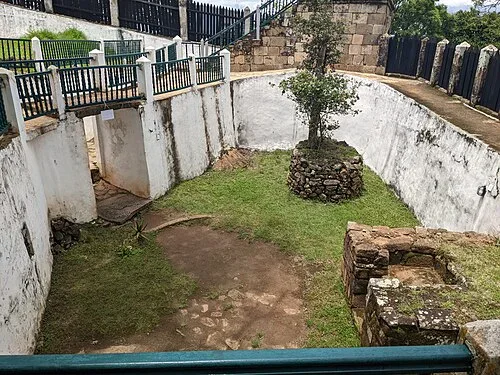 Sunken Zebu Pen
Sunken Sacrificial Zebu Pen
This sunken pen with its stone walls is the fahimasina, the sacrificial cattle pen. It stands to the west of the courtyard, and it held only the two most prized types of sacred zebu. One was the volavita, a black zebu with white markings on the forehead. The other was the malaza, entirely reddish-brown. The animals waited here before sacrifice at royal events such as circumcisions and the fandroana festival. Before slaughter, the cattle were made to walk from west to east, the direction of the ancestors and of sanctity. A second large sacrificial pen once stood to the northeast of the courtyard, until the French colonial authority filled it in during the late nineteenth century.
Listen in the appPhoto: Artvill · CC BY-SA 4.0
09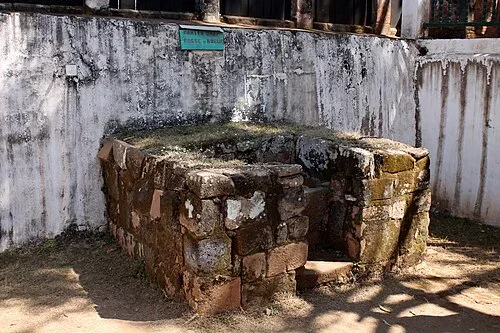 Royal Bathing Basins
Royal Bathing Basin
Two large basins were carved from the stone foundation of this compound under Queen Ranavalona the First. One was built in honor of the wives of soldiers of the ennobled Hova Tsimahafotsy clan. The other was for the wives of the elite military corps known as the five hundred. The basins held fish brought from Lake Itasy, swimming in specially consecrated water. Bathing there or drinking from them was strictly forbidden to the public. Ranavalona the First and her successors, Radama the Second and Rasoherina, used the larger royal pool for ritual purification at the annual fandroana, the new year festival of renewal. The water traces back to the sacred lake Amparihy at the base of the hill. Oral history attributes the lake to Andrianampoinimerina, who is said to have had villagers dig it out, sanctified it with a zebu sacrifice, and threw pearls and silver rings into the water to inaugurate it.
Listen in the appPhoto: Heinonlein · CC BY-SA 4.0
10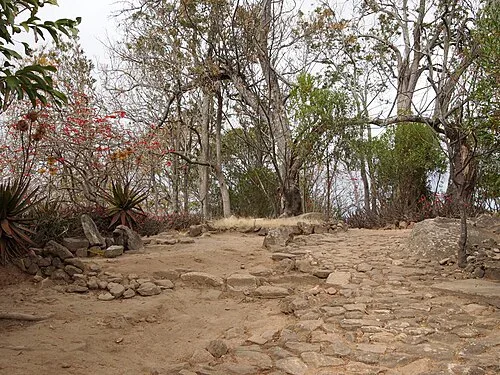 Heights of Nanjakana
Nanjakana is the most highly elevated of the three compounds, built in the late eighteenth century by King Andrianjafy. It was his nephew who made history here. Andrianampoinimerina dethroned Andrianjafy in a violent conflict that ended in seventeen eighty-seven, then used Ambohimanga as his launching point to bring the twelve sacred hills of Imerina under his rule, Antananarivo among them. That campaign reunited the four quadrants of the divided kingdom and put an end to seventy-seven years of civil war. On the stone esplanade to the north, the king reportedly came to reflect on his military strategy. The compound also saw tragedy. At the funeral of Queen Ranavalona the First in eighteen sixty-one, a spark ignited a barrel of gunpowder meant for the ceremony. The explosion and fire killed bystanders and destroyed three of the compound's historic royal residences. Since nineteen ninety-six, the buildings of Ambohimanga have been restored using traditional materials and the construction practices of the era that first raised them, and the sacred forest on the hill remains protected. Of all the royal cities of the Merina kingdom, this hill is the one that kept its sacred character intact.
Listen in the appPhoto: Lemurbaby · CC BY-SA 3.0
Ambohimanga
Frequently asked questions
How much does the guide cost?
Free app download. Listed guide price: $1.99. Guide price shown in the app. Audio guide only. Venue admission is separate.
Can I listen without internet?
Yes. Download the guide’s audio, images, and maps in the app before your visit. Your downloaded content is then available offline.
Can I listen in my language?
This audio guide is available in 15 languages, including English.
Do I need to follow a schedule?
No. This is a self-guided experience. Choose your stops, pause whenever you like, and return to a story at your own pace.
At your own pace
Explore Ambohimanga.
Download Stanza, then search for “Ambohimanga”.
Free app download · Guide price shown in the app