Stanza · Audio guide
Erdene Zuu Monastery Audio Guide
A place to remember. A story to take with you.
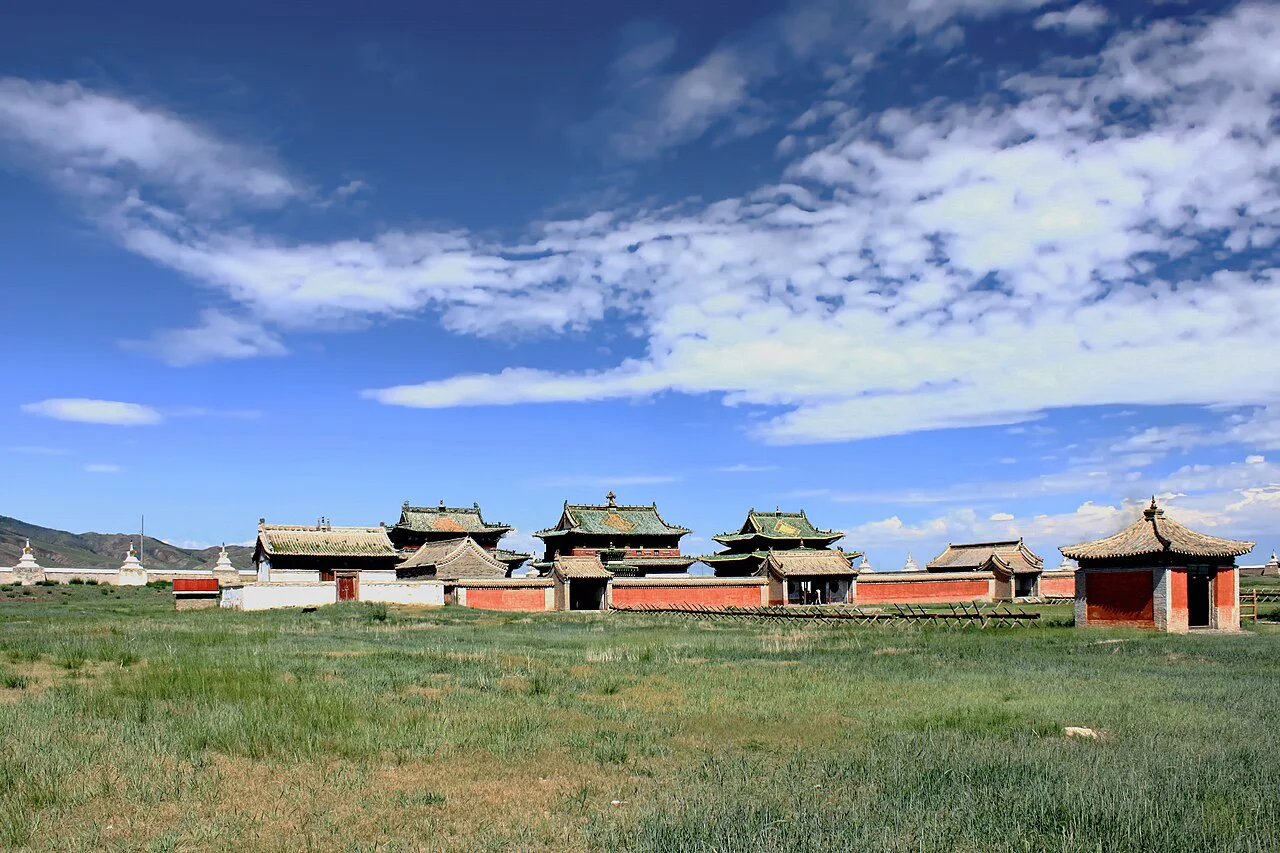
The Erdene Zuu Monastery is the earliest surviving Buddhist monastery in Mongolia. Built in 1585, it is part of the Orkhon Valley Cultural Landscape World Heritage Site.
Download Stanza, then search for “Erdene Zuu Monastery”.
About the tour
One guide. Your kind of visit.
The Erdene Zuu Monastery is the earliest surviving Buddhist monastery in Mongolia. Built in 1585, it is part of the Orkhon Valley Cultural Landscape World Heritage Site.
Ready when you are.
- 01Get the free Stanza app.
iOS & Android
- 02Find your guide.
“Erdene Zuu Monastery”
- 03Download before you go.
Works offline
Audio guide / 14 narrated stops
Inside the guide
Get to know a few of the stories before you go. Open a stop to read more.
01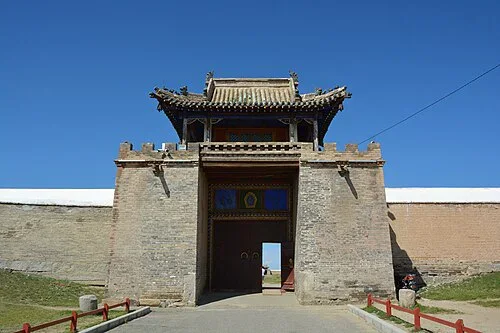 Main Gateway and Stupa Wall Perimeter
Main Southern Gate of Erdene Zuu
Welcome to Erdene Zuu, probably the earliest surviving Buddhist monastery in Mongolia. Its story starts in the 1580s with a meeting between two men from different worlds. Abtai Sain Khan, ruler of the Khalkha Mongols, met the 3rd Dalai Lama of Tibet. After that meeting, Tibetan Buddhism was declared the state religion of Mongolia, in its Gelug tradition. To give the new faith a home, Abtai ordered this monastery built beside the ruins of Karakorum, the old Mongol capital. His family carried the story further. His great-grandson Zanabazar became the first Jebtsundamba Khutuktu, the highest lama of Mongolia, and the lineage he founded shaped Mongolian Buddhism for centuries. What grew here was a walled monastic city, later nearly destroyed, and reborn as both museum and working monastery. This gatehouse opens onto all of it.
Photo: Jonashtand · CC BY-SA 4.0
02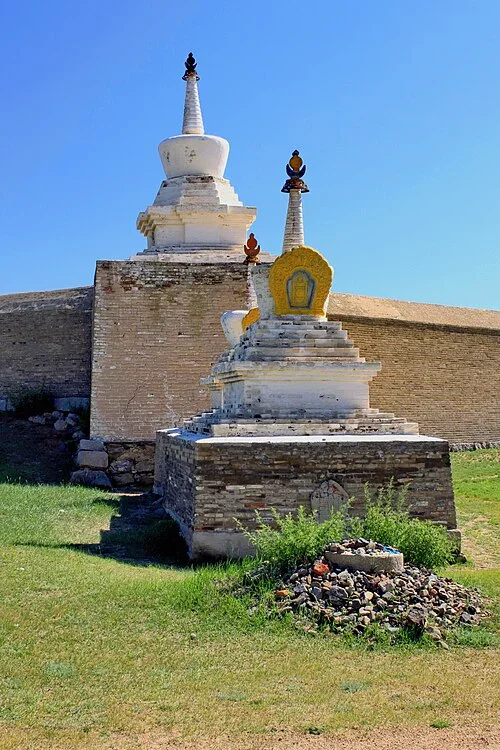 Main Gateway and Stupa Wall Perimeter
The Stupa-Crowned Fortress Wall
White stupas rise at even intervals along the brick ramparts, like beads on a string. That image is the design. The planners wanted the perimeter wall to resemble a Tibetan Buddhist rosary, with 108 stupas in all. In Buddhism, 108 is a sacred number, and a rosary carries exactly that many beads. The ideal, though, was probably never reached. Today the wall is guarded by 102 stupas, close to the plan but short of it. Either way, the effect works. Walking the wall's length is much like telling a long prayer, one bead at a time.
Marcin Konsek · CC BY-SA 4.0
03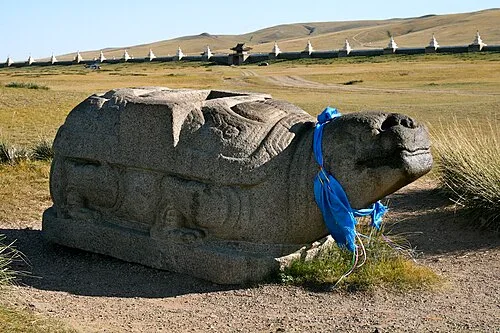 Ancient Karakorum Stone Foundations
Stone Turtle of Karakorum
A carved stone turtle rests on the grass, its head worn smooth by centuries of weather. Such turtles marked the great structures of Karakorum, the Mongol capital of the thirteenth century, standing on the steppe around this spot. When that capital fell to ruin, its stones did not go to waste. Builders carried them the short distance to raise Erdene Zuu, so the monastery literally stands on the bones of the imperial city. The borrowing was more than practical. A new sacred place, anchored to the stones of Genghis Khan's city, took on some of its prestige.
Listen in the appFrançois Philipp from Darmstadt, Germany · CC BY 2.0
04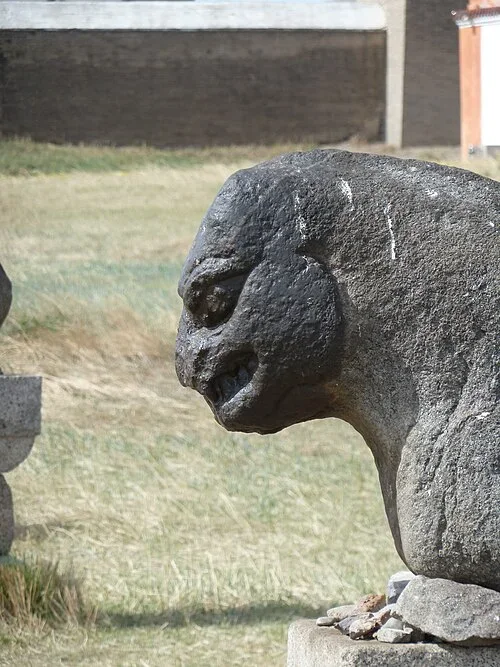 Ancient Karakorum Stone Foundations
Sculpture Attributed to Burnt Karakorum
A dark stone animal glares out of the grass, all weathered muscle and broken snout. It is presented as a survivor of burnt Karakorum, though that attribution is hard to prove after so many centuries. What is certain is the capital's fate. Karakorum served the Mongol emperors for a short, brilliant span, then lost its court and its reason for being. Abandoned, it slowly collapsed into ruin. The carved turtle nearby is another relic of that city.
Listen in the appGyula Péter · CC BY 3.0
05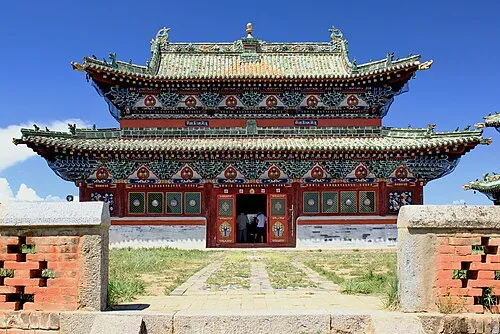 Western Zuu Temple (Baruun Zuu)
Western Zuu Temple Facade
Three temples stand side by side at the heart of the monastery, raised as parallel sanctuaries. Baruun Zuu lies in the west, Gol Zuu in the middle, and Züün Zuu in the east. Each wears the same handsome dress. The walls are painted, and the roofs rise in the Chinese style, covered with green tiles that catch the light. Curved eaves sweep up at the corners, layered storey above storey. These three buildings are the surviving heart of Erdene Zuu, and each holds a Buddha of its own inside.
Listen in the appMarcin Konsek · CC BY-SA 4.0
06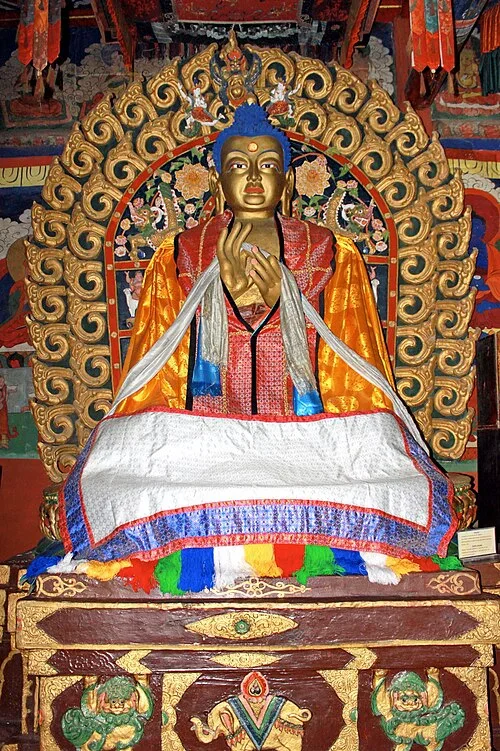 Western Zuu Temple (Baruun Zuu)
Buddha Sanjaa (Dipankara) in the Western Temple
A golden figure sits calm and upright against an enormous carved halo, wrapped in bright robes. This is Sanjaa, the Buddha Dipankara. In Buddhist tradition he is the Buddha of a past age, the one who came before Sakyamuni, the historical Buddha. Showing him here places this temple's sanctuary in a long line of awakened teachers reaching back before recorded memory. The statue has sat in this Western Temple through the monastery's hardest years. How it and its neighbours survived the twentieth century is a story told at the Main Temple.
Listen in the appMarcin Konsek · CC BY-SA 4.0
07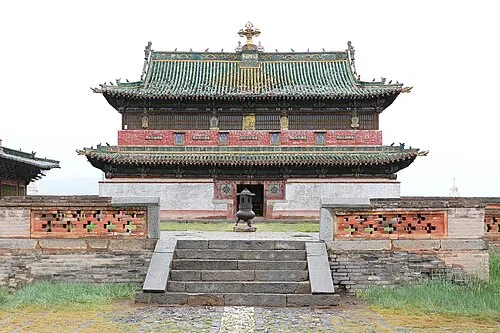 Gol Zuu Main Temple
Gol Zuu, the Main Temple
The central sanctuary of Gol Zuu stands serene under its green roof, which makes what happened here harder to picture. In 1939 the communist leader Khorloogiin Choibalsan ordered this monastery destroyed. It was part of a purge that wiped out hundreds of monasteries across Mongolia and killed more than ten thousand monks. At Erdene Zuu, the onslaught levelled nearly everything. Only three small temples and the outer wall with its stupas came through. These three sanctuaries, the same trio of Zuu temples, are what the visitor still walks among.
Listen in the appBernard Gagnon · CC0
08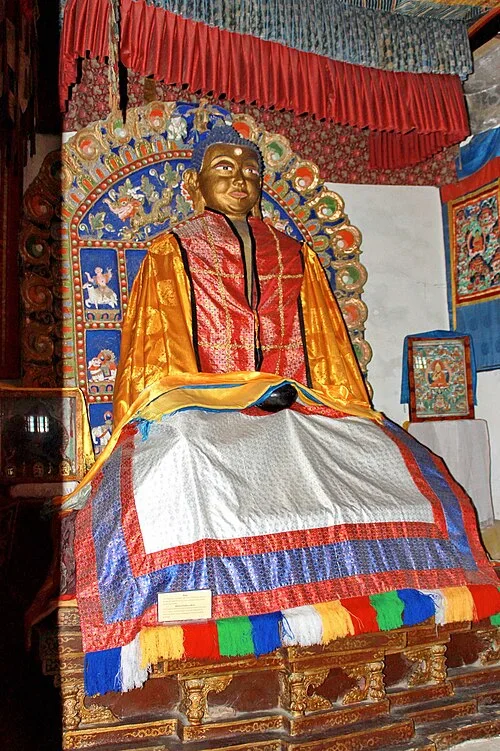 Gol Zuu Main Temple
Buddha Amitabha in the Main Temple
Seated in the Main Temple is Buddha Amitabha, the Buddha of Immeasurable Life and Light, robed in orange and gold against a painted halo. His temple owes its survival to an unlikely audience abroad. By 1944, Joseph Stalin was pressuring Choibalsan to keep Erdene Zuu, along with Ulaanbaatar's Gandan monastery, as a showpiece. The aim was to convince international visitors that the communist regime allowed freedom of religion. Among the guests was Henry Wallace, Vice President of the United States. In 1947 the temples were turned into museums. For the next four decades, Gandan remained Mongolia's only functioning monastery, and faith here survived only as display.
Listen in the appMarcin Konsek · CC BY-SA 4.0
09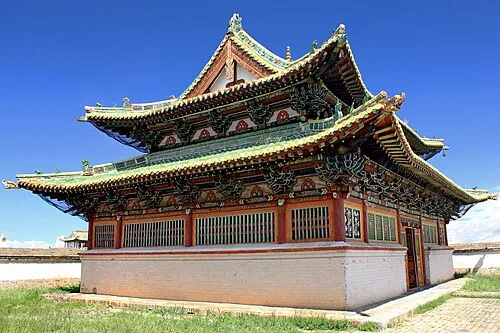 Eastern Zuu Temple (Züün Zuu)
Eastern Zuu Temple
The Eastern Temple raises its green roofs against the sky, graceful and intact, which was not always a safe assumption here. In 1688, during one of the wars between the Dzungars and the Khalkha Mongols, the monastery was damaged. It was left abandoned, and locals dismantled its wooden fortifications for their own use. That was long before the communist era, a reminder that Erdene Zuu has lived through hard times across its whole life. The catastrophe of the twentieth century belongs to another temple in this story.
Listen in the appMarcin Konsek · CC BY-SA 4.0
10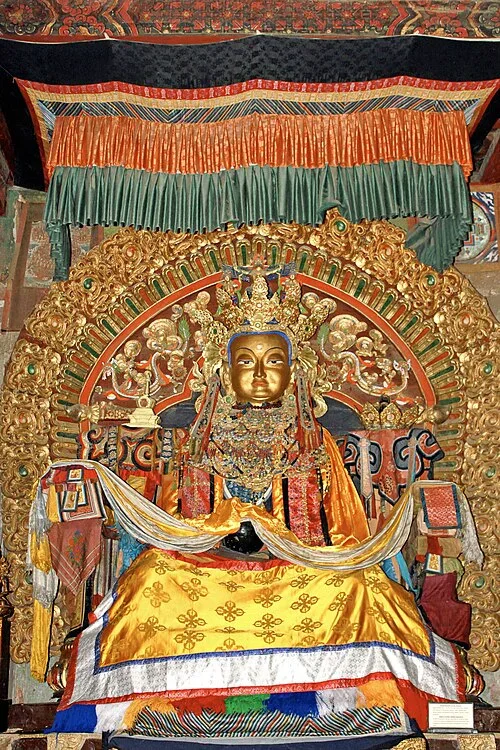 Eastern Zuu Temple (Züün Zuu)
The Buddha in His Youth, Eastern Temple
Inside the Eastern Temple sits the Buddha crowned and bejewelled, draped in golden silk, his face serene and strangely young. This image shows him in his teenage years, a prince before his awakening. Buddhist devotion loves these stages of a life, the child, the youth, the seeker, the awakened teacher, each given its own face and its own shrine. Here the young Buddha wears a tall crown and heavy ornaments, more like a royal heir than a wandering monk. His image, like the statues in the two neighbouring temples, is part of what those three surviving sanctuaries preserved.
Listen in the appMarcin Konsek · CC BY-SA 4.0
- 11
The Golden Stupa in the Courtyard
The monk who tried to fly, and the stupa he is remembered by.
- 12
Lavrin Temple
The white Tibetan temple where worship came back to life after 1990.
- 13
Inside Lavrin: Active Prayer Hall
Inside Lavrin: thangkas, altars, and a prayer hall in daily use.
- 14
Temple of the Dalai Lama
The Temple of the Dalai Lama, and the meeting that started it all.
Erdene Zuu Monastery
Frequently asked questions
How much does the guide cost?
Free app download. Listed guide price: $0.99. Guide price shown in the app. Audio guide only. Venue admission is separate.
Can I listen without internet?
Yes. Download the guide’s audio, images, and maps in the app before your visit. Your downloaded content is then available offline.
Can I listen in my language?
This audio guide is available in 15 languages, including English.
Do I need to follow a schedule?
No. This is a self-guided experience. Choose your stops, pause whenever you like, and return to a story at your own pace.
At your own pace
Explore Erdene Zuu Monastery.
Download Stanza, then search for “Erdene Zuu Monastery”.
Free app download · Guide price shown in the app