Languages
15Malbork Castle Audio Guide
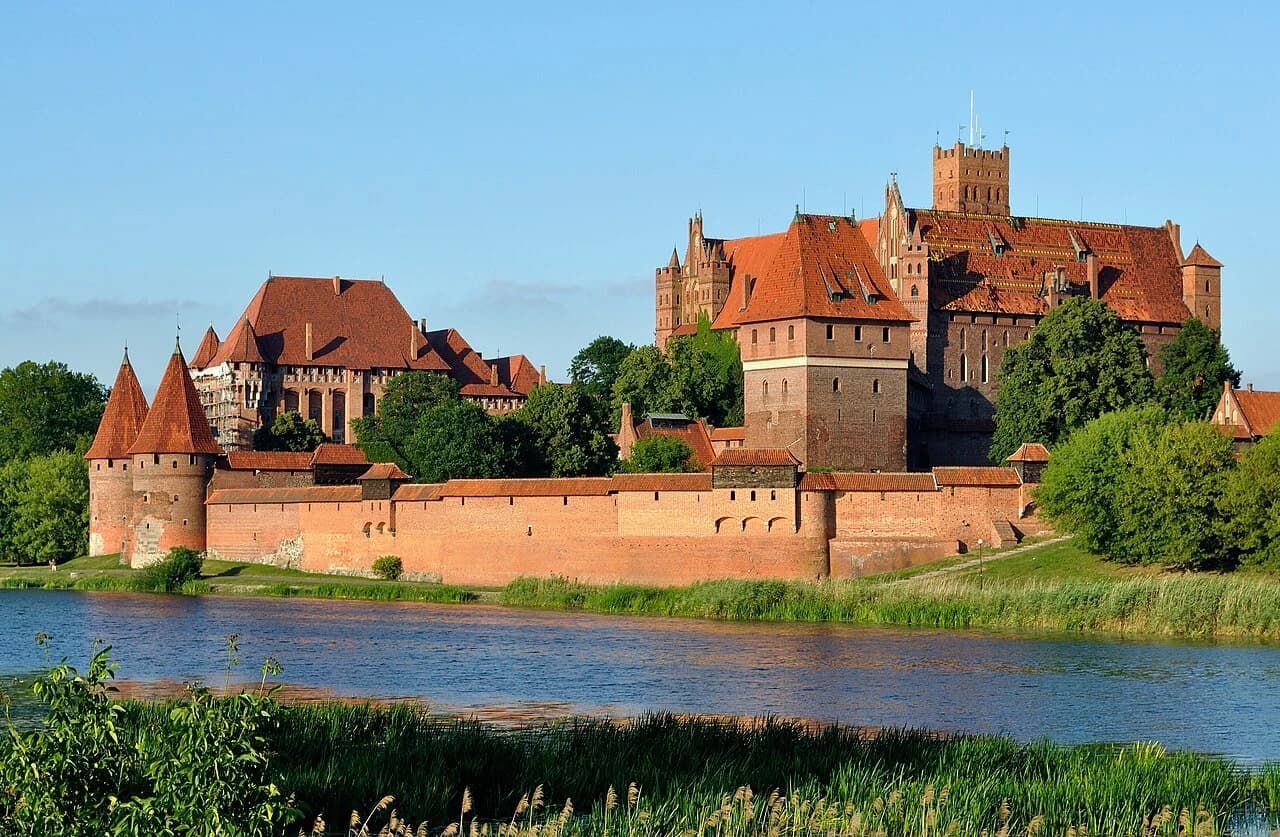
Malbork Castle is a landmark in Malbork, Poland. Explore it with Stanza's GPS-triggered offline audio guide — available in 15 languages.
Quick Facts
25
Stops
15
Languages
100%
Offline
📍 Malbork, Poland · 54.0397°N, 19.0278°E
About Malbork Castle
Malbork Castle is a medieval Teutonic Order stronghold built in Prussia, now Poland. It served as a residence for the Grand Master of the Teutonic Knights.
Malbork Castle is also known as Castle of the Teutonic Order in Malbork, Zamek w Malborku.
This self-guided audio tour features 25 narrated stops organized across 6 sections, including Lower Castle and Main Gates, Grand Master's Palace, Great Refectory, High Castle Drawbridge, St. Mary's Church and the Golden Gate, The Dansker (Toilet Tower). As a castle, Malbork Castle offers a unique cultural experience in the heart of Malbork, Poland.
The Stanza audio guide is available in 15 languages and works entirely offline — download the complete tour including audio narration, maps, and images before your visit. As you walk through Malbork Castle, GPS-triggered narration plays automatically at each point of interest.
Last updated:
What you will hear
Lower Castle and Main Gates
Entering the first line of defense through the outer ward.
The Buttermilk Tower
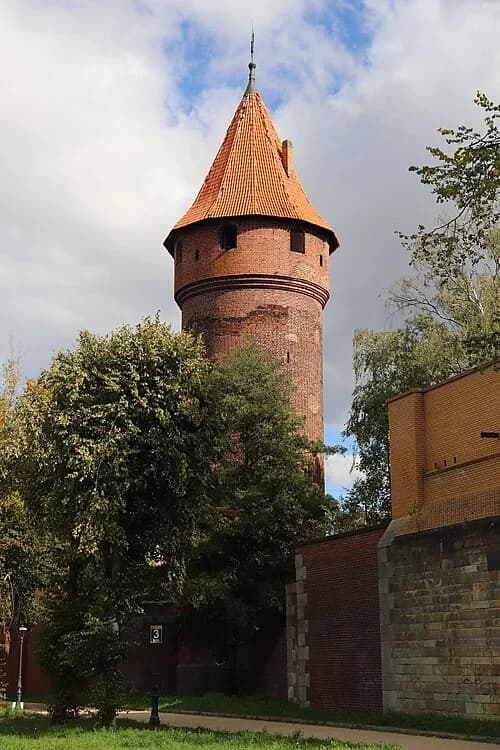
The massive structure before you is the 'Baszta Maślankowa,' or the Buttermilk Tower. Its curious name has sparked several colorful local legends. One popular story suggests that the medieval mortar used for its construction was mixed with buttermilk to make the walls exceptionally strong and resistant to the elements. Another more practical theory posits that the tower's name refers to a tax paid by local farmers in dairy products, which helped fund its construction. Regardless of the myth, the tower is a perfect example of the sheer scale of Malbork's outer defenses. Its height and the thickness of its brick walls were designed to overlook the surrounding landscape and provide a dominant defensive position. Standing at its base, you can see how the circular form provided no blind spots for archers and crossbowmen defending the perimeter. The tower also served as a storage area and sometimes as a prison, with its cold, thick walls offering little comfort to those inside. It remains one of the most recognizable silhouettes of the Lower Castle, a reminder of the immense resources the Teutonic Knights extracted from their territories to build their impenetrable headquarters.
Grand Master's Palace
The residential masterpiece of late Gothic architecture where the leader hosted royalty. Covers the heating system and Polish royal era.
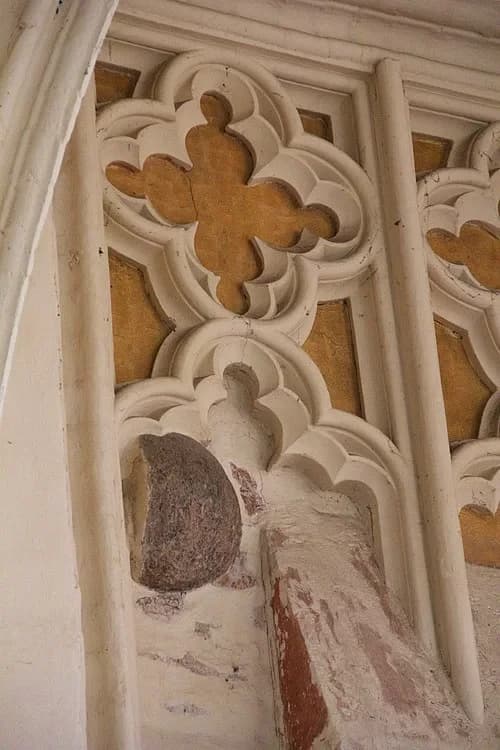
Traces of Conflict
If you look closely at the wall near one of the windows, you will see a round stone object firmly embedded in the brickwork. This is a genuine cannonball, a relic from the dramatic siege of 1410. Following the crushing defeat of the Teutonic Knights at the Battle of Grunwald, the Polish-Lithuanian army advanced on Malbork, hoping to finish off the Order. Legend tells us that the besieging forces knew exactly where the Grand Master was meeting with his commanders: right here in the Summer Refectory. They aimed their heavy artillery at the single central pillar, hoping to collapse the entire roof and kill the leadership in one blow. The projectile missed the pillar by just a few inches, embedding itself in the wall instead. Had the aim been slightly more accurate, the history of the castle and the Order might have taken a very different turn. The presence of the ball today is a tangible connection to the violence that once surrounded these elegant halls. It serves as a stark reminder that even within the most refined spaces of the fortress, the threat of war was never far away. The brick surrounding the impact site remains as it was, preserving a moment of near-total destruction.
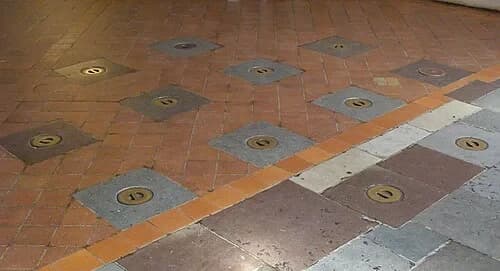
The Medieval Radiators
Look down at the floor and you will see several circular, brass-rimmed openings. These are not decorative elements; they are the vents for a remarkably advanced 14th-century central heating system known as a hypocaust. In an era when most of Europe relied solely on smoky fireplaces, the Teutonic Knights enjoyed a much more sophisticated solution. Deep below this floor, large furnaces were fired to heat piles of heavy stones. Once the stones reached a high temperature, the vents were opened, allowing the warm air to rise through the hollow spaces beneath the tiles. This system provided a clean, radiant heat that would have kept the Grand Master’s feet warm while the rest of the massive brick fortress remained freezing cold. It was a luxury typically reserved for the highest-ranking members of the Order, allowing them to conduct business comfortably even in the depths of winter. The placement of these holes was strategic, ensuring the warmth was distributed where it was needed most. This engineering marvel demonstrates that the Knights were not just military innovators, but also masters of domestic technology, utilizing ancient Roman principles to survive the northern climate.
Great Refectory
The largest hall in the castle, used for massive feasts and diplomatic receptions.
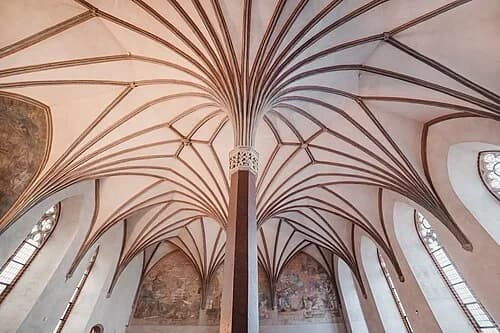
Feasts and Faith
Looking up, you can admire the complex rib vaulting of the ceiling, where the architectural lines cross in a sophisticated geometric dance. This room also preserves fragments of medieval frescoes on the walls, giving us a glimpse into the once-vibrant colors of the castle interior. Despite the luxury of these surroundings, the Knights were never allowed to forget their religious calling. Even during the most elaborate feasts, strict monastic regulations were in place. A brother monk would typically stand at a pulpit, reading aloud from the scriptures or the rules of the Order while the others ate in relative silence. This was intended to ensure that the knights remained focused on their vows of poverty, chastity, and obedience, even as they enjoyed the spoils of their vast trade and military conquests. The combination of religious imagery and grand architecture serves as a constant reminder of the Order’s dual identity as both a monastic community and a ruling military elite. Notice the detail in the ceiling bosses where the ribs meet—these often featured religious symbols or the heraldry of the Order. The presence of these spiritual elements within a dining hall underscored that for a Teutonic Knight, every aspect of life was governed by faith.
High Castle Drawbridge
Crossing the deep moat into the most fortified and sacred part of the castle.
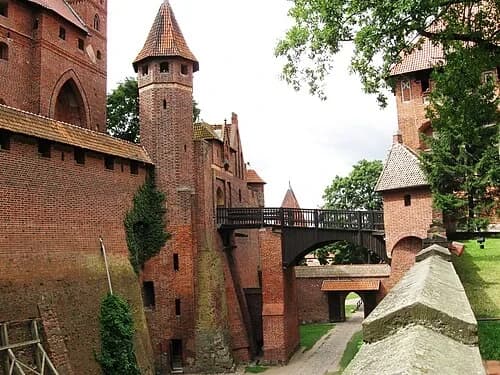
Crossing the Inner Moat
Crossing the bridge over the inner moat brings you to the threshold of the High Castle. This transition was deeply significant in the medieval period, as it marked the entrance into the most fortified and sacred part of Malbork. While the Middle Castle was for guests and administration, the High Castle was the monastic cloister—a strictly private domain reserved for the 'brothers' of the Order. This was where the knights lived, prayed, and held their most secret deliberations. To protect this inner sanctum, the approach was guarded by multiple layers of defenses, including drawbridges, portcullises, and the moat itself. If the rest of the castle fell, the High Castle could be completely isolated, functioning as an unconquerable fortress within a fortress. The architecture becomes even more imposing here, with higher walls and more limited access points. The transition across the water served as a physical and symbolic separation from the outside world, reinforcing the Order's identity as a religious community withdrawn from secular life. Even today, the movement from the broad courtyards of the Middle Castle into the more confined, defensive space of the High Castle conveys the sense of entering a place of immense power and deep spiritual significance.
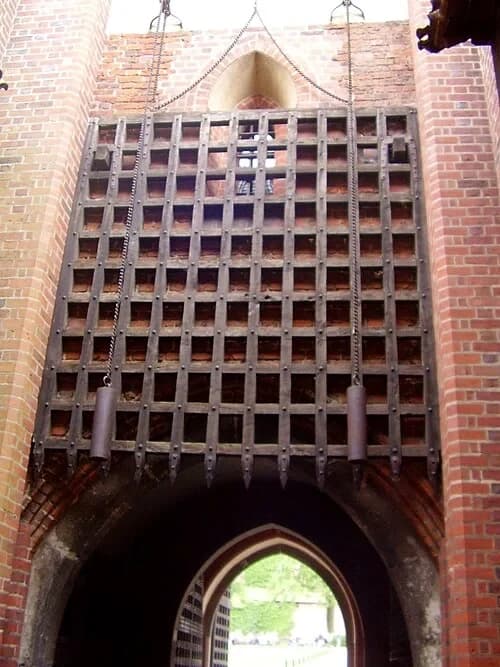
The Iron Portcullis
Above the main entrance to the High Castle hangs a massive portcullis, a heavy grating of wood and iron that represents the ultimate in medieval security. This was the castle’s last-resort barrier. In the event of a breach, the chains holding this gate could be released, causing it to drop instantly and seal the entrance with brute-force finality. You can still see the wear on the heavy iron chains and the massive counterweights used to operate it. The engineering required to lift and drop such a weight was significant, and the portcullis had to be perfectly balanced to ensure it didn't jam during a crisis. Notice the sharp, iron-shod tips at the bottom, designed to embed themselves into the ground and prevent anyone from prying the gate upward. This gate was part of a series of defensive layers that made the High Castle nearly impossible to take by storm. Behind it, defenders could stand in the vaulted passage, raining projectiles through 'murder holes' in the ceiling on any attackers trapped against the gate. It stands as a silent witness to the extreme lengths the Teutonic Knights went to in order to secure their inner cloister, a testament to the brutal realities of medieval warfare.
St. Mary's Church and the Golden Gate
The main place of worship, featuring the ornate Golden Gate and the giant Madonna statue.
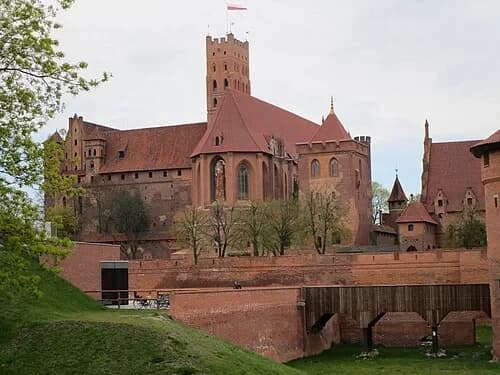
The Rebirth of St. Mary’s
St. Mary’s Church stands as a triumph of modern preservation, though its pristine appearance belies a violent 20th-century history. In early 1945, during the closing stages of the Second World War, Malbork Castle became a German strongpoint and was subsequently bombarded. Roughly fifty percent of the entire complex was reduced to rubble, with the church suffering some of the most catastrophic damage. The roof collapsed, and large sections of the walls were blown outward, leaving the sacred space exposed to the elements for years. What you see today is the result of a meticulous restoration project that spanned several generations. Architects and historians used old photographs, drawings, and surviving fragments to reconstruct the Gothic facade and the towering windows with incredible accuracy. The work was only fully completed in the 21st century, finally closing the scars left by the war. Looking closely at the brickwork, you can sometimes spot the subtle difference in color between the original medieval bricks and the modern replacements, marking the boundary between what survived the siege and what was reborn from the ruins.
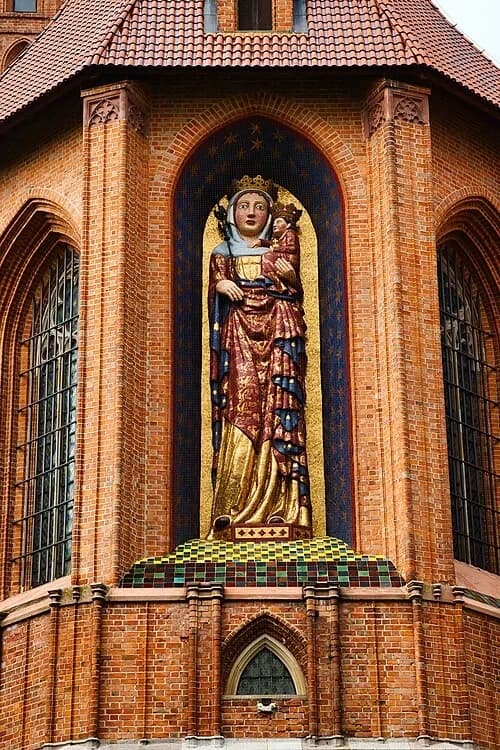
The Madonna of Malbork
High up on the exterior wall of the church, the towering figure of the Virgin Mary keeps watch over the fortress. Standing eight meters tall, this is the Madonna of Malbork, the patroness and namesake of the Order—the knights were officially the 'Order of Brothers of the German House of Saint Mary in Jerusalem.' The original statue, a medieval landmark visible for miles across the flat river delta, was completely destroyed during the heavy fighting in 1945. For decades, the niche remained empty, a stark reminder of the war’s toll. The current statue is a faithful reconstruction completed in recent years. It is covered in over 300,000 individual glass mosaic tiles, some of which are layered with real gold leaf to catch the sunlight. This technique mirrors the medieval original, which would have shimmered brilliantly against the red brick. The figure holds the Christ child, emphasizing the religious identity that defined the Teutonic State. It serves as a visual anchor for the High Castle, reestablishing the spiritual skyline that had characterized Malbork since the 14th century.
The Dansker (Toilet Tower)
A unique defensive and sanitary structure detached from the main walls.
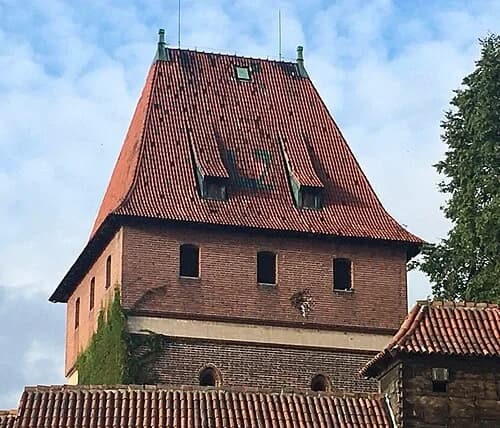
The Dansker Tower
Rising from the ground away from the main complex is the Dansker, a unique structure often referred to as the 'Toilet Tower.' While its primary daily function was indeed as the castle’s main latrine, its design was far from primitive. The tower was built directly over a flowing stream, ensuring that waste was immediately carried away from the castle walls to maintain hygiene and prevent disease. However, the Dansker had a much grimmer secondary purpose. It was designed as a 'last stand' fortress. Because it is detached from the main High Castle and connected only by a narrow, defensible walkway, the knights could retreat here if the main fortress was breached. It had its own supplies and defensive positions, allowing a small group of defenders to hold out even after the rest of Malbork had fallen. This combination of essential sanitation and high-stakes military strategy is a hallmark of Teutonic engineering. The thick walls and elevated position made it nearly impossible to storm from below, ensuring that the final line of defense was also the most practical.
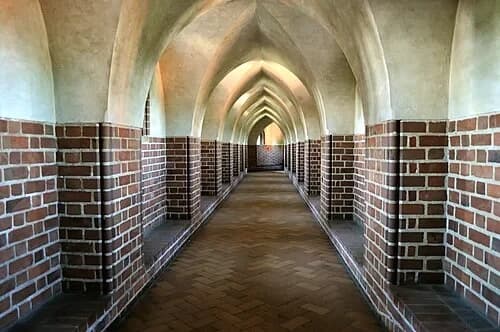
The Bridge of Sighs
Walking along this extended, covered bridge toward the Dansker Tower, the sheer distance from the main High Castle becomes apparent. This length was entirely intentional and served two vital purposes. First, for hygiene, it physically distanced the living quarters from the smells and health risks associated with the latrines. Second, and more importantly, it created a controlled kill-zone for the castle's archers. Because the bridge is the only way to reach the tower, any enemy attempting to infiltrate the castle through the sewer system or the tower itself would be forced down this long, narrow passage. Defenders could rain down arrows or other projectiles from the main walls onto anyone caught on the walkway. The structure is supported by massive brick arches, and the high walls of the corridor provided protection for the knights as they moved back and forth. It exemplifies the Teutonic approach to architecture, where even a simple hallway was transformed into a sophisticated defensive asset, ensuring that every inch of the path was under constant surveillance.
Want to hear the rest?
Download the Stanza app to unlock all 25 stops and full GPS-guided navigation.
Frequently Asked Questions
How long does the Malbork Castle audio tour take?
The Malbork Castle audio guide includes 25 narrated stops. Most visitors spend 45 minutes to 1.5 hours exploring the complete tour, though you can listen at your own pace and skip or revisit any stop.
Is the Malbork Castle audio guide available in my language?
Stanza supports 15 languages: English, Spanish, French, German, Italian, Portuguese, Russian, Japanese, Chinese, Korean, Arabic, Hindi, Polish, Dutch, Hebrew. Check the guide in the app to confirm the languages currently available for this tour.
Can I use the audio guide offline at Malbork Castle?
Yes! Download the complete Malbork Castle tour — including all audio, maps, and images — before your visit. The Stanza app works completely offline, so you don't need WiFi or mobile data at the venue.
How much does the Malbork Castle audio guide cost?
The Stanza app is free to download. The current listed price for the Malbork Castle audio guide is $4.99; app-store region and currency may affect the final price.
How do I use the Stanza audio guide at Malbork Castle?
Download the free Stanza app, search for "Malbork Castle", and download the tour. When you arrive at the venue, the app uses GPS to detect your location and automatically plays the relevant narration as you move between points of interest — completely hands-free.
What makes the Stanza audio guide different from other Malbork Castle tours?
Stanza offers GPS-triggered narration that plays automatically as you walk through Malbork Castle — no need to manually select stops. The tour is available in 15 languages, works fully offline, and includes 25 expertly narrated stops with images and historical context.
What other audio guides are available near Malbork Castle?
Stanza offers multiple audio guides in Malbork, Poland and nearby areas. After downloading the app, browse the map to discover all available tours near Malbork Castle. Each guide can be downloaded for offline use.