Languages
15Wieliczka Salt Mine Audio Guide
Wieliczka Salt Mine is a landmark in Wieliczka, Poland. Explore it with Stanza's GPS-triggered offline audio guide — available in 15 languages.
Quick Facts
15
Stops
15
Languages
100%
Offline
📍 Wieliczka, Poland · 49.9831°N, 20.0557°E
About Wieliczka Salt Mine
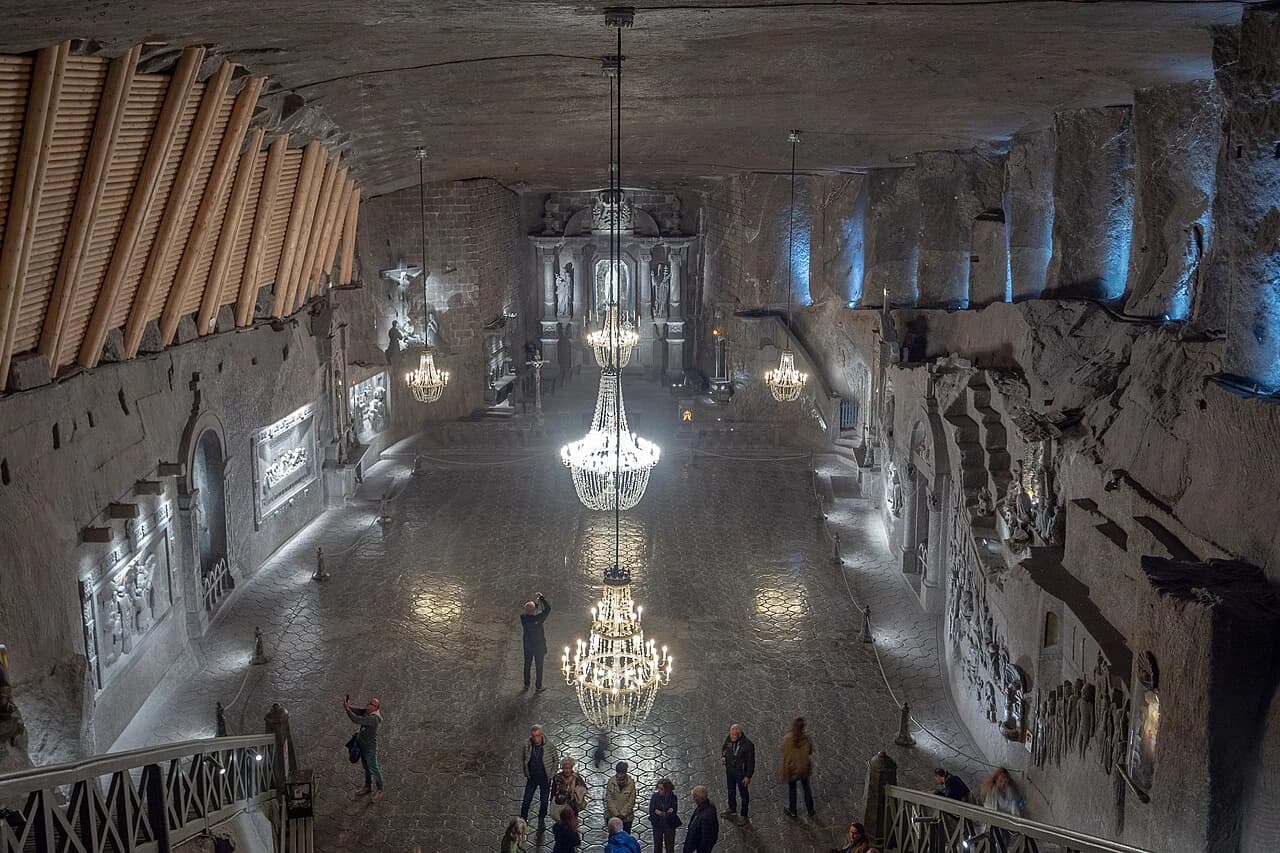
The Wieliczka Salt Mine is a historic salt mine in Poland, renowned for its underground chapels, sculptures, and galleries carved from rock salt. It is a UNESCO World Heritage Site.
Wieliczka Salt Mine is also known as Salt Mine Museum, Wieliczka Salt Mine Museum, Kopalnia soli Wieliczka, Kopalnia soli (Wieliczka), and 7 other names in various languages.
This self-guided audio tour features 15 narrated stops organized across 9 sections. As a monument, Wieliczka Salt Mine offers a unique cultural experience in the heart of Wieliczka, Poland.
The Stanza audio guide is available in 15 languages and works entirely offline — download the complete tour including audio narration, maps, and images before your visit. As you walk through Wieliczka Salt Mine, GPS-triggered narration plays automatically at each point of interest.
Last updated:
What you will hear
The Chapel of St. Anthony
The oldest surviving underground chapel, dating back to the late 17th century.
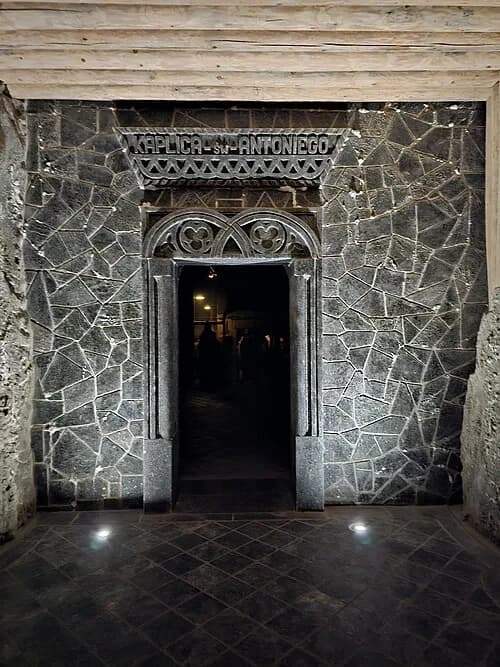
Saint Anthony's Chapel
Saint Anthony’s Chapel is the oldest surviving underground place of worship in the mine, dating back to the late 17th century. The ornate portal is carved directly into the dark, massive rock salt. Unlike the white table salt you might use at home, the salt here appears deep grey, almost like granite, due to the presence of various minerals. Faith was an essential part of a miner's life, and sanctuaries like this were vital for their mental and spiritual well-being. Mining was a perilous profession; workers faced the constant threat of methane gas explosions, sudden floods, and structural collapses. Consequently, it became a tradition for miners to gather here for prayer before every shift, seeking protection from the dangers that awaited them in the dark tunnels. The figures and altars were all meticulously crafted from the surrounding salt, demonstrating the artistic devotion of the people who worked here. Despite the centuries that have passed, the chapel retains a quiet, contemplative atmosphere. The carvings have softened slightly over time due to the humidity in the air, giving the space a weathered, timeless appearance that reflects the long history of labor and belief deep beneath the surface.
The Legend of Princess Kinga
Illustrate the foundation myth of the mine with the famous salt-carved statues.
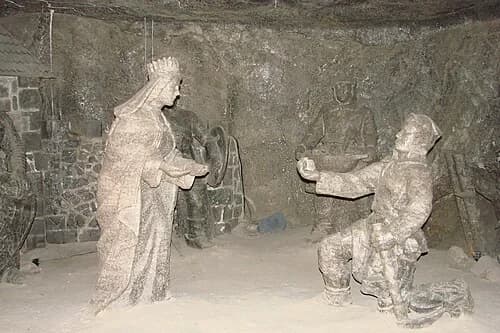
The Legend of Princess Kinga
This chamber houses a series of statues that bring the mine's foundation myth to life. The story centers on the Hungarian Princess Kinga, who lived in the 13th century. According to local legend, Kinga was gifted a salt mine in Hungary as part of her dowry. Before leaving for Poland to marry Prince Bolesław, she threw her engagement ring into the Hungarian mine. Upon arriving here in Wieliczka, she ordered the local miners to dig in a specific spot. To everyone's astonishment, they unearthed a large lump of salt, and inside it was her lost ring. This miracle is said to have marked the discovery of salt in the region. The statues depicting this scene have a grey, slightly mottled appearance. This is characteristic of the rock salt found throughout the mine, which contains impurities like clay and gypsum that give it a look more akin to unpolished stone or granite than translucent crystal. This visual surprise often catches visitors off guard, as they expect a white, snowy environment. These salt-carved figures stand as a permanent tribute to the folklore that has bound the local community to this underground treasure for over seven hundred years.
The Casimir the Great Chamber
Focus on the industrial history and the King who 'found Poland in wood and left it in stone'—and salt.
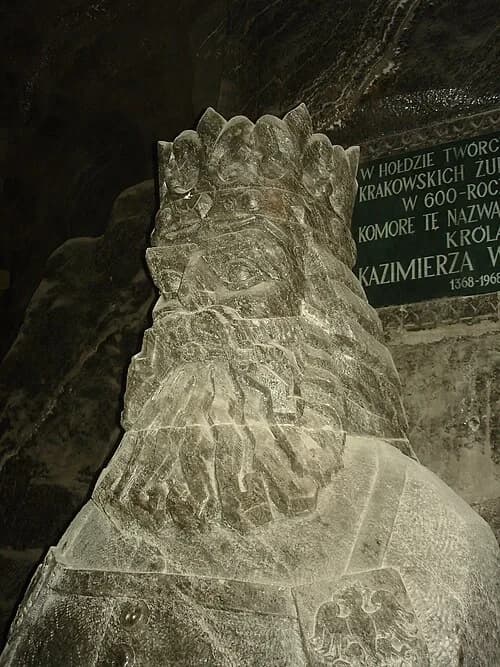
King Casimir the Great Chamber
This chamber is dedicated to King Casimir the Great, the 14th-century monarch who famously realized that salt was 'white gold.' Under his reign, the income from these mines accounted for a significant portion of the royal treasury, funding the construction of universities, fortifications, and churches throughout Poland. The large bust of the king is meticulously carved from the dark rock salt. The artist has captured the monarch with a flowing beard and a crown, giving him a regal, imposing presence in the grey mineral. On the base of the monument, a carving of the Polish eagle remains a symbol of national identity that has watched over the mine for generations. The chamber itself illustrates the scale of early mining efforts, with high ceilings and wide spans created by extracting massive quantities of salt. Behind the bust, a plaque commemorates the 600th anniversary of the mine's administration, highlighting the long-standing importance of this site. The textures of the salt wall behind the sculpture show the tool marks of the miners, grounding the royal tribute in the reality of the physical labor performed here. It is a powerful example of how the wealth of the earth supported the growth of the nation.
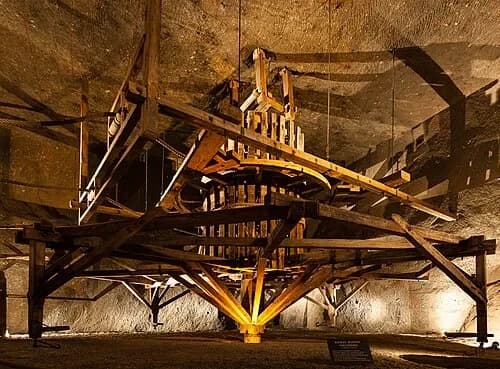
Hungarian Horse Mill
In this chamber stands a masterwork of pre-industrial engineering: the Hungarian Horse Mill. This massive wooden 'treadmill' mechanism was used to haul heavy cylinders of salt, known as 'bałwany,' from the lower levels up to the surface. Each of these cylinders could weigh over two tons, requiring immense power to move. To provide this force, horses were brought into the mine. These animals often lived their entire lives underground, residing in stables located on the lower levels. They worked in the darkness, circling the central axis of this mill to wind the thick hemp ropes. While the conditions were difficult, the horses were vital companions to the miners and were treated with considerable care. The structure itself is a labyrinth of heavy timber beams, joined without the use of metal bolts, which would have corroded quickly in the salty environment. Although modern machinery eventually replaced these manual systems, commercial mining at Wieliczka only officially ceased in 1996. This mill stands as a silent reminder of the transition from animal power to the industrial age. The wood has been preserved for centuries by the high salt content of the air, which naturally prevents rot and keeps the massive mechanism in remarkable condition.
The Weimar Chamber and Lake
Introduce the surreal atmosphere of the underground brine lakes.
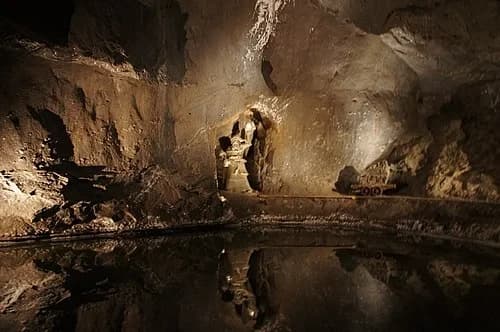
Weimar Chamber Lake
The Weimar Chamber is home to one of the most tranquil and surreal sights in the mine: a deep brine lake. The water here is so heavily saturated with salt—roughly 30 percent—that it is nearly impossible for a human to sink. This extreme salinity creates a dense, still liquid that acts like a perfect mirror, reflecting the rugged salt walls and the illumination of the chamber with crystal clarity. This particular space was named after the German city of Weimar to honor the famous poet and scientist Johann Wolfgang von Goethe, who visited the mine in 1790. His visit is a testament to the mine's long-standing status as a premier destination for travelers. Observe how the light plays on the surface, creating an illusion of infinite depth. The silence here is profound, broken only by the occasional drip of water from the ceiling. A set of wooden stairs and a viewing gallery allow close access to the water's edge, where crusts of salt crystals form along the shoreline. This chamber offers a moment of quiet reflection, contrasting the industrial history of the mine with the natural beauty of its mineral-rich waters.
The Chapel of St. Kinga
The spiritual heart and artistic masterpiece of the mine, carved entirely from salt.
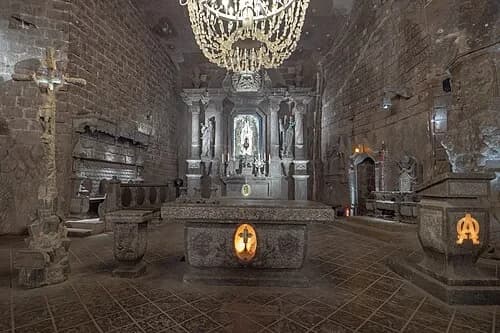
Chapel of Saint Kinga
You are currently in the Chapel of Saint Kinga, widely considered the most spectacular part of the entire mine. This vast hall functions as a subterranean cathedral, and everything you see—from the ornate floor tiles and the grand altars to the intricate wall reliefs—is carved entirely from rock salt. Even the sparkling crystals in the massive chandeliers overhead are actually polished salt. This monumental task was a labor of love that took three brothers and another miner over 60 years of dedicated work to complete. The soft, amber glow from the chandeliers illuminates the grey salt rock, creating a warm and inviting atmosphere despite being over 100 meters underground. The floor has been buffed to a smooth finish, yet it remains pure salt under your feet. This chapel is not merely a museum piece; it remains an active place of worship where Sunday masses and weddings are still held. The acoustics here are exceptional, with the salt walls reflecting sound in a way that creates a rich, resonant environment. Every surface tells a story of artistic vision meeting centuries-old mining tradition, resulting in a sanctuary that feels both ancient and miraculously preserved.
The Erazm Barącz Chamber
Focus on the natural geology and the striking turquoise color of the brine.
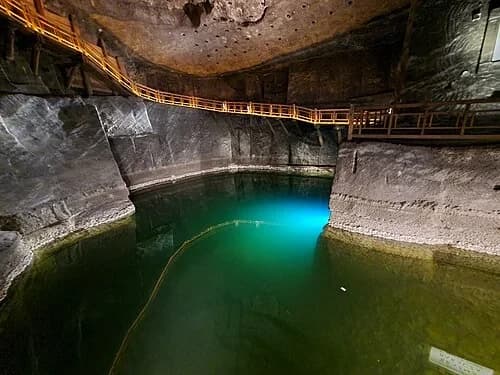
Erazm Barącz Chamber
The Erazm Barącz Chamber offers a view of a stunning underground lake, known for its striking turquoise hue. This vibrant color is a natural result of the high concentration of salt and various minerals dissolved in the water. The lake is approximately nine meters deep, and the brine is so dense that objects cannot sink to the bottom. Surrounding the water are sheer walls of dark rock salt, which show the jagged marks of manual extraction from centuries past. To navigate this vertical space, miners constructed a series of wooden galleries and staircases that appear to cling to the rock faces. These structures allowed workers to move between different levels of the excavation and provided access to the water when needed. The contrast between the colorful water and the dark, somber rock creates one of the most photogenic spots in the mine. Observe how the wooden supports are encrusted with white salt deposits, formed as the salty air evaporates on their surfaces. This chamber highlights the intersection of natural geological beauty and the practical engineering required to work in such an extreme environment.
The Józef Piłsudski Grotto
A historic chamber connecting levels II and III, featuring a commemorative statue.
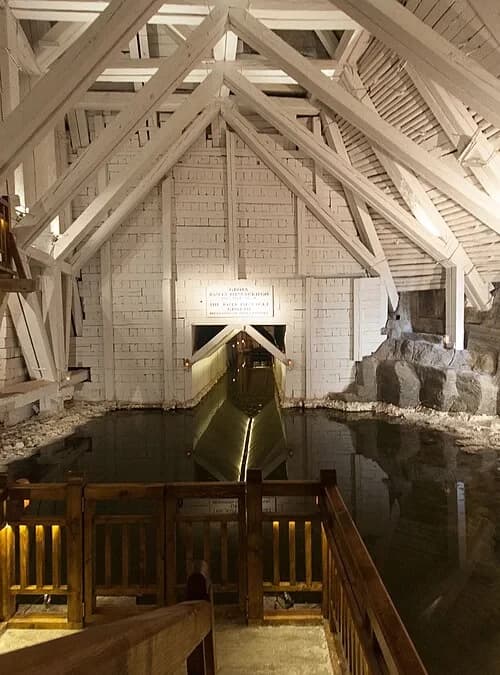
Józef Piłsudski Grotto
This flooded tunnel, known as the Józef Piłsudski Grotto, connects two different levels of the mine and serves as a fascinating window into early tourism. During the 19th century, this was a highlight for adventurous travelers. Visitors would board a small wooden boat and be ferried through the dark, brine-filled passage. To add to the atmosphere, a brass band would often play from the shore, their music echoing through the salt-walled tunnel. It was a romantic, if somewhat eerie, attraction typical of the Victorian era's fascination with industrial and subterranean wonders. The grotto is named after a prominent Polish statesman, reflecting its significance as a site of national interest. The water fills the narrow passage, creating a smooth path through the rock. The timber beams overhead and the stone-lined banks show the efforts made to stabilize this transit route over the decades. While boat tours are no longer a standard part of the visitor experience, the grotto remains a unique architectural feature. It reminds us that even while it was an active workplace, the mine has always held a powerful allure for visitors.
The Regis Shaft
Conclude the underground portion at one of the oldest and most historic exits.
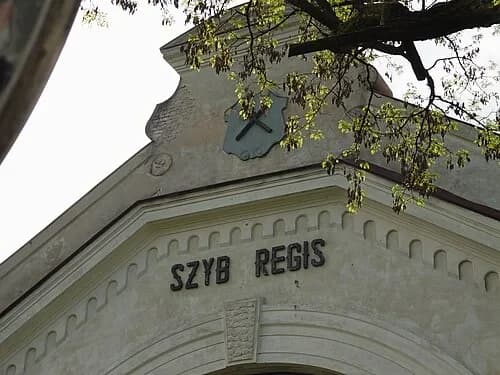
Regis Shaft
The Regis Shaft building is a significant landmark in the mine's history, representing its expansion beyond the medieval town walls. Established in the 14th century, this was the first shaft located outside the original fortifications, signaling a major period of growth for the salt industry. The facade features a crest with crossed hammers, the traditional 'Ku żelazo' symbol of the mining guild. This emblem is a constant presence throughout the town, serving as a reminder of the industry that built this community. The building's architecture, with its arched windows and decorative stonework, reflects the importance and wealth of the mine during its peak. This location often serves as a primary access point for the 'Miners' Route,' a more hands-on tour focusing on the daily tasks of the workers. It acts as a bridge between the deep underground world and the everyday life of the town above. The Regis Shaft has been modernized over the years but retains its historic character, standing as a landmark at one of the mine's many entry points. Its presence above ground is a testament to the seven centuries of activity that occurred beneath its foundation.
The Graduation Tower Park
End the tour on the surface, where visitors can enjoy the health benefits of the brine.
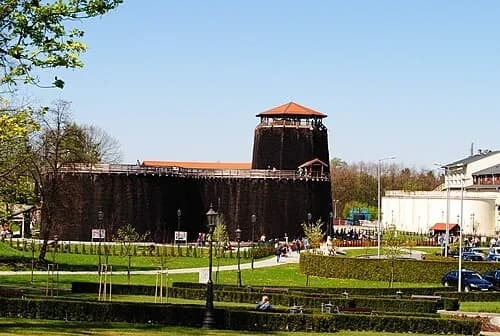
Graduation Tower
The Graduation Tower is a massive structure made from thousands of bundles of blackthorn branches. Brine from the mine is pumped to the top and allowed to trickle down through the dense layers of twigs. As the water evaporates, it creates a salty aerosol in the air, rich in iodine and other minerals. This natural mist is famously beneficial for respiratory health, acting as a giant outdoor inhaler. Visitors often spend time walking around the perimeter or sitting on nearby benches to breathe in the refreshing, salty air—a practice known as halotherapy. It is a perfect conclusion to your visit, allowing you to experience the therapeutic properties of the salt in a completely different environment from the deep chambers below. The tower is surrounded by a peaceful park, offering a moment of quiet after the subterranean tour. Observe how the salt has crusted onto the blackthorn branches over time, giving the structure a rugged, textured appearance. This facility continues the long tradition of utilizing the mine's natural resources for health and well-being, long after the last commercial salt was extracted from the depths.
Want to hear the rest?
Download the Stanza app to unlock all 15 stops and full GPS-guided navigation.
Frequently Asked Questions
How long does the Wieliczka Salt Mine audio tour take?
The Wieliczka Salt Mine audio guide includes 15 narrated stops. Most visitors spend 45 minutes to 1.5 hours exploring the complete tour, though you can listen at your own pace and skip or revisit any stop.
Is the Wieliczka Salt Mine audio guide available in my language?
Stanza supports 15 languages: English, Spanish, French, German, Italian, Portuguese, Russian, Japanese, Chinese, Korean, Arabic, Hindi, Polish, Dutch, Hebrew. Check the guide in the app to confirm the languages currently available for this tour.
Can I use the audio guide offline at Wieliczka Salt Mine?
Yes! Download the complete Wieliczka Salt Mine tour — including all audio, maps, and images — before your visit. The Stanza app works completely offline, so you don't need WiFi or mobile data at the venue.
How much does the Wieliczka Salt Mine audio guide cost?
The Stanza app is free to download. The current listed price for the Wieliczka Salt Mine audio guide is $1.99; app-store region and currency may affect the final price.
How do I use the Stanza audio guide at Wieliczka Salt Mine?
Download the free Stanza app, search for "Wieliczka Salt Mine", and download the tour. When you arrive at the venue, the app uses GPS to detect your location and automatically plays the relevant narration as you move between points of interest — completely hands-free.
What makes the Stanza audio guide different from other Wieliczka Salt Mine tours?
Stanza offers GPS-triggered narration that plays automatically as you walk through Wieliczka Salt Mine — no need to manually select stops. The tour is available in 15 languages, works fully offline, and includes 15 expertly narrated stops with images and historical context.
What other audio guides are available near Wieliczka Salt Mine?
Stanza offers multiple audio guides in Wieliczka, Poland and nearby areas. After downloading the app, browse the map to discover all available tours near Wieliczka Salt Mine. Each guide can be downloaded for offline use.