Stanza · Audio guide
Kasubi Tombs Audio Guide
A place to remember. A story to take with you.
The Kasubi Tombs in Kampala serve as the burial grounds for four kabakas and members of the Baganda royal family. The site is a significant spiritual and political location that features traditional…
Download Stanza, then search for “Kasubi Tombs”.
About the tour
One guide. Your kind of visit.
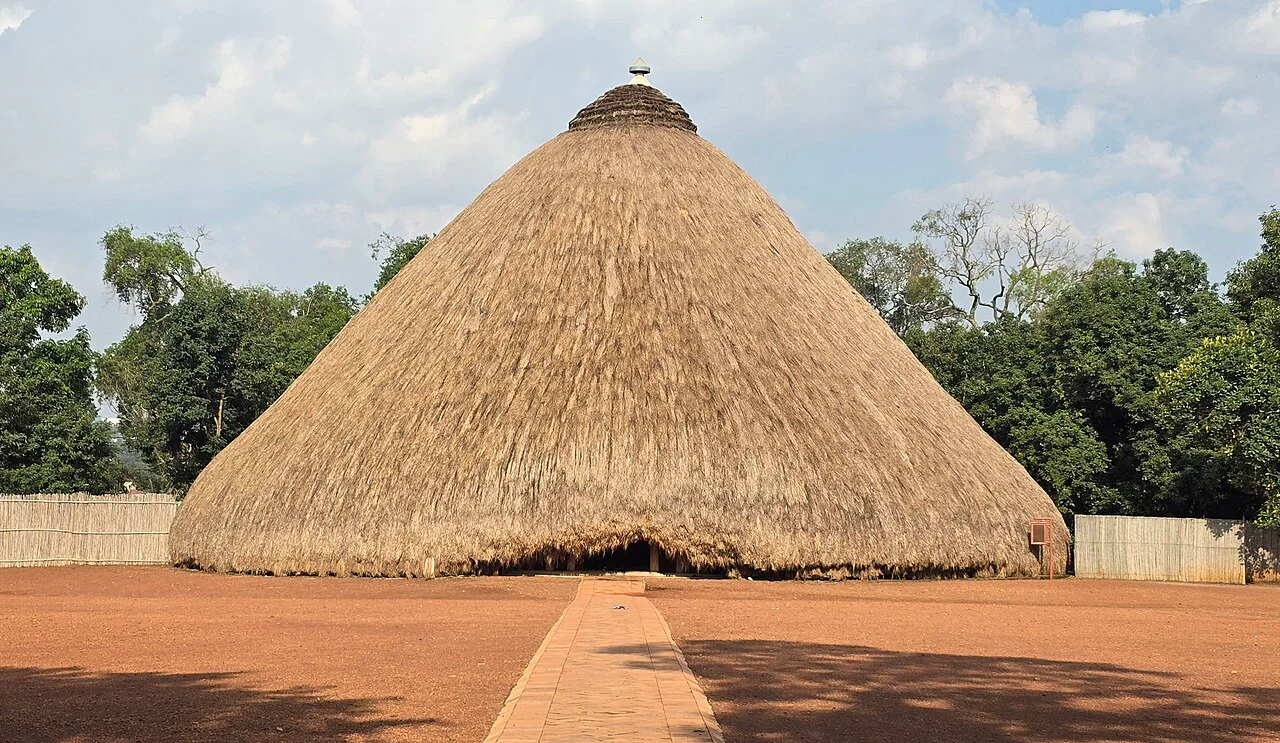
The Kasubi Tombs in Kampala serve as the burial grounds for four kabakas and members of the Baganda royal family. The site is a significant spiritual and political location that features traditional architecture made from vegetal materials.
Ready when you are.
- 01Get the free Stanza app.
iOS & Android
- 02Find your guide.
“Kasubi Tombs”
- 03Download before you go.
Works offline
Audio guide / 11 narrated stops
Inside the guide
Get to know a few of the stories before you go. Open a stop to read more.
01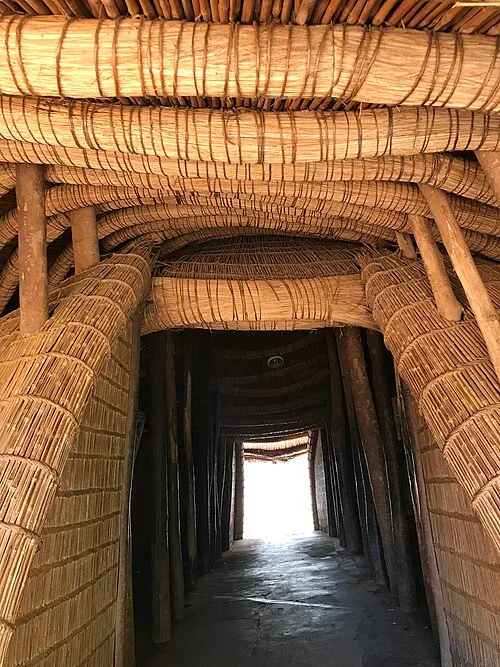 Bujjabukula Gatehouse
Welcome to the Kasubi Tombs, on a hilltop just northwest of Kampala. The passage here runs beneath a ceiling of bundled reeds and poles, lashed together with fibre. Nearly everything on this hill is built from plants. In 1882 the hill carried a royal palace, raised by Kabaka Muteesa I. He was the thirty-fifth king of Buganda. He built to replace a palace his father, Ssuuna II, had raised in 1820. When Muteesa died in 1884, the palace became his tomb, and then the burial ground of the kings who followed. The boundaries drawn around the site in 1882 still hold, marked by barkcloth fig trees standing against the housing that now presses in on every side. In December 2001 the site was listed by UNESCO as a World Heritage Site. Beyond this gatehouse lie a small courtyard, a drum house, and the great domed tomb.
Photo: Jim Joel · CC BY-SA 4.0
02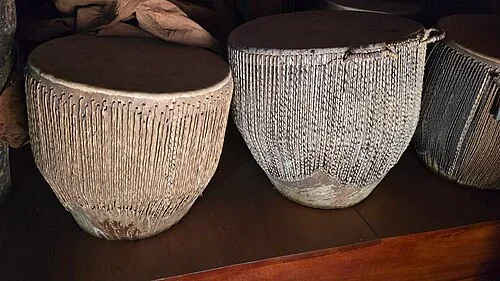 Ndoga-Obukaba (The Royal Drum House)
Royal Drums of the Ndoga-Obukaba
Beside the gatehouse stands the Ndoga-Obukaba, the royal drum house. Inside, drums wrapped in hide and coiled cord sit in the half-dark. The great drum of the kingdom was the Gwanga Mujje, a name meaning the drum that gathers the nation. When it sounded, the Baganda knew their king was calling them to him. Before telephones or loudspeakers, a drum could reach farther than any voice, and it announced both war and ceremony at court. That is why a house for drums stands inside the tomb enclosure, close behind the guard's passage. The drums here still hold their ceremonial place at the tombs. Which of them is the original Gwanga Mujje, and which came later, is not said for certain.
Photo: Z thomas · CC BY 4.0
03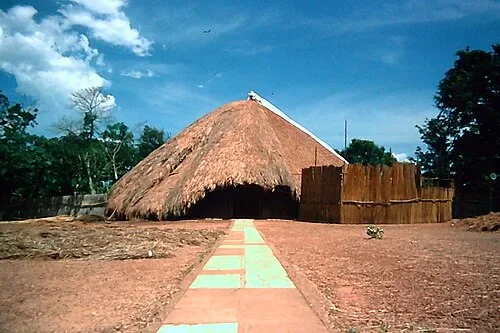 Olugya (Ceremonial Courtyard)
The Olugya Courtyard
Through the drum house, the way opens onto the Olugya, a broad circular courtyard on the hilltop, ringed by a tall fence of reeds. The plan is a deliberate sequence: gatehouse, small courtyard, drum house, then this main courtyard, with the tomb at its far side. The whole site covers about twenty-six hectares of the hill. Most of that is open farmland, worked with traditional techniques, and the crops are part of the site's life rather than scenery beside it. The reed fence encloses the ceremonial ground the way a palace court would. At the far edge of the courtyard, under its own cone of thatch, stands the great house of the kings.
Listen in the appGunnar Ries zwo · CC BY-SA 2.0
04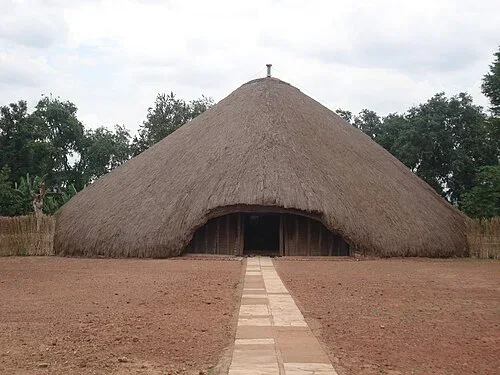 Muzibu Azaala Mpanga Exterior
Muzibu Azaala Mpanga, Exterior
The great house at the end of the courtyard is called Muzibu Azaala Mpanga. It is circular in plan, swelling into a vast dome of thatch. It measures about thirty-one metres around and rises about seven and a half metres. When UNESCO listed the site, it called this one of the most remarkable buildings using purely vegetal materials in the entire region of sub-Saharan Africa. Grass, reeds, poles and palm fronds give the house its face. The building straddles the border of the courtyard, on the edge opposite the entrance, facing its grounds the way a palace would. That placement is a surviving trace of the time when a king lived here. From the courtyard it reads as one smooth cone of straw, with a low wide arch at its base.
Listen in the appLazare Eloundou Assomo · CC BY-SA 3.0 igo
05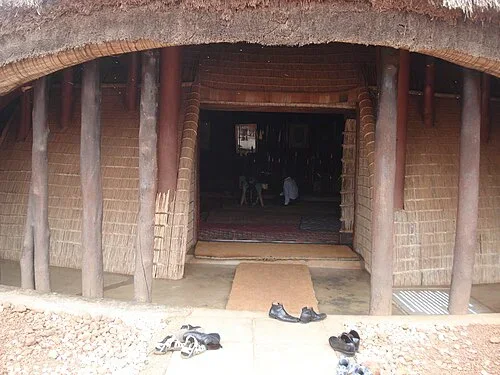 Muzibu Azaala Mpanga Exterior
The Threshold of the Sacred House
At the entrance, shoes come off. Pairs of them sit on the pavement outside the low, wide arch, and visitors cross the threshold barefoot onto mats of lemon grass and palm leaf. Taking off footwear is part of the etiquette of a sacred royal place. The arch itself marks the passage from the public courtyard into the sacred spaces within. This approach once led to a living king's palace; it now leads into his tomb. The pause at the doorway is a small ceremony of its own, a moment of respect before going in.
Listen in the appLazare Eloundou Assomo · CC BY-SA 3.0 igo
06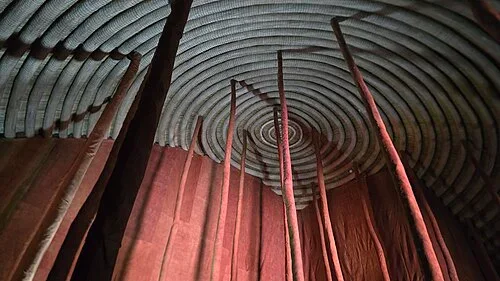 The Great Dome and 52 Clan Rings
Inside the Great Dome
Inside, the space rises in one tall circle, held by wooden pillars, with reed partitions dividing the sacred rooms. The original recipe for the building was simple: wooden poles, reed wattle and daub, all crowned by a thick thatched dome. In 1938 Kabaka Mutesa II carried out the last major renovation, and he brought in modern materials. A steel structure, concrete columns and bricks went into the fabric, largely hidden behind the traditional surfaces. From outside, and mostly within, the house still shows the face that tradition gave it. The old materials keep the look; the new ones quietly do the structural work.
Listen in the appPhoto: Z thomas · CC BY 4.0
07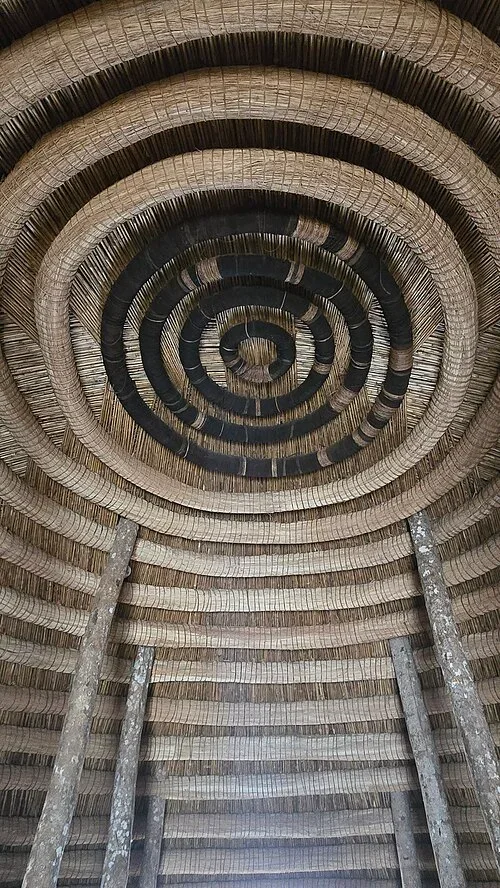 The Great Dome and 52 Clan Rings
Fifty-Two Rings Above the Tombs
Overhead, rings of palm fronds coil upward through the thatch, and the straw of the dome rests on them. There are fifty-two rings, one for each of the traditional clans of the Baganda. The roof also carries the site's hardest story. Late on the evening of 16 March 2010, fire destroyed the main thatched buildings. The cause has never been established. The Buganda kingdom answered with a grassroots fundraising campaign called Etofaali, a name that means brick. A UNESCO mission helped plan the reconstruction, and the government of Japan funded the work. Rebuilding began in 2014. It was finished in 2023, and the site then left the List of World Heritage in Danger. The fifty-two rings now crown a dome that the whole nation helped raise.
Listen in the appPhoto: Z thomas · CC BY 4.0
08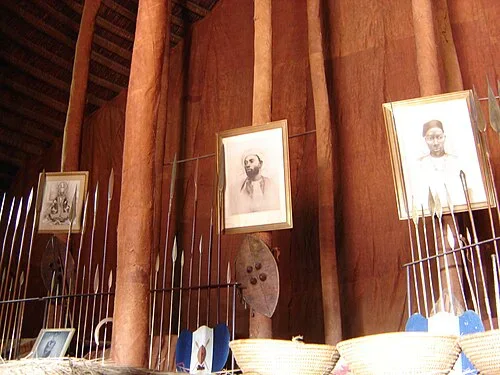 The Kibira and Royal Ancestors
Portraits and Regalia of the Four Kabakas
Portraits of the buried kings hang among spears and shields, the regalia of the monarchy. Four Kabakas of Buganda lie together here, in a kingdom that has buried its rulers at separate sites since the thirteenth century. The first was Muteesa I, who died in 1884. Mwanga II died in exile on the Seychelles in 1903. His remains were brought home in 1910. Daudi Chwa II is the third. The fourth, Sir Edward Muteesa II, died in London in 1969. His remains returned in 1971. Both of those kings came home from exile to lie among their ancestors, and the spears and shields around their portraits keep their office present in the house.
Listen in the appnot · CC BY-SA 2.0
09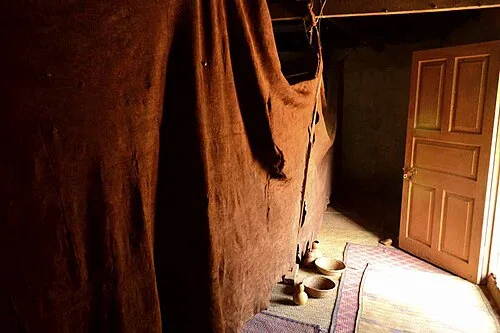 The Kibira and Royal Ancestors
The Kibira and the Barkcloth Curtain
Deep within the house, behind a curtain of barkcloth, lies the Kibira, the sacred forest where the royal tombs stand. The cloth hangs to keep that place hidden from every public view. Barkcloth itself is a soft brown fabric, beaten from the inner bark of fig trees. In the old custom of Buganda, a king's soul was believed to live in his jawbone. The jawbone was therefore enshrined in a place of its own, apart from the body. Muteesa I broke with that ancestral custom at Kasubi and kept body and jawbone together. The kings who followed him did the same, and that break shaped the royal burials on this hill.
Listen in the appDiego Tirira from Quito, Ecuador · CC BY-SA 2.0
10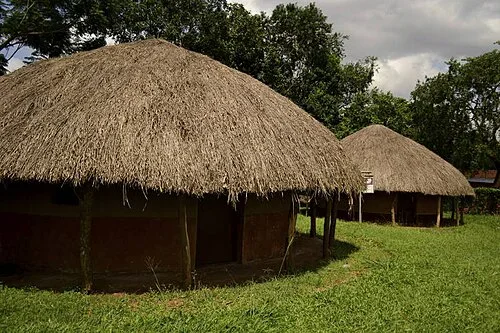 Royal Widows' Quarters
The Widows' Houses
Around the courtyard stand round houses with steep thatched cones, built of wattle and daub. Some are the houses of the deceased kabakas' widows, who tend the family graves. Others are the residences of royal officials. The Nalinya serves as spiritual guardian of the tombs. Her deputy, the Lubuga, coordinates the farming on the site. The Katikkiro is her administrative assistant. Over time, some of the houses have been rebuilt with bricks and given metal roofs, though the traditional straw thatch remains on others. This is a royal place still lived in and tended, day by day.
Listen in the appDiego Tirira from Quito, Ecuador · CC BY-SA 2.0
- 11
Barkcloth and the Living Craft
Barkcloth painting and traditional thatching, crafts still alive at Kasubi.
Kasubi Tombs
Frequently asked questions
How much does the guide cost?
Free app download. Listed guide price: $0.99. Guide price shown in the app. Audio guide only. Venue admission is separate.
Can I listen without internet?
Yes. Download the guide’s audio, images, and maps in the app before your visit. Your downloaded content is then available offline.
Can I listen in my language?
This audio guide is available in 15 languages, including English.
Do I need to follow a schedule?
No. This is a self-guided experience. Choose your stops, pause whenever you like, and return to a story at your own pace.
At your own pace
Explore Kasubi Tombs.
Download Stanza, then search for “Kasubi Tombs”.
Free app download · Guide price shown in the app