Stanza · Audio guide
Sheikh Zayed Grand Mosque Audio Guide
A place to remember. A story to take with you.
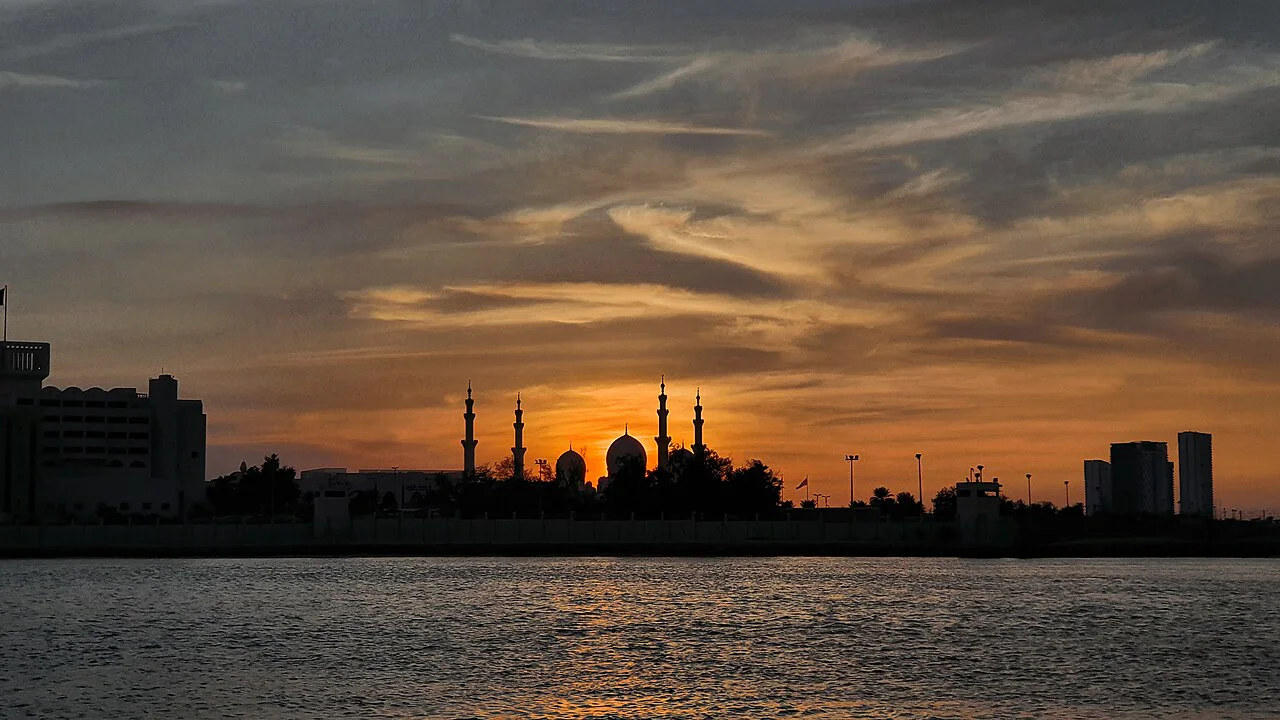
The Sheikh Zayed Grand Mosque is located in Abu Dhabi and serves as the country's largest mosque. It is the key place of worship for daily Islamic prayers.
Download Stanza, then search for “Sheikh Zayed Grand Mosque”.
About the tour
One guide. Your kind of visit.
The Sheikh Zayed Grand Mosque is located in Abu Dhabi and serves as the country's largest mosque. It is the key place of worship for daily Islamic prayers.
Ready when you are.
- 01Get the free Stanza app.
iOS & Android
- 02Find your guide.
“Sheikh Zayed Grand Mosque”
- 03Download before you go.
Works offline
Audio guide / 14 narrated stops
Inside the guide
Get to know a few of the stories before you go. Open a stop to read more.
01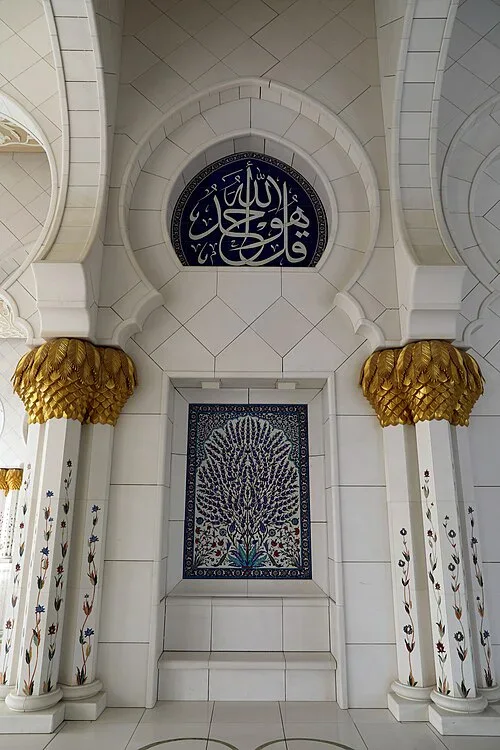 Reflecting Pools and Outer Colonnade
The Outer Colonnade: A Vision Begun
Welcome to the Sheikh Zayed Grand Mosque in Abu Dhabi, the largest mosque in the United Arab Emirates and the country's key place of daily worship. The project began with Sheikh Zayed bin Sultan Al Nahyan, the first president of the UAE. He wanted a building that would unite the cultural diversity of the Islamic world with both historical and modern architecture and art. Ground was broken in 1996, and the mosque was completed and inaugurated in 2007. Sheikh Zayed died in 2004, before the work was finished, and he was buried in the courtyard of his own mosque. Above the niche in this arcade arches a deep blue medallion, ringed with white Arabic calligraphy. Sacred text runs through the building like this, woven into tile, stone and wall. Over the next stops, the same idea of unity keeps reappearing, in gold, in gemstone flowers, and in marble brought from across the world.
Francesco Bini · CC BY-SA 4.0
02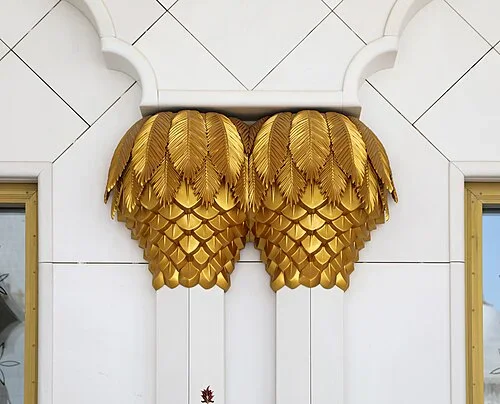 Reflecting Pools and Outer Colonnade
The Golden Palm-Frond Capitals
At the top of these paired columns, the capitals bloom into gilded palm fronds, every leaf cast and layered like a real date palm. The palm is the signature plant of the Gulf, the tree that made settlement here possible at all, so it crowns the columns of a mosque built in the desert. It is also a clue to a rule that governs the whole building. The designers chose natural materials for their lasting qualities: marble stone, gold, semi-precious stones, crystals and ceramics. Almost nothing here is paint or imitation. The gold leaf on these fronds, the carved marble behind them and the ceramics further in are all the real thing, chosen to outlast the weather and the years. That decision shapes every surface the eye meets, from these capitals down to the flowers inlaid in the pillars nearby.
Francesco Bini · CC BY-SA 4.0
03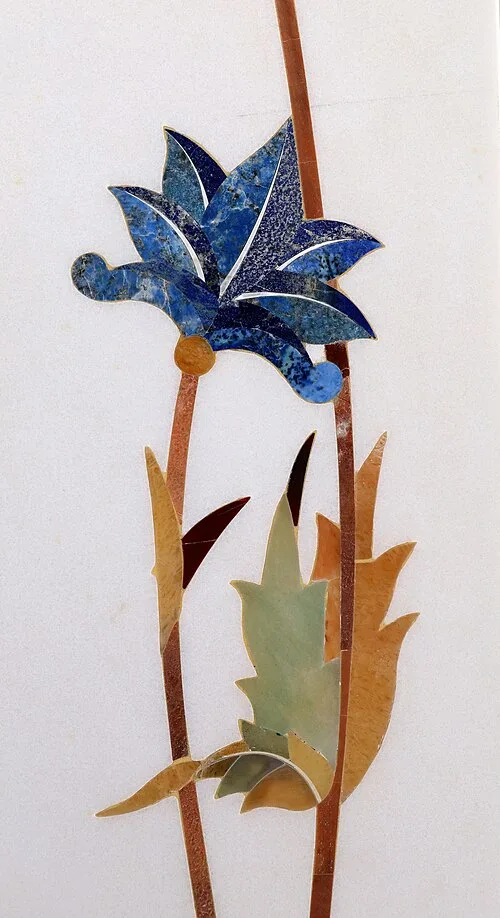 Reflecting Pools and Outer Colonnade
Flowers in Stone: The Hardstone Inlays
One blue flower, cut from lapis lazuli, opens on the white face of this pillar. Around the mosque, marble is inlaid with a whole palette of stones: lapis lazuli like this, carnelian, amethyst, abalone shell and mother of pearl. Craftsmen cut each petal and stem to fit, then set the pieces into the pale stone so the flower seems to grow out of it. The blue of the lapis carries flecks and veins that no paint could copy. These inlay traditions come from different craft cultures, and here they were brought together on a single building. The same white marble runs for miles of wall and column, and the flowers keep surfacing along it, one blossom at a time.
Listen in the appFrancesco Bini · CC BY-SA 4.0
04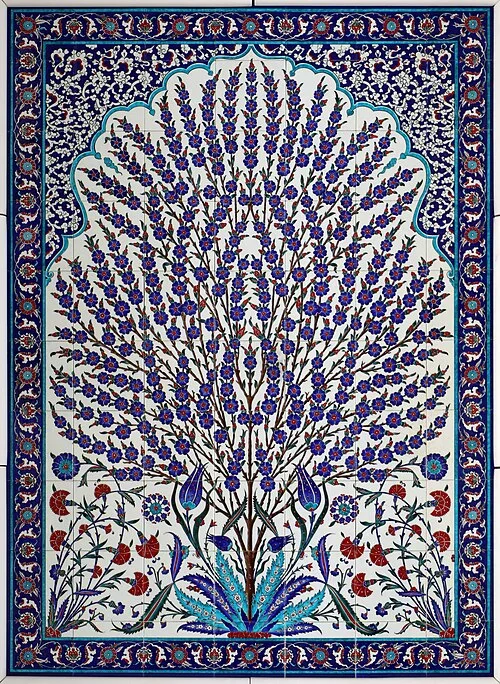 The Sahan (Main Courtyard) Arcades
Ottoman-Style Ceramic Panels: The Cypress Panel
A slender cypress tree rises through this glazed ceramic panel, its branches heavy with small blue blossoms. The design speaks the language of Ottoman Iznik tilework, the tradition that covered the mosques of Istanbul in cypresses, tulips and carnations centuries ago. Those tiles were made to survive heat, steam and centuries of prayer, and their deep blues and greens still glow under glaze. This panel quotes that inheritance deliberately, in a twenty-first-century Emirati mosque. Panels like it line the arcades that frame the great central courtyard, the space the mosque calls the Sahan. Tile by tile, the old imperial vocabulary of Ottoman ceramics now frames a courtyard in Abu Dhabi.
Listen in the appFrancesco Bini · CC BY-SA 4.0
05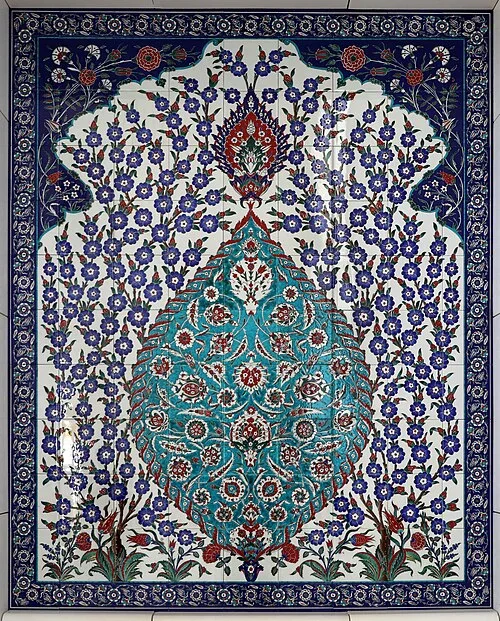 The Sahan (Main Courtyard) Arcades
A Mosque Made by the World
Beside the cypress panel hangs its companion, a teardrop medallion wreathed in vines, another voice of the same tile tradition. The vision told at the Outer Colonnade, a mosque uniting the Islamic world, was carried out by hands from many countries. Artisans and materials arrived from Syria, especially Damascus and Aleppo, and from India, Italy, Germany, Turkey, Pakistan, Malaysia, Iran, China, the United Kingdom, New Zealand, North Macedonia and the Emirates themselves. More than three thousand workers laboured on the site. Thirty-eight subcontracting companies shared the work between them. Each craft came with its own masters: carvers, tile painters, inlayers, weavers. Panels like these two are the founding idea made visible, many traditions sitting side by side on one wall.
Listen in the appFrancesco Bini · CC BY-SA 4.0
06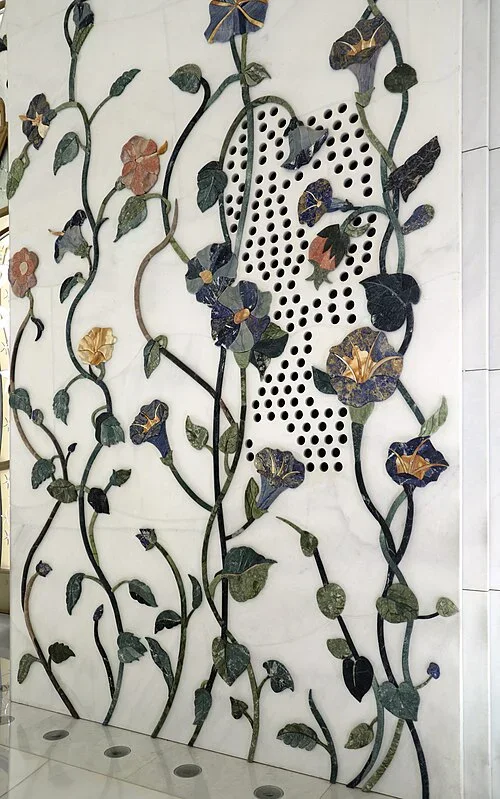 The Foyer (Lobby of Flowers)
The Foyer of Flowers
Flowering vines climb this foyer wall in raised stone, their blooms cut from coloured hardstone and curling around a lattice of pierced marble. The flower is the mosque's favourite word, and its longest sentence lies just beyond this stop, in the great courtyard called the Sahan. There, the British artist Kevin Dean designed the floral marble mosaics, embracing Sheikh Zayed's ideal of a mosque that unites the world. He chose flowers of the Middle East, tulips, lilies and irises, so the region's own plants would carry the message. The courtyard spreads over about seventeen thousand square metres, and it is considered the largest example of marble mosaic in the world. This wall speaks the same design language in relief, a rehearsal for the expanse of flowers waiting past the doors.
Listen in the appFrancesco Bini · CC BY-SA 4.0
07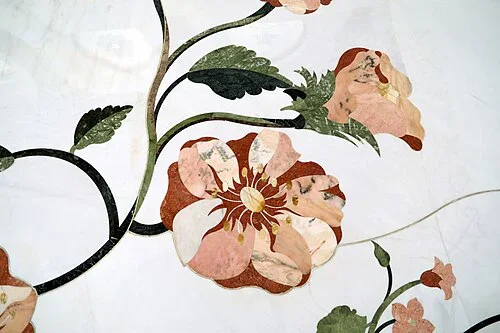 The Foyer (Lobby of Flowers)
Marble from Afar
Roses and trailing stems are laid into this floor in opus sectile, the old craft of cutting stone into shaped pieces that fit together like a puzzle. The marble itself travelled far to lie here. East White and Ming Green came from China, the quiet whites and pale greens that give the mosque its luminous surface. Makrana marble from India, the stone of older monuments, was used in the annexes and offices. Across the building, these stones are inlaid with precious materials, so the floors bloom as richly as the walls. The mosque remains in active civic life, a significant destination for visiting foreign leaders, among them Queen Elizabeth the Second. The stone underfoot has already received heads of state.
Listen in the appFrancesco Bini · CC BY-SA 4.0
08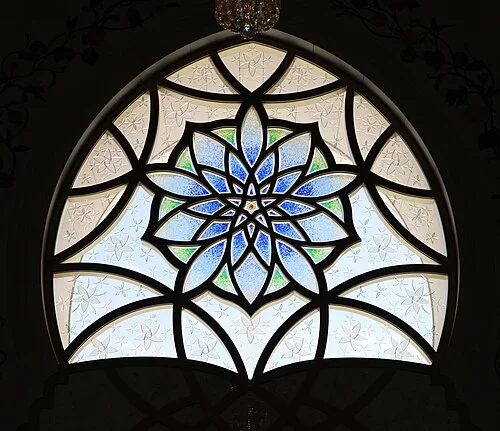 The Foyer (Lobby of Flowers)
Stained Glass at the Threshold
A stained-glass window opens in a pointed arch, its blue and green petals radiating from a star at the centre. Light has always been a material in mosque architecture, shaped and softened before it reaches the worshipper. Here the glass does that work at the threshold between the bright courtyard and the dimmer halls beyond. Every pane is bounded by flower-shaped leadwork, so the daylight arrives already patterned. The glow shifts through the day as the sun moves, cooling and warming the foyer in turn. Even before the prayer hall opens its doors, the light has begun telling visitors where they are heading.
Listen in the appFrancesco Bini · CC BY-SA 4.0
09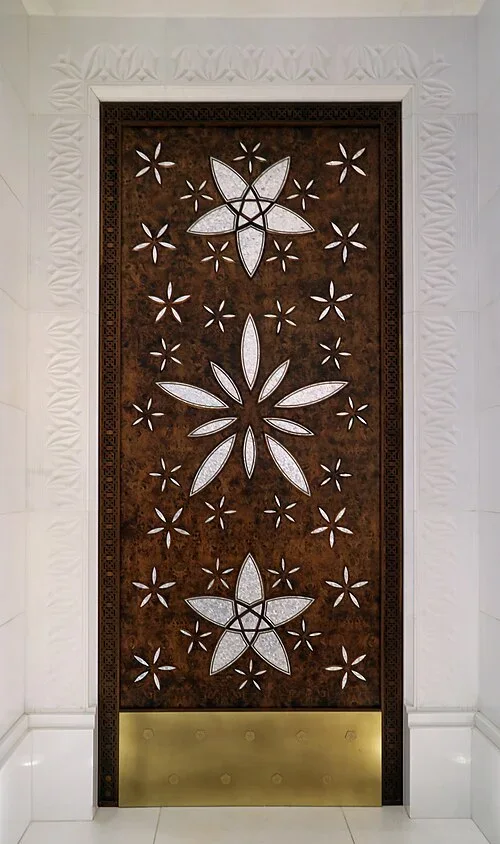 The Prayer Hall Threshold
The Door to the Prayer Hall
A tall bronze door stands in its white frame, scattered with stars inlaid in mother of pearl, three great blooms rising one above the other. This is the passage from foyer to main prayer hall, and the numbers behind it are remarkable. The whole complex can hold over forty thousand worshippers. The main prayer hall takes more than seven thousand of them. Two smaller halls hold fifteen hundred each, and one of those is the women's prayer hall. Before anyone crosses a threshold like this one, the practice is the same: shoes come off, because the halls beyond are fully carpeted for prayer. The door with its pearly stars opens onto a floor built to be touched by bare feet.
Listen in the appFrancesco Bini · CC BY-SA 4.0
10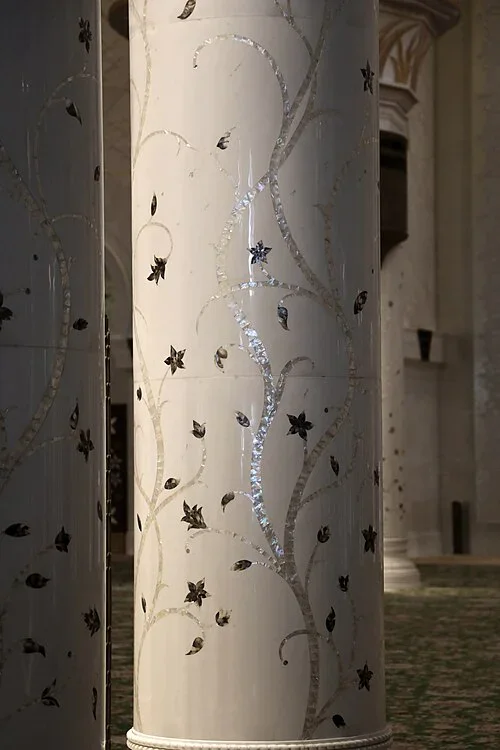 The Prayer Hall Threshold
Columns of Mother of Pearl
Slender vines of mother of pearl wind up this pale column, their leaves and five-petalled stars catching the light as the eye moves. The main prayer hall holds ninety-six columns like it, each clad in marble and inlaid with the same shimmering shell. Craftsmanship of this kind at this scale is rarely seen anywhere else. Mother of pearl is a humble material, the inner lining of an oyster, yet cut into thin tendrils it turns a structural column into a garden. The design repeats ninety-six times around the hall, so wherever a worshipper stands, a vine of light climbs beside them. Plant life, the mosque's constant theme, has climbed indoors and up the pillars.
Listen in the appFrancesco Bini · CC BY-SA 4.0
- 11
The World's Largest Hand-Knotted Carpet
The giant hand-knotted carpet: two billion knots, two years, twelve hundred weavers.
- 12
The Great Chandelier
Seven chandeliers from Munich, hung with millions of Swarovski crystals.
- 13
Under the Dome
Eighty-two domes, and the Syrian architect who looked to Lahore and Alexandria.
- 14
The Prayer Clock and the Qibla Wall
The prayer clock, the qibla wall, and a building aligned on Mecca.
Sheikh Zayed Grand Mosque
Frequently asked questions
How much does the guide cost?
Free app download. Listed guide price: $0.99. Guide price shown in the app. Audio guide only. Venue admission is separate.
Can I listen without internet?
Yes. Download the guide’s audio, images, and maps in the app before your visit. Your downloaded content is then available offline.
Can I listen in my language?
This audio guide is available in 15 languages, including English.
Do I need to follow a schedule?
No. This is a self-guided experience. Choose your stops, pause whenever you like, and return to a story at your own pace.
At your own pace
Explore Sheikh Zayed Grand Mosque.
Download Stanza, then search for “Sheikh Zayed Grand Mosque”.
Free app download · Guide price shown in the app