Stanza · 音声ガイド
ソローリャ美術館 音声ガイド
心に残る場所。持ち帰りたくなる物語。
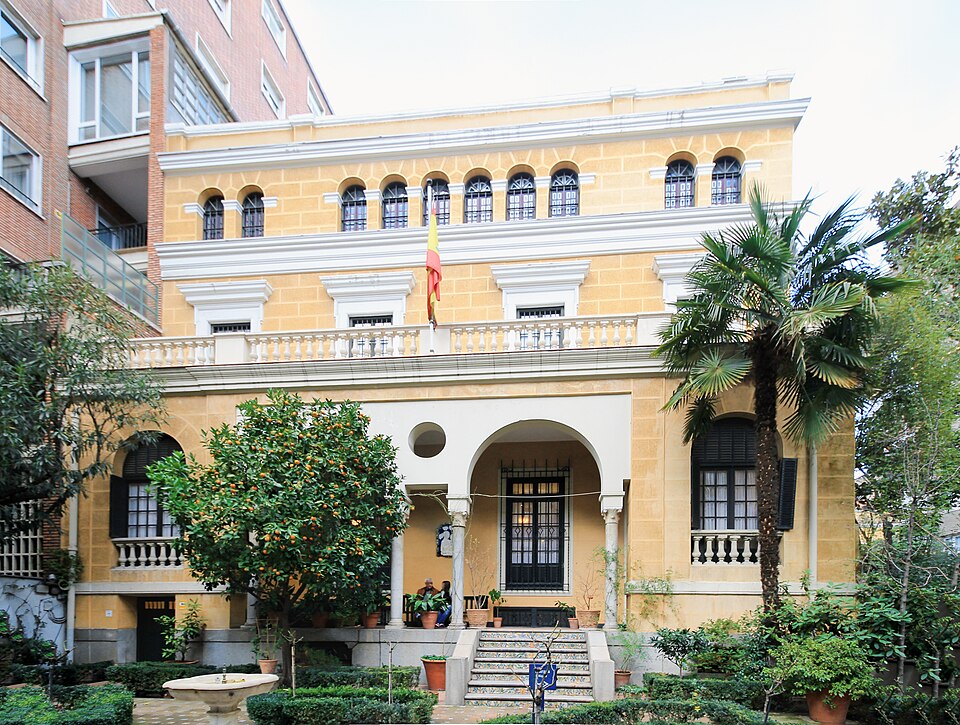
スペインのマドリードにあるこの美術館は、スペインの印象派画家、ホアキン・ソローリャの作品を展示しています。この建物は、かつて画家の自宅兼アトリエだった場所を利用しており、彼の個人的なコレクションや作品が当時のまま保存されています。
現在は英語のみ。ほかの言語も近日対応。
Stanzaをダウンロードして検索: “ソローリャ美術館”.
ツアーについて
ひとつのガイド。あなたらしい見学。
スペインのマドリードにあるこの美術館は、スペインの印象派画家、ホアキン・ソローリャの作品を展示しています。この建物は、かつて画家の自宅兼アトリエだった場所を利用しており、彼の個人的なコレクションや作品が当時のまま保存されています。
好きなときに出かけよう。
- 01Stanzaを無料でダウンロード。
iOS & Android
- 02ガイドを見つける。
“ソローリャ美術館”
- 03訪問前にダウンロード。
オフライン
音声ガイド / 35作品
ガイドの内容
訪問前に物語の一部をご覧ください。スポットを開くと詳しく読めます。
01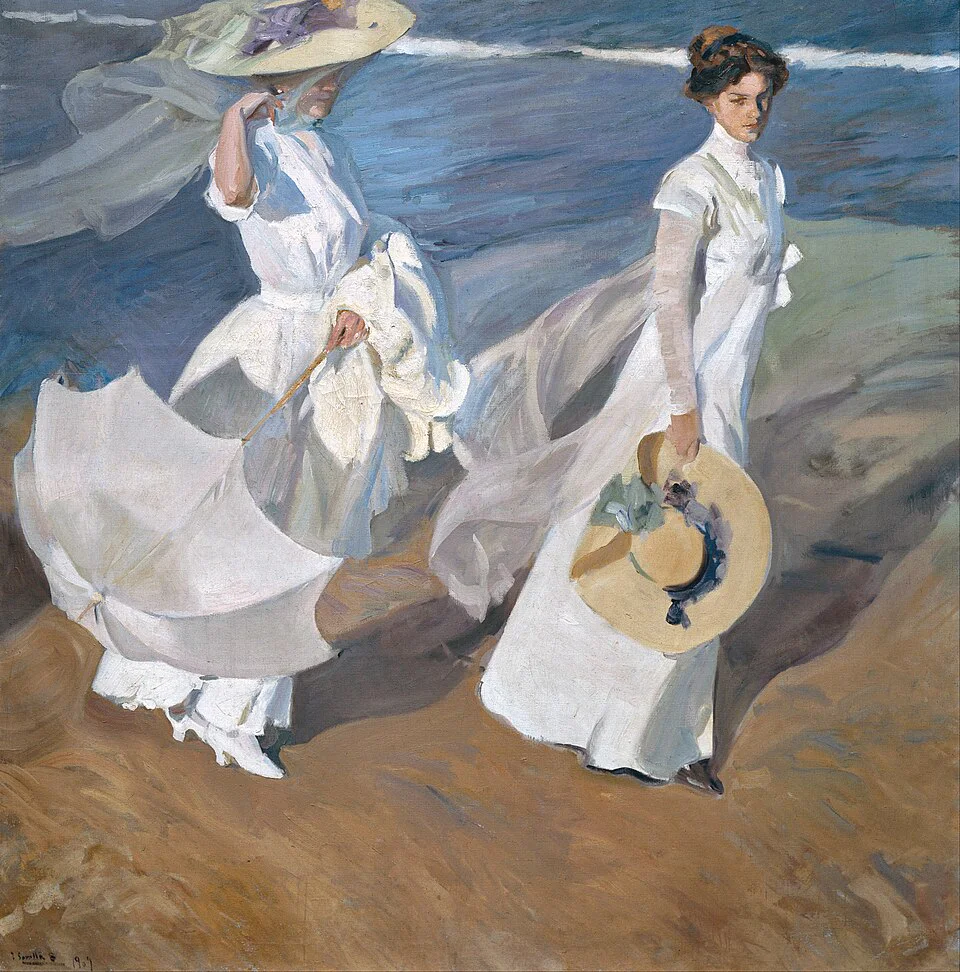
Walk on the Beach
It looks like the most peaceful walk in the world. Two women in white, and the sea behind them. But nothing here is still. Walk on the Beach, by Joaquín Sorolla. It is the summer of 1909 in Valencia, his hometown. He is back from a big show in New York, and he needs new paintings. He paints his wife and his eldest daughter, life size. Start with the girl on the right. Maria is nineteen. Her hair is pinned in a knot, so nothing hides her face. Her face is turned to the low evening sun. In her hand, a straw hat with a turquoise bow and purple flowers. She carries it. She does not wear it. Now her mother, Clotilde. Her face is almost gone. The wide hat throws it into shadow, and only the lower part catches light. The wind has flung her veil back, nearly flat. Her hand goes up, as if to hold it in place. The daughter in the sun. The mother in the shadow. Now the white. Their dresses are white. Or so you think. Look closer. Blue and grey lie in the folds. Cream in the light. Sorolla mixed that white with blue, with yellow, with lilac, with orange. Those colours make the light and the shadow. Behind the girl, a long panel of cloth streams away. The sea wind twists it into curls. Her sleeves are sheer, and her skin shows through. The mother's parasol is open and tipped toward the sand. Long shadows run behind them. The sun is low. Look up. There is no horizon. A curl of white foam sits where it should be. It looked like the most peaceful walk in the world. Now look again. Even the white is moving.
アプリで聴くJoaquín Sorolla · Public domain
02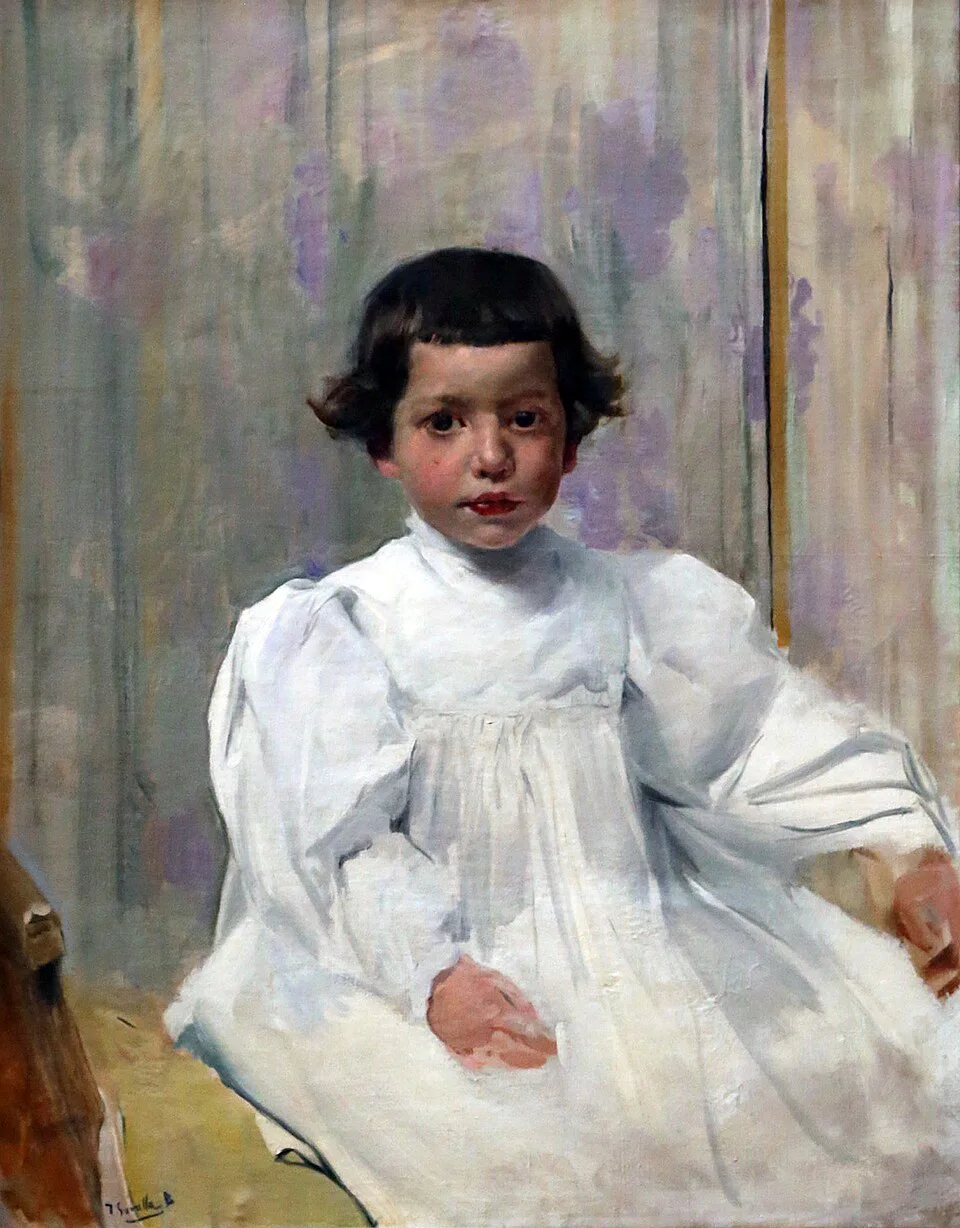
Joaquín Sorolla García dressed in white
A young child dressed all in white is seated upon a wooden sofa. In Joaquín Sorolla García dressed in white, painted in 1896 by Joaquín Sorolla, you see his son posing for the portrait. His left arm rests on the armrest while his right hand rests on his legs. Behind the figure, a colourful curtain composed of grey, mauve, and light brown tones surrounds the child. Look at how the background curtain makes the white suit and the whole portrait appear brighter.
アプリで聴くJoaquín Sorolla · CC BY-SA 4.0
03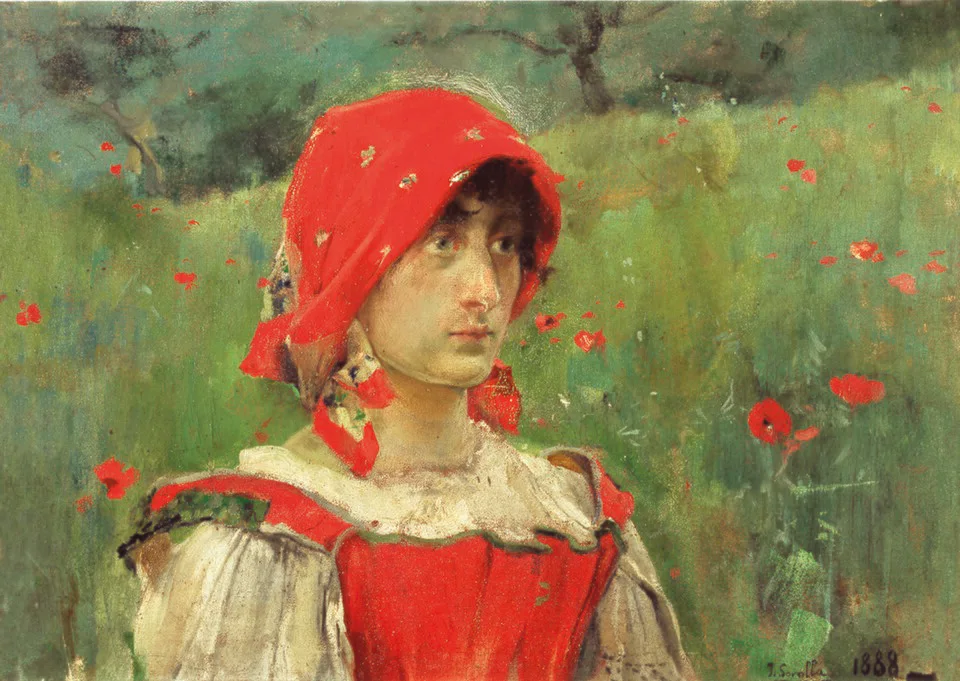
Peasant Woman from Assisi
At first, your eye is drawn to the woman standing still in the landscape, wearing a red scarf and matching red bodice over her white blouse while she slightly turns her head to the right. Joaquín Sorolla painted Peasant Woman from Assisi in 1888, during his time in Assisi, a small Italian town. He always wanted to capture real, natural beauty. Around her stands a landscape filled with growing plants and bright red poppies. The scene comes together through vivid natural hues paired with loose brush work. Now look back at the woman's head, where the red scarf tied at the back of her neck now appears as part of a carefully captured realistic scene from Assisi.
アプリで聴くJoaquín Sorolla · CC BY-SA 4.0
04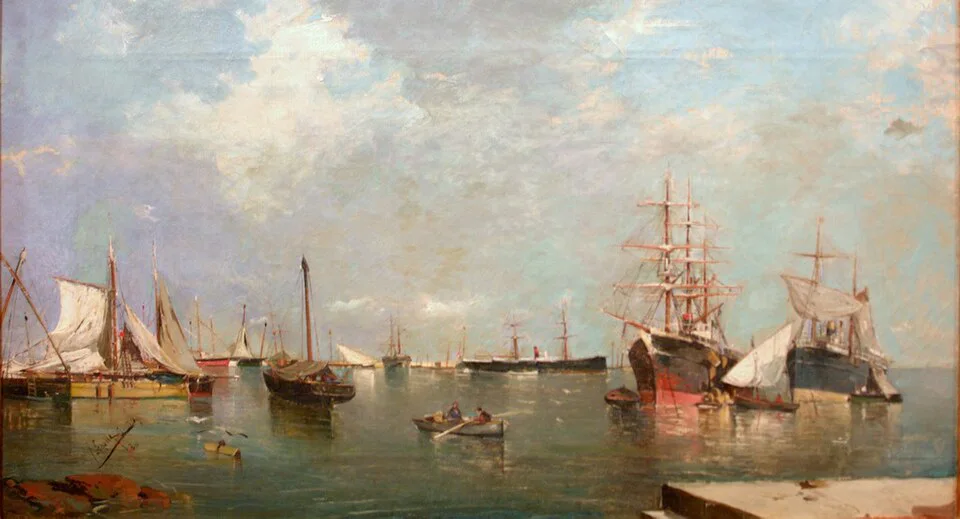
Harbour
Seascapes fill the frame. Painted in 1881, Harbour by Joaquín Sorolla is an early work. It follows the Spanish academic style of the late nineteenth century. Central European post-romantic traditions of seascapes shape the approach, along with Rafael Monleón y Torres, who worked as a Valencian pilot and archaeologist as well as a painter. It is a small canvas, painted when Sorolla was only starting out.
アプリで聴くJoaquín Sorolla · Public domain
05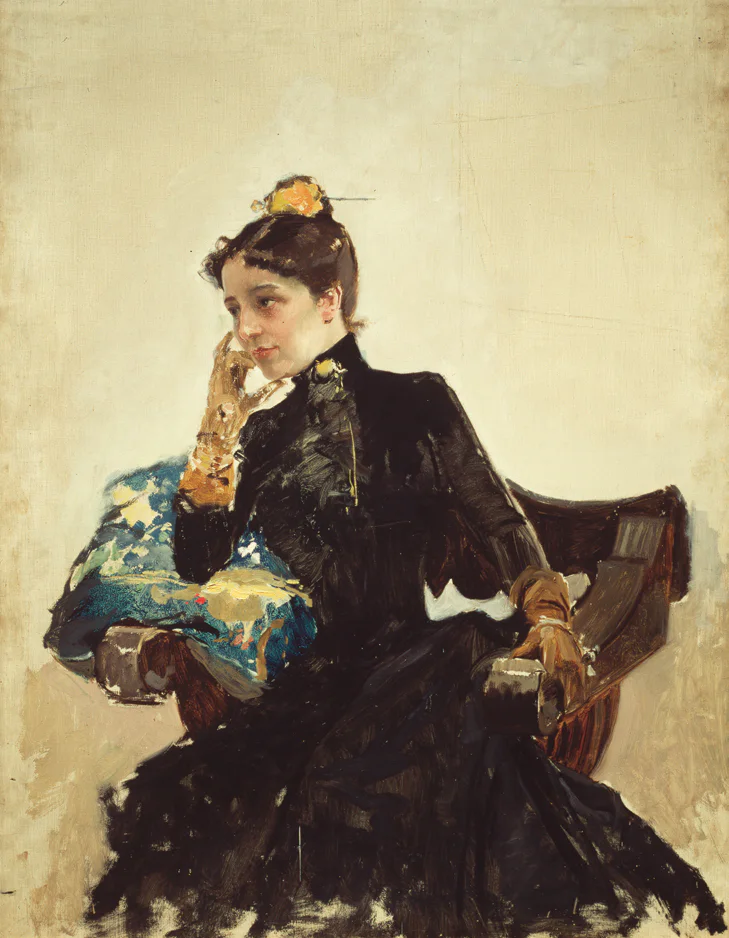
Clotilde García del Castillo
She sits on a wooden chair in an elegant black high neck gown and brown gloves, her hair bound at the top and crowned with a yellow flower. In Clotilde García del Castillo painted in 1890 by Joaquín Sorolla, she takes a tilted posture on the right side. Her right hand rests firmly on a pillow on the chair, with her fingers touching her cheek and chin. Her left hand rests on the armrest. Behind her, a light and neutral background flattens the canvas and removes any notion of perspective. Look at that pale space again. It is painted following a technique used by Diego Velázquez.
アプリで聴くJoaquín Sorolla · CC BY-SA 4.0
06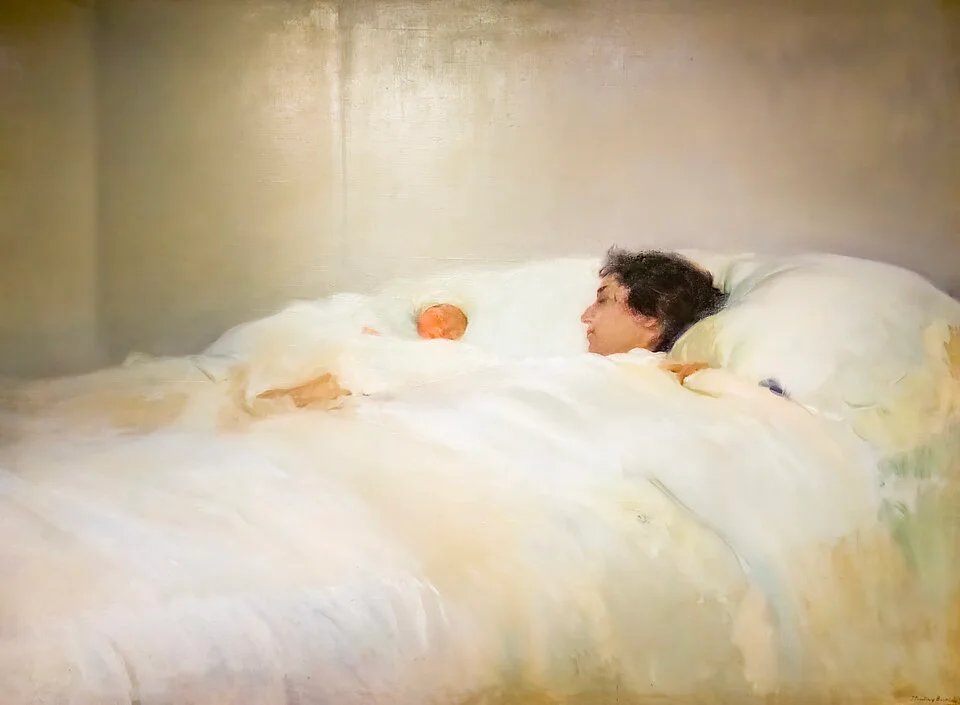
Mother
A woman and a newborn baby lie in a bed, almost entirely hidden beneath a vast expanse of white bedding. Painted in 1900, Mother by Joaquín Sorolla shows his wife, Clotilde García del Castillo, and their daughter, Elena. The mother and child are nearly swallowed by the huge white bedspread, leaving only their heads visible. The mother's gaze is turned completely toward the infant rather than engaging you. Filtered light and an overwhelming whiteness evoke the hidden emotion of the absent father. Look closely at the canvas. The white bedspread and filtered light now appear not just as a bedroom setting, but as a vehicle for the father's invisible emotional presence.
アプリで聴くDidier Descouens · Public domain
07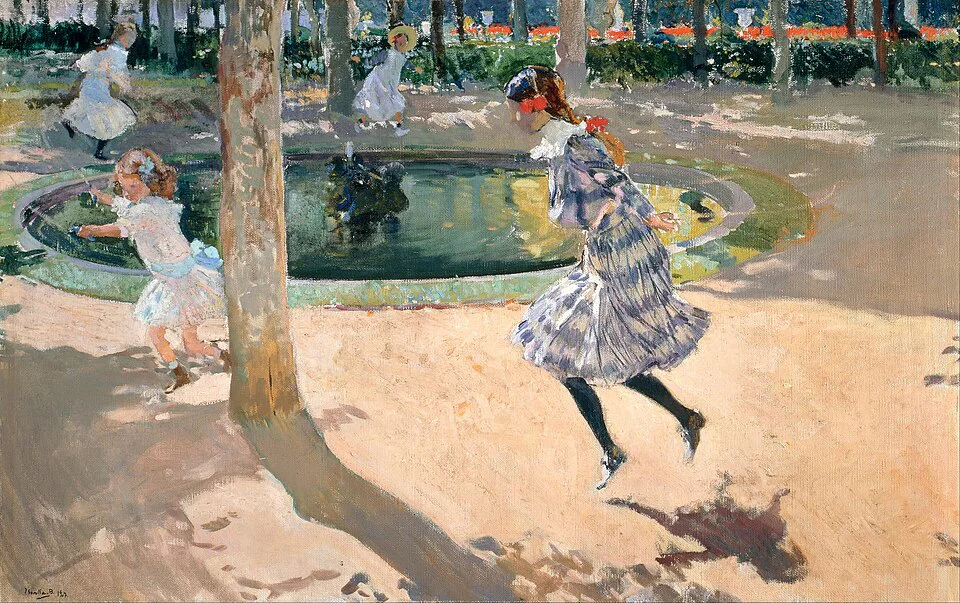
The Skipping Rope
The twelve-year-old daughter Elena appears as if weightless during a jump in The Skipping Rope by Joaquín Sorolla. Her face remains indistinct, recognizable only by her silhouette and red hair ribbons. The fountain and the vegetation of the park act as calm components contrasting with the children's movement. We look down and into the distance, so the park tilts like a slanted plane, with no clear line between foreground and background. The light falls through the leaves onto the scene while Elena is highlighted against the bright ground.
アプリで聴くJoaquín Sorolla · Public domain
08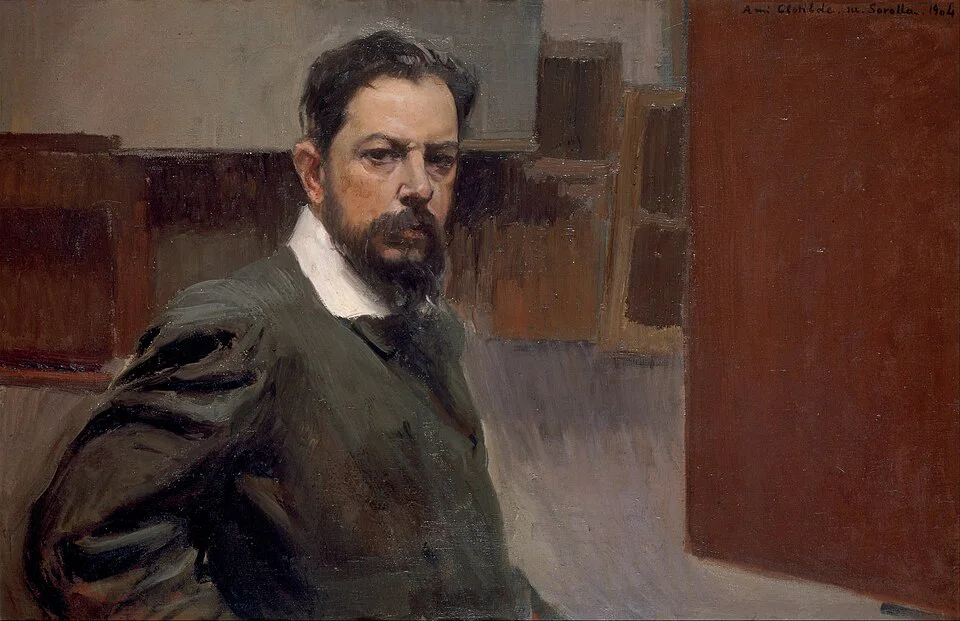
Self-Portrait, 1904
Sorolla stares back at you from his canvas with a steady, intense gaze that almost feels like a challenge. Painted in 1904, this Self-Portrait shows Joaquín Sorolla during a time of many portrait commissions and professional success. Look at the sparse background where paintings hang on the walls, and a blank canvas waits on the right to mark out the room. Strong shadows and bright light pick out specific focal points in the scene. A glowing brightness falls across his face and the crisp collar of his shirt. This portrait is a tribute to his trade as a painter. Sorolla took his inspiration from Velázquez, and from the self-portrait in Las Meninas. See how the light touches only the collar and the face, the way painters of the Spanish Golden Age used it.
アプリで聴くJoaquín Sorolla · Public domain
09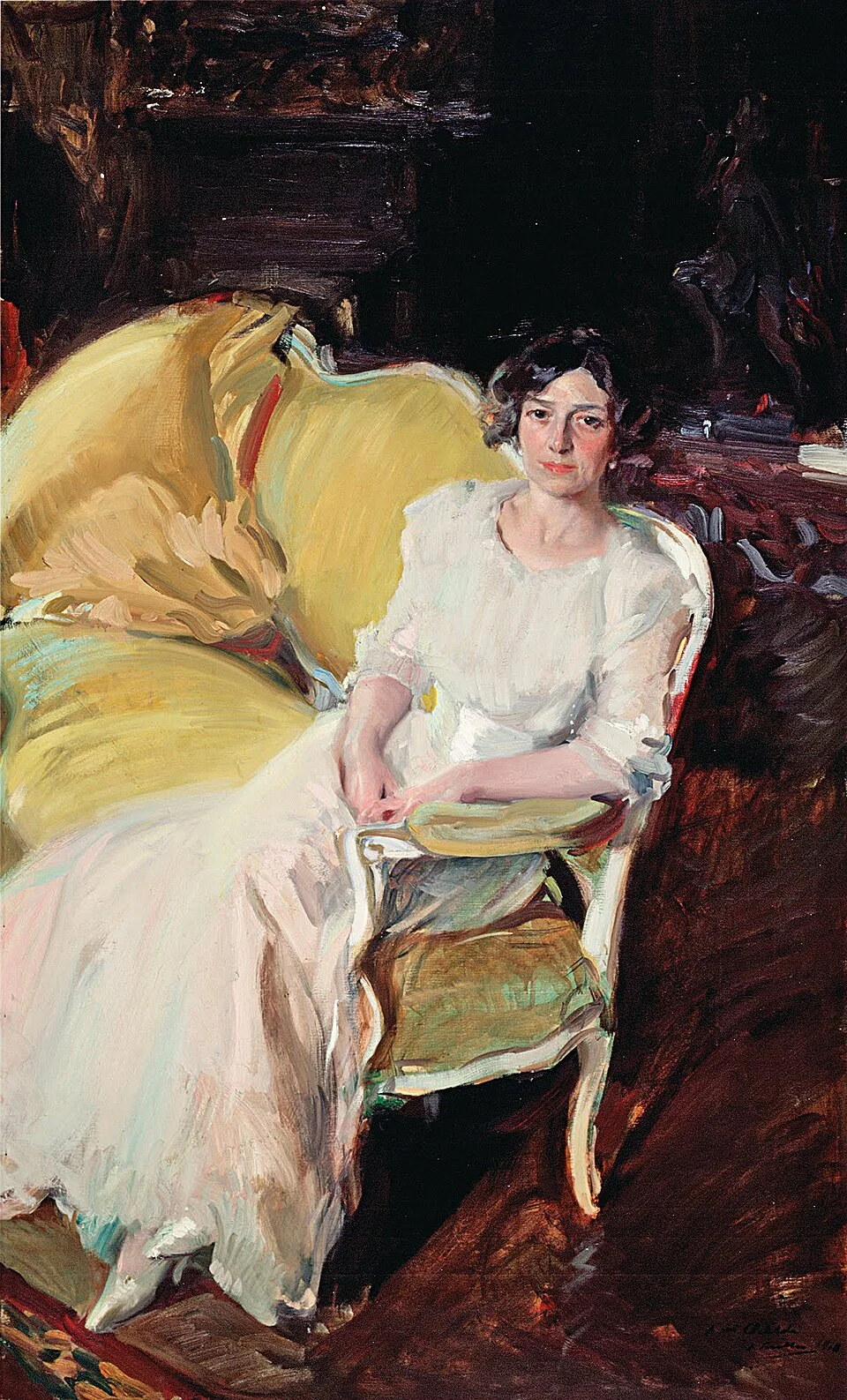
Clotilde seated on the Sofa
Clotilde sits on the sofa with a book on her knees, looking directly out at the viewer as if her reading has just been paused. In Clotilde seated on the Sofa by Joaquín Sorolla in 1910, the wife of the artist is shown as a refined woman. Her elegant white gown is painted straight onto the canvas preparation to capture the sheer, transparent qualities of gauze, rather than layered over thick pigment. Her delicate high-heeled shoes complete the picture of a refined woman reflecting her husband's established social status and artistic success. Look at how the bright white dress now reveals itself not just as fabric, but as a demonstration of painting directly on the raw ground of the canvas.
アプリで聴くJoaquín Sorolla · Public domain
10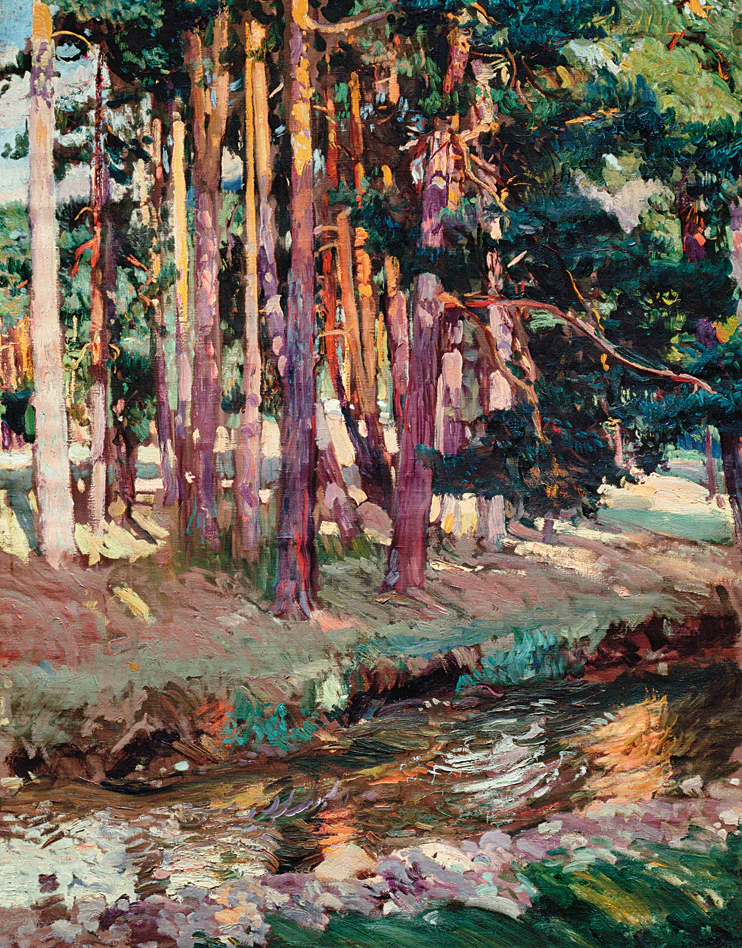
The Forest. La Granja
Bare pine tree trunks stand in a row, mirroring themselves down in a small stream. Painted in 1907, The Forest. La Granja by Joaquín Sorolla captures a series of mostly naked stems above the water. Look at how the light plays on this scene under a southern sun. This way of showing light effects belongs to Valencian Luminism. Sorolla spent the summer making this work near the palace of La Granja in the province of Segovia, while he stayed with his family close to the royal summer residence. He had come to paint the king in uniform. Notice the tall trees again, reflecting softly in the stream.
アプリで聴くJoaquín Sorolla · CC BY-SA 4.0
- 11
Clotilde in evening dress
Joaquín Sorolla · 1910
- 12
White slave trade
Joaquín Sorolla · 1894
- 13
The horse's bath
Joaquín Sorolla · 1909
- 14
Snapshot
Joaquín Sorolla · 1906
- 15
Bathing in La Granja
Joaquín Sorolla · 1907
- 16
The Little Sailing Boat
Joaquín Sorolla · 1909
- 17
Nude Woman
Joaquín Sorolla · 1902
- 18
The Pink Robe
Joaquín Sorolla · 1916
- 19
After Bathing
Joaquín Sorolla · 1915
- 20
Garden of the Sorolla House
Joaquín Sorolla · 1919
- 21
The Gardens at the Sorolla Family House
Joaquín Sorolla · 1920
- 22
Rope Makers of Jávea
Joaquín Sorolla · 1898
- 23
Courtyard of San Juan de la Cartuja de Porta Coeli, Valencia
Joaquín Sorolla · 1896
- 24
Eating Grapes
Joaquín Sorolla · 1898
- 25
Sierra Nevada in Winter
Joaquín Sorolla · 1902
- 26
Chapel on the Láchar estate
Joaquín Sorolla · 1917
- 27
My Wife and My Children
Joaquín Sorolla · 1897
- 28
The Fountain, Buñol
Joaquín Sorolla · 1895
- 29
Beach Urchin
Joaquín Sorolla · 1891
- 30
The Guitarists, Valencian Customs
Joaquín Sorolla · 1889
- 31
Reflections in a Fountain
Joaquín Sorolla · 1908
- 32
Sea and Rocks at San Esteban, Asturias
Joaquín Sorolla · 1903
- 33
People of the Roncal Valley
Joaquín Sorolla · 1912
- 34
Fifth Avenue, New York
Joaquín Sorolla · 1911
- 35
Fisherwomen with her son
Joaquín Sorolla · 1908
ソローリャ美術館
よくある質問
ガイドの料金はいくらですか?
アプリは無料. 1月1日まで無料. 音声ガイドのみ。施設の入場料は別途必要です。
インターネットなしで聴けますか?
はい。訪問前にアプリで音声、画像、地図をダウンロードしてください。ダウンロード済みの内容はオフラインで利用できます。
自分の言語で聴けますか?
現在は英語のみ。ほかの言語も近日対応。
決まった時間に参加する必要がありますか?
いいえ。セルフガイド形式です。スポットを選び、好きなときに休憩して、自分のペースで何度でも物語を聴けます。
自分のペースで
ソローリャ美術館を巡ろう。
Stanzaをダウンロードして検索: “ソローリャ美術館”.
アプリは無料 · ガイドの価格はアプリに表示
さらに探索する
近くの音声ガイド
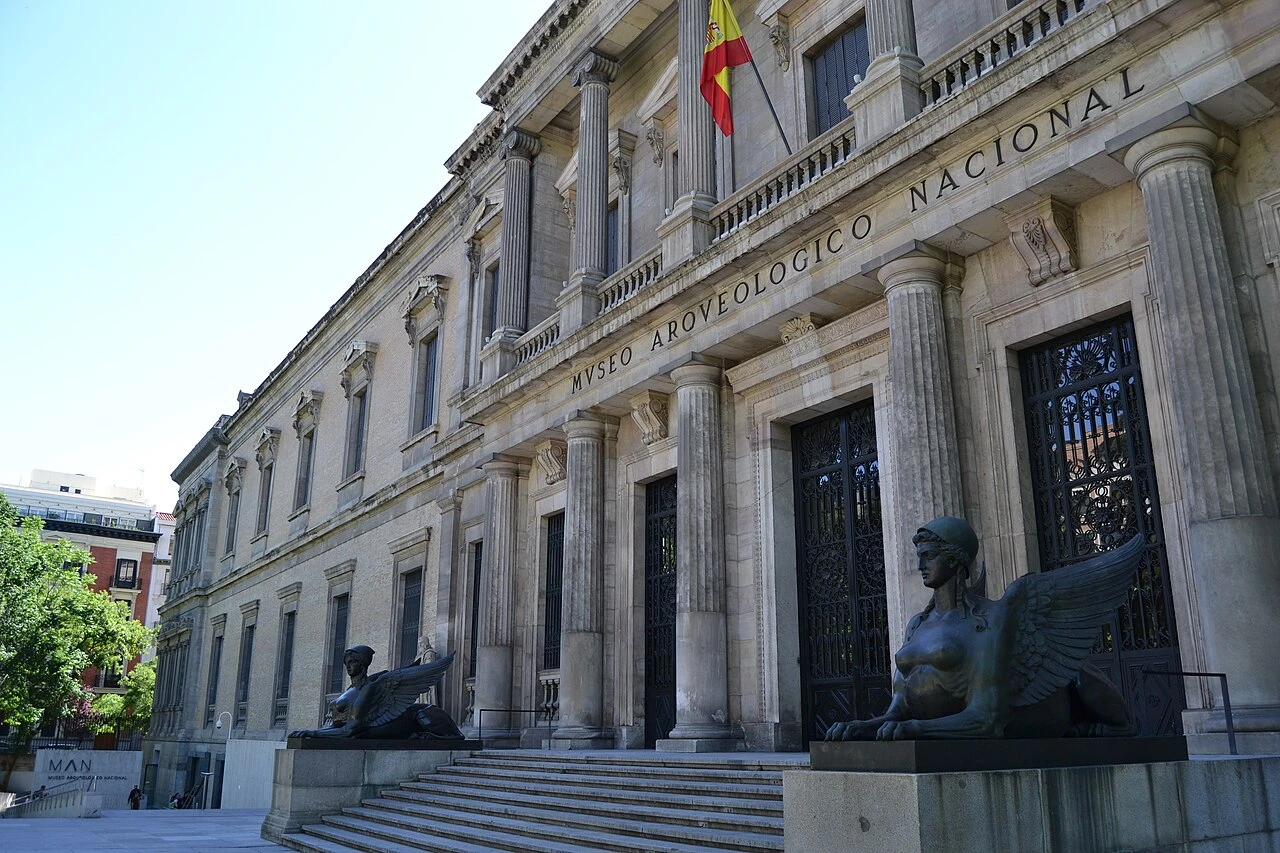
マドリード · 1 km
Museo Arqueológico Nacional de España
コンテンツと出典
Emilio J. Rodríguez Posada · CC BY-SA 2.0
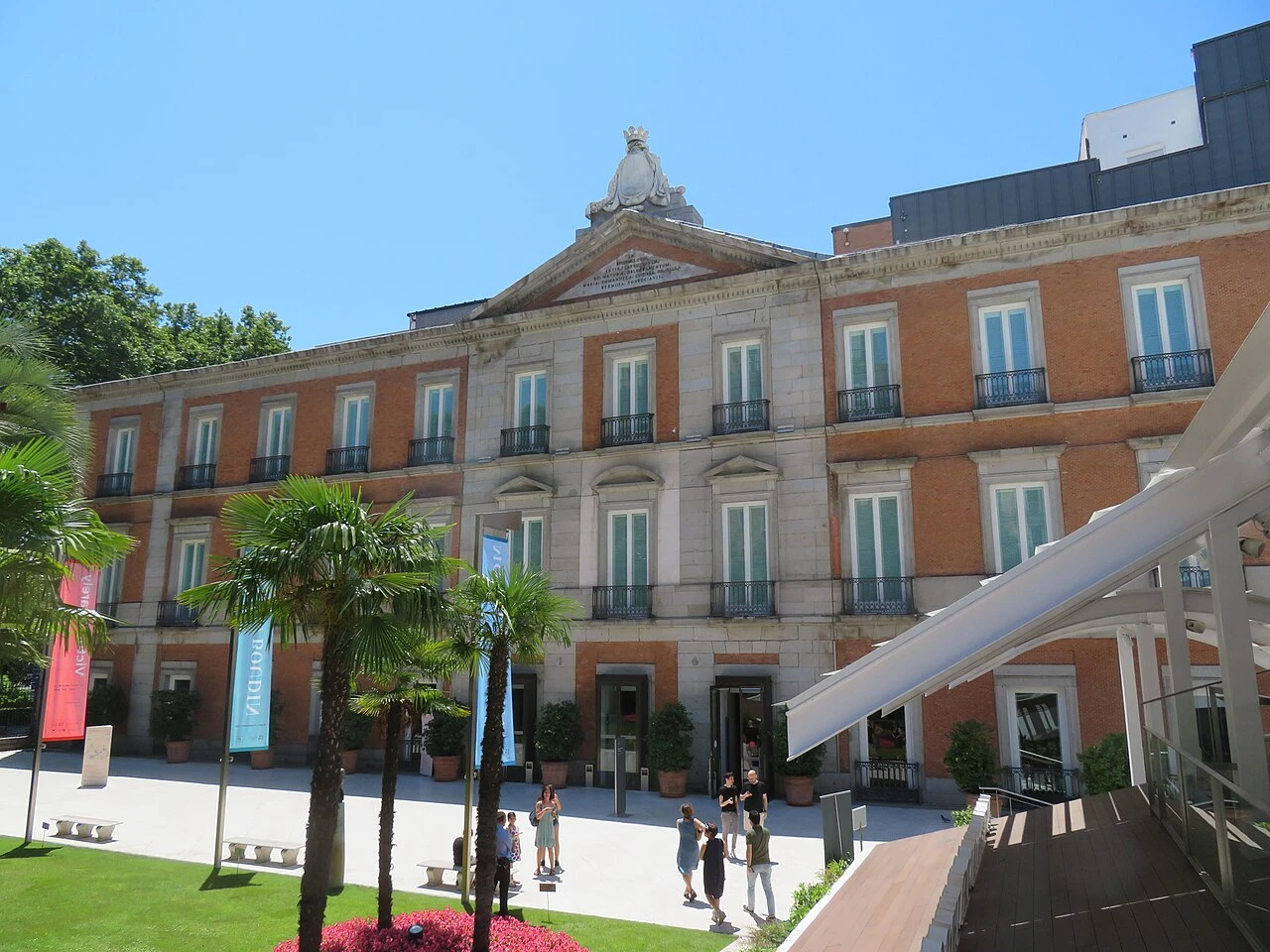
マドリード · 2 km
Museo Thyssen-Bornemisza
コンテンツと出典
Kyle Magnuson from Los Angeles, United States · CC BY 2.0
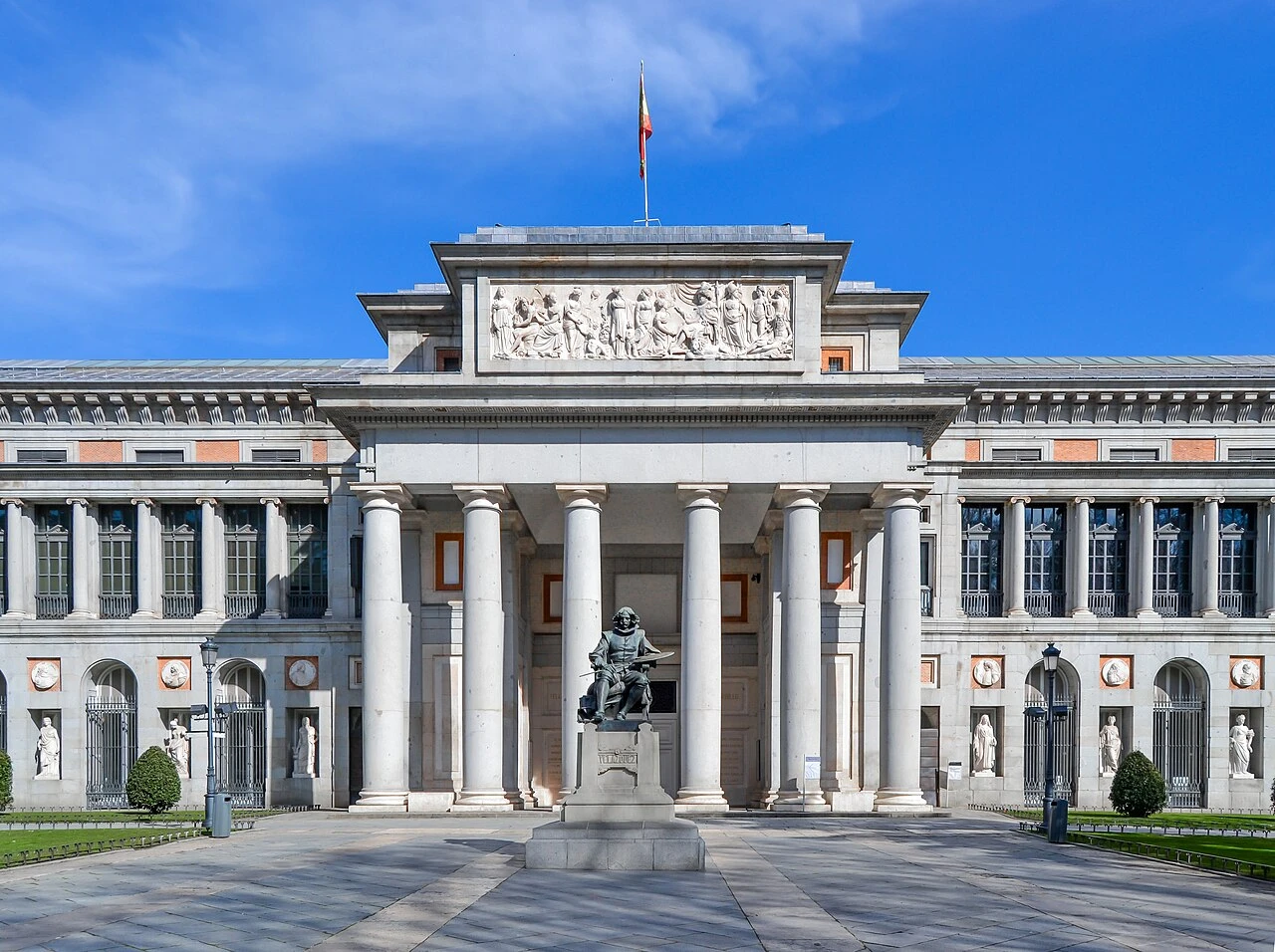
マドリード · 2 km
Museo del Prado
コンテンツと出典
Emilio J. Rodríguez Posada · CC BY-SA 2.0
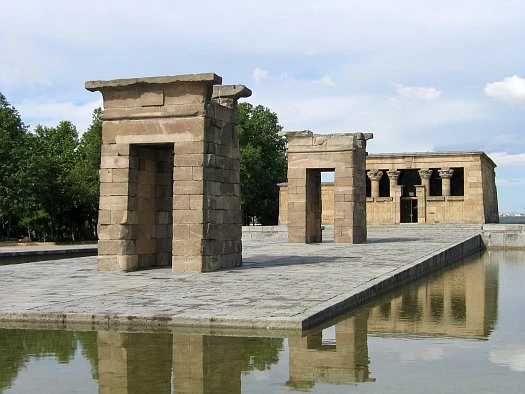
マドリード · 2 km
デボー神殿
コンテンツと出典
Photo: OsvaldoGago · CC BY-SA 2.0