Stanza · Audioguia
Galleria degli Uffizi Audioguia
Um lugar para recordar. Uma história para levar consigo.
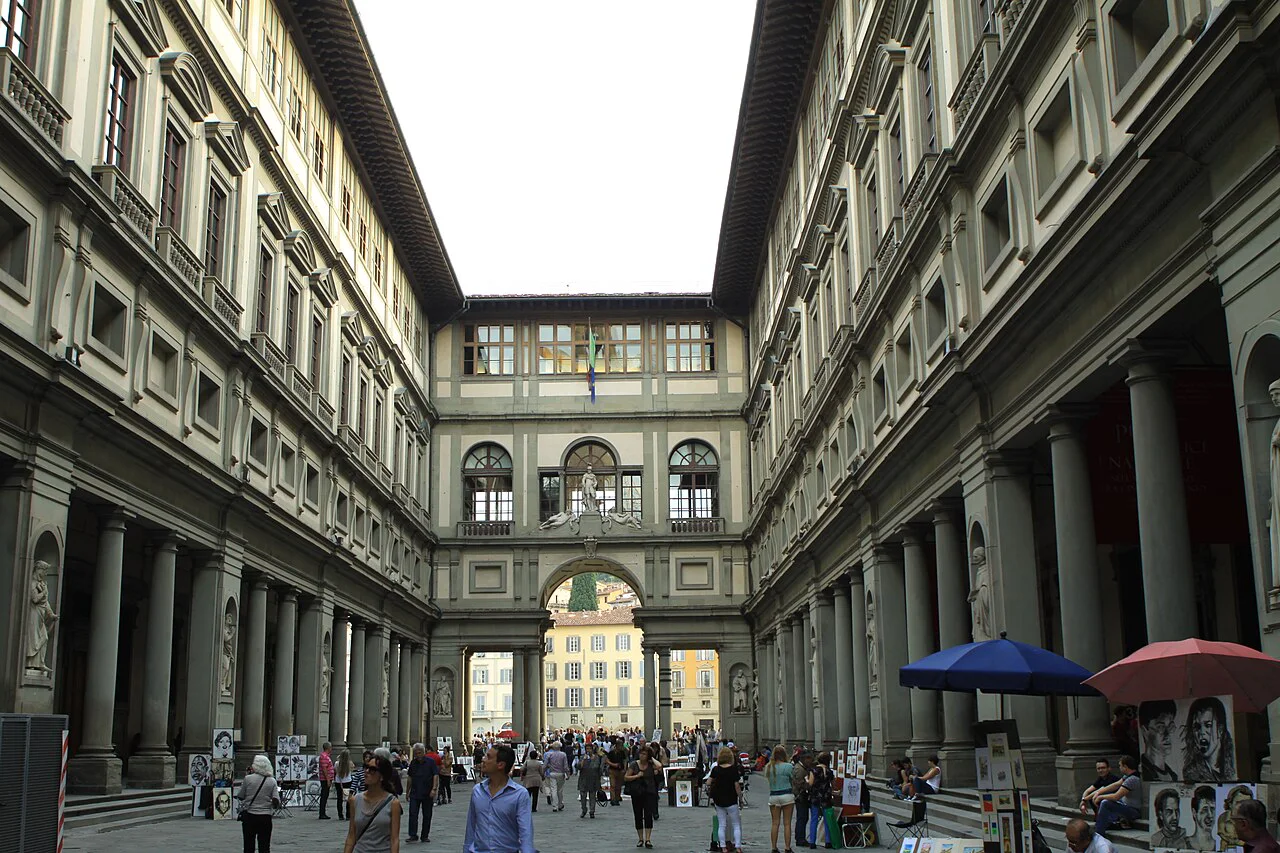
The Uffizi Gallery is an art museum located in the Historic Centre of Florence. It is one of the most visited museums in Italy and is globally significant for its collection of Italian Renaissance art.
Por enquanto em inglês. Mais idiomas em breve.
Descarregue o Stanza e procure “Galleria degli Uffizi”.
Sobre o passeio
Um guia. A sua forma de visitar.
The Uffizi Gallery is an art museum located in the Historic Centre of Florence. It is one of the most visited museums in Italy and is globally significant for its collection of Italian Renaissance art.
Quando estiver pronto.
- 01Descarregue o Stanza gratuitamente.
iOS & Android
- 02Encontre o seu guia.
“Galleria degli Uffizi”
- 03Descarregue-o antes da visita.
Offline
Audioguia / 70 obras
Dentro do audioguia
Descubra algumas histórias antes da visita. Abra uma paragem para ler mais.
01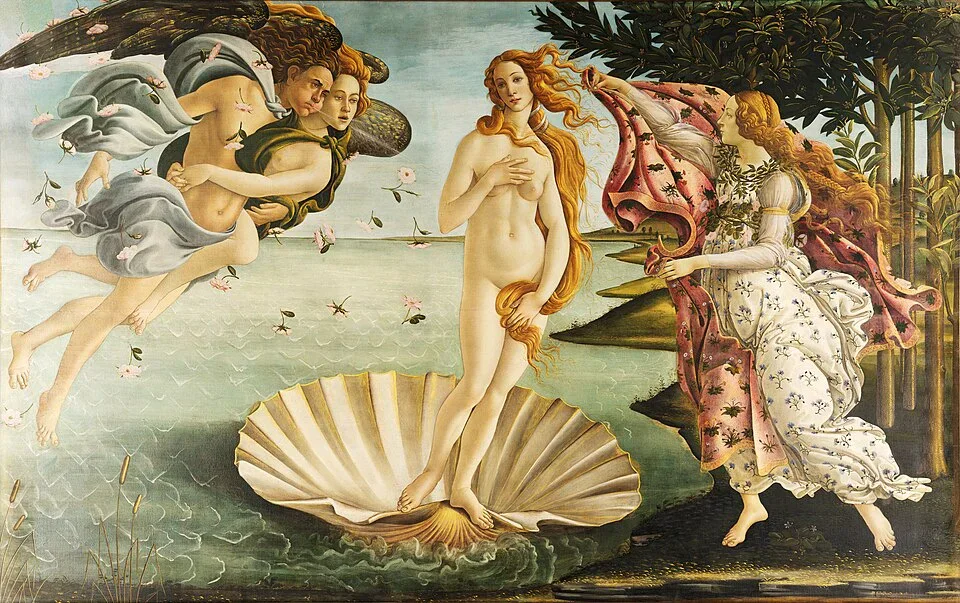
The Birth of Venus
You think you know this moment. A goddess, rising from the sea. But look at her face. Her eyelids are heavy, her gaze is far away, and she seems a little cool. Botticelli's Birth of Venus is not quite what its name says. She is not being born. She was born already, fully grown. This is the next scene, and she is arriving. The winds are pushing her toward the shore. Start on the left. The wind god Zephyr holds a young woman tight, and both of them are blowing. Lines run out of his mouth. That is the wind. Hers is the lighter breeze. Pink roses scatter around them, and the rose is supposed to have flowered for the first time when Venus was born. She stands on a giant shell, and its size is pure imagination. Ancient artists drew it huge too. One hand rests on her chest. The other gathers her long hair low across her body. Her hands borrow a pose from ancient statues, and she rises there pale and smooth, like a statue. Yet no one could really hold this pose, because her weight leans too far over one leg. She seems to float more than stand. Now the right. A woman comes in on the tips of her toes, holding out a rich cloak. It is for Venus, to cover her the moment she lands. The little flowers on her dress suggest she is Spring, one of the goddesses of the seasons. She seems glad that Venus has come. In Botticelli's own day, a poem told of Venus driven ashore on a shell by the wind, with the goddesses of the seasons waiting on the shore. Nobody here casts a shadow. This is a world of the imagination. Not a birth, but a landing, with a cloak held out to cover her. Now look at her face again. She is almost ashore, and her gaze is still far away.
Ouvir no appSandro Botticelli · Public domain
02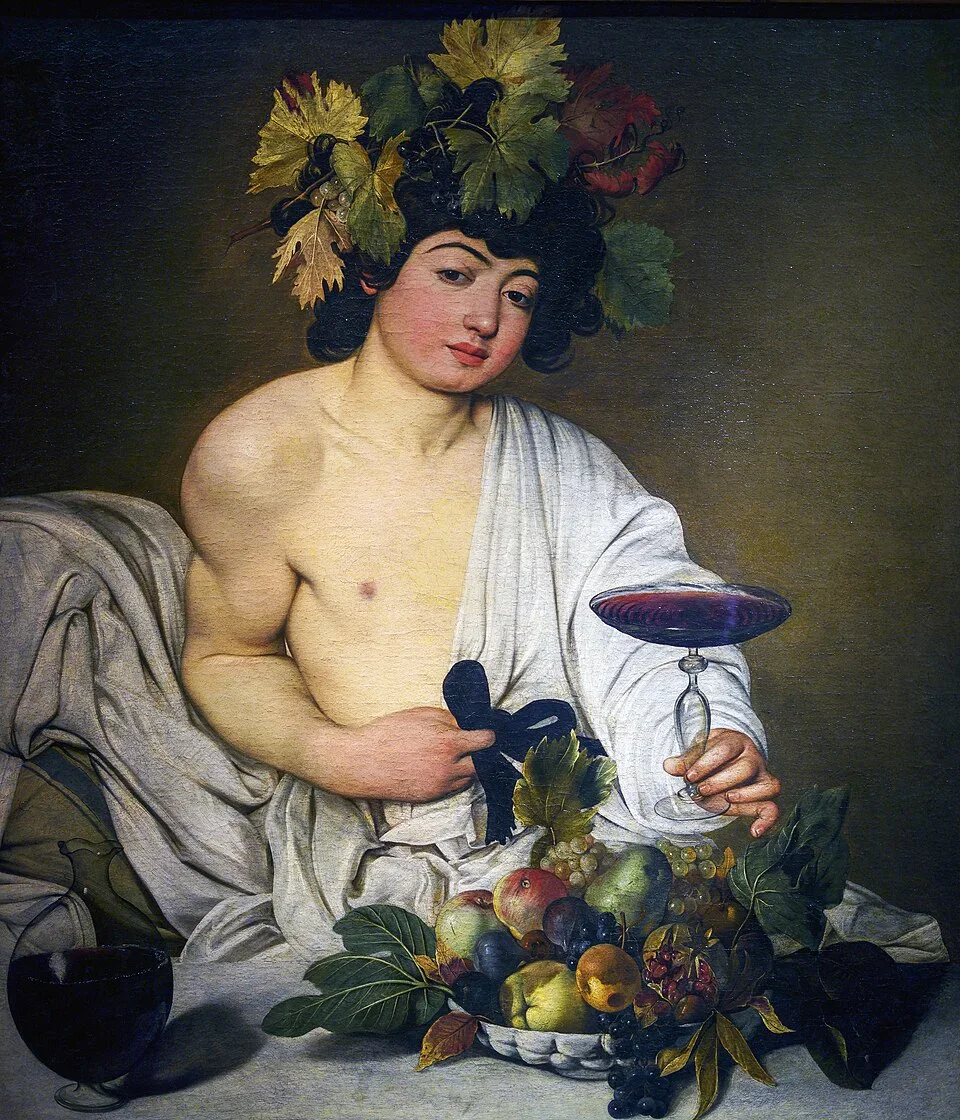
Bacchus
He holds out a glass of wine, and he is looking straight at you. Heavy eyelids, a half smile, and a robe slipping off one shoulder. It feels like an invitation, doesn't it? Caravaggio called him Bacchus, the god of wine. But look at his face again. He does not look like an ancient god. Caravaggio painted a real boy, dressed up in a costume as the god. His look is tired and watchful at the same time. Grapes and vine leaves crown his dark curls. Some leaves are already turning yellow and red. A cardinal who loved ancient myths had this painted. Now his hand. It plays with the black knot of his robe, as if it might slip loose. Come closer, the whole picture says. The glass is a wide, shallow bowl on a thin stem. The red wine trembles inside it, ring after ring. And his fingers on the stem, with grimy nails. A god with dirty nails? This is somebody you could meet in the street. Then the fruit. Apples, pears, grapes, a pomegranate split open, its seeds showing. And one fruit already spotted with rot. Ripe and rotten, side by side. Perhaps that is the warning. Youth and pleasure do not last. So the god of wine is only a boy in a costume. He is still holding out the glass. Look at his eyes again. Would you drink?
Ouvir no appCaravaggio · Public domain
03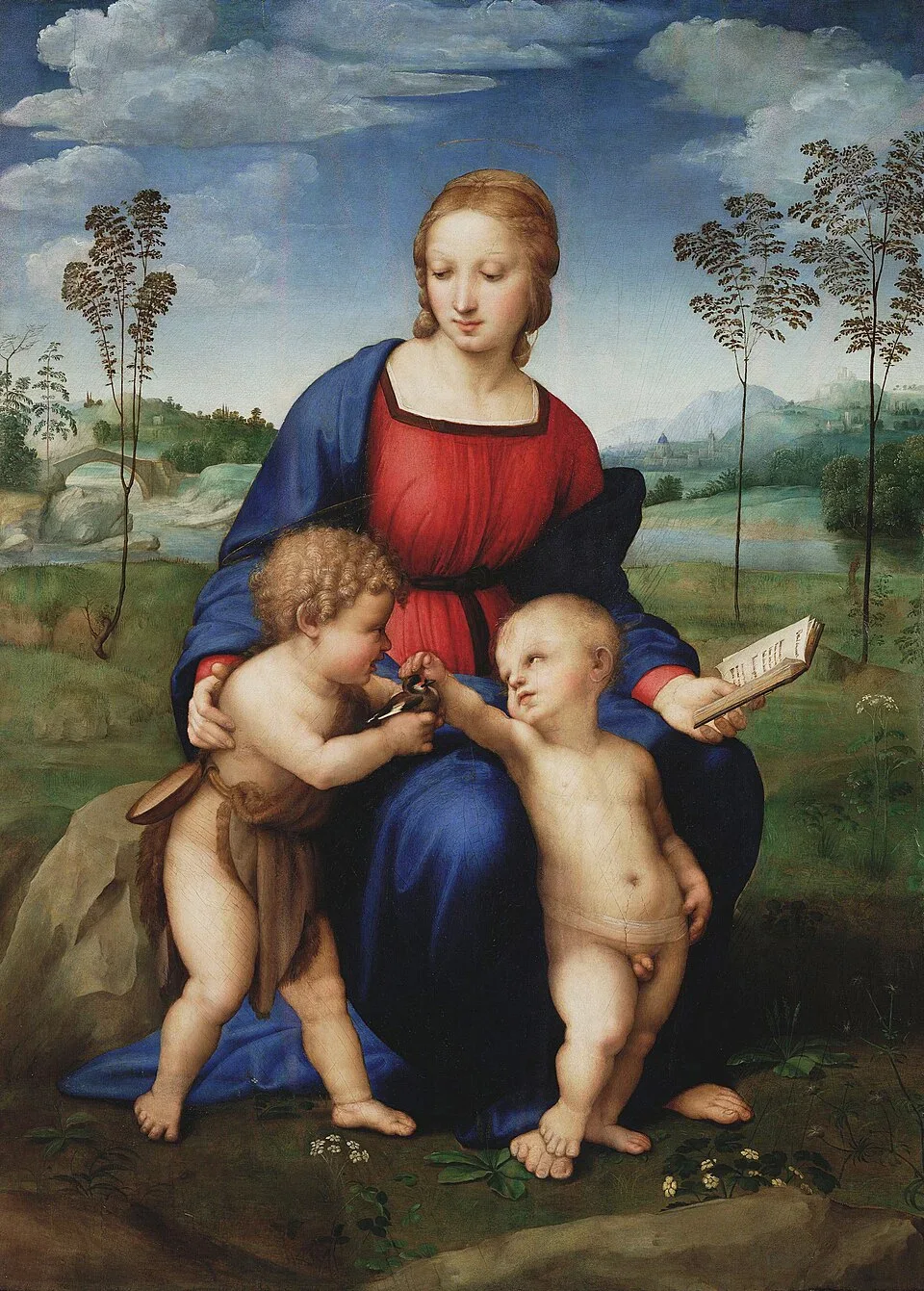
Madonna of the Goldfinch
At first it looks like a gentle moment. A mother sits in a meadow with two little boys and a small bird, and nobody seems to hurry. Raphael painted this Madonna of the Goldfinch between 1505 and 1506. Start with her face. Young and calm, her eyes lowered toward the children. She is not smiling. Her red dress stands for the Passion of Christ, and her blue mantle for the church. Her hand rests on the shoulder of the curly haired boy, John. Now the bird. John holds a goldfinch in both hands, with black and white wings and a patch of red on its face. A goldfinch stands for Christ's crucifixion. So the little game is not only a game. The smaller child reaches out and touches it with just the tips of his fingers. His face is turned up, and it is serious. In Mary's other hand, a small open book. A sign of her faith. And a hint of the sacrifice to come. Together the three make almost a regular triangle, her head at the top and the children at the base. Behind them, a river, a little bridge, hills, a town far away. The whole landscape frames the scene in calm. Painted for a wedding, this is a gentle moment with the cross already inside it. Look at her face again. Gentle, and not smiling.
Ouvir no app{{creator:Raffaello Sanzio]}} · Public domain
04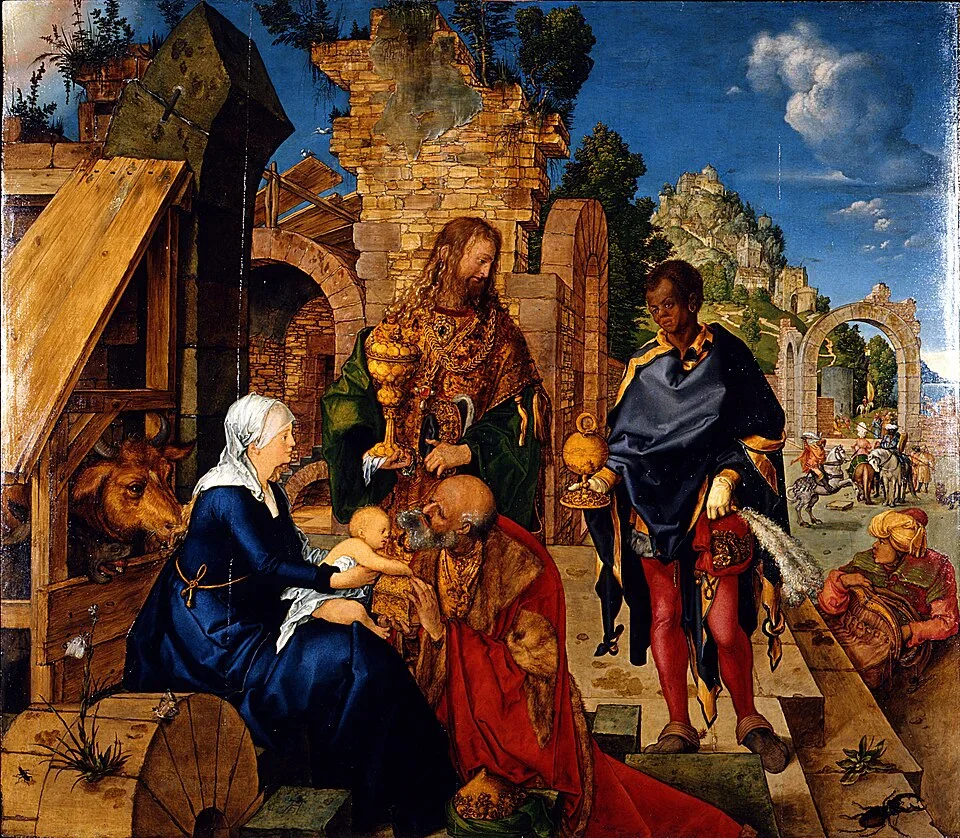
Adoration of the Magi
This should be the quietest scene in the world. A mother. A newborn. Kings who have come to kneel. But look at the place around them. Some arches are broken. The tower is crumbling, with trees growing out of its top. A holy birth, in a building that has already fallen apart. Albrecht Dürer painted it in 1504, for an altar in Wittenberg. Start with Mary, in deep blue. She holds the child out to the old man, and looks his way. He kneels, bald and grey bearded, so close that his beard almost brushes the baby's cheek. His gold cap lies on the step beside him. Now go up to the king in green and gold, with long curling hair and a beard, his eyes lowered. You may know this face. Dürer painted himself again and again, and here he has given himself to the second king. Now drop your eyes to the stone block in the foreground. His monogram is lined up with that king. A signature, set in line with his own face. Then the third king, standing apart in blue and gold, a hoop in his ear and a golden globe cup in his gloved hand. He stands outside the walls, with trees behind him. And his gaze is what pulls your eye around the whole picture. Far behind him, a hill town and riders. Dürer had seen towns like that on his journey to Italy. And down in the corner, a stag beetle crawls across the stone. The quietest scene in the world, set among ruins. And the painter has stepped into it himself.
Ouvir no appAlbrecht Dürer · Public domain
05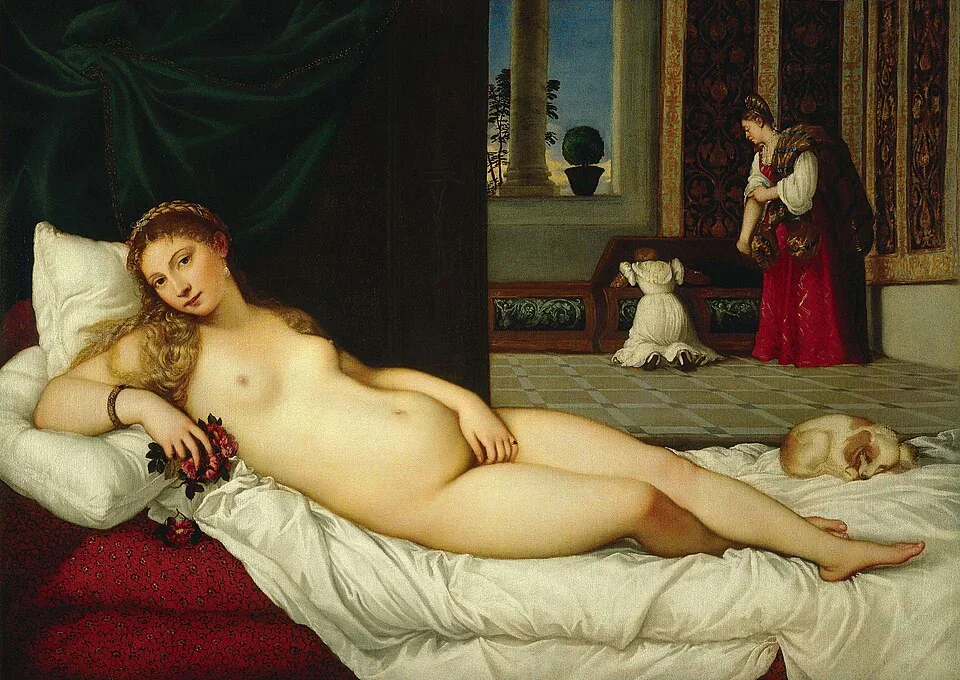
Venus of Urbino
Does she look like a goddess to you? She doesn't. She looks like a woman resting on her bed, her head tilted toward you. Her eyes meet yours. Calm. Not shy at all. She is called Venus, and Titian put her indoors, on a bed, in the rich rooms of a palace. She lies on rumpled white sheets, against a pillow, with a heavy green curtain behind her. In one hand, a small bunch of roses. Roses belong to Venus. They stand for love that lasts. Her other hand lies low across her body, in the old pose of a modest Venus. But she is not hiding from you. A ring sits on her finger. At the foot of the bed, a little dog, fast asleep. A dog often stands for faithfulness in marriage. Now go deeper into the room. Two maids are busy at a chest of clothes. One kneels with her head inside it. The other stands, looking down, a gold and light blue dress over her shoulder. Perhaps a wedding dress. Behind them, a window. A column, an evening sky, and a small plant in a pot. Myrtle, another plant of Venus, for faithful love. So where is the myth? There are no clouds, no sea, no cupids. Just a room, a dog, a chest of clothes. The young man who bought it, the duke's son, called it simply the nude woman. Titian gave the goddess a home. Then he let her look at you. Look again. Who is she looking at?
Ouvir no appTitian · Public domain
06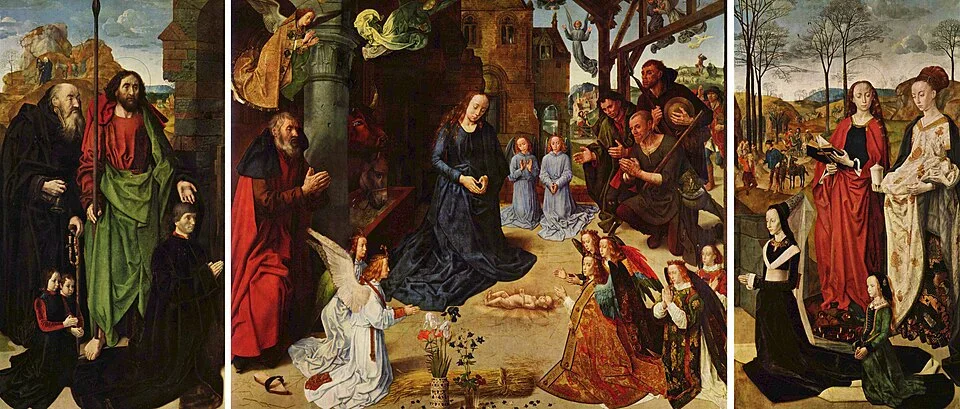
Portinari Triptych
Nearly everyone in the middle of this picture is looking at the same small spot on the floor. A newborn. Naked, on the bare ground, with no crib and no blanket. Thin golden rays spread out around him. Hugo van der Goes painted this great altarpiece. It shows the shepherds adoring the newborn Jesus. But it is dressed as something else. Look at the angels kneeling around him. Heavy gold robes. A green one patterned with flowers. Wings of red, blue and green. These are the vestments worn by the ministers at a solemn Mass. The painter wants you to think of the altar, where this picture would have stood. In front of the child lies a sheaf of wheat. Wheat and vestments together say the same word. Eucharist. Beside it, a jar of flowers. Red lilies. White irises. They stand for suffering still to come. So even this birth hints at how the story ends. And on the floor, a single wooden sandal. Someone has taken it off. You do that on holy ground. So the stable floor is the holy place. No walls needed. Now the shepherds. Weathered faces, rough hands held out or pressed together. One clutches his hat to his chest. They are real men, painted as they are. And they kneel anyway. Go to the left wing. A man in black, hands joined, is Tommaso Portinari. He paid for all of this. A picture this size tells everyone what he was worth. Yet here he is on his knees, with his two sons, like the shepherds. A stable that feels like an altar. A birth that feels like a Mass. Now look again at that small spot on the floor. Everyone around it is kneeling.
Ouvir no appHugo van der Goes · Public domain
07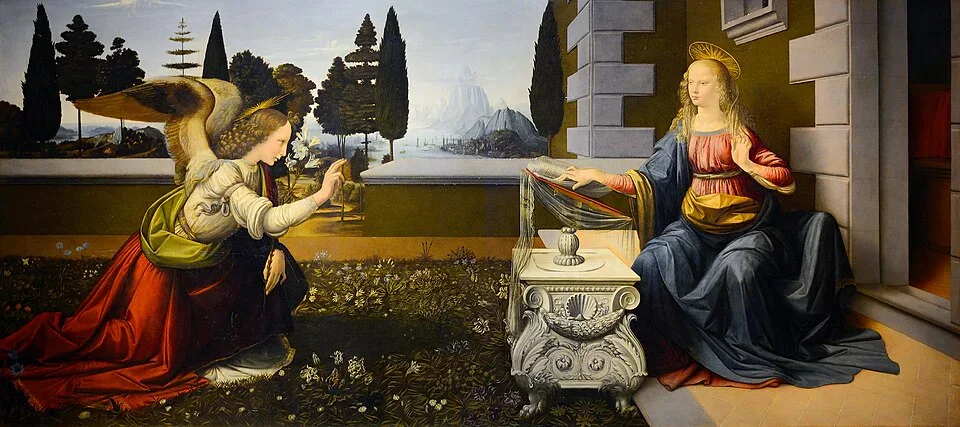
Annunciation
For a long time, no one knew who had painted this. It hung in a small monastery church on a hill outside Florence, until 1867, when it was brought down to the Uffizi. At first it was given to Domenico Ghirlandaio, who had trained in the same workshop as Leonardo. Then, in 1869, someone spoke up and named a very young Leonardo da Vinci instead. The proof came later, in Oxford, where a drawing by Leonardo turned up, a study for the sleeve of the angel kneeling at the left. He was still an apprentice in the studio of Andrea del Verrocchio when he made this, and he borrowed from his own master. The marble lectern where Mary reads takes its shape from a tomb Verrocchio had just carved for the Medici in San Lorenzo. Gabriel holds a lily, a sign of Mary's virginity and of Florence itself. The young apprentice was already Leonardo.
Ouvir no appLeonardo da Vinci · Public domain
08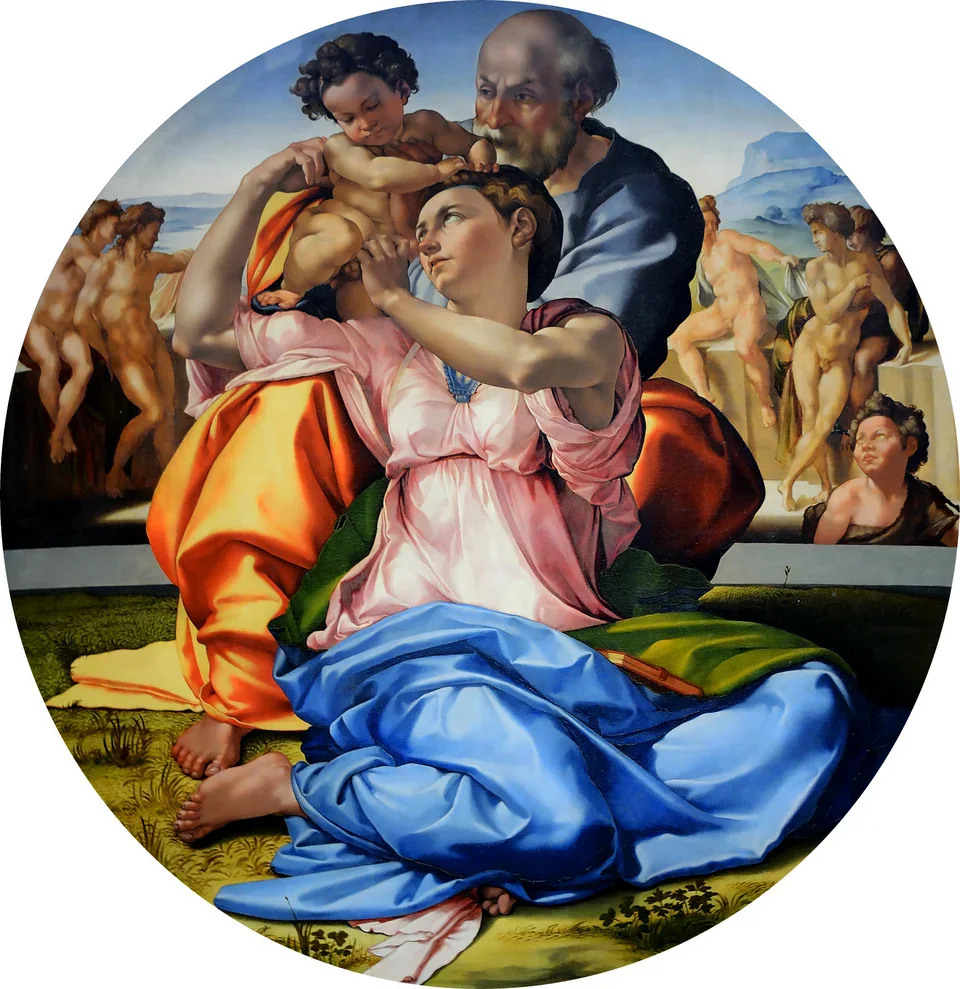
Doni Tondo
It looks like a gentle family afternoon on the grass, doesn't it? A mother, a father, a baby held high. Mother and child tightly joined. But look closer, and very little here is soft. Michelangelo made this round picture, the Doni Tondo. Start with her face. Mary twists round, eyes lifted high, lips a little parted. Now her arms. Bare, thick, muscled. The child swings across above her, and both her hands hold on to him. The folds of cloth are cut sharp. The bodies look carved from marble. Michelangelo did not even think of himself as a painter. The child sits high, one small hand pressed on her hair. His face is serious. Nobody laughs here. Behind her, Joseph. Old, bald, a grey beard, higher than she is. Mary sits between his knees, as if he were guarding her. His great legs make her throne. And like her, he looks at the child. Then the colours. Her blue robe shines, and an orange cloth blazes beside it. The loudest colour went to her, because she matters most here. And her feet? Bare, on bare grass. No cushion. No throne of her own. Now look past the low wall. Naked young men lean, twist and sit. Why are they here? No one knows for sure. But see where they look. Not one of them looks at the child. Only a boy at the wall's edge looks up. He is John the Baptist, the patron saint of Florence. A man named Agnolo Doni had it made, probably to mark his marriage. A round picture, a shape often linked with home life. A close family in front. A group behind, turned away from the child. Go back to her hands. That is what holding on looks like.
Ouvir no appMichelangelo · Public domain
09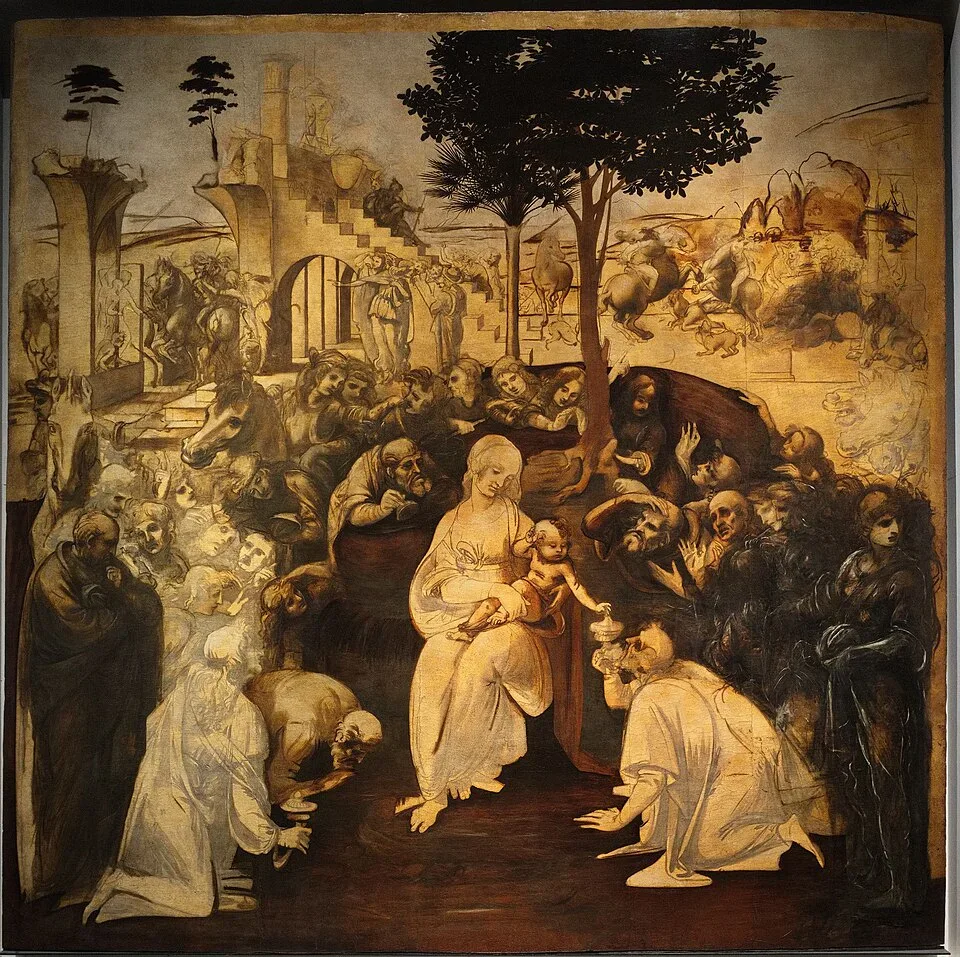
Adoration of the Magi
Almost nothing here is finished. What you see is mostly underdrawing, the first stage of a painting, drawn in charcoal and ink with only a thin layer of colour over it. The monks of San Donato in Scopeto ordered this altarpiece in 1481 and gave Leonardo two years to deliver it. Within a year he had left Florence for Milan, and the panel stayed the way it is now. The monks waited fifteen years, then gave up and asked Filippino Lippi to paint their Adoration instead. His version hangs in this museum too. Even unfinished, it was unlike any Adoration Florence had seen. There is no calm procession of kings bearing gifts. Figures press in a half circle around Mary and her child, gesturing and startled, as the baby reveals his divine nature. Behind them the old world is coming apart. On the left, workmen repair a ruined pagan building. On the right, horsemen fight, still untouched by the news. And at the far right edge, a young man looks out of the crowd. It may be Leonardo himself, about thirty.
Ouvir no appLeonardo da Vinci · CC BY-SA 4.0
10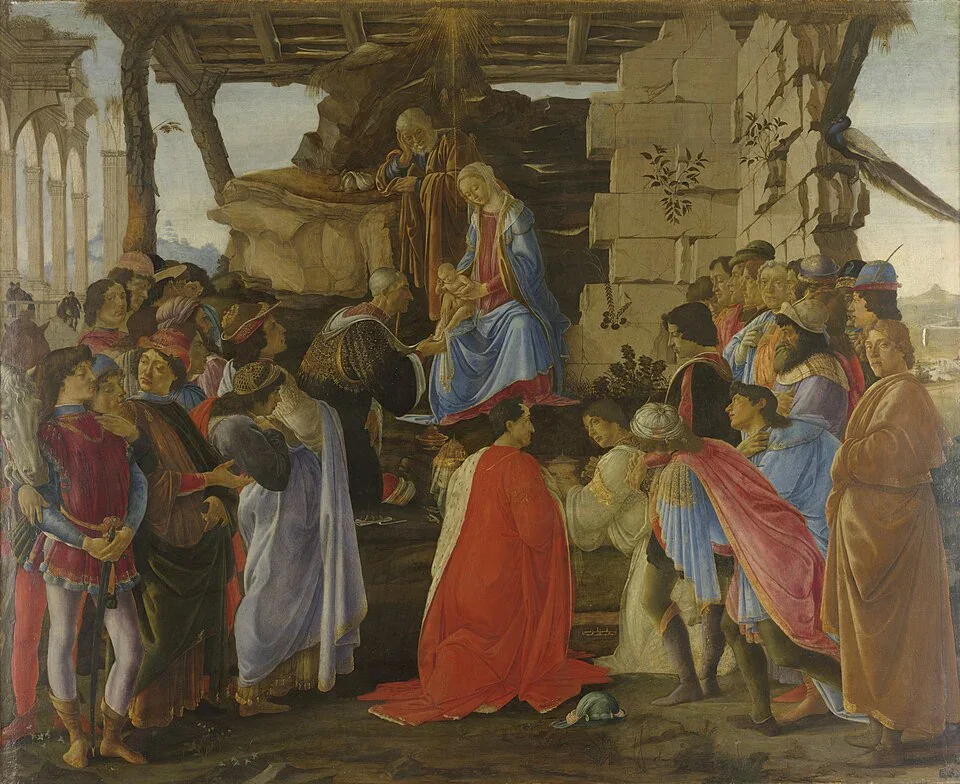
Adoration of the Magi
Count the faces looking at the Child. Now count the ones looking at you. It is a holy scene, and yet this crowd looks dressed for a party. The kings have come with gifts, and a whole crowd has come along. The oldest king kneels first. His grey head bends low, and his black robe is stitched all over with gold. That is Cosimo the Elder, who began the Medici's rule over Florence. And more of the Medici family are painted among the crowd. Above, Mary lowers her eyes to her Child. Rays of gold from the star fall on the two of them. Back to us, another king kneels in a red cloak that spreads across the ground. Reds like this stood out on a dark altar. By candlelight, perhaps, they seemed to glow. On the right, cloaks edged in gold. Cloth like this meant wealth. On holy figures, it honoured them, and the man who paid. And there he is. White hair, a light blue robe, eyes on you, one hand pointing your way. Gaspare del Lama. A money changer, once convicted of stealing public money. He joined the grandest brotherhoods and paid for a chapel, all to win the standing he lacked. The public would have seen this painting. Here he stands among kings and Medici, looking straight out at you. The chapel was dedicated on the sixth of January, the feast day of the Epiphany. At the far right edge, a young man in a golden cloak turns toward you. Botticelli painted himself into the crowd, and this is very likely him. He looks out too, steady and serious, at the edge of the crowd. A birth, and a man buying his way in. Look again at who is looking at you.
Ouvir no appSandro Botticelli · Public domain
- 11
Primavera
Sandro Botticelli · 1480
- 12
Self-portrait
Raphael · 1504–1506
- 13
Venus de' Medici
Cleomenes · -50
- 14
Madonna with the Long Neck
Parmigianino · 1534–1540
- 15
The Baptism of Christ
Leonardo da Vinci, Andrea del Verrocchio · c. 1468–1478
- 16
Medusa
Caravaggio · 1597–1599
- 17
Flora
Titian · c. 1515
- 18
Adoration of the Magi
Gentile da Fabriano · 1423
- 19
Diptych of Federico da Montefeltro and Battista Sforza
Piero della Francesca · c. 1465–1475
- 20
Madonna and Child
Filippo Lippi · c. 1450–1465
- 21
Madonna Enthroned
Giotto · c. 1300–1310
- 22
Madonna of the Pomegranate
Sandro Botticelli · c. 1487
- 23
Pallas and the Centaur
Sandro Botticelli · 1482–1483
- 24
Madonna of the Magnificat
Sandro Botticelli · 1480–1483
- 25
Madonna della Loggia
Sandro Botticelli · c. 1467
- 26
Calumny of Apelles
Sandro Botticelli · 1494–1495
- 27
Portrait of Eleanor of Toledo and her son Giovanni de' Medici
Bronzino · 1545
- 28
Portrait of a Man with a Medal of Cosimo the Elder
Sandro Botticelli · c. 1470–1477
- 29
Annunciation with Saints Maxima and Ansanus
Lippo Memmi, Simone Martini · 1333
- 30
Judith Beheading Holofernes
Artemisia Gentileschi · c. 1620
- 31
Madonna and Child Enthroned with Angels and Prophets. ˋSanta Trinità Maestà´
Cimabue · 1290
- 32
Rucellai Madonna
Duccio di Buoninsegna · 1285
- 33
Cestello Annunciation
Sandro Botticelli · 1489–1490
- 34
Portrait of Cosimo I de' Medici
Bronzino · 1545
- 35
Adam and Eve
Lucas Cranach the Elder · 1528
- 36
Portrait of Agnolo Doni
Raphael · 1506
- 37
Lamentation of Christ
Rogier van der Weyden · c. 1449–1463
- 38
Portrait of Maddalena Doni
Raphael · 1504–1507
- 39
Portrait of Elisabetta Gonzaga
Raphael · 1504
- 40
Madonna of the Harpies
Andrea del Sarto · 1517
- 41
Portrait of Lucrezia Panciatichi
Bronzino · 1545
- 42
Adoration of the Magi
Lorenzo Monaco · 1420–1422
- 43
The Judgement of Solomon
Giorgione · c. 1495–1505
- 44
Portrait of a Young Man with an Apple
Raphael · c. 1505
- 45
Portrait of Giovanni de' Medici as a Child
Bronzino · 1545
- 46
Wrestlers
Unknown Artist
- 47
Fortitude
Sandro Botticelli · 1470
- 48
Heracles and Antaeus
Antonio del Pollaiuolo · 1500
- 49
The Return of Judith to Bethulia
Sandro Botticelli · c. 1467–1472
- 50
The Four Philosophers
Peter Paul Rubens · 1611–1612
- 51
Portrait Diptych of Dürer's Parents
Albrecht Durer · 1490
- 52
Noli me tangere
Andrea del Sarto · c. 1510
- 53
The Martyrdom of Saint Lawrence
Gian Lorenzo Bernini · 1614–1618
- 54
The Discovery of the Body of Holofernes
Sandro Botticelli · c. 1467–1472
- 55
Self-portrait of Élisabeth Louise Vigée Le Brun
Élisabeth Louise Vigée Le Brun · 1790
- 56
Pagagnotti Triptych
Hans Memling · c. 1480
- 57
Cardinal of Portugal's Altarpiece
Piero del Pollaiuolo, Antonio del Pollaiuolo · 1466–1468
- 58
Hercules and the Hydra
Antonio del Pollaiuolo · c. 1475
- 59
Barbadori Altarpiece and Predella
Filippo Lippi · 1437–1438
- 60
Coronation of the Virgin
Filippo Lippi · 1439–1447
- 61
Adoration of the Magi
Filippino Lippi · 1496
- 62
Perseus Freeing Andromeda
Piero di Cosimo · 1510–1513
- 63
Holy Allegory
Giovanni Bellini · c. 1487–1504
- 64
Moses Defending the Daughters of Jethro
Rosso Fiorentino · c. 1523–1524
- 65
Charity
Piero del Pollaiuolo · 1469
- 66
Presentation at the Temple
Ambrogio Lorenzetti · 1342
- 67
Venus with a Satyr and Cupids
Annibale Carracci · c. 1588–1590
- 68
Madonna of the people
Federico Barocci · 1575–1579
- 69
Portrait of Bia de' Medici
Bronzino · c. 1542
- 70
Saint Catherine of Alexandria
Artemisia Gentileschi · 1615
Galleria degli Uffizi
Perguntas frequentes
Quanto custa o audioguia?
App gratuita. Grátis até 1 de janeiro. Preço indicado do guia: $2.99. Apenas audioguia. A entrada no local é separada.
Posso ouvir sem internet?
Sim. Descarregue áudio, imagens e mapas na app antes da visita. O conteúdo descarregado fica disponível offline.
Posso ouvir no meu idioma?
Por enquanto em inglês. Mais idiomas em breve.
Tenho de seguir um horário?
Não. A visita é autónoma. Escolha as paragens, faça pausas e volte às histórias ao seu ritmo.
Ao seu ritmo
Explorar Galleria degli Uffizi.
Descarregue o Stanza e procure “Galleria degli Uffizi”.
App gratuita · Preço do guia na app
Continue a explorar
Audioguias próximos
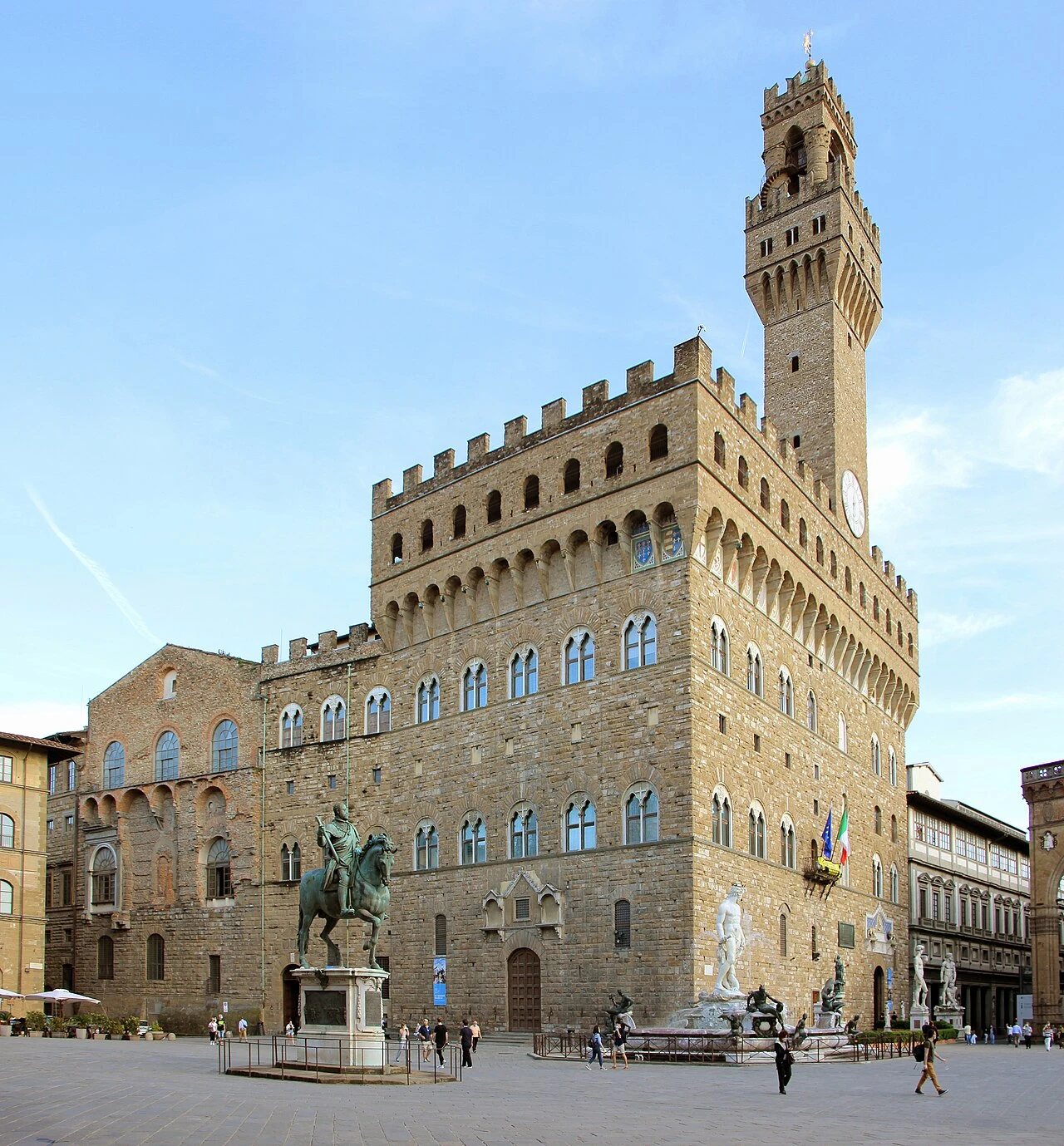
Florença · 1 km
Palazzo Vecchio
Conteúdo e fontes
Francesco Bini · CC BY-SA 4.0
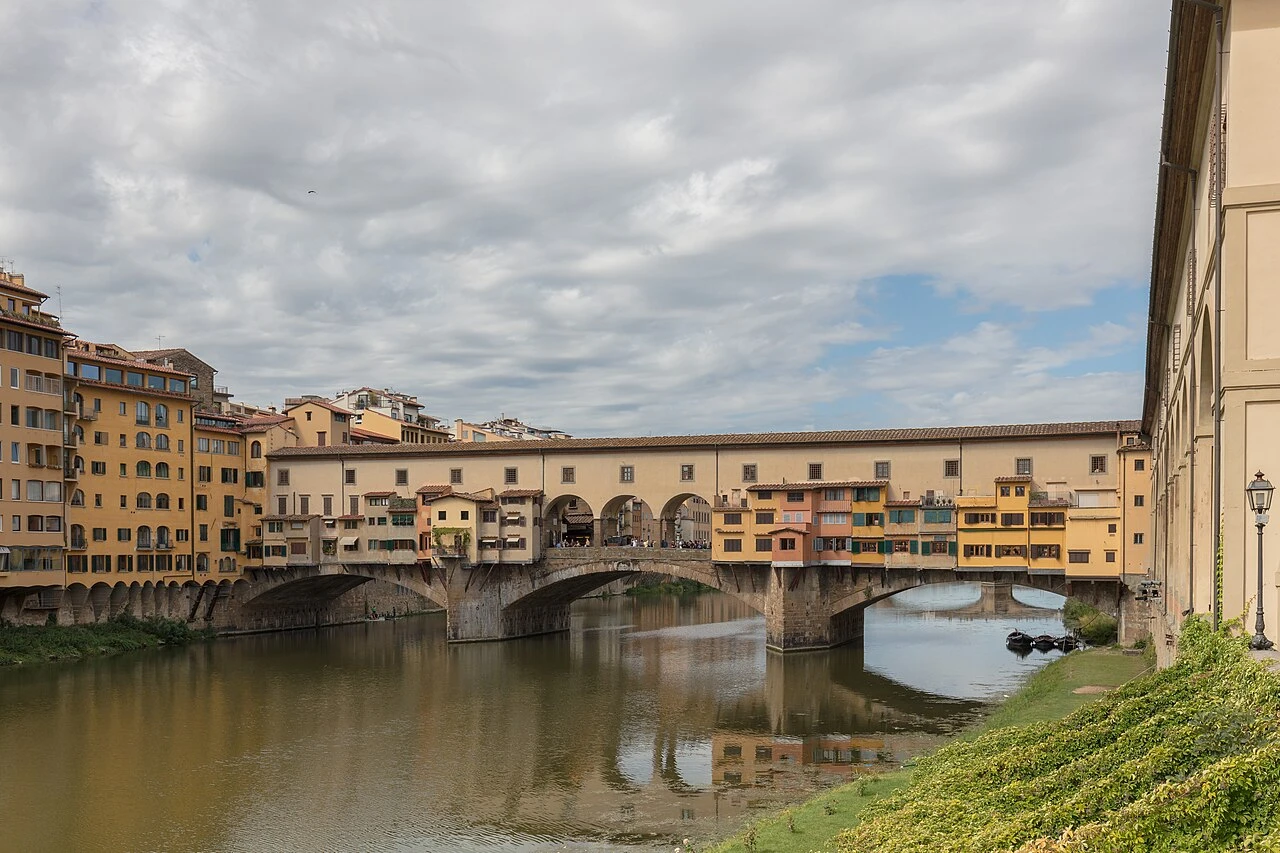
Florença · 1 km
Ponte Vecchio
Conteúdo e fontes
Diego Delso · CC BY-SA 4.0
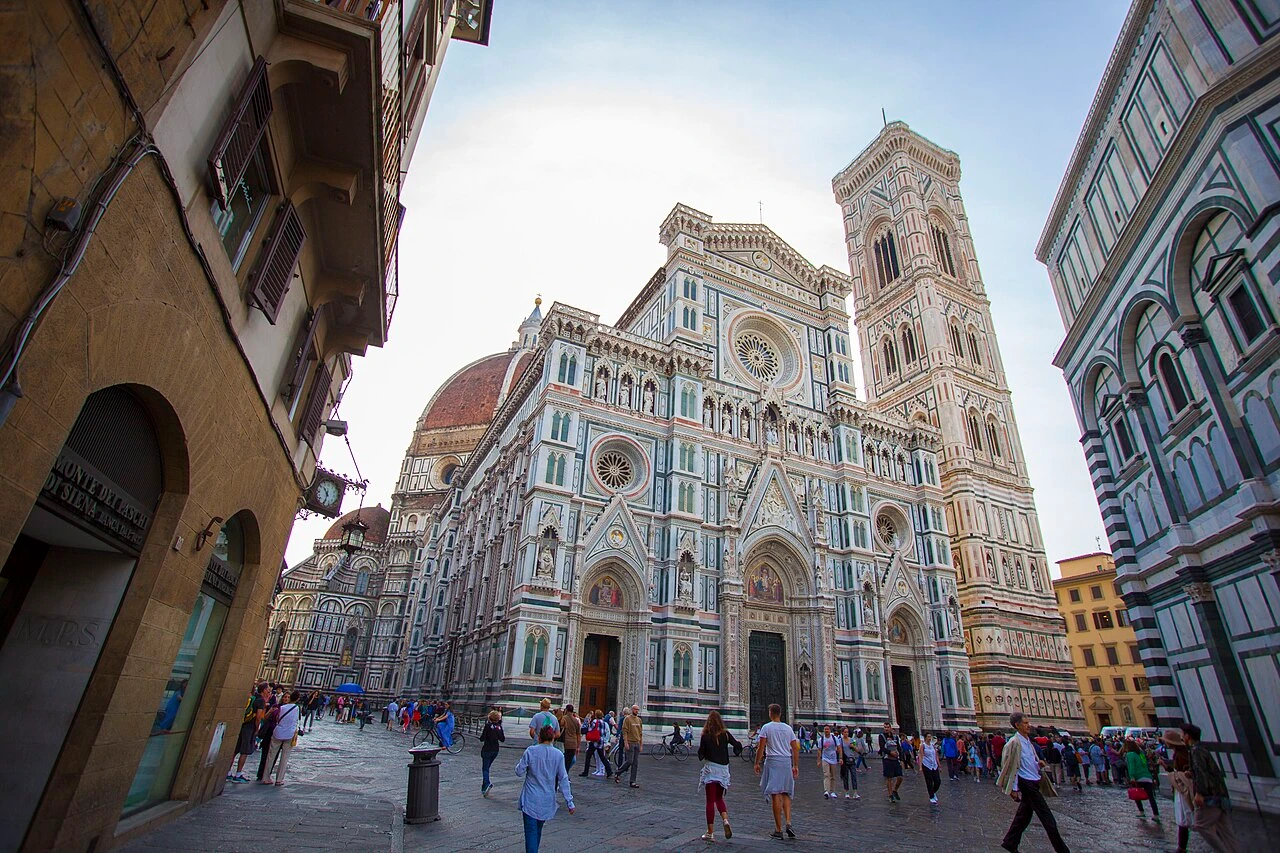
Florença · 1 km
Catedral de Santa Maria del Fiore
Conteúdo e fontes
Photo: ScareCriterion12 · CC BY-SA 4.0
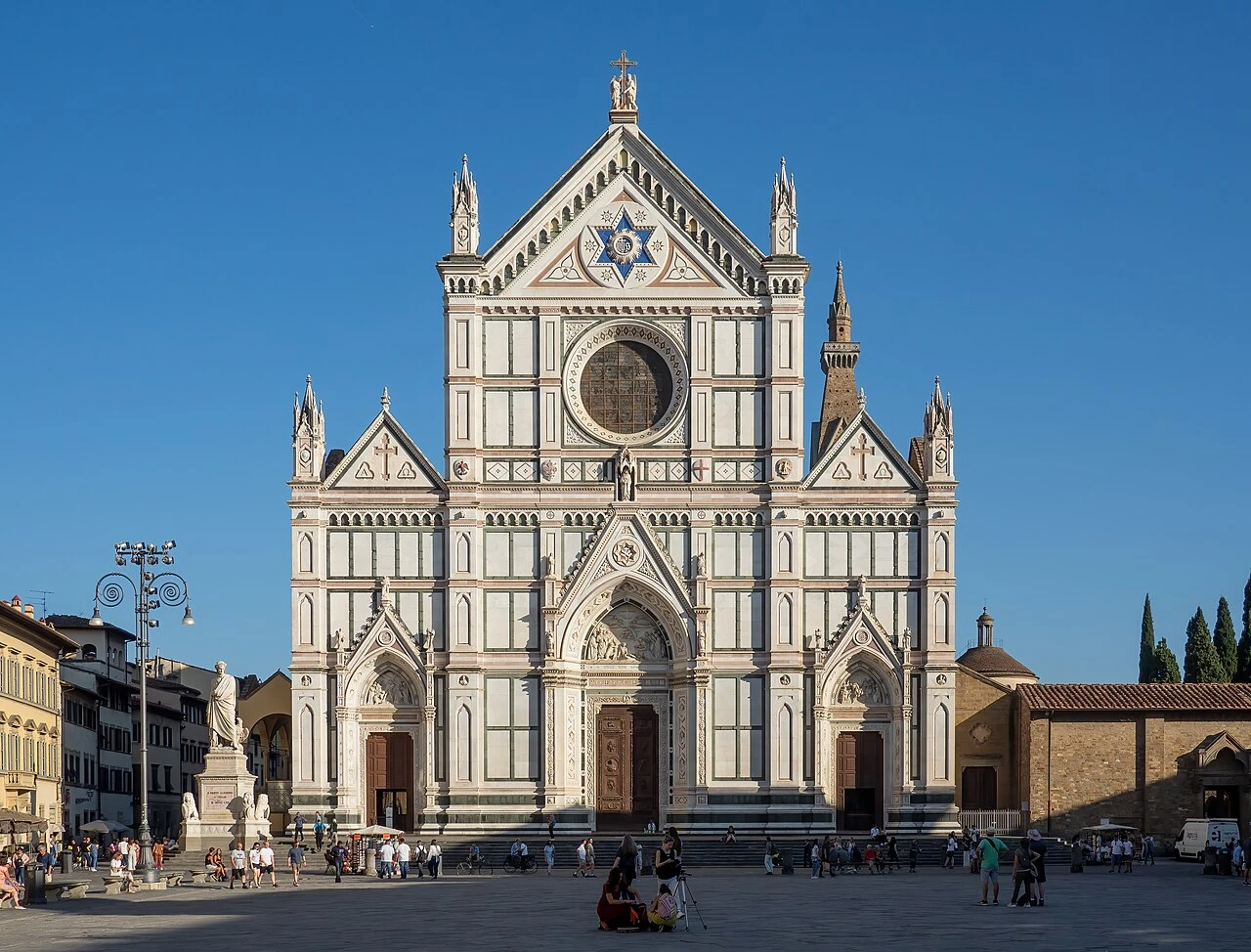
Florença · 1 km
Basílica de Santa Cruz
Conteúdo e fontes
Photo: Rhododendrites · CC BY-SA 4.0