Travel tips/Batalha, Portugal
Batalha Monastery: what to see beyond the church
The nave is only the beginning. Follow royal ambition, everyday monastic life and changing ideas in stone through the rest of Batalha.
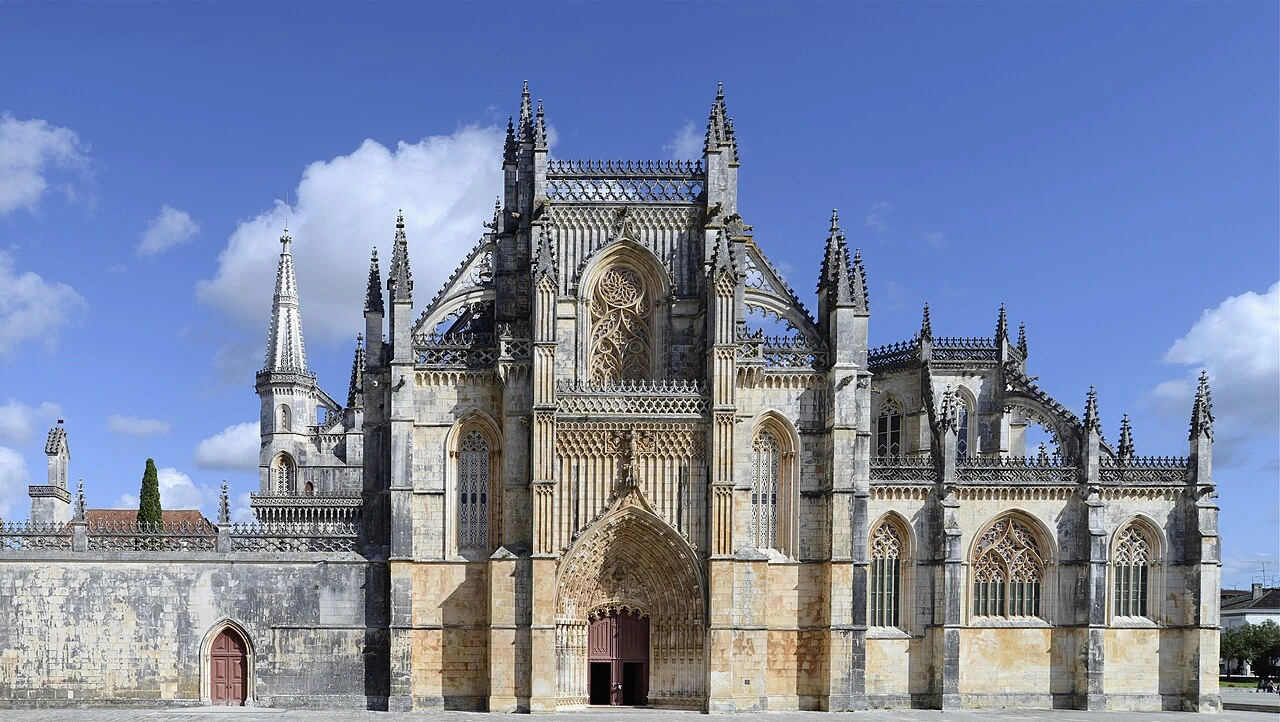
Batalha rewards a second question after the church: what did the rest of this enormous building do? Royal tombs make a claim about succession; a cloister organises meals and meetings; a roofless mausoleum exposes ambitions that outlasted their patrons. You can read those differences without memorising a dynasty. Start by comparing the spaces, then let the details slow you down.
Start with the ticket desk, not an assumed entrance
The official page places the ticket office behind the monument, at Largo Infante D. Henrique, and warns that Storm Kristin changed access and circulation. It lists €15 adult admission. Its route includes the Founder’s Chapel, both cloisters, Chapter House and Unfinished Chapels, but does not spell out ticket coverage or a free church-only entitlement. Ask staff to confirm both, along with any closures and re-entry rules; keep your ticket.
For 16 October–31 March, the posted hours are 09:00–18:00, last entry 17:30; for 1 April–15 October, 09:00–18:30, last entry 18:00. Holiday closures apply. Check your date on the official page. Last admission leaves too little time for the visit proposed here.
The Founder’s Chapel: a dynasty arranged in stone
Commissioned for João I, the chapel was completed in 1435 under Huguet. Look from its square outer plan towards the higher octagonal centre and the joint tomb of João and Philippa of Lancaster. Then compare the children’s tombs along the south wall with the nineteenth-century revival tombs on the west: this is a royal memorial shaped in different periods, not an untouched medieval room.
Two cloisters, two different kinds of looking
In the João I Cloister, compare the early Gothic framework with the later, intricate Manueline screens filling its arches. Look towards the lavabo and former refectory: circulation here connected communal routines. The plainer, two-storey Afonso V Cloister shifts attention from ornament to practical space. Try looking at what each gallery connects before photographing its arches.
Inside the Chapter House, trace the star-shaped ribs across the stone vault and notice the absence of a central support. Huguet’s engineering makes the open floor possible. The Unknown Soldier memorial, installed in 1921, adds a later commemorative layer. Pause respectfully; do not plan the visit around an unverified guard-changing timetable.
Leave room for the Unfinished Chapels
Duarte commissioned this second royal mausoleum in 1437. Seven radiating chapels surround an uncovered centre. Compare Mateus Fernandes’s dense Manueline portal with the later Renaissance balcony: the building records changing architectural intentions. Manuel I’s decision to be buried at Belém contributed to its non-completion; avoid reducing a long building history to a single dramatic explanation.
The official route directs visitors outside after the cloisters, then right towards the chapels. Ask for today’s connection before leaving the controlled area; this direction does not establish unlimited re-entry. Conservation completion reported in 2026 is not proof that every area is continuously open.
Give the contrasts time to register
A workable editorial budget is 20 minutes for the church and orientation, 20 for the Founder’s Chapel, 45 for the cloisters and Chapter House, 25 for the Unfinished Chapels and 10 for transitions. These total two hours, without a queue, long listening stops or a meal. With less time, choose fewer spaces rather than rushing each one; agree that choice with staff before crossing an exit.
The official page says most of the route has ramps, with the Founder’s Chapel listed as an exception; the Afonso V upper level has three flights of stairs and no lift. Ask about your exact route if these matter. The roofless chapels also make weather relevant. Wear shoes suited to stone surfaces and leave time to sit and look.
Choose a story that helps you see
UNESCO inscribed Batalha in 1983; its account links the Dominican monastery to Portugal’s victory at Aljubarrota in 1385. Keep that national story beside the smaller details: a family tomb, a washing place, a rib crossing empty space. They make the monument more than a victory symbol.
Stanza’s independent guide page offers previews, including the western façade, and lists 26 narrated stops. Listen before buying, check current languages and price, and download in advance for offline listening. Its stop list does not certify physical access. Admission is separate. The monastery’s Portuguese and English interpretation, available accessible materials and your own reading are useful alternatives; official QR audio is described for the temporary exhibition, not as a verified whole-monastery audio tour.
A few more questions before you go
Sources & further reading
Visitor information checked .
Official monastery visitor and history pages, UNESCO, the restoration contractor and Stanza’s public guide checked on 18 October 2026. The official visitor page describes a revised route after Storm Kristin. Its ticket link returned a missing-page error; free church access, detailed ticket coverage and re-entry terms were not established. Confirm arrangements directly. Times below are editorial allowances, not a tested itinerary.
- Batalha Monastery: visitor information
- Batalha Monastery: history and architectural spaces
- UNESCO: Monastery of Batalha
- ERA: completion of conservation at the Unfinished Chapels
Questions or a correction? Let us know. Our content standards (English).