Stanza · Audio guide
Maiden Tower Audio Guide
A place to remember. A story to take with you.
The Maiden Tower is a 12th-century monument located in the Old City of Baku. It is a UNESCO World Heritage site and serves as a distinctive national emblem of Azerbaijan.
Download Stanza, then search for “Maiden Tower”.
About the tour
One guide. Your kind of visit.
The Maiden Tower is a 12th-century monument located in the Old City of Baku. It is a UNESCO World Heritage site and serves as a distinctive national emblem of Azerbaijan.
Ready when you are.
- 01Get the free Stanza app.
iOS & Android
- 02Find your guide.
“Maiden Tower”
- 03Download before you go.
Works offline
Audio guide / 10 narrated stops
Inside the guide
Get to know a few of the stories before you go. Open a stop to read more.
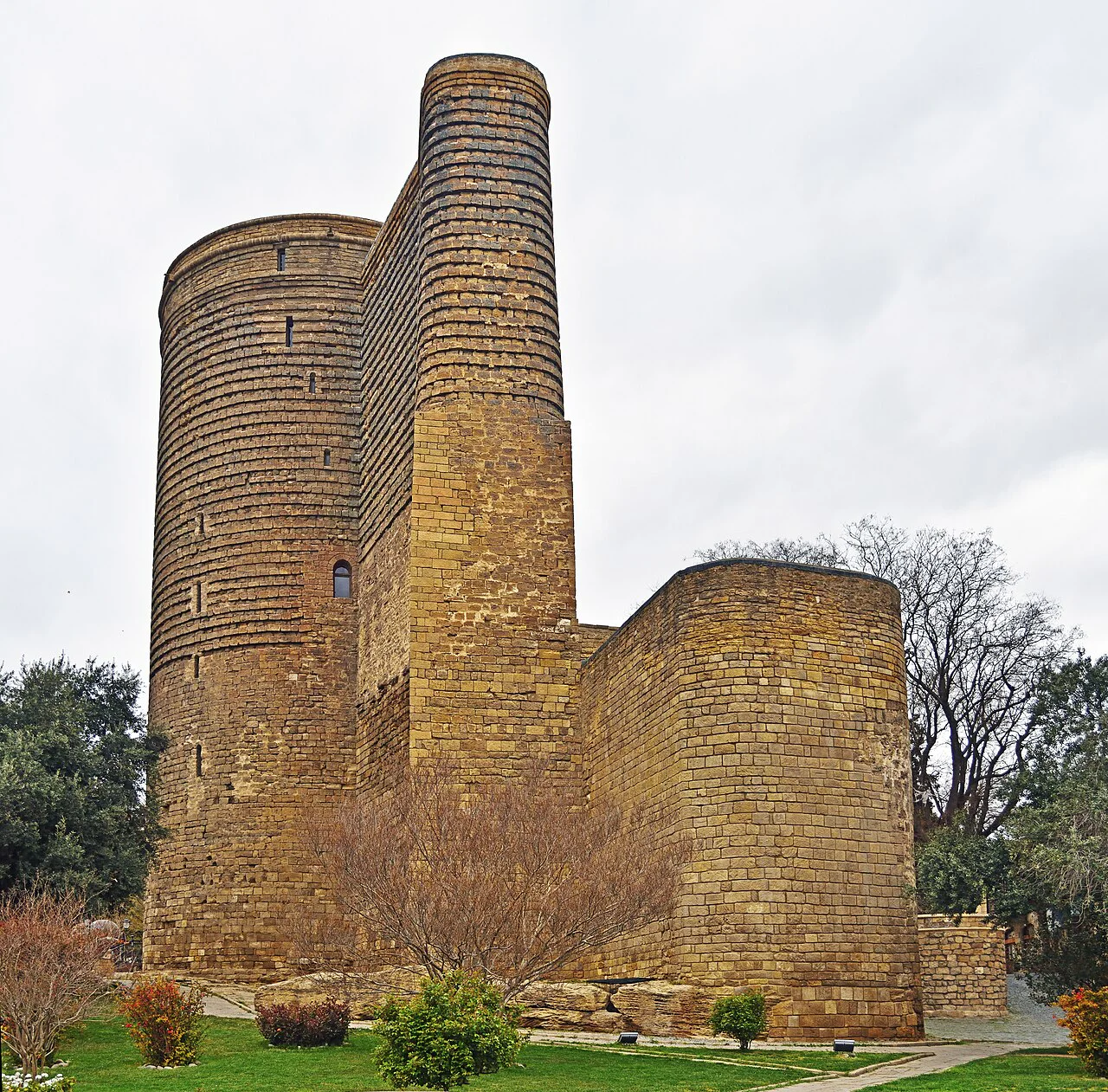
01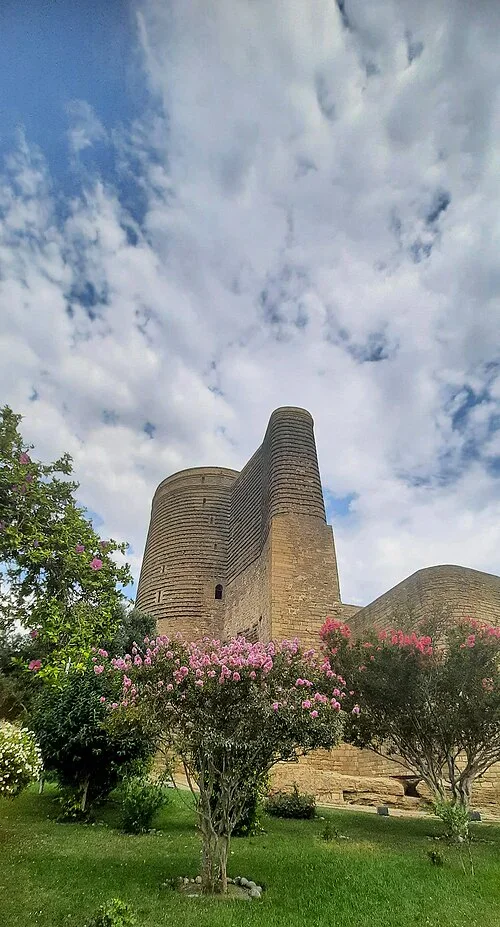 Exterior Plaza and the Eastern Buttress
Maiden Tower: Icon of Baku
Welcome to the Maiden Tower, the great stone cylinder that rises from the Old City of Baku. Azerbaijanis call it Qiz Qalasi, and it is among the most distinctive landmarks in the country. The Shirvanshahs, the dynasty that ruled here, raised most of the buildings of the Old City, and the tower belonged to their fortress. Together with the Shirvanshahs' Palace nearby, it forms a World Heritage property listed by UNESCO in 2000. An earthquake that same year damaged the monuments, and UNESCO placed them on its danger list for several years before conservation work earned their removal in 2009. The tower stands on solid rock beside the sea, a defensive keep with a long working life. Its deepest layers may hide something far older, and possibly sacred. That puzzle, and the legends that grew around this stone, are what this visit follows.
Aykhan Zayedzadeh · CC BY 4.0
02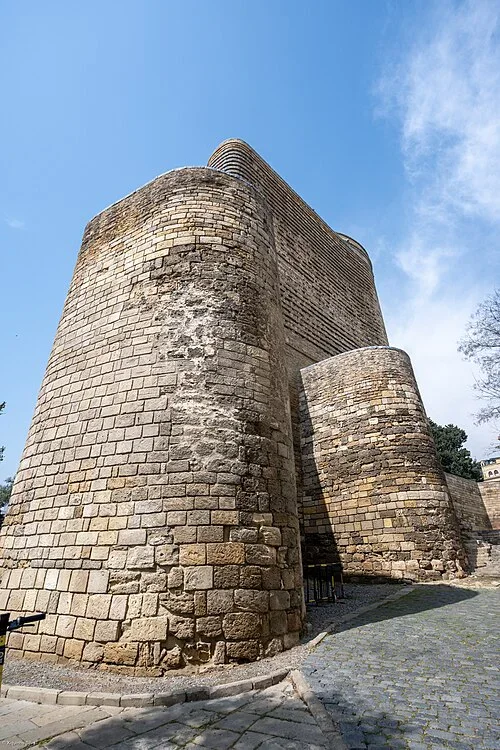 Exterior Plaza and the Eastern Buttress
The Nine-Shaped Silhouette
A huge curved spur of masonry juts from the eastern side of the cylinder and merges into its wall. Seen from above, the tower and its spur together draw the shape of a number nine. The stonework itself tells a story. The builders used local grey limestone, laying alternate courses in gypsum plaster, which gives the walls their black and white banding. The northwestern face keeps the original finish, and the earliest stonework has square corners. What the spur was for has kept scholars arguing. Excavations in the early 1960s showed the tower stands on a large rock sloping toward the sea, and that the buttress braces it against that slope. Wooden girders found deep at the foundation suggest the builders also designed it to withstand earthquakes. Others read the eastward projection differently, as oriented toward sunrise at the equinoxes, which would make the tower an astronomical instrument. That remains a hypothesis, not a settled answer.
xiquinhosilva · CC BY 4.0
03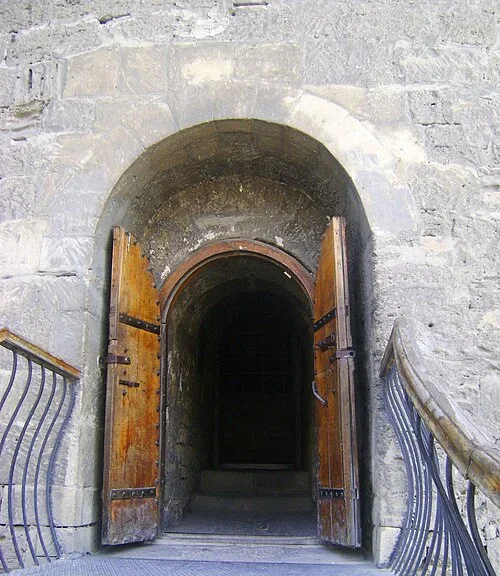 The Fortified Ground Entrance
The Unconquered Threshold
The doorway is a plain arch of grey stone, closed by wooden doors studded with iron. Its modesty is the point. This threshold was built to be defended, set into walls roughly five metres thick at the base. Those walls taper toward the top, but at ground level they are a fortress in themselves. Narrow windows and niches light the stair inside, each one flaring inward so that an attacker could not easily force an entry. The tower's name carries the same defensive idea. Historians suggest that 'Maiden' refers not to any young woman, but to the citadel itself. In the language of fortification, a maiden fortress was one that was never taken, never violated by an enemy. The name is a boast in stone, a claim that this keep held out against every assault.
Listen in the appPhoto: Самый древний · Public domain
04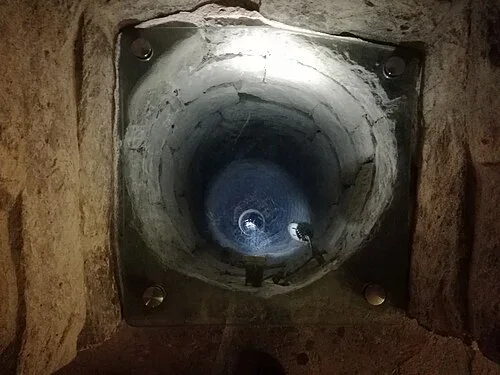 The Vertical Shaft and Well Chamber
Eight Floors, One Shaft
Through the opening in the floor, the tower drops away in a single illuminated line. Each of its eight levels is covered by a shallow vaulted ceiling, a stone cupola with a central opening. Those openings align one above another, so the eye can travel straight through the building from top to bottom. The tower rises 29.5 metres above its coastal rock, with a base nearly 16 and a half metres across. All that stone leaves a modest interior, said to be enough to accommodate about two hundred people. A staircase connects the floors, hugging the circular wall the whole way up, lit only by those narrow flaring niches. Climbing it means winding through the thickness of the wall itself, level by level, in near darkness.
Listen in the appToghrul Rahimli · CC BY-SA 4.0
05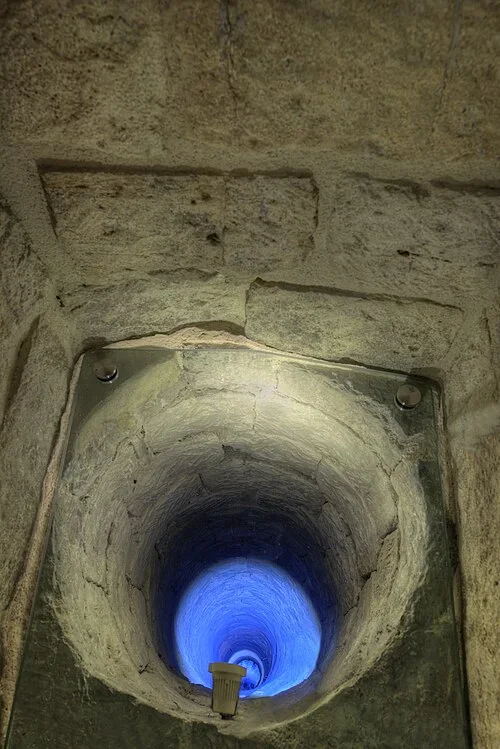 The Vertical Shaft and Well Chamber
The Well in the Rock
The well is easy to miss, a round shaft about the width of a person, cut deep into the bedrock. It runs some 21 metres down to the aquifer, and the archaeologist Abbas Islamov traced it from the second floor to a second entrance at ground level. Though the sea is close by, the water in it is described as clean and fresh. Ceramic pipes about thirty centimetres across ran down from the tower's niches into the well, collecting water for the people inside. That plumbing survives in its original form, and it still awaits a full study. The ceramics and the silt settled inside them could one day help date the tower itself. And the tower needs dating, because its beginnings are a puzzle. Some scholars believe the site served as a Zoroastrian temple in the Sasanian era, and Davud Akhundov and Hassan Hassanov date a fire temple-tower here as far back as the eighth or seventh century before Christ. If they are right, this was holy ground long before any fortress rose above it.
Listen in the appToghrul Rahimli · CC BY-SA 4.0
06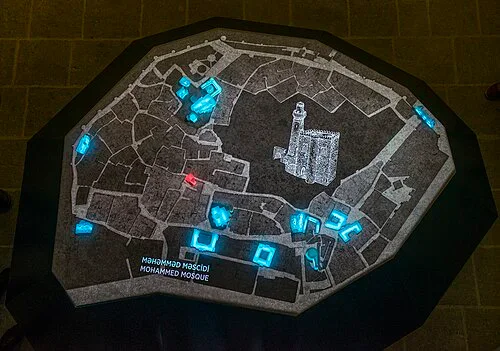 Citadel Galleries and Medieval Defense
The Walled City in Miniature
The illuminated model on this floor shows the whole walled Old City at once, the Maiden Tower among its clustered lanes, with the Muhammad Mosque marked beside it. Baku grew as a fortress town, and the sea shaped it. As the Caspian shoreline receded, a strip of new land emerged, and between the ninth and fifteenth centuries the city walls and the palace rose on it, including the huge bastion of this tower. The clearest date on the tower itself sits 14 metres up its south wall, an inscription in old Kufic script. It mentions Qubbeye Masud ibn Davud, a figure of the twelfth century. Unlike the inscription on the Mardakan Round Tower, it never actually calls him the architect, so his exact role is disputed. Still, scholars generally agree that much of the present tower dates to the twelfth century. The historian Sara Ashurbeyli calculated that the foundations reach 15 metres below ground, and that the bottom three stories were built with stone different from the medieval city around them, an earlier life beneath the Shirvanshah rebuilding.
Listen in the appToghrul Rahimli · CC BY-SA 4.0
07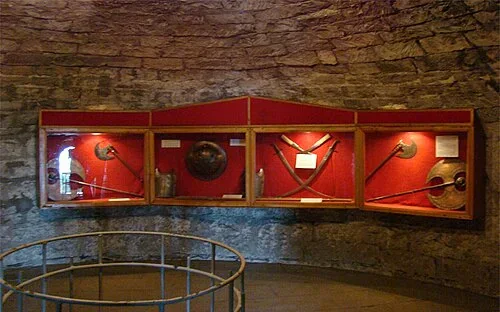 Citadel Galleries and Medieval Defense
The Siege and the Fire-Haired Maiden
Set into the curved stone wall, glass cases hold swords, shields and helmets, the museum's picture of the tower as a fighting keep. Its garrison would have known siegecraft from the inside. Probably the most famous legend tells of just such a siege, and it is one of some twenty tales attached to this tower. A long time ago, the story goes, an enemy encircled Baku and cut the water lines, leaving the fortress only thirst and death. The priests prayed day and night to the Holy Fire kept in the tower, calling on the god Ahura Mazda. Then a piece of the Holy Fire fell from the top of the temple-tower, and a beautiful girl rose from it, her hair the color of flame. The crowd fell to their knees, and she called out, don't be afraid, I am here to help and protect you, give me a sword and helmet. She went into battle against general Nureddin and his troops and saved her countrymen. But she had fallen in love with the enemy general she killed, so she stabbed her own shoulder with her sword and gave her soul to the Holy Fire Tower. The Khazri and Gilavar winds blew hard for seven days after, and since then the temple fires have stopped burning. The tale is rooted in Azerbaijan's Zoroastrian past, and the tower is said to take its name from that maiden savior.
Listen in the appداود مجتهدی · Public domain
08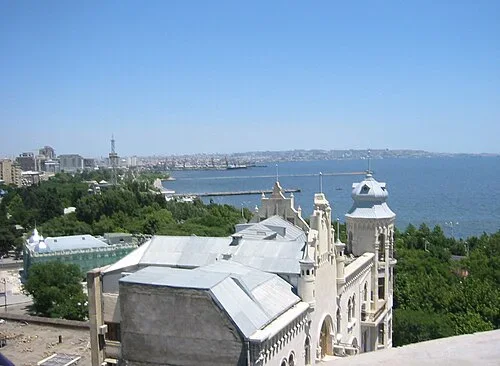 Rooftop Observation Platform
The Princess on the Parapet
From the top of the tower, the view opens over the whole curve of Baku Bay and the wide Caspian beyond. This summit carries the tower's saddest legend. A king wished to force his daughter to marry a man she did not love, so she asked him to build her a tower first. When it was finished, she climbed to the top and threw herself from the parapets into the sea. The tale became the subject of many Azerbaijani poems and plays. In 1940 the composer Afrasiyyab Badalbayli made it into Maiden Tower, the first Azerbaijani ballet, still performed at Baku's Opera and Ballet Theatre in a modified telling. The story is folklore, and no historical princess is attached to the actual tower. But its echo reached into this century. Between 2011 and 2013 the tower was restored, and plexiglass barriers were installed around this observation deck to prevent suicides.
Listen in the appArt Anderson · CC BY-SA 3.0
09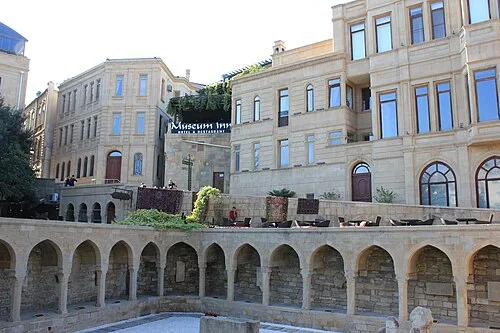 Rooftop Observation Platform
Watching the Old City
From the roof, the alleys and minarets of the Old City spread out below the walls, with the Baku Boulevard running along the shore and the Isa bek Hajinski House among the buildings in view. This was a watchtower's field of vision, kept against attack from the sea. The sea it watched for has since drawn back from the walls, and the city has followed it outward.
Listen in the appAsif Masimov · CC BY-SA 4.0
10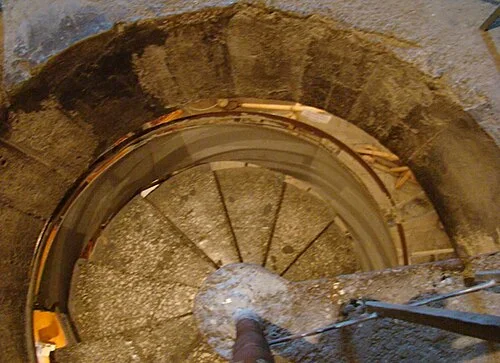 The Intramural Spiral Staircase and Exit
The Spiral Descent
The staircase winds downward in a tight spiral, its stone steps built against the circular wall, carved into the very thickness of the masonry. Every generation the tower sheltered made this same climb, guards carrying water, soldiers, priests, and now visitors. The stair is one of the quiet reasons the tower has lasted, along with its walls and the bedrock beneath it, through earthquakes, sieges and a shifting sea. Its image now travels further than any siege ever reached. The Maiden Tower appears on Azerbaijani currency notes and official letterheads, a national symbol carried in countless pockets.
Listen in the appداود مجتهدی · Public domain
Maiden Tower
Frequently asked questions
How much does the guide cost?
Free app download. Listed guide price: $0.99. Guide price shown in the app. Audio guide only. Venue admission is separate.
Can I listen without internet?
Yes. Download the guide’s audio, images, and maps in the app before your visit. Your downloaded content is then available offline.
Can I listen in my language?
This audio guide is available in 15 languages, including English.
Do I need to follow a schedule?
No. This is a self-guided experience. Choose your stops, pause whenever you like, and return to a story at your own pace.
At your own pace
Explore Maiden Tower.
Download Stanza, then search for “Maiden Tower”.
Free app download · Guide price shown in the app
Keep exploring
Nearby audio guides
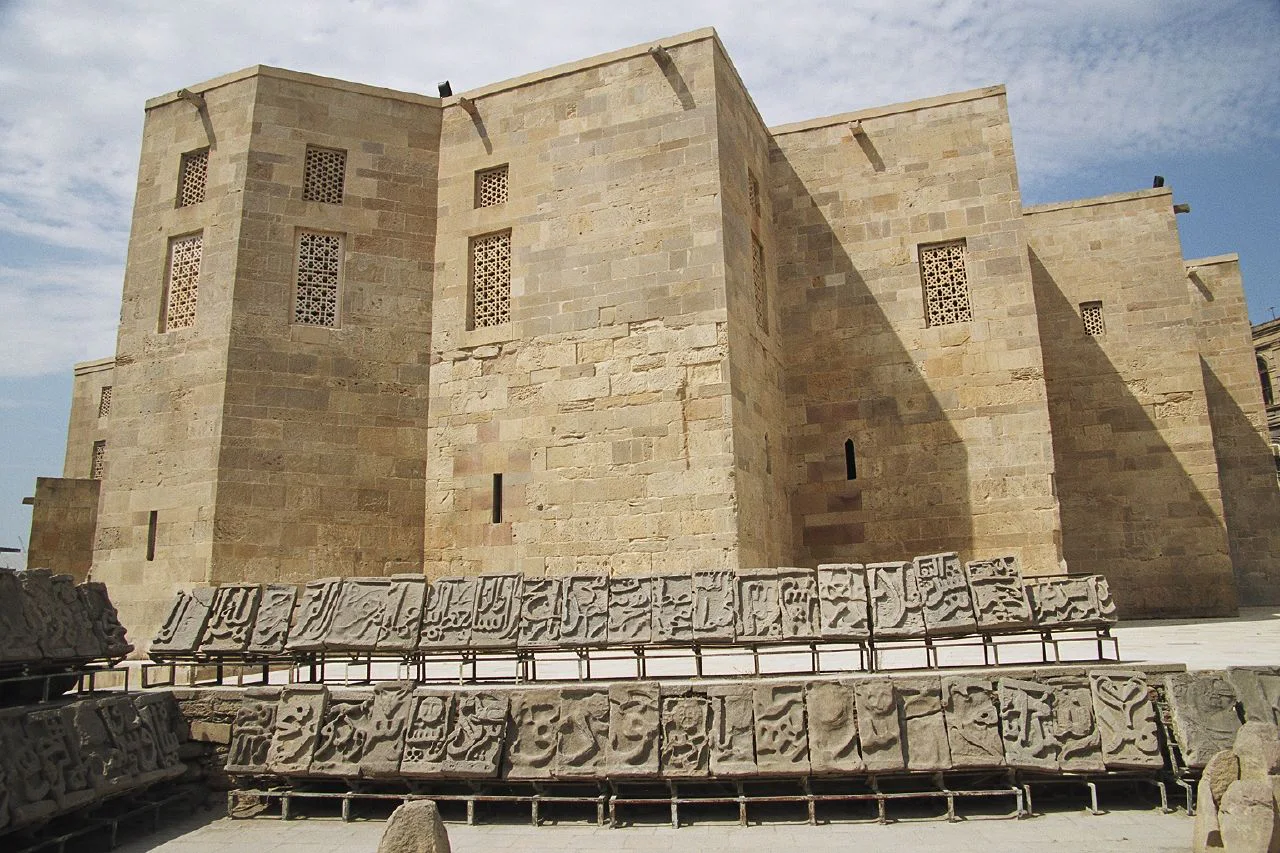
Baku · 1 km
Palace of the Shirvanshahs
Content & sources
Bruno Girin · CC BY-SA 2.0