Stanza · Audio guide
Palace of the Shirvanshahs Audio Guide
A place to remember. A story to take with you.
The Palace of the Shirvanshahs is a 15th-century palace built by the Shirvanshahs in Baku. It is recognized by UNESCO as one of the pearls of Azerbaijan's architecture and is part of a World Heritage site.
Download Stanza, then search for “Palace of the Shirvanshahs”.
About the tour
One guide. Your kind of visit.
The Palace of the Shirvanshahs is a 15th-century palace built by the Shirvanshahs in Baku. It is recognized by UNESCO as one of the pearls of Azerbaijan's architecture and is part of a World Heritage site.
Ready when you are.
- 01Get the free Stanza app.
iOS & Android
- 02Find your guide.
“Palace of the Shirvanshahs”
- 03Download before you go.
Works offline
Audio guide / 14 narrated stops
Inside the guide
Get to know a few of the stories before you go. Open a stop to read more.
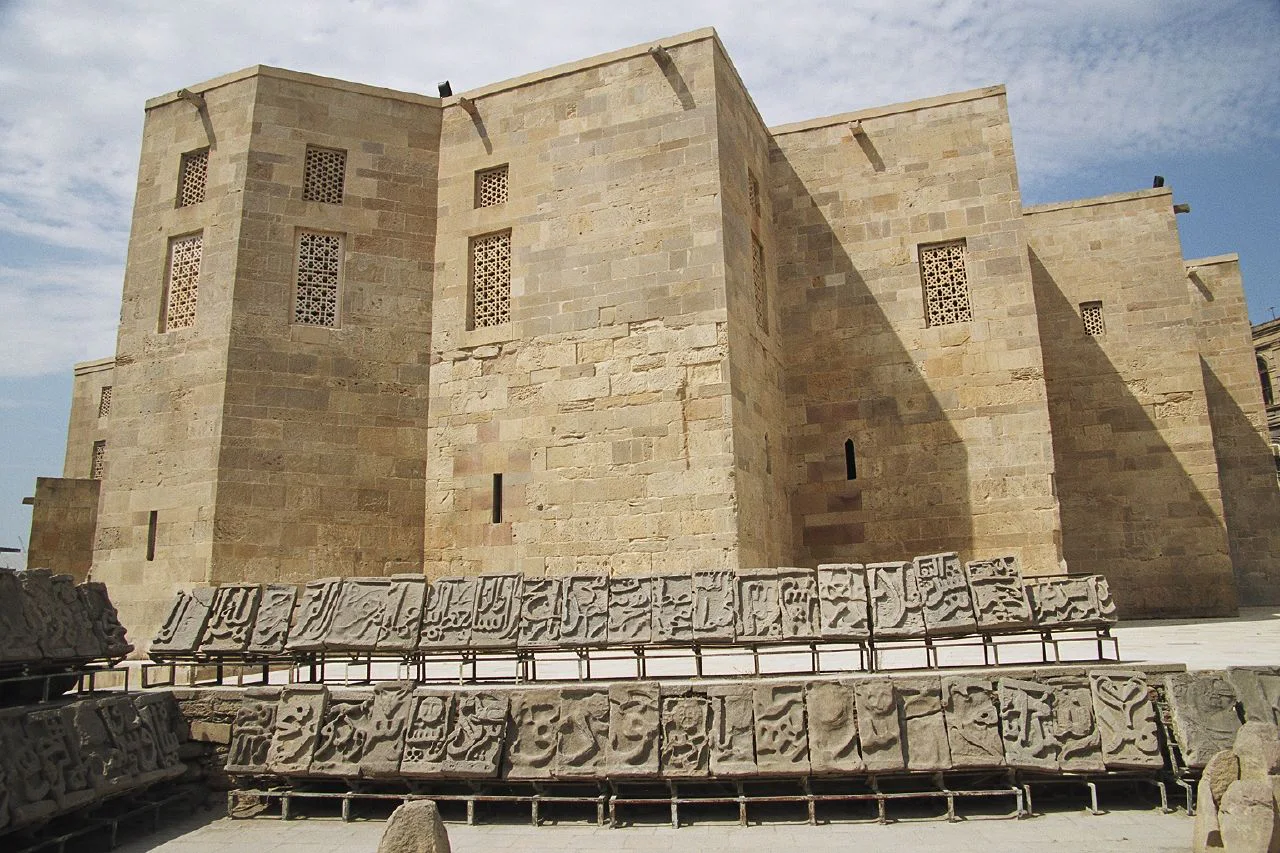
01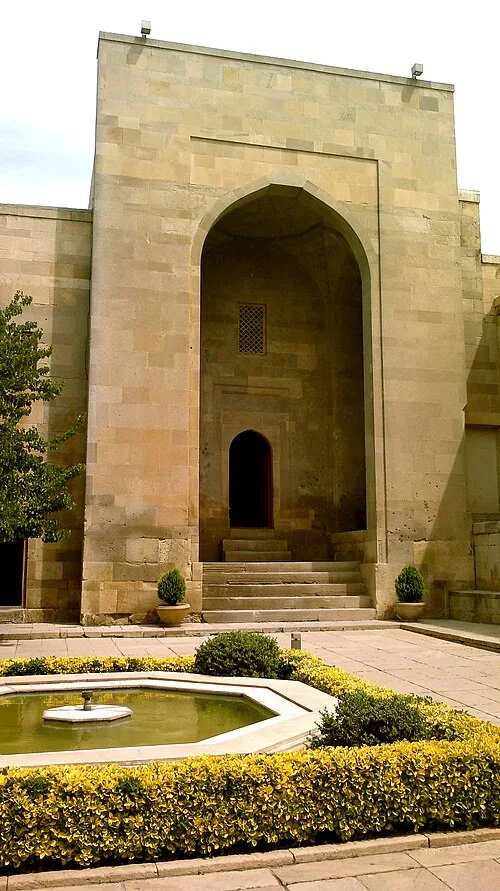 Upper Courtyard: Palace Plaza and Arrival
Arrival: Gateway to the Shirvanshahs' Citadel
Welcome to the Palace of the Shirvanshahs, on the crest of Baku's Old City. For centuries this was the residence and seat of government of the Shirvanshah dynasty, rulers of Shirvan. Their story here began with a disaster. A devastating earthquake wrecked their capital at Shamakhi, and Ibrahim I of Shirvan moved it to Baku. He committed himself to building this palace, and by the usual account work began in 1411. The complex did not rise all at once. Its buildings step down the hill in walled courtyards, one below another, forming a stronghold within the walls of the Baku fortress. Today it is a state museum-preserve, protected since 1964. In 2000 it joined the Maiden Tower and the old city walls on the UNESCO World Heritage List, which calls it one of the pearls of Azerbaijan's architecture.
Interfase · Public domain
02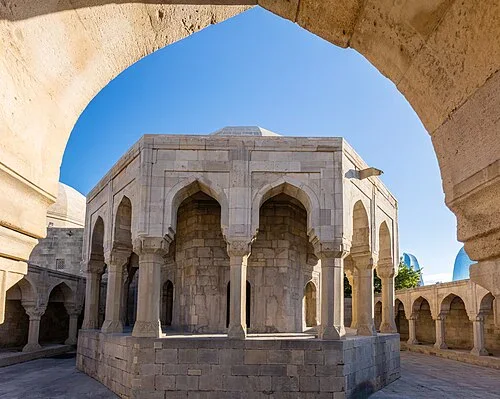 Divankhana: The Octagonal Rotunda
The Divankhana Rotunda
In the middle of a closed courtyard ringed by a pointed arcade stands an octagonal rotunda. This is the Divankhana, and nobody knows for certain what it was built for. The candidates are a court of law, a hall for receptions, a state council chamber, a house of the Sufi order, or a tomb. Each theory has its defenders, and the question remains open. Some clues lean toward a memorial. Beneath the rotunda lies a dungeon-crypt, and the inscription above the entrance to the hall quotes verses from the tenth sura of the Koran. The decoration was never finished. That incompleteness, along with the style, dates the building to the end of the fifteenth century, the very years when Safavid troops captured Baku. Whatever its purpose, the work stopped with the dynasty's fall.
Diego Delso · CC BY-SA 4.0
03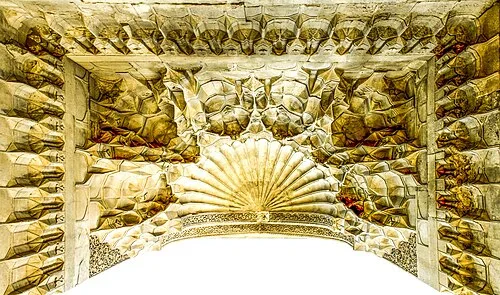 Divankhana: The Octagonal Rotunda
Stone Filigree: The Divankhana Portal
Over the Divankhana's western portal, stone seems to dissolve into lace. The half-cupola is built of muqarnas, carved stalactites stacked in fine rows to carry the curved form. This is the signature of the Shirvan-Absheron school of building, which prized exact geometry, careful masonry and delicate relief carving. The whole ensemble follows its traditions, which is why buildings raised at different times still match in scale and proportion. Overhead planes here are covered in ornament, and arabesques frame the portal. There is also an older, stranger suggestion about this ground. The historian Sara Ashurbeyli believed the site may have been sacred even before Islam. She pointed to cup-shaped grooves in the area, which she thought might have collected the blood of sacrificial animals. It remains her suggestion, nothing more.
Listen in the appphoto:Urmen19, retouch: Sefer azeri · CC BY-SA 4.0
04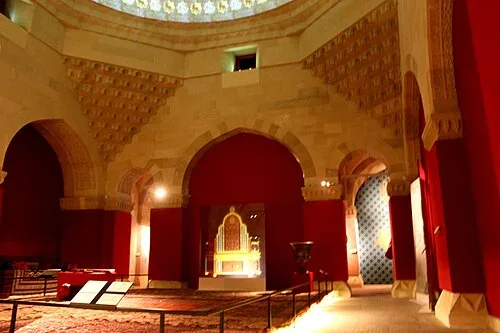 Residential Palace: Royal Chambers and Throne Hall
The Throne Hall of the Two-Storey Palace
The main palace building is a two-storey limestone residence of fifty-two rooms. Twenty-seven stood on the ground floor and twenty-five above, joined by three narrow spiral staircases. A big lancet portal led straight from the courtyard to the second floor, into a tall domed octagonal hall. That hall is assumed to have served for receptions, where the ruler received dignitaries and ran the affairs of state. The upper rooms were the ceremonial heart of the palace, with quarters for the shah and his family. Its later history was rougher. Under Russian rule the military turned the building into a warehouse for army equipment. Workers demolished interior walls and propped the roof on semicircular arches. A huge opening was even punched through the northern facade, so that a horse-drawn cart could drive straight onto the second floor. A petition to demolish the palace for a church failed for one simple reason: the army wanted its storage space.
Listen in the appPhoto: Urmen19 · CC BY-SA 4.0
05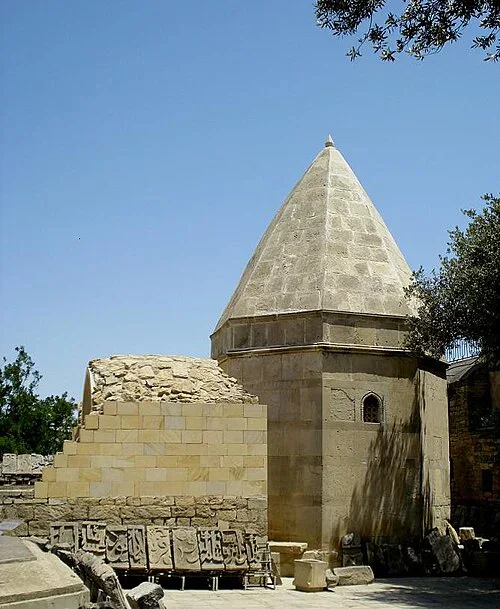 Middle Courtyard: Bakuvi Mausoleum and Keygubad Ruins
The Mausoleum of Seyid Yahya Bakuvi
A small octagonal building with a pyramidal tent roof stands in the southern courtyard. This is the mausoleum of Seyid Yahya Bakuvi, a court scholar of Khalilullah the First's time, buried here in the second half of the fifteenth century. Bakuvi was a man of wide learning, engaged in medicine, mathematics and astrology. He belonged to the Helwati Sufi order, and the Shirvanshahs were that order's patrons. Some historians believe the entire palace grew as a memorial complex around his sacred tomb, a place of worship known as a pir. Others hold that it was simply the ruler's palace. Both theories lack decisive evidence. His tombstone lies in an underground crypt, with a chamber above it. In the limestone walls, small windows are carved from solid slabs, their stone gratings pierced into multi-beamed stars that still let the light through.
Listen in the appЭмин Маммадов · Public domain
06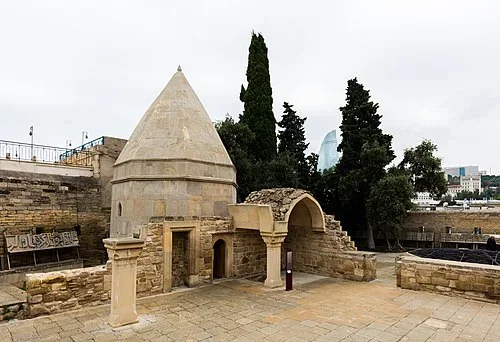 Middle Courtyard: Bakuvi Mausoleum and Keygubad Ruins
Ruins of the Keygubad Mosque
Beside the mausoleum stood the old Keygubad Mosque, built at the end of the fourteenth and the beginning of the fifteenth century. Its dome rested on four stone columns, and its masonry was bonded directly into the mausoleum's walls. The historian Abbasgulu Bakikhanov wrote of it: the cell where Bakuvi prayed, the school where he worked and his grave are there, in the mosque. In 1918 the mosque burned down. In the 1920s the archaeologist Pakhomov surveyed the ruins and made a sombre discovery. A column pedestal covered a trench holding several old tombstones, and the mausoleum crypt held the scattered bones of twenty skeletons, stacked without any order. The explanation was grim housekeeping: graves had been broken during construction, and the bones had been gathered and stored. Those tombstones have not survived. Today only two columns and part of the wall with its roof remain.
Listen in the appDiego Delso · CC BY-SA 4.0
07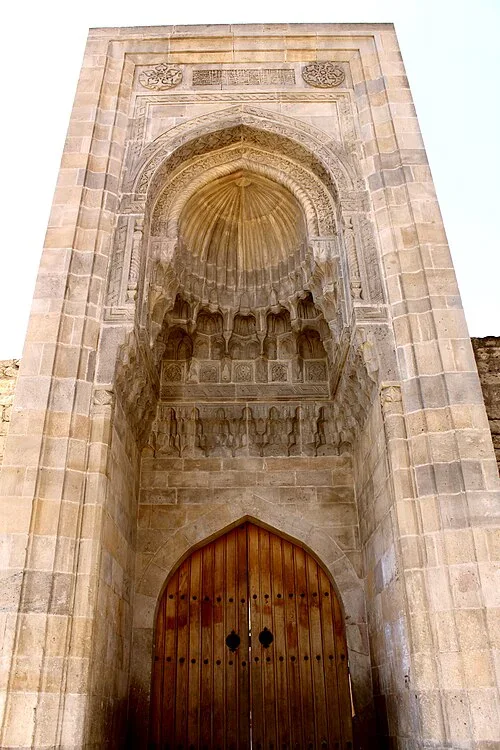 Murad's Gate: The Eastern Portal
This freestanding gateway of dressed stone carries the story of a war fought over Baku. In 1578, during the war between the Safavids and the Ottoman Empire, the Turks conquered the city. While they held it, this eastern gate was built into the palace wall. An inscription in Arabic across the top of the portal records the details. It was raised in the year 994 of the Islamic calendar, 1585 or 1586 by our reckoning, at the behest of a local nobleman, Rajab Baba. The architect was Amir Shah, from the Vaillankoukh suburb of Tabriz. With this portal, the formation of the whole ensemble was complete. Its carving is noticeably plainer than the palace's other portals, less rich and less elegant. The historian Sara Ashurbeyli suggested that its wide lancet opening may have been the entrance to a building that never survived, or was never built.
Listen in the appPhoto: Urmen19 · CC BY-SA 4.0
08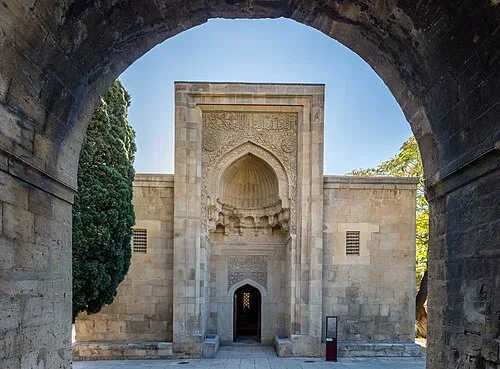 Lower Courtyard: Shirvanshah Family Mausoleum
The Shirvanshah Family Burial Vault
Set into the wall between the two courtyards, opposite the mosque entrance, stands the dynastic tomb, the Turbe. Shirvanshah Khalilullah built it in 1435 or 1436 for his mother and his son. Archaeologists later found a crypt beneath the hall, under the wooden floor, holding fourteen burials of the royal family. Among them were the remains of a child of six or seven, probably the shah's son, and an older woman, probably his mother. The facade is lined with carefully fitted Baku limestone. Then came 1501. Shah Ismail the First's Safavid troops defeated Shirvanshah Farrukh Yasar near Shamakha, besieged Baku and took the citadel. Period chronicles say the conqueror ordered the tall palace building destroyed, and that the remains of former rulers in the tombs were burned. Yet the crypt kept one remarkable secret: the skeleton of a man about two metres and ten centimetres tall, suggested by some to be Khalilullah himself, whose tomb had survived.
Listen in the appDiego Delso · CC BY-SA 4.0
09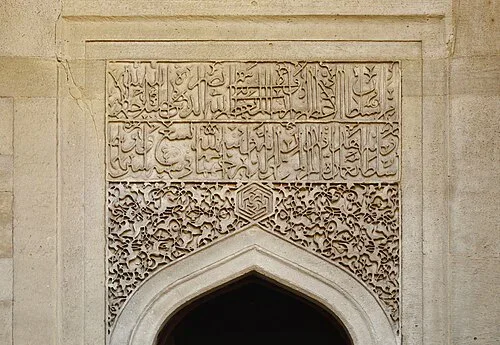 Lower Courtyard: Shirvanshah Family Mausoleum
The Architect's Mirror Signature
On either side of the tomb's lancet doorway, two onion-shaped medallions hold a secret in calligraphy. Each medallion carries the same inscription twice, once written forwards and once in mirror image. The words read: Allah, Muhammad, Ali, an architect. Muhammad Ali was the master builder of this tomb, and he fixed his name in stone where the shah's family would be buried. Judging by his name alone, he was probably a Shiite, working for a Sunni royal court. The mirrored writing let him honour his faith while keeping the design perfectly symmetrical. Above him, the portal carries further strips of inscription, a verse from the twelfth sura of the Koran and a saying of the Prophet. The stalactite arch above the entrance repeats the composition of the Divankhana portal, in a lighter, simpler form.
Listen in the appPhoto: Ludvig14 · CC BY-SA 4.0
10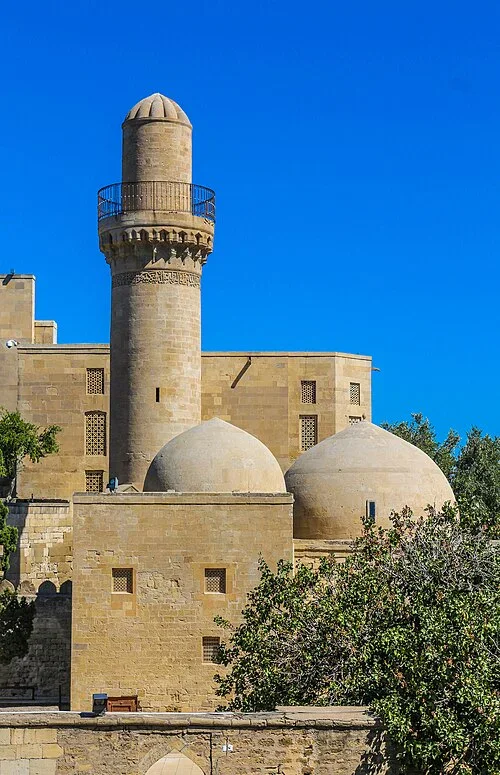 Shah's Mosque and Minaret
The Shah's Mosque and Minaret
In the lower courtyard stands the shah's mosque with its slender minaret. The minaret was built in 1441 and 1442 by order of Khalilullah, and its inscription carries the proof. An inscription in the naskh script encircles the shaft just below its stalactite cornice, asking blessings on the sultan and dating the work to the year 845. The minaret ends in a stalactite cornice that once supported a balcony with a stone barrier. The mosque is a simple rectangle: a large hall, a small women's chapel and service rooms, covered with domes. Its two portals tell of rank and access. The solemn northern portal faces the Shirvanshahs' burial vault across the courtyard. The humbler eastern portal was for the palace inhabitants, who arrived by a semi-underground passage. The minaret's inscription celebrates the minaret, not the mosque, which was built earlier.
Listen in the appPhoto: Sefer azeri · CC BY-SA 4.0
- 11
Inside the Prayer Hall: The Acoustic Pots
Hollow clay jugs hidden in the dome that carried the imam's voice to every corner.
- 12
The Palace Bathhouse and Its Underfloor Heating
A bathhouse buried in the ground, warmed by channels that ran beneath its floors.
- 13
The Ovdan: Water Beneath the Citadel
The underground cistern, fed by a distant water pipe, that quenched the whole citadel.
- 14
The Bayil Stones: Closing Reflections
Carved stones raised from the Caspian seabed, the last remains of a thirteenth-century castle.
Palace of the Shirvanshahs
Frequently asked questions
How much does the guide cost?
Free app download. Listed guide price: $0.99. Guide price shown in the app. Audio guide only. Venue admission is separate.
Can I listen without internet?
Yes. Download the guide’s audio, images, and maps in the app before your visit. Your downloaded content is then available offline.
Can I listen in my language?
This audio guide is available in 15 languages, including English.
Do I need to follow a schedule?
No. This is a self-guided experience. Choose your stops, pause whenever you like, and return to a story at your own pace.
At your own pace
Explore Palace of the Shirvanshahs.
Download Stanza, then search for “Palace of the Shirvanshahs”.
Free app download · Guide price shown in the app
Keep exploring
Nearby audio guides
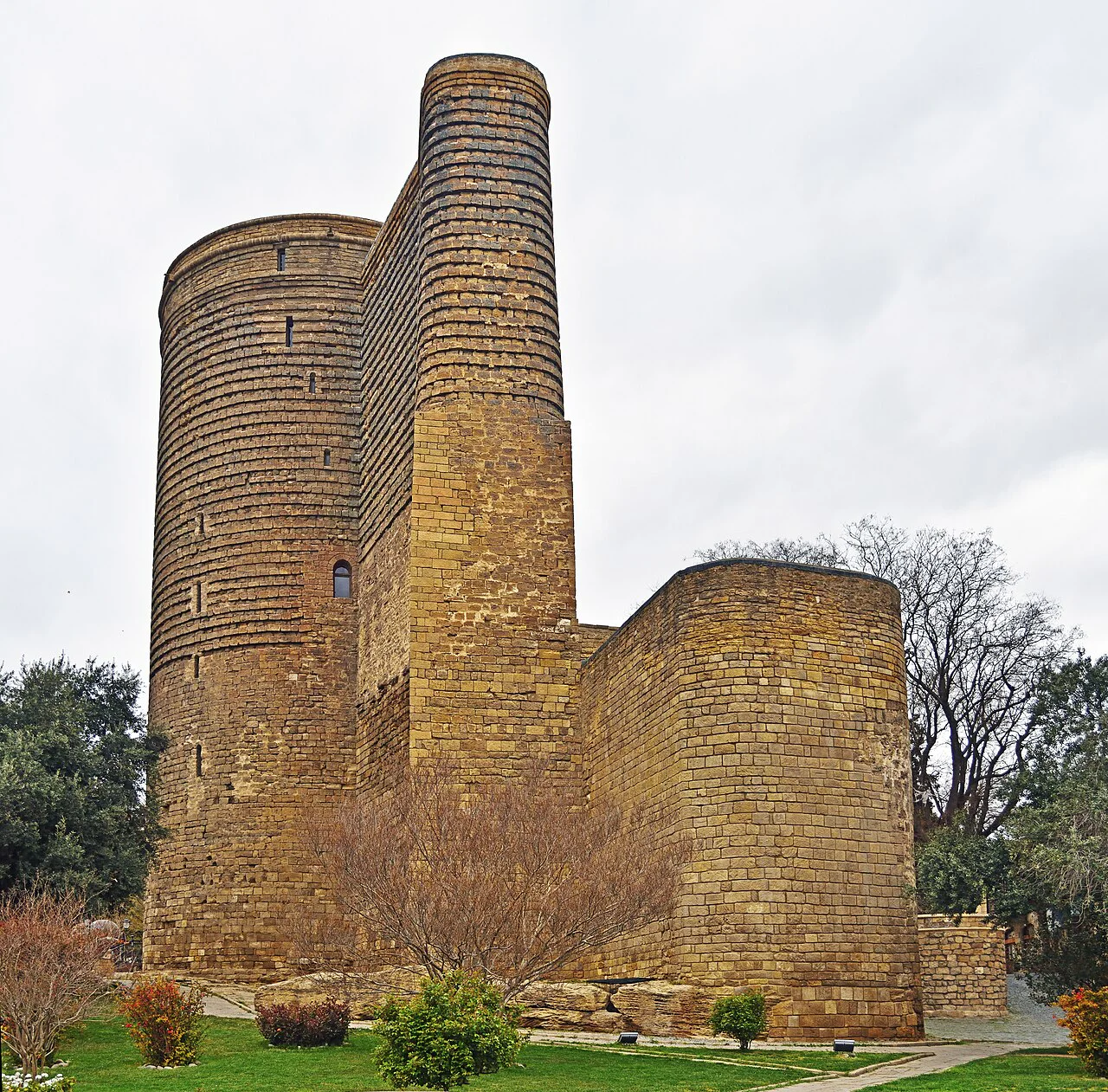
Baku · 1 km
Maiden Tower
Content & sources
Photo: Ludvig14 · CC BY-SA 4.0