Stanza · Audio guide
Ahsan Manzil Audio Guide
A place to remember. A story to take with you.
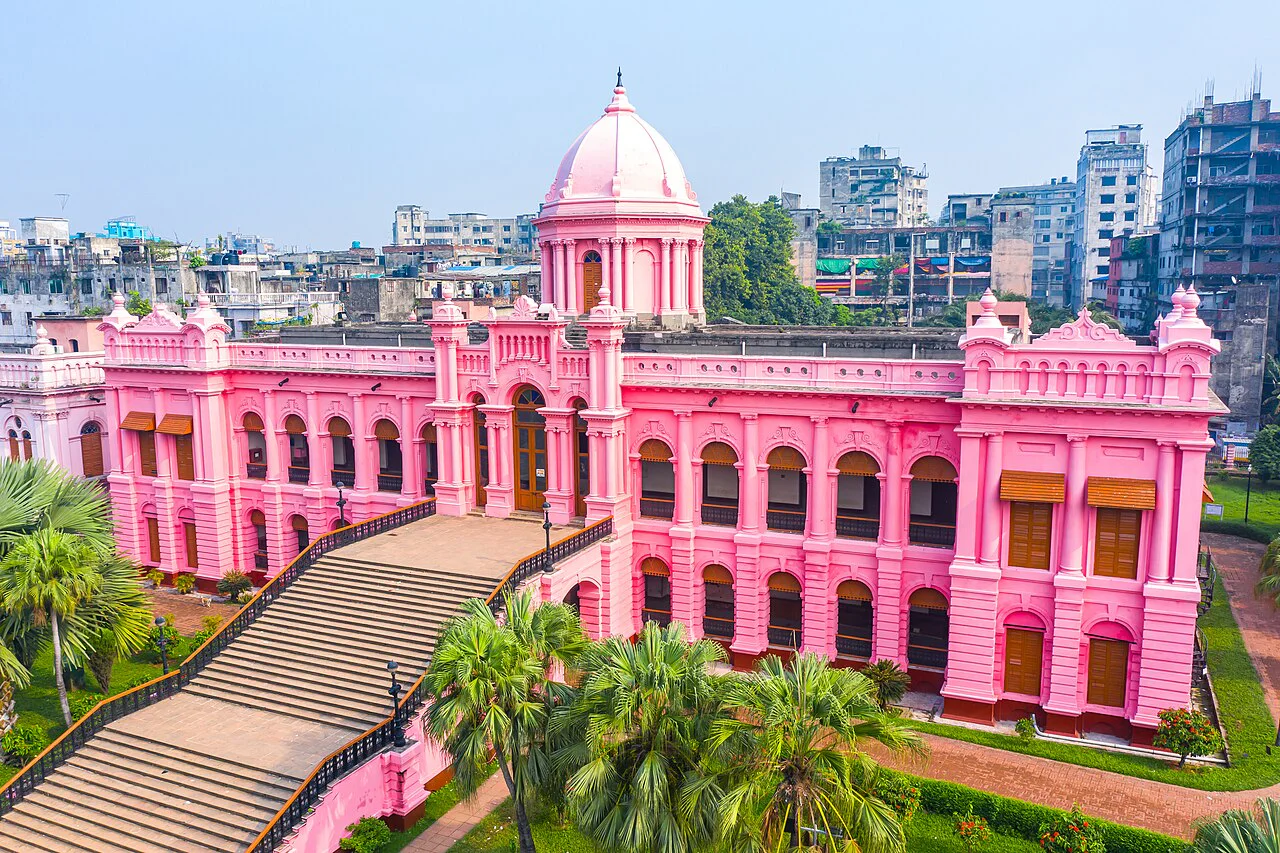
Ahsan Manzil is a historic palace situated along the banks of the Buriganga River in Dhaka. It served as the official residence and administrative seat of the Nawab of Dhaka during the late 19th and early…
Download Stanza, then search for “Ahsan Manzil”.
About the tour
One guide. Your kind of visit.
Ahsan Manzil is a historic palace situated along the banks of the Buriganga River in Dhaka. It served as the official residence and administrative seat of the Nawab of Dhaka during the late 19th and early 20th centuries.
Ready when you are.
- 01Get the free Stanza app.
iOS & Android
- 02Find your guide.
“Ahsan Manzil”
- 03Download before you go.
Works offline
Audio guide / 16 narrated stops
Inside the guide
Get to know a few of the stories before you go. Open a stop to read more.
01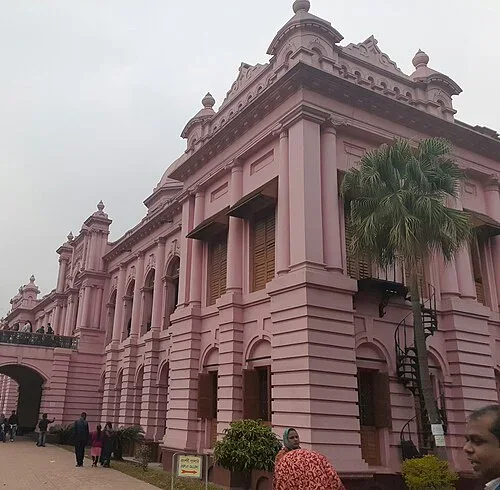 North Lawn and Indo-Saracenic Facade
Pink Palace Facade
Ahsan Manzil is a pink palace on the bank of the Buriganga River, in the Kumartoli area of Dhaka. In the late nineteenth and early twentieth centuries, it was the official home and administrative seat of the Nawab of Dhaka. Its style is called Indo-Saracenic, a blend of Indian and European building traditions. Tall pink walls rise between flat pilasters, and wooden shutters hang over many of the windows. Small domes crown the corners of the roofline. Building began in 1859. It was finished in 1872. The Nawab, Khwaja Abdul Ghani, hired Martin and Company, a European construction and engineering firm, to make a master plan for the residence. He named the palace after his son, Khwaja Ahsanullah. Today it is a museum run by the Bangladesh National Museum. The All India Muslim League was also founded here.
Rayhan9d · CC BY-SA 4.0
02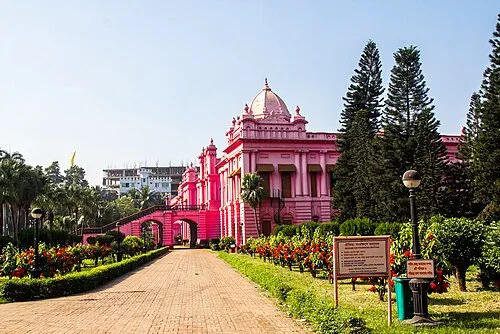 North Lawn and Indo-Saracenic Facade
North Lawn and Arched Approach
During the Mughal era, this ground held a garden house. It belonged to Sheikh Enayetullah, the zamindar, or landholder, of Jalalpur. Later he added a palace to the house and called it Rang Mahal. Around 1740, his son sold the land to French traders, who built a trading house beside it. Over the following decades, the land changed hands several times among French traders. In 1830, Khwaja Alimullah bought the property from them. He turned the old trading house into a residence, and he added a stable and a family mosque.
Rayhan9d · CC BY-SA 4.0
03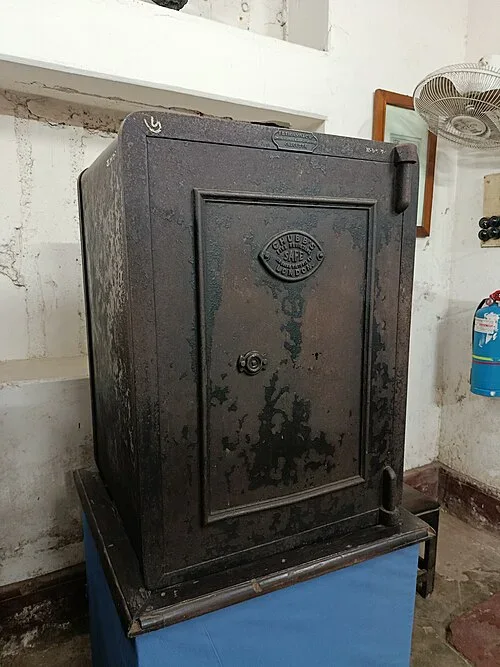 Nawab Treasury and Strongroom
Free-standing Safe with Maker's Plate
The palace once had a treasury, called the sindook room, or chest room, where valuables were kept. This heavy iron safe has a dark, weathered door, a small oval plate fixed to its front, and a round knob. It stands on a blue-painted stand. In the 1960s, valuables kept in the treasury were auctioned, and members of the Nawab family bought them. In 1974, the family's heirs proposed putting the palace itself up for auction. Prime Minister Sheikh Mujibur Rahman rejected the proposal on the second of November that year.
Listen in the appPhoto: Yahya · CC BY-SA 4.0
04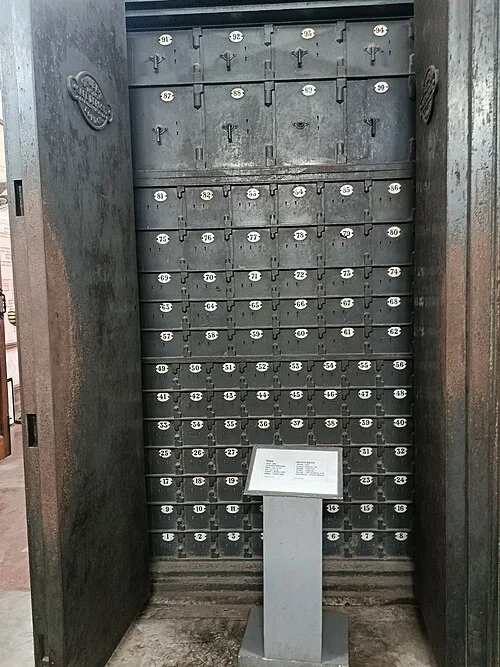 Nawab Treasury and Strongroom
Wall of Numbered Deposit Compartments
The metal wall behind this open door is split into dozens of small compartments. Each one has its own number, painted in a white oval, and its own keyhole. The idea is simple: every item gets its own numbered box, and each box locks on its own. Nothing here tells us whose valuables, if any, went into these boxes. Neat rows of numbers run from the top of the wall to the bottom.
Listen in the appPhoto: Yahya · CC BY-SA 4.0
05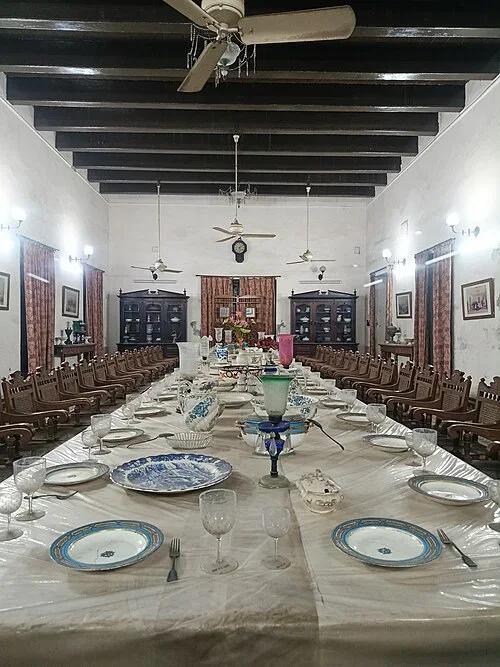 The Royal Dining Hall and Civic Modernization
The Royal Dining Hall
The long table in this room is dressed with a pale cloth, blue-and-white plates, and glasses. The room was arranged to match photographs that Fritz Kapp took in 1904. Those photographs are now held in the India Office Library in London. It is one of nine rooms arranged this way. The chairs, tables, fans and light fittings were either made to match or collected. Most of the glass and porcelain, the mirrors, and the big cabinets are original Nawab items found in the palace.
Listen in the appPhoto: Yahya · CC BY-SA 4.0
06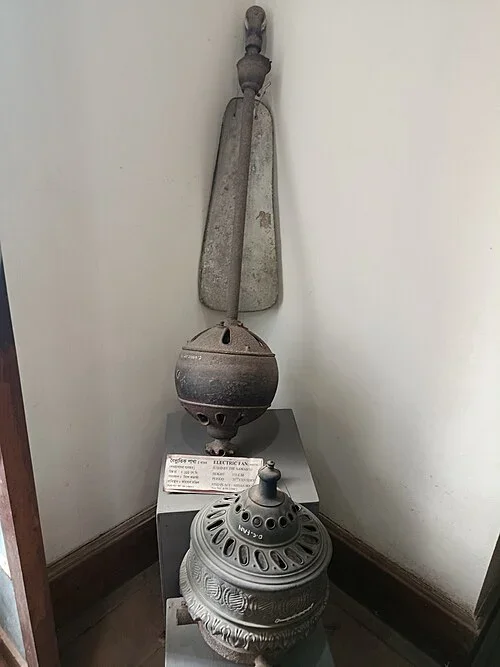 The Royal Dining Hall and Civic Modernization
Electric Fan Display
An old fan with a long metal blade rises from a round housing pierced with oval openings. Its label reads Electric Fan, in English and in Bengali. The museum's collection stands at just over four thousand items, and this fan is one of them. Like the dining room, the displays here combine original pieces with collected objects.
Listen in the appPhoto: Yahya · CC BY-SA 4.0
07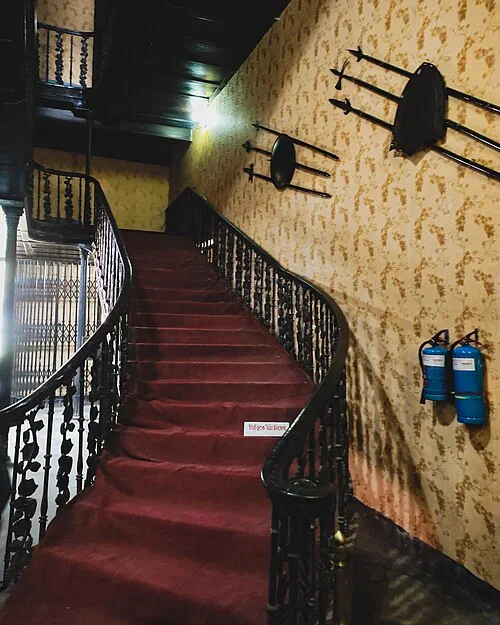 The Monumental Wooden Staircase and Armory
Monumental Wooden Staircase
The staircase in this hall is made of wood. One account says a wooden stair like this is unusual in Bengali architecture. It curves up over a red carpet, between ornate railings. The stair was restored to match its earlier look, as the dining room was. Spears and a shield hang on the wall beside it. They are items from Ahsan Manzil itself. In the Nawabs' time, a visitors' book decorated with gold was kept in this stair hall.
Listen in the appPhoto: Tanvir Rahat · CC BY-SA 4.0
08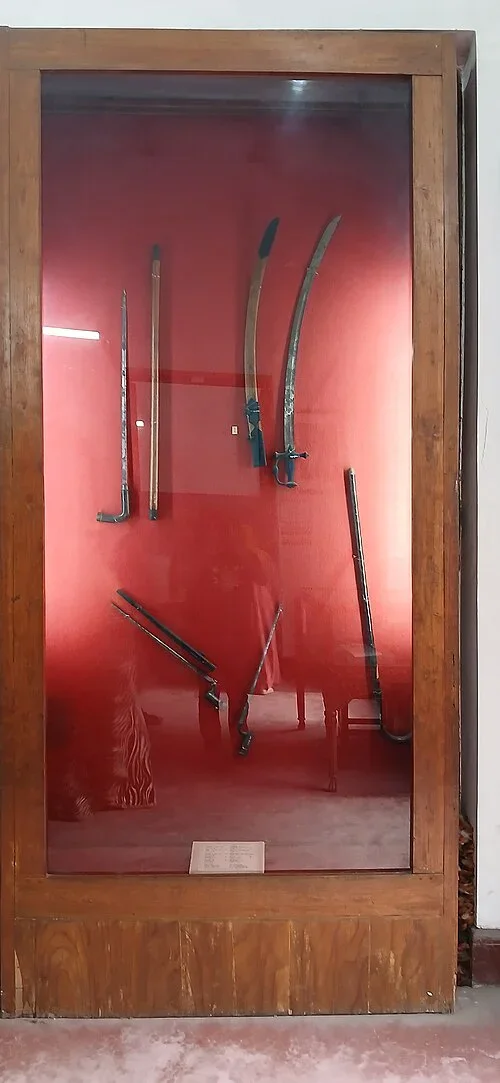 The Monumental Wooden Staircase and Armory
Weapons Display Case
Two curved blades stand upright in this glass case, one shorter and dark, the other longer and sweeping. Beside them hangs a hooked metal tool, and a long straight rod runs up the case. A long pole lies at a slant across the lower part. The round room below the dome also displays shields and swords used by the Nawabs. Its backing is a deep red, which makes the dark metal stand out.
Listen in the appPhoto: DeloarAkram · CC BY 4.0
09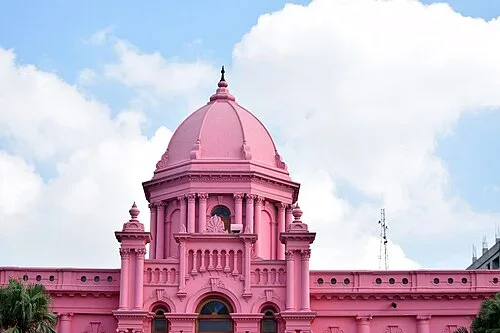 The Soaring Lotus Dome and Upper Golghar
Central Lotus-Bud Dome
The dome over the centre of Ahsan Manzil is more intricate than it looks. The round room beneath it began as a square. Brickwork in the corners turns that square into a circle. Squinches were then added to the corners of the roof. A squinch is a small arch built across a corner. These turn the room into an octagon, and from there it slopes up gradually. That slope gives the dome the look of a lotus bud. A small pointed finial sits at its top, and the peak stands twenty-seven point one three metres high. Accounts say the tall dome was raised during the repairs after the tornado of April 1888. Bricks were brought from Raniganj for that work. The engineer Gobinda Chandra Roy directed the repair work. It ranks among the tallest peaks in the city.
Listen in the appPhoto: Farhan alvee · CC BY-SA 4.0
10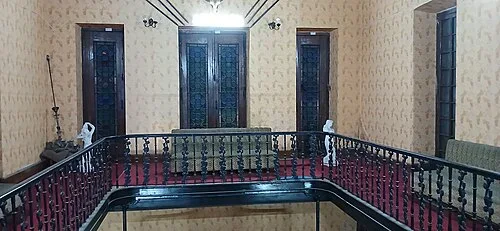 The Soaring Lotus Dome and Upper Golghar
Upper Gallery Railing
Ahsan Manzil grew from two buildings, an older one and a newer one. The older building was kept and renamed the Andarmahal, on the western side. The newer one, begun in 1859, became the Rangmahal, on the eastern side. After the tornado of April 1888, the former French trading house was rebuilt. It became a two-storey wing, much like the Rangmahal. A wooden bridge then joined the first floors of the two buildings.
Listen in the appPhoto: DeloarAkram · CC BY 4.0
- 11
Furnished Bedroom with Metal Bed
The kind of bedroom a high-ranking guest might have used at Ahsan Manzil.
- 12
Billiard Table and Leisure Room
A green billiard table under lamps, with antlers mounted high on the walls.
- 13
Painting of the 1906 League Session
The founding of the All-India Muslim League, recorded in a large painting of its first session.
- 14
Painted Scene of a Dance Party
A painted ballroom where couples dance while musicians play on a rug nearby.
- 15
Monumental Stair to the Central Portal
A broad stairway, and the fountain that once stood at its foot but was not rebuilt.
- 16
Arched Veranda with Garden View
Arched verandas, and the 1897 earthquake that brought down a gatehouse and a veranda.
Ahsan Manzil
Frequently asked questions
How much does the guide cost?
Free app download. Listed guide price: $0.99. Guide price shown in the app. Audio guide only. Venue admission is separate.
Can I listen without internet?
Yes. Download the guide’s audio, images, and maps in the app before your visit. Your downloaded content is then available offline.
Can I listen in my language?
This audio guide is available in 15 languages, including English.
Do I need to follow a schedule?
No. This is a self-guided experience. Choose your stops, pause whenever you like, and return to a story at your own pace.
At your own pace
Explore Ahsan Manzil.
Download Stanza, then search for “Ahsan Manzil”.
Free app download · Guide price shown in the app
Keep exploring
Audio guides — Bangladesh
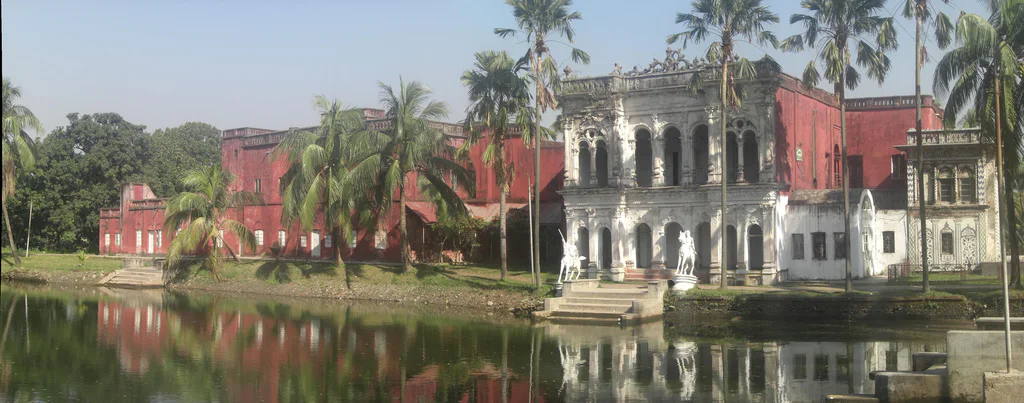
Sonargaon · 22 km
Sonargaon
Content & sources
Sourav Das from Santa Barbara, USA · CC BY 2.0
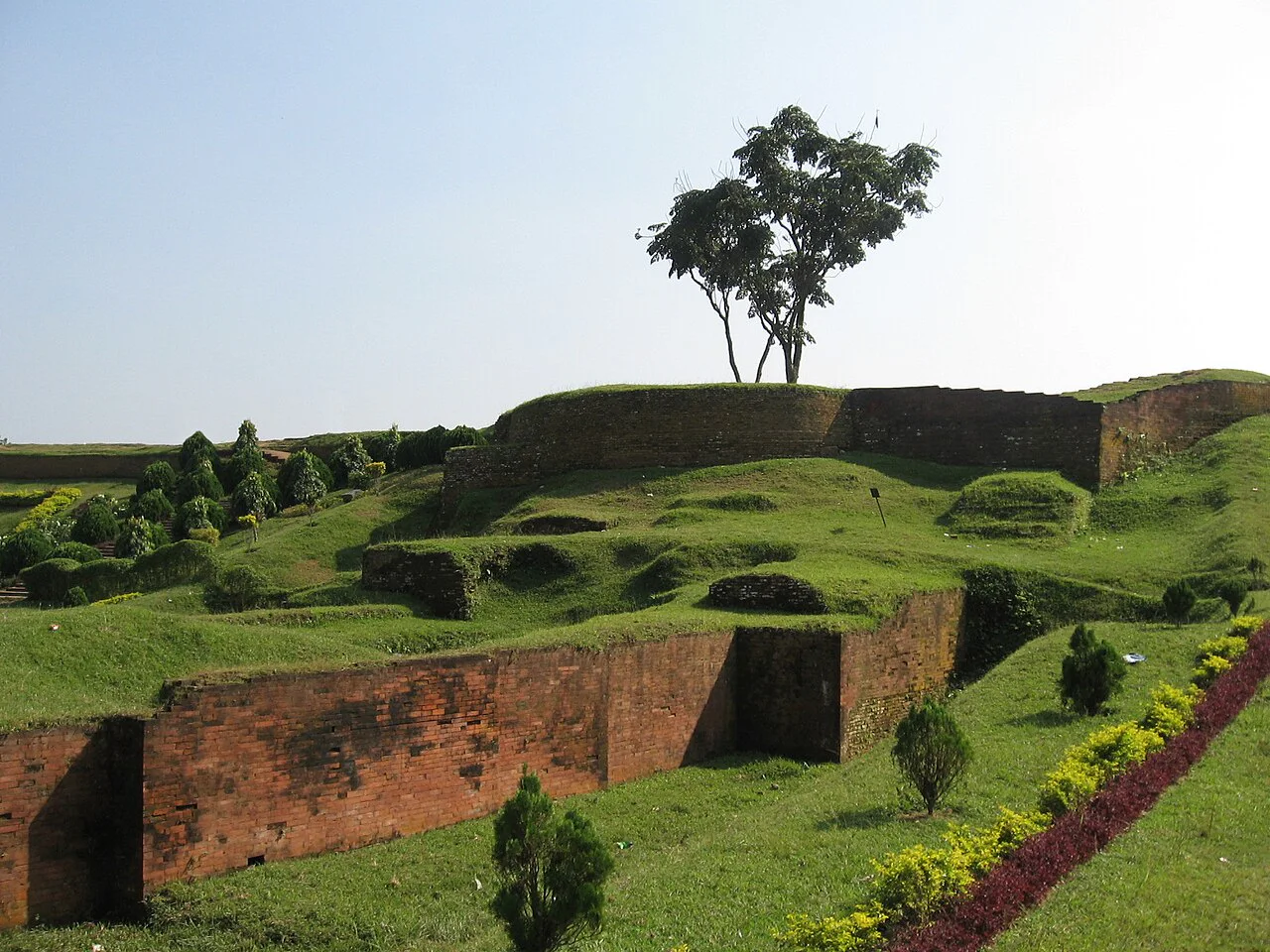
Shibganj Upazila (Bogura)
Mahasthangarh
Content & sources
Picture taken by P.K.Niyogi, people removed by GreenComputer · CC0