 Stanza / Audio guide
Content & sources
Stanza · Audio guide
Mahasthangarh Audio Guide
A place to remember. A story to take with you.
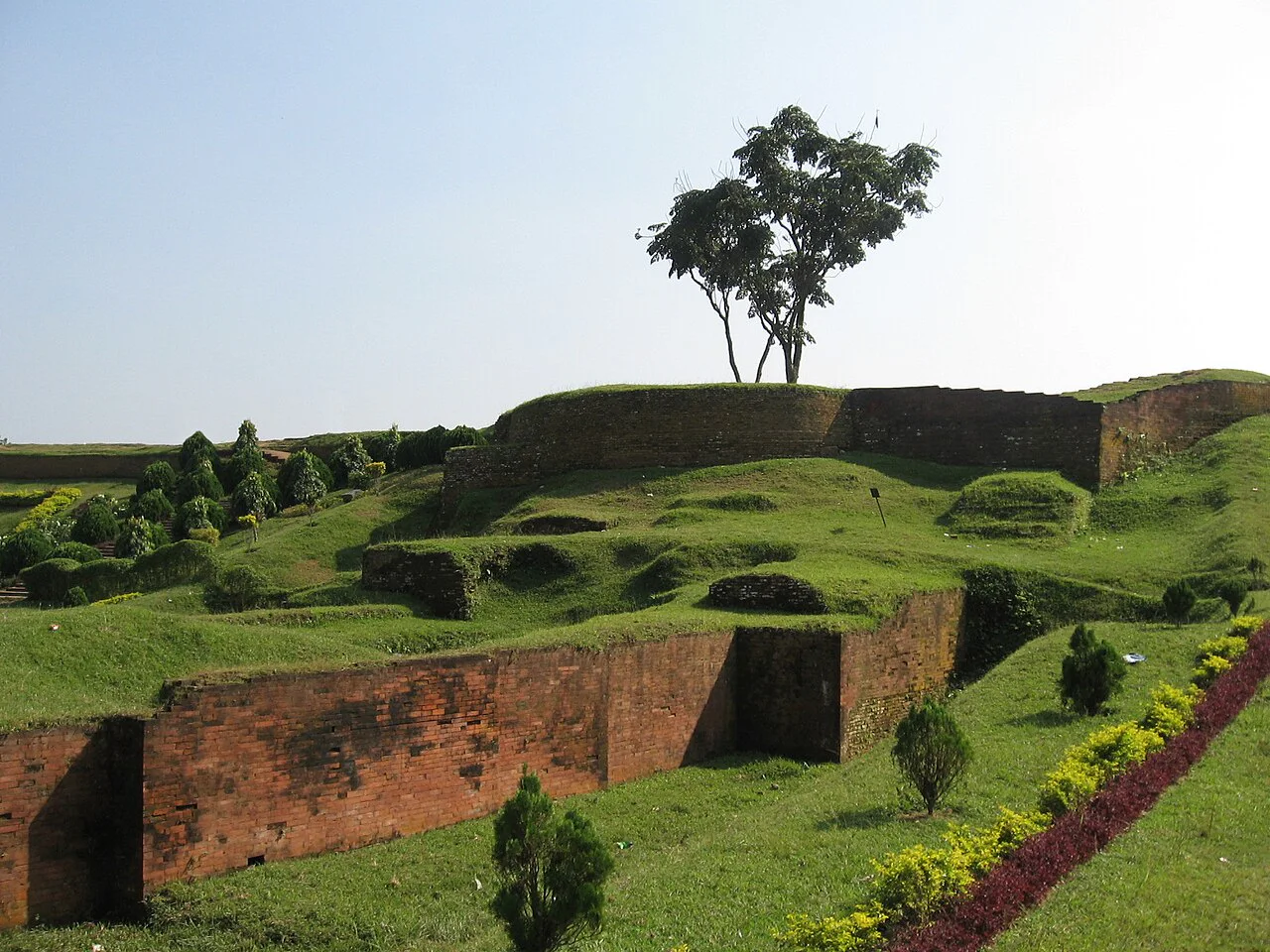
Mahasthangarh is the earliest urban archaeological site discovered so far in Bangladesh. It contains the remains of an ancient city that served as an important center under the Maurya Empire.
Download Stanza, then search for “Mahasthangarh”.
About the tour
One guide. Your kind of visit.
Mahasthangarh is the earliest urban archaeological site discovered so far in Bangladesh. It contains the remains of an ancient city that served as an important center under the Maurya Empire.
Ready when you are.
- 01Get the free Stanza app.
iOS & Android
- 02Find your guide.
“Mahasthangarh”
- 03Download before you go.
Works offline
Audio guide / 13 narrated stops
Inside the guide
Get to know a few of the stories before you go. Open a stop to read more.
01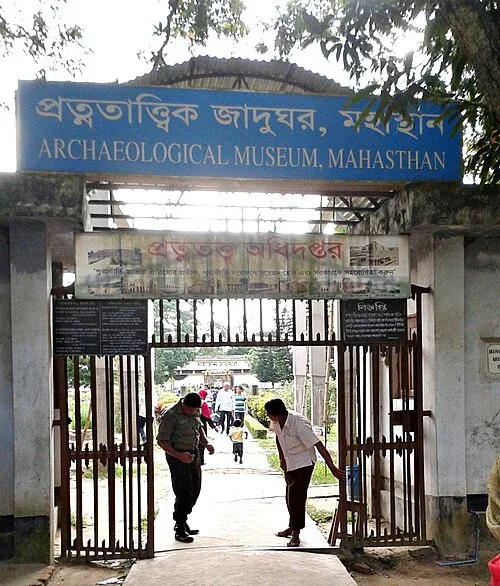 Mahasthangarh Archaeological Museum
Archaeological Museum, Mahasthangarh
Behind this blue signboard lies the story of a city more than two thousand years old. The Bengali letters above the English ones read the same name: Archaeological Museum, Mahasthan. Mahasthangarh is the remains of Pundranagar, capital of the ancient kingdom of Pundravardhana, and the earliest urban site yet discovered in Bangladesh. People lived here from at least the third century BCE, and the place stayed in use deep into the medieval age. The city owes its position to the land itself. It stands on the red soil of the Barind Tract, ground high enough to escape the floods that drown the plains around it, beside a river that once carried its trade. Inside the museum, finds from the excavations tell that long story room by room, and the open-air city waits beyond the gate.
Masum-al-hasan · CC BY-SA 4.0
02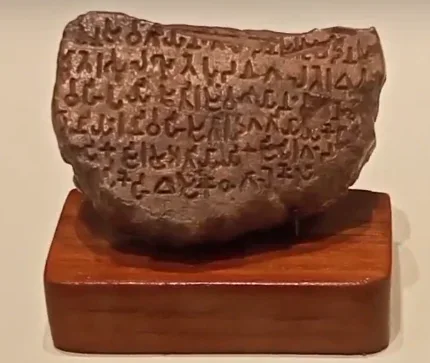 Mahasthangarh Archaeological Museum
The Mahasthan Brahmi Inscription
The most important object in this museum is also one of the smallest. It is a limestone slab measuring 4.4 by 5.7 centimetres, carved with six lines of Prakrit in the Brahmi script. It came to light at the site in 1931, and it changed everything. Scholars date it to the third century BCE and read it as an administrative decree of the Mauryan Empire. The leading interpretation is striking: the order releases food grain and financial assistance from royal storehouses for the famine-stricken people of Pundranagara. An emperor's relief order, sent to this city from the Ganges plain. Some records describe the slab instead as recording a land grant, so the exact wording is still argued over. Either way, it is the oldest written record found anywhere in the Bengal region, and the single find that fixed this site's identity and age.
Amader kotha · CC BY-SA 4.0
03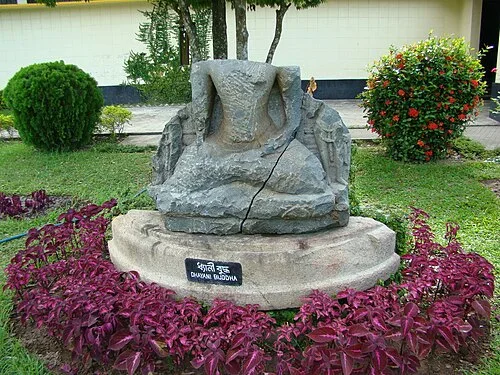 Mahasthangarh Archaeological Museum
Durga Image in the Museum Garden
Not every sacred image found here was Buddhist. This large seated goddess, carved in stone and worn by centuries of weather, carries a label reading Durga Image. Her head and arms are gone, and a crack runs down her body, but the seated pose still carries weight and calm. She was excavated from the remains of the ancient city, and she stands for the Hindu worship that flourished here alongside the Buddhist temples. Pundranagar changed faiths over its long life, and each faith left its sculpture in the ground. Images like this one were recovered from mounds all around the site, then brought to the museum to be set out and labelled. Her missing head is part of the story too. Stone gods rarely survive their centuries intact.
Listen in the appShahnoor Habib Munmun · CC BY 3.0
04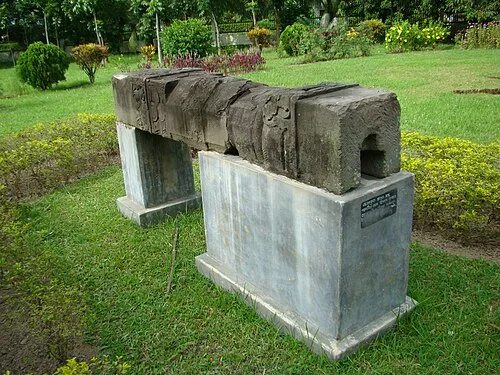 Mahasthangarh Archaeological Museum
Carved Stone Architectural Block
This heavy carved block, laid out on its plinth in the garden, once belonged to some ancient structure whose position and purpose are now unknown. Its story is really the story of how Mahasthangarh was found again. For centuries the ruins slept under mounds and jungle. In 1808 Francis Buchanan Hamilton became the first to locate and visit the site. Others followed him, and in 1879 Alexander Cunningham identified the place as the capital of the ancient kingdom of Pundravardhana. Real digging began much later. Systematic excavation started in 1928 and 1929 under K.N. Dikshit of the Archaeological Survey of India, beginning around the Jahajghata steps, the Munir Ghon bastion and the Bairagir Bhita mound. Everything on display around you, and every ruin outside the walls, came out of the ground through that work.
Listen in the appShahnoor Habib Munmun · CC BY 3.0
05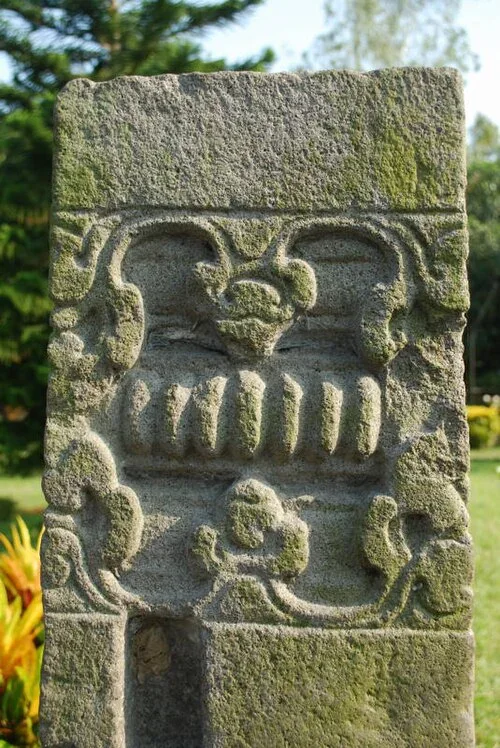 Mahasthangarh Archaeological Museum
Carved Stone Pillar with Lush Foliage
The carving on this pillar rewards a long look. Deep, flowing foliage climbs the stone, curling into leaves and vase-like motifs, all of it softened now by moss and weather. Whoever cut this had a sure hand. The design was worked into hard stone with nothing but chisels and patience, and the pattern still reads clearly after all its years outdoors. Carved pillars, door-frames and lintels recovered from the site range in date from the fifth to the twelfth century, so ornament like this served the city's temples across many generations. The Bairagir Bhita mound inside the citadel yielded two sculptured sandstone pillars. Blocks like these were pulled from the ruins, recorded, and set out here as finds in their own right.
Listen in the appDiego Tirira from Quito, Ecuador · CC BY-SA 2.0
06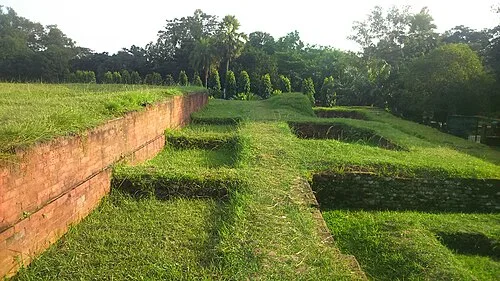 Govinda Bhita Temple Ruins
Govinda Bhita Temple Terraces
The stepped brick terraces of Govinda Bhita hold one of the clearest stories on the whole site. This temple mound sits 185 metres north-east of the Jahajghata steps, directly opposite the site museum, just outside the citadel's north-eastern corner. Excavation here in the campaigns of 1934 to 1936 exposed the base remains of two temples, one above the other. And the layers run far deeper than those two structures. Remains on this mound have been dated from the third century BCE all the way to the fifteenth century CE. That is more than seventeen hundred years of sacred ground. Temple after temple was raised on the same spot, each new builder levelling and building over what came before, until the mound grew into the terraces that stand here now.
Listen in the appPhoto: Ekela rajkumar · CC BY-SA 4.0
07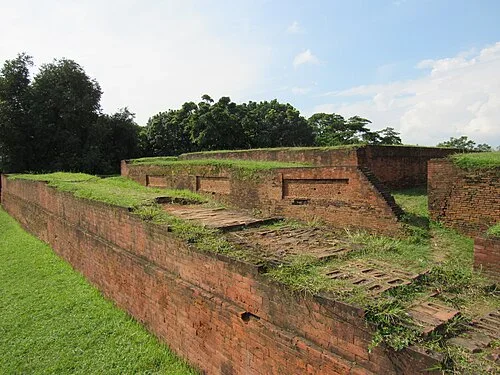 Govinda Bhita Temple Ruins
Govinda Bhita on the Karatoya
The flat green country beyond these temple walls hides the reason this city existed. The Karatoya river once flowed here, and it was not the modest stream seen today. As late as the thirteenth century it was three times wider than the Ganges. That made it the great water highway of northern Bengal, and Pundranagar grew into a commercial hub on its banks because of it. Boats moving along the river brought the city its trade, and the temple of Govinda Bhita was raised on the waterfront to watch over it. Then the river changed. Over the centuries it shrank and shifted, until now only a small stream passes along the eastern side of the citadel. A city built for a mighty waterway was left with a trickle, and its fortunes faded with the water.
Listen in the appPhoto: Afifa Afrin · CC BY-SA 4.0
08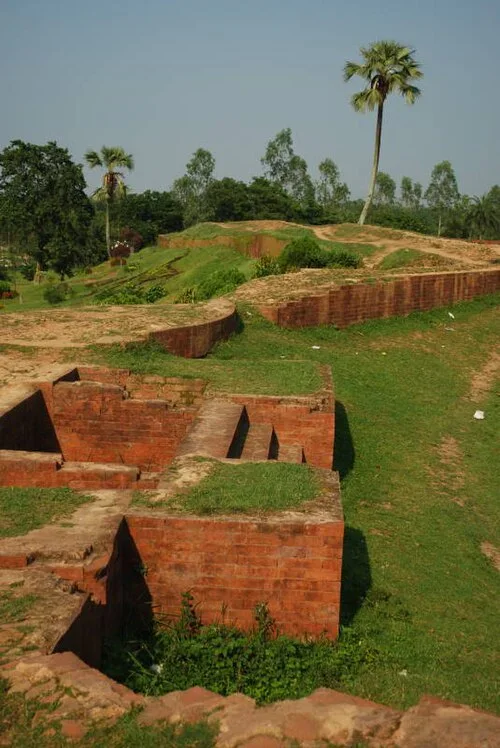 Pundranagar Citadel & Ramparts
The Citadel of Pundranagar
The sunken brick walls and excavated rooms in this trench belong to the citadel, the fortified heart of Pundranagar. The plan is a rough rectangle, about 1.5 kilometres long from north to south and 1.4 kilometres across from east to west, with ramparts running along all four wings. All told it covers roughly 185 hectares, a true capital's footprint. The deepest secret lies underneath. A Bangla-Franco joint excavation venture dug down beside the middle of the citadel's eastern rampart and found eighteen archaeological layers, one city stacked on the remains of another, from around the fifth century BCE to the twelfth century CE. The digging reached virgin soil at a depth of about seventeen metres.
Listen in the appDiego Tirira from Quito, Ecuador · CC BY-SA 2.0
09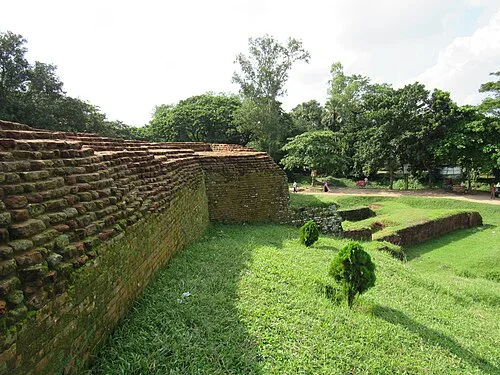 Pundranagar Citadel & Ramparts
The Ramparts of the Citadel
The great brick wall rising here is part of the rampart that ringed the whole citadel. The choice of ground came first. The high ground of the Barind Tract, which you heard about at the museum, was what a capital needed. On top of that natural advantage, the builders raised ramparts standing 11 to 13 metres higher than the land around them. Until excavations began in the 1920s, the whole rampart looked like a jungle-clad wall of mud, broken open in several places, with the ground inside the citadel standing well above the countryside. Digging revealed the massive brickwork behind the earthen face.
Listen in the appPhoto: Afifa Afrin · CC BY-SA 4.0
10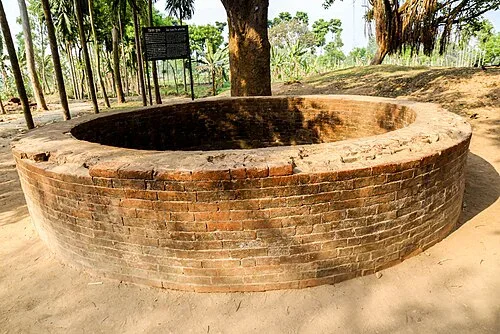 Pundranagar Citadel & Ramparts
Jiat Kunda, the Well of Legend
This round brick well is Jiat Kunda, and the story attached to it is the most famous legend of Mahasthangarh. The story goes that a holy man named Shah Sultan Balkhi Mahisawar arrived at Pundravardhana in the guise of a fakir, riding a fish, as his Persian name suggests. He came from Balkh in Afghanistan with a retinue, though the tradition disagrees wildly about when, placing his arrival in the fifth, the eleventh or even the seventeenth century. At that time a king named Parshuram held his palace here. The holy man asked for land to spread his prayer mat, the mat began expanding on its own, and the alarmed king declared war. The battle turned on this pool. A dead soldier bathed in the waters of Jiat Kunda and came back to life, so the royal troops could not be beaten. Then the saint had a kite drop a piece of beef into the pool, its power broke, and the kingdom fell with it. The tale survives in many local variations, sold in Bengali booklets around the site.
Listen in the appPhoto: Najmul Huda · CC BY-SA 4.0
- 11
Mankalir Dhap
A mound inside the citadel walls, consecrated to the goddess Mankali and dug in the 1960s.
- 12
Palace of Parshuram
One compound, three faiths: Pala stone, Muslim glaze and Company coins in the same walls.
- 13
Parshuram's Palace Walkway
Between the palace walls, where legend and archaeology share the same ground.
Mahasthangarh
Frequently asked questions
How much does the guide cost?
Free app download. Listed guide price: $0.99. Guide price shown in the app. Audio guide only. Venue admission is separate.
Can I listen without internet?
Yes. Download the guide’s audio, images, and maps in the app before your visit. Your downloaded content is then available offline.
Can I listen in my language?
This audio guide is available in 15 languages, including English.
Do I need to follow a schedule?
No. This is a self-guided experience. Choose your stops, pause whenever you like, and return to a story at your own pace.
At your own pace
Explore Mahasthangarh.
Download Stanza, then search for “Mahasthangarh”.
Free app download · Guide price shown in the app
Keep exploring
Audio guides — Bangladesh
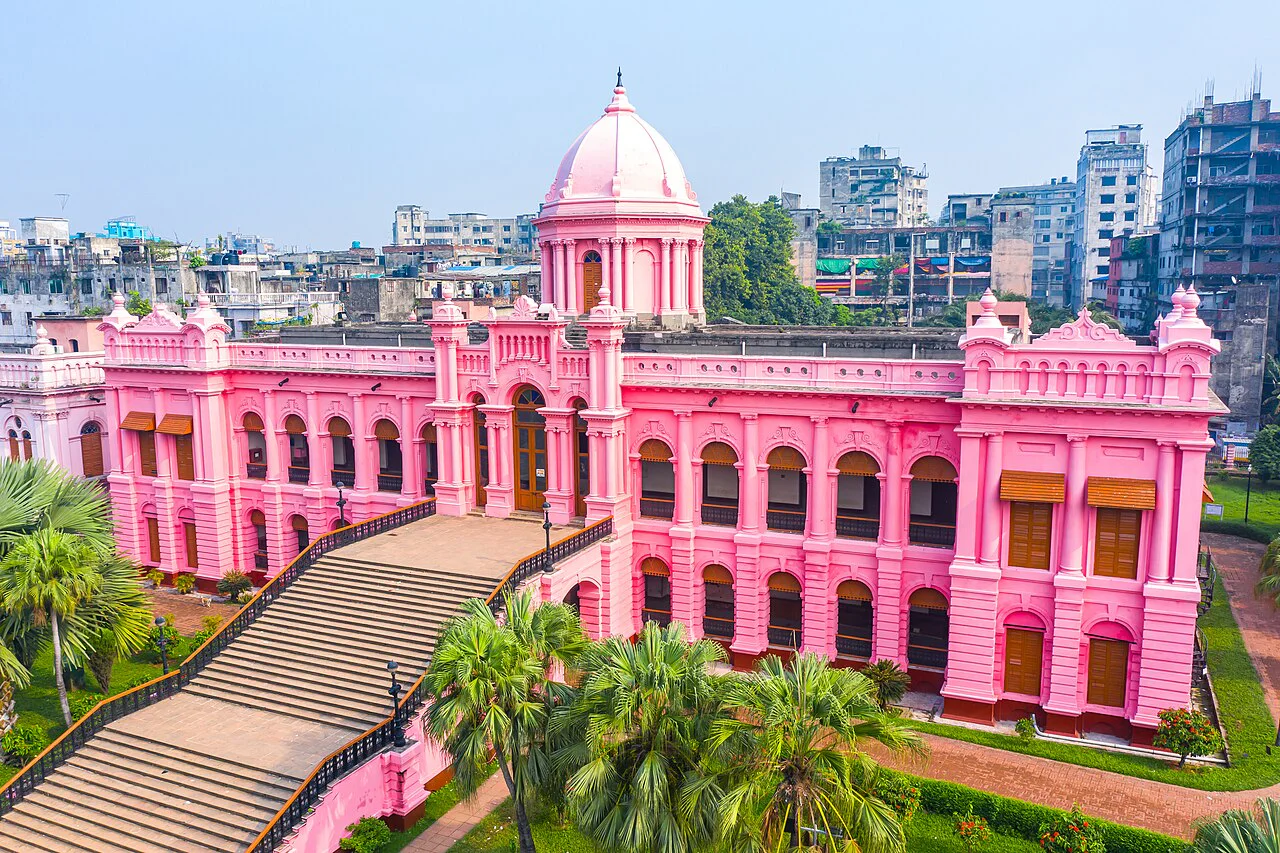
Dhaka
Ahsan Manzil
Content & sources
Photo: Md. Ahsanul Haque Nayem · CC BY-SA 4.0
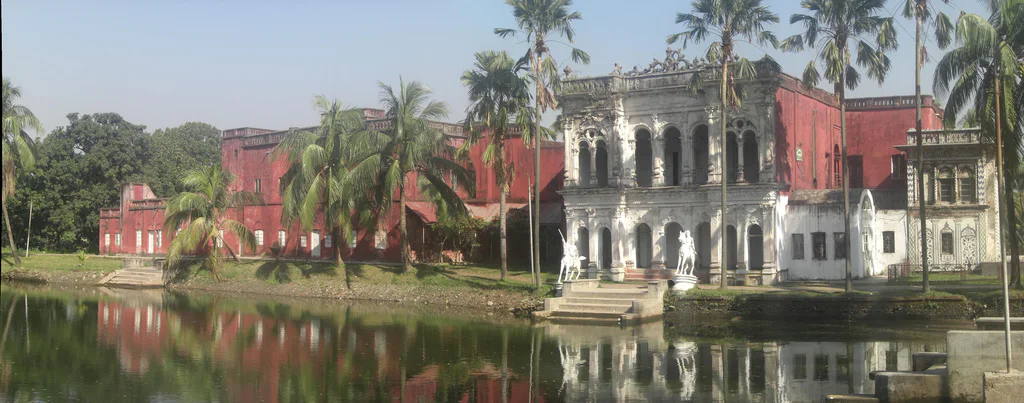
Sonargaon
Sonargaon
Content & sources
Sourav Das from Santa Barbara, USA · CC BY 2.0
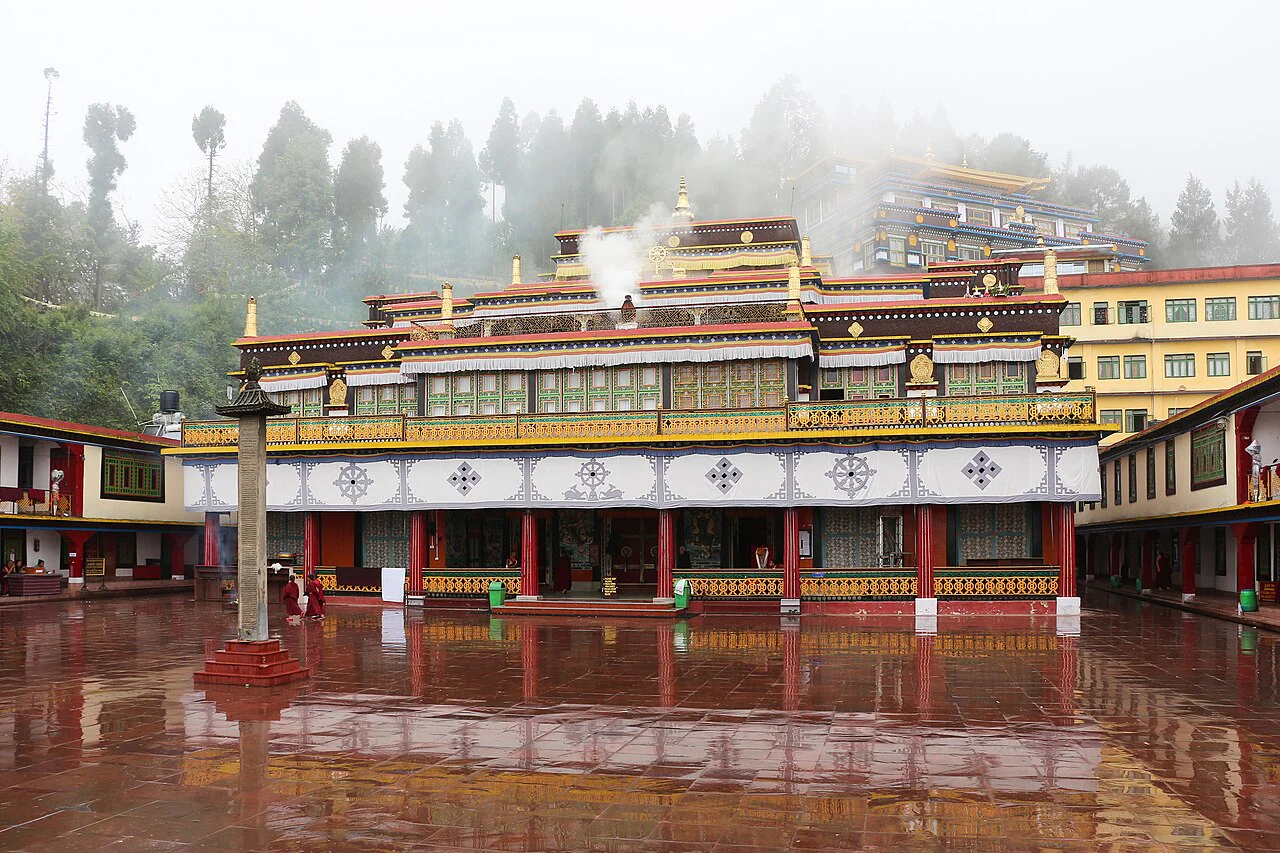
Singtam
Rumtek Monastery
Content & sources
Bernard Gagnon · CC BY-SA 4.0