Stanza · Audio guide
Rumtek Monastery Audio Guide
A place to remember. A story to take with you.
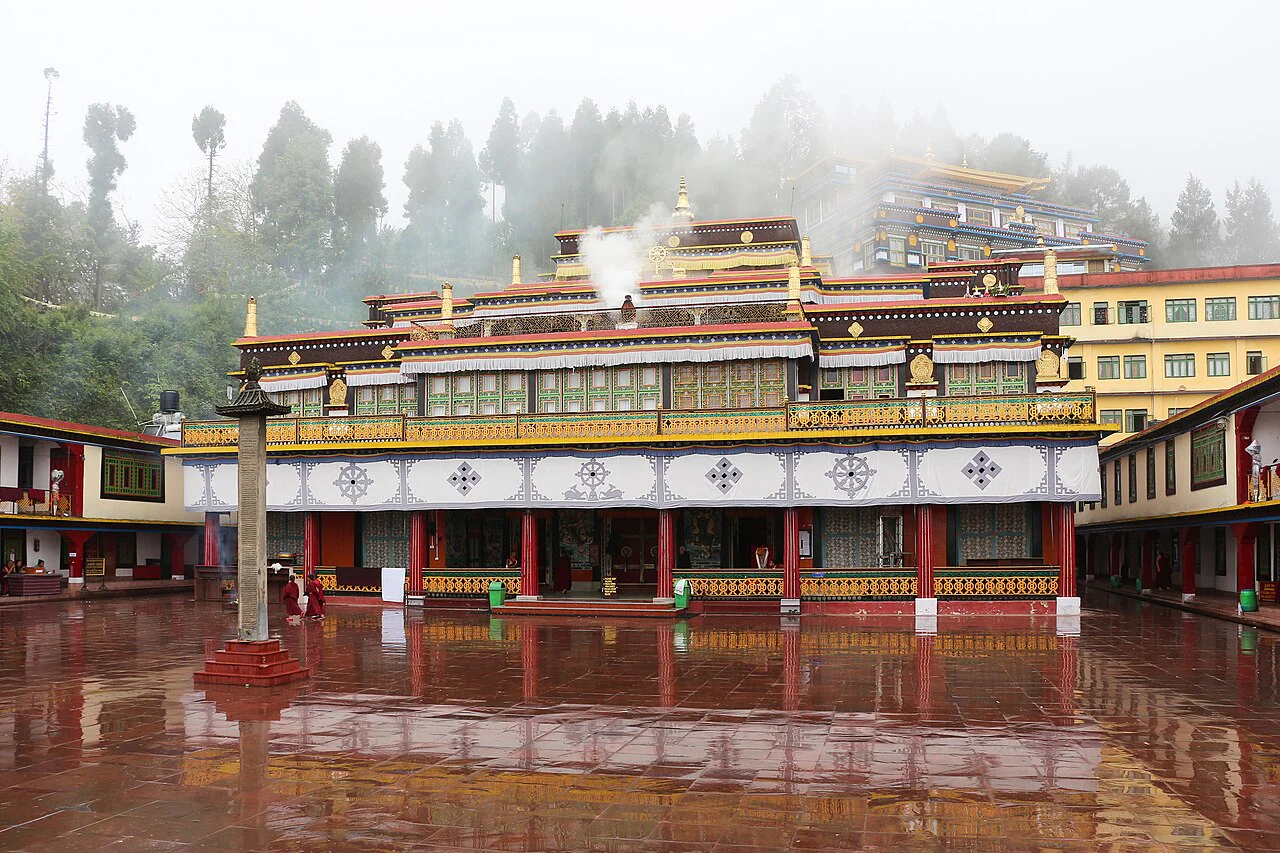
Rumtek Monastery is a gompa located in the Indian state of Sikkim near Gangtok. It serves as the seat in exile of the Gyalwang Karmapa and was inaugurated in 1966.
Download Stanza, then search for “Rumtek Monastery”.
About the tour
One guide. Your kind of visit.
Rumtek Monastery is a gompa located in the Indian state of Sikkim near Gangtok. It serves as the seat in exile of the Gyalwang Karmapa and was inaugurated in 1966.
Ready when you are.
- 01Get the free Stanza app.
iOS & Android
- 02Find your guide.
“Rumtek Monastery”
- 03Download before you go.
Works offline
Audio guide / 11 narrated stops
Inside the guide
Get to know a few of the stories before you go. Open a stop to read more.
01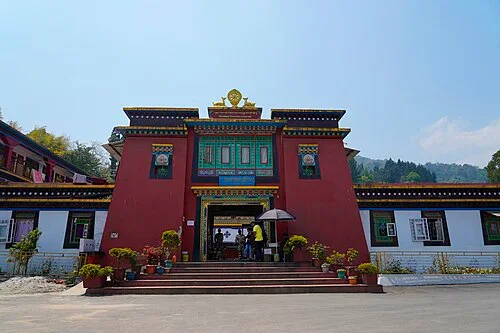 Main Gateway and Outer Walkway
Main Gateway of the Dharma Chakra Centre
Welcome to Rumtek, the Dharma Chakra Centre, a Tibetan Buddhist monastery in the hills of East Sikkim. This gateway is the threshold of the international seat in exile of the Gyalwang Karmapa, head of the Karma Kagyu school. Behind it lives a large community of monks, and from here the Karmapa's tradition reaches followers around the world. The gateway is built in the traditional Tibetan style, red walls and painted window frames under a golden emblem. It is also guarded, and the guard has a history. When the 16th Karmapa died, two rival organisations backed different candidates for the 17th Karmapa, and each claimed stewardship of this monastery and its contents. The fight went to the Indian courts, with a legal contest filed in 1998 over who should possess and administer the centre. In 2003, Indian security forces removed monks of one faction to quell the violence, and armed soldiers have patrolled here since. Neither claimant to the title has ever been enthroned at Rumtek. So the gate that welcomes pilgrims also stands watch over one of the bitterest succession disputes in modern Buddhism.
Photo: Amitabha Gupta · CC BY 4.0
02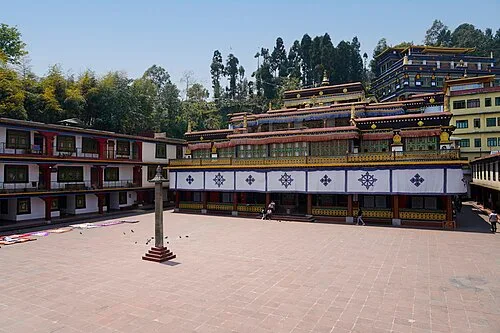 Grand Monastery Courtyard
The Grand Monastery Courtyard
This broad stone courtyard is the working heart of a living monastery. Rumtek is home to a community of monks, the sangha, who carry out the rituals and practices of the Karma Kagyu lineage here every day. The courtyard is framed by the monastic wings, with the multi-tiered facade of the main shrine rising at the far end. A tall pillar stands at its centre, a feature of Tibetan monastic courtyards. In gompas across the Himalayas, spaces like this one host the monastic assemblies, and at larger centres they hold public ceremonies too, with room for monks and laypeople to gather in numbers. Notice the scale of the open ground, and the low buildings wrapped around it on the slopes. This is where the community assembles, where people meet and move between the shrine and the living quarters. Rumtek is currently the largest monastery in Sikkim, and the courtyard gives you the measure of that.
Photo: Amitabha Gupta · CC BY 4.0
03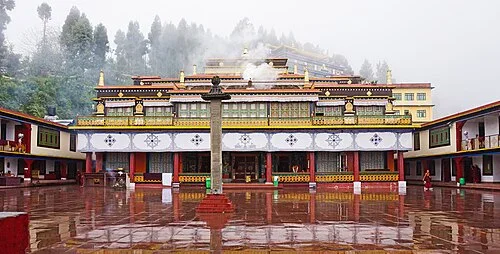 Grand Monastery Courtyard
The Main Shrine Building
The story of this main shrine building runs in two acts. The first act begins in the mid-18th century, when Changchub Dorje, the 12th Karmapa, established a monastery on this spot. For a time it served as the main seat of the Karma Kagyu lineage in Sikkim. Then came the second act. When the 16th Karmapa reached Sikkim in 1959, he found the old monastery in ruins. He resolved to rebuild it, and work began in 1962. The Sikkim royal family gave generously, and local people helped too, so the new seat rose with the support of the land that sheltered it. Construction took four years. On Losar, the Tibetan New Year, in 1966, the 16th Karmapa formally inaugurated the completed building as the Dharmachakra Centre, a place of erudition and spiritual accomplishment, the seat of the glorious Karmapa. The tiered facade you can see, tier above tier, carries that sense of an active temple. On festival days, smoke from the incense burners drifts up across the courtyard.
Listen in the appBernard Gagnon · CC BY-SA 4.0
04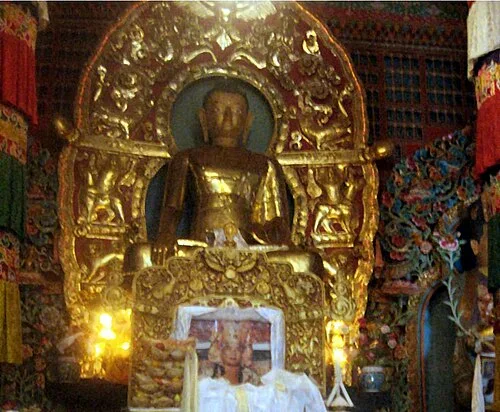 Main Assembly Hall (Dharmachakra Centre)
The Golden Buddha of the Shrine Hall
Inside the main assembly hall, a gilded Buddha sits as the devotional centre of everything around it. Golden-robed, framed by an ornate backrest of carved and painted detail, it is the image the monks face in ritual, and the one pilgrims come before. But the hall also guards something less visible. When the new building was finished in the 1960s, the sacred items and relics brought out of Tsurphu Monastery were installed here. Tsurphu, in Tibet, had been the Karmapas' seat for centuries. As China took control of Tibet in 1959, those treasures were carried out of the country, a removal that could easily have ended differently. They crossed the Himalayas with the fleeing community and found a new home here, in this hall. So the principal image of the shrine stands among objects that made the same journey, from the old seat in Tibet to this one in exile. That is what makes the hall more than a beautiful room.
Listen in the appPamri · Public domain
05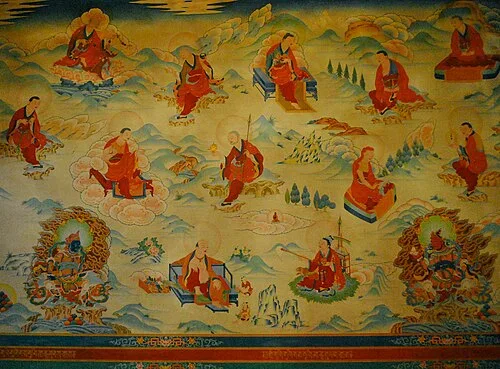 Main Assembly Hall (Dharmachakra Centre)
Lineage Murals of the Dharmachakra Centre
One wall of the centre is a landscape of masters. Dozens of red-robed lamas sit scattered across painted hills and clouds, each in his own small setting of trees, rocks and sky. Tibetan Buddhist schools paint their teachers this way, in transmission order, so the wall reads like a family tree of the tradition. Each master received the teachings from the one before and passed them on, and the painting makes that chain visible. At a seat built to preserve the Karma Kagyu tradition outside Tibet, that matters in a particular way. The painted lineage asserts that the chain did not break when the community crossed the Himalayas. The same teachings, the same line of masters, continuing in a new country. Visitors who know the school can trace the great figures of its history on the wall. The point the painters made, though, needs no names: nothing essential was left behind.
Listen in the appPhoto: Sujay25 · CC BY-SA 4.0
06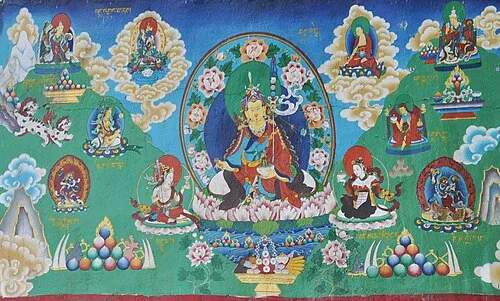 Upper Veranda and Sacred Wall Murals
Mural of Guru Padmasambhava
At the centre of this mural sits a figure the whole Himalayan region holds dear. This is Guru Rinpoche, Padmasambhava, the tantric master who reached the Himalayas in the 8th century. He is shown in his characteristic form, robed and crowned, holding his ritual staff and skull-cup, seated on a lotus. Around him spread his retinue, the manifestations and disciples that surround him in traditional images, each in a cloud-borne scene of its own. Across Sikkim and the Himalayas, Padmasambhava is remembered as the master who established Buddhism in these mountains, and the landscape itself is dotted with places held sacred to him. That long association explains why he has a place of honour on Rumtek's walls, even though this is a Karma Kagyu seat. For travellers in Sikkim, his face is one of the most familiar sights in the region's monasteries, and this mural is a fine example of the style.
Listen in the appPhoto: Prof Ranga Sai · CC BY-SA 4.0
07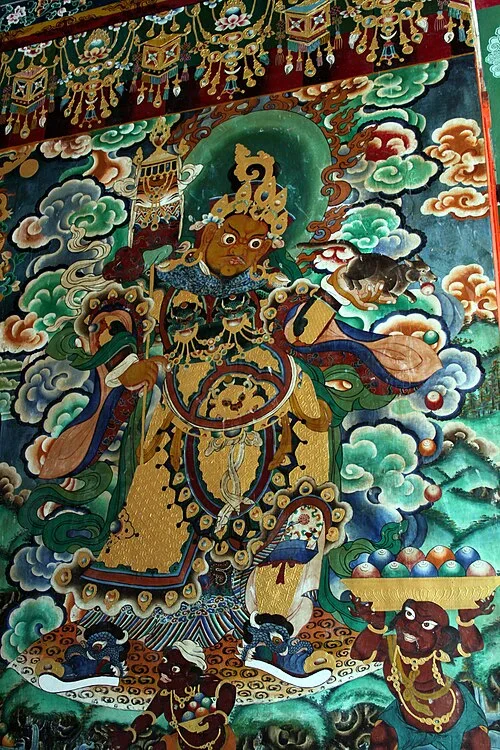 Upper Veranda and Sacred Wall Murals
Guardian Deity Mural
Not every figure on these walls is calm. This guardian glares out from a swirl of coloured clouds, richly robed and crowned, armour over his robes, a fierce face above all that ornament. In one hand he holds a banner, and at his side sits a mongoose disgorging jewels, with a pile of gems below. That mongoose is the tell. It marks a guardian of wealth and protection, a figure who safeguards treasure and turns it outward for the benefit of the community. Paintings like this belong to the wrathful side of Tibetan Buddhist art, where fierce appearance serves a protective purpose. Such guardians are placed to flank monastery entrances and shrine halls, guarding the dharma and those who support it. Their anger is directed at obstacles and harm, not at the visitor. Painted in bright mineral colours against the dark clouds, this one has watched over the veranda with open eyes for as long as the murals have stood.
Listen in the appflowcomm · CC BY 2.0
08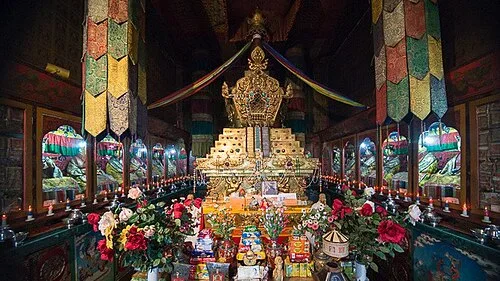 Golden Stupa Reliquary Hall
The Golden Stupa of the 16th Karmapa
This is the most sacred monument on the site. The golden stupa holds the relics of Rangjung Rigpe Dorje, the 16th Karmapa, the man who rebuilt Rumtek and made it his seat in exile. A stupa of this kind is a reliquary, built to enshrine the remains of a great teacher, and this one rises in gilded tiers under a canopy hung with ceremonial banners. Around its base, the devotion is continuous. Fresh flowers crowd the offerings, butter lamps burn in rows, and small gifts of food and ritual items lie before the stupa. Pilgrims come from far away to stand here, and the general practice is to remove shoes and keep a reverent quiet in the hall. The 16th Karmapa's community scattered after his death, and the disputes that followed touched this monastery deeply. But at the stupa itself, what you see is simpler: people still coming, still lighting lamps, still leaving flowers for the teacher who built all of this.
Listen in the appPhoto: Sandyroyrocky · CC BY-SA 4.0
09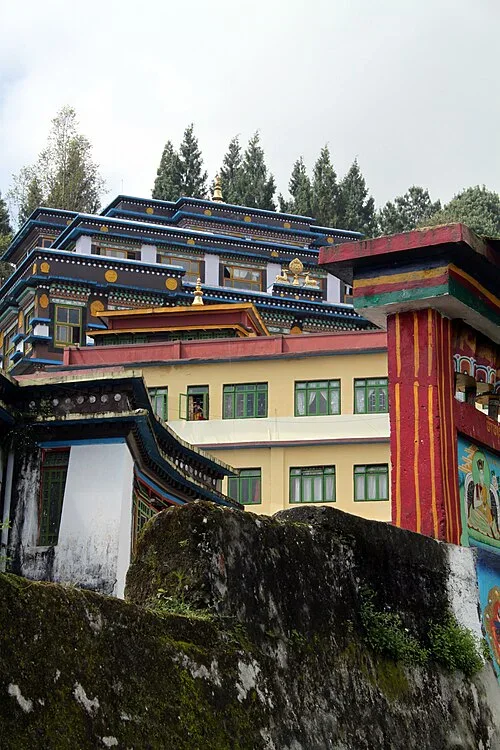 Karma Shri Nalanda Institute and Surrounding Geography
Karma Shri Nalanda Institute
Across from the reliquary building stands the college, and its presence is no accident. When the 16th Karmapa inaugurated the centre, he named it a place of erudition and spiritual accomplishment. Erudition first. A college was part of the design from the beginning, not an add-on to the temples. This is the Karma Shri Nalanda Institute for Higher Buddhist Studies, where monks train in Buddhist philosophy and practice, sometimes for years, before they take on teaching and ritual duties of their own. The buildings climb the slope above the older structures, modern blocks with rows of green-framed windows against the forest. The campus is still growing, which tells its own story about the community's confidence in the future. Scholarship was how the tradition survived its uprooting, and this institute is where that survival is organised, one cohort of monks at a time.
Listen in the appflowcomm · CC BY 2.0
10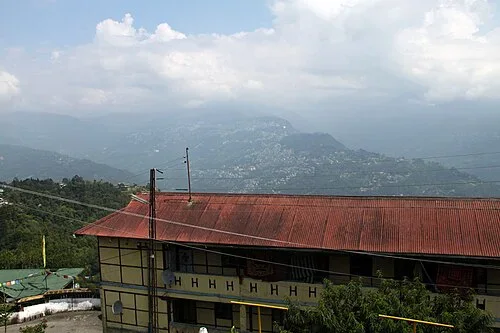 Karma Shri Nalanda Institute and Surrounding Geography
The View over Gangtok
The landscape explains why the Karmapas ended up here. When Rangjung Rigpe Dorje, the 16th Karmapa, fled Tibet in 1959, he was offered other sites in Sikkim for his new seat. He chose the ruined monastery at Rumtek anyway. To him, the place possessed many auspicious qualities, and the sources of that reading are all around: mountains behind, a snow range in front, flowing streams nearby and a river below. In Tibetan tradition, a site's geography is read as a sign of its favour, and this spot scored well on every count. The setting also has practical virtues. Rumtek sits about 24 kilometres from Gangtok, at an altitude of roughly 1,500 metres, high enough for clear air and views, low enough to be reached easily from the capital. From here the land falls away toward Gangtok, the rooftops of the capital faint in the haze below. The Karmapa looked at all this and saw the right place to rebuild.
Listen in the appflowcomm · CC BY 2.0
- 11
The Prayer Wheel Path
Spinning drums on the outer path, where every turn of a wheel counts as a prayer.
Rumtek Monastery
Frequently asked questions
How much does the guide cost?
Free app download. Listed guide price: $0.99. Guide price shown in the app. Audio guide only. Venue admission is separate.
Can I listen without internet?
Yes. Download the guide’s audio, images, and maps in the app before your visit. Your downloaded content is then available offline.
Can I listen in my language?
This audio guide is available in 15 languages, including English.
Do I need to follow a schedule?
No. This is a self-guided experience. Choose your stops, pause whenever you like, and return to a story at your own pace.
At your own pace
Explore Rumtek Monastery.
Download Stanza, then search for “Rumtek Monastery”.
Free app download · Guide price shown in the app
Keep exploring
Audio guides — India
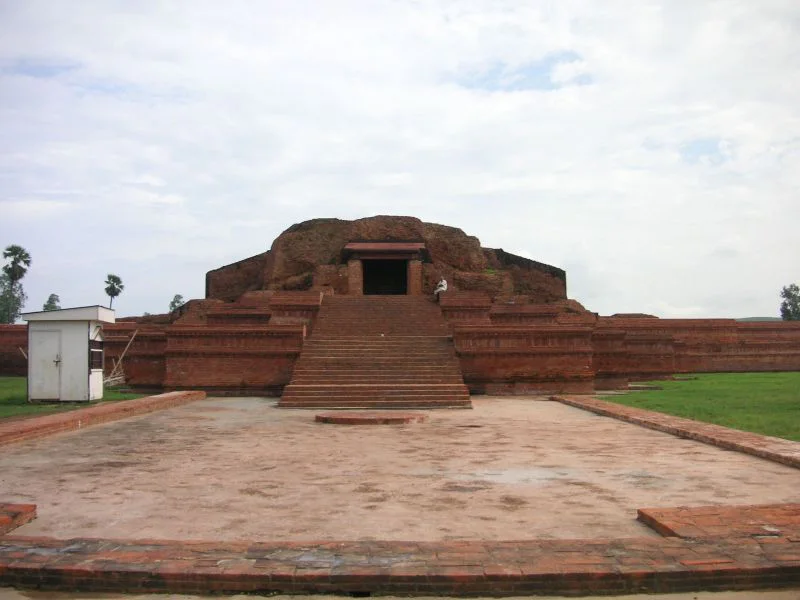
Mathurapur
Vikramashila
Content & sources
Photo: Alokprasad · CC BY 2.0
Vaishali
Vaishali
Content & sources
mself · CC BY-SA 2.5
Nalanda
Nalanda mahavihara
Content & sources
Photo: Uphogaphy · CC BY-SA 4.0
Makhdumpur
Barabar Caves
Content & sources
Thomas Fraser Peppé · Public domain