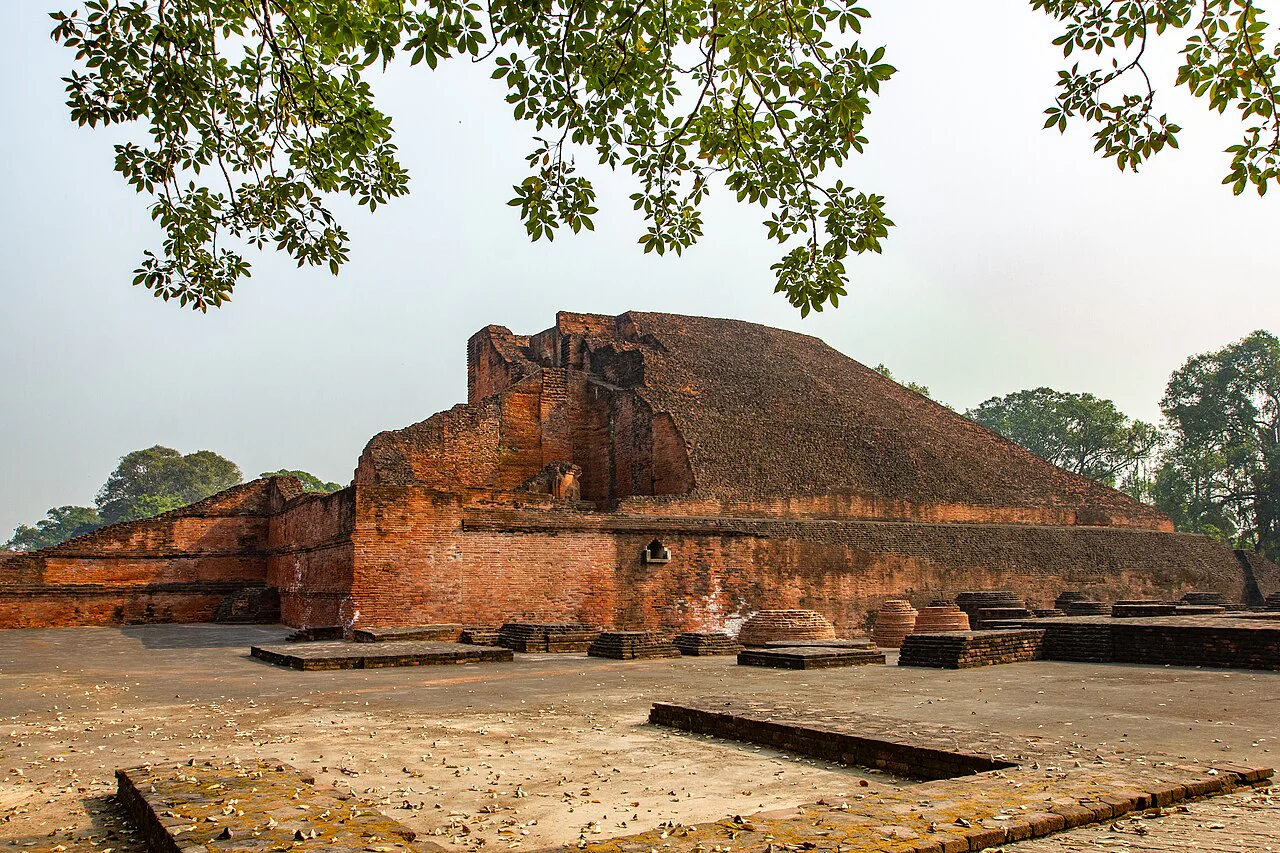
Stanza · Audio guide
Nalanda mahavihara Audio Guide
A place to remember. A story to take with you.
Nalanda was a renowned Buddhist mahavihara in medieval Magadha, eastern India. It is widely considered to be among the greatest centres of learning in the ancient world.
Download Stanza, then search for “Nalanda mahavihara”.
About the tour
One guide. Your kind of visit.
Nalanda was a renowned Buddhist mahavihara in medieval Magadha, eastern India. It is widely considered to be among the greatest centres of learning in the ancient world.
Ready when you are.
- 01Get the free Stanza app.
iOS & Android
- 02Find your guide.
“Nalanda mahavihara”
- 03Download before you go.
Works offline
Audio guide / 15 narrated stops
Inside the guide
Get to know a few of the stories before you go. Open a stop to read more.
01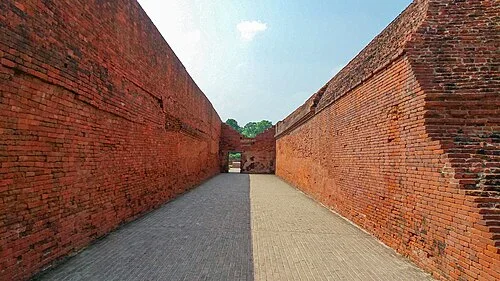 The Great Central Avenue & Campus Layout
Entering the Great Monastic Enclosure
Welcome to Nalanda, one of the great centres of learning of the ancient world. This long passage runs between walls of red brick laid well over fifteen hundred years ago. Here stood a mahavihara, a great Buddhist monastery, founded around 427 CE under the Gupta emperor Kumaragupta I. Later tradition names a king called Shakraditya as the founder, and many identify him with Kumaragupta. What made Nalanda exceptional was its form: a residential institution where scholars lived and studied together for years. It is often called the world's first residential university. The Chinese pilgrim Xuanzang described a compound ringed by a brick wall with a single great gate. He was describing a campus that operated for nearly a thousand years, only ceasing around 1400.
Photo: Paramanu Sarkar · CC BY-SA 4.0
02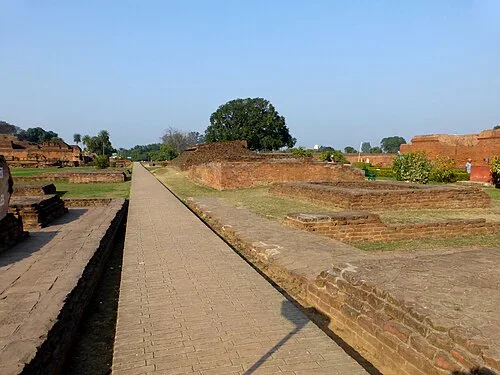 The Great Central Avenue & Campus Layout
The Great Central Avenue
From this long paved walkway, the plan of Nalanda reads clearly. A wide passage, about thirty metres across, runs north to south through the heart of the site. The temples stand on its west, the monasteries on its east. Excavation has uncovered eleven monasteries. Beside them stand six major brick temples, all in an ordered layout. The excavated ground stretches about 488 metres north to south. East to west it runs around 244 metres, roughly twelve hectares in all. That is only part of the medieval complex, which spread far wider. Most buildings here were rebuilt again and again, new structures raised on the ruins of old ones. So the low walls and platforms are stacked histories, centuries of building pressed into a few metres of height.
Hiroki Ogawa · CC BY 3.0
03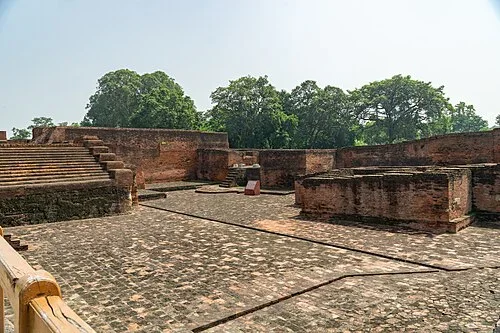 Monastery 1 & The Srivijayan Legacy
Monastery 1 Courtyard
Monastery 1 is considered the oldest and the most important of the monastery group. Its fabric shows as many as nine levels of construction, one built upon another across the centuries. The building was originally at least two storeys high, and it held a colossal statue of a seated Buddha. Every monastery at Nalanda followed the same basic design, the vihara plan. A rectangular block of cells surrounds a central courtyard, ringed by a verandah. The cell facing the entrance served as a shrine chamber, the first thing to catch the eye on entering. One building, then, held worship, teaching and residence together. Nine rebuildings mean the monks kept repairing and enlarging their home rather than starting elsewhere.
Listen in the appPhoto: Sumitsurai · CC BY-SA 4.0
04 Monastery 1 & The Srivijayan Legacy
The Copper Plate of Devapala
This copper plate records an endowment that crossed the sea. In the ninth century, Balaputradeva, king of Srivijaya in Sumatra, sponsored a monastery at Nalanda for monks from his kingdom. He was, as the inscription says, 'attracted by the manifold excellences of Nalanda'. He then asked the Pala king Devapala to grant the new monastery the tax revenue of five villages for its upkeep. Devapala granted it. The plate was found in 1921, in the antechamber of Monastery 1, and it is the written proof of that promise. A royal patron in Indonesia, paying for monks in Bihar: that is how far Nalanda's reputation reached. Village revenue like this kept a monastery's residents fed and housed for generations.
Listen in the appArchaeological Survey of India · Public domain
05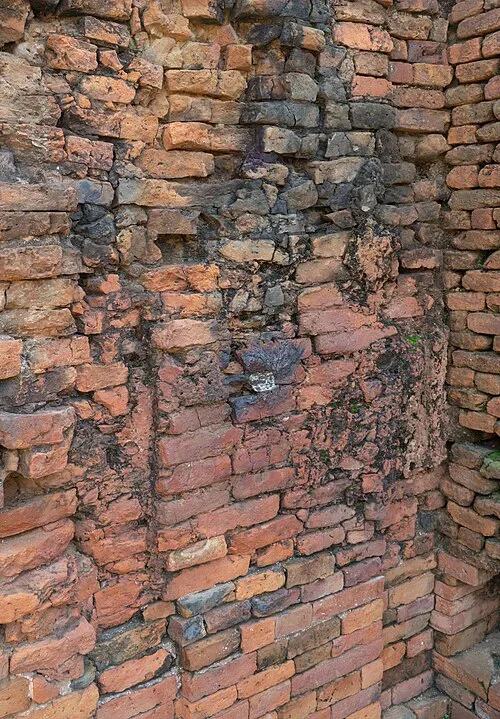 Monastery 1 & The Srivijayan Legacy
The Burnt Walls
The scorching on these bricks tells how the story ended. Excavations in the early 1920s found a thick layer of ash in the upper strata, across many buildings separated by some distance. That points to a catastrophic fire, generally attributed to arson during the raid by the troops of Muhammad Bakhtiyar Khalji around 1200. The famous tale that the library burned for months comes from a chronicle passage that actually describes a monastery a few miles away. So that story is best heard as tradition, not settled evidence for this site. What is clear is that Nalanda was raided, and that it declined afterwards. Some accounts suggest teaching continued for a time in makeshift fashion. Eventually the site was abandoned and forgotten, until the nineteenth century, when it was surveyed and excavated.
Listen in the appPhoto: Sumitsurai · CC BY-SA 4.0
06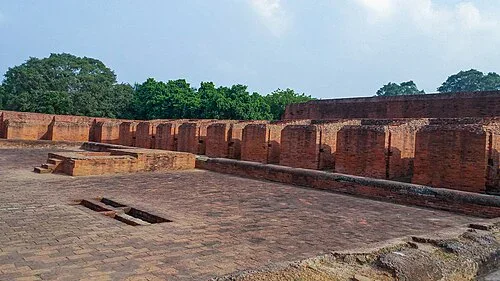 Monastic Living Quarters & Daily Routines
The Monks' Living Quarters
Rank upon rank of small brick cells made Nalanda a residential place. The pilgrim Yijing described eight viharas with as many as 300 cells. Students came here from across Asia, and the most famous was Xuanzang. He reached Nalanda in the seventh century and spent about two years here in all. Shilabhadra, the venerable head of the institution, became his teacher and gave him the Indian name Mokshadeva. Xuanzang had crossed mountains and deserts to find this man, wanting instruction in Yogachara, a school of thought then only partly known in China. Study here was never quiet reading alone. A student had to be versed in logic, ready to defend Buddhist teaching against rival schools in formal debate. Xuanzang also took courses in grammar and Sanskrit, and in time lectured at the monastery himself.
Listen in the appPhoto: Paramanu Sarkar · CC BY-SA 4.0
07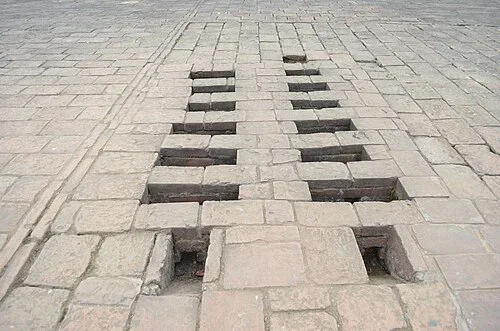 Monastic Living Quarters & Daily Routines
The Monastery Kitchen Ovens
Feeding a residential university took an economy of its own. These brick platforms are the surviving ovens of the complex's kitchens. Tuition, lodging, food and medicine were provided free, under royal patronage. In Yijing's time, revenues from 200 villages had been assigned to Nalanda's upkeep. In Xuanzang's day the figure had been a hundred. Yijing also recorded how the day began, with the ghanta, the monastery bell. Monks took their bathing sheets to one of the ten great pools and bathed with their underclothes on. Bathing after meals was forbidden. Rules like these, he wrote, were set out in the monastery's Nikaya procedures. Behind every lecture here stood a kitchen, a bell, and the revenue of distant villages.
Listen in the appPhoto: Debazoti1985 · CC BY-SA 4.0
08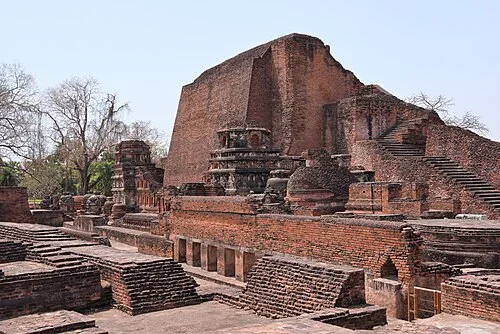 Temple 3 – The Great Sariputta Stupa
Temple 3: The Sariputta Stupa
Temple 3, the Sariputta Stupa, is the most iconic structure at Nalanda, its flights of stairs climbing to the very top. Tradition holds that it honours Sariputta, one of the Buddha's two chief disciples, who was born and died at Nalanda. King Ashoka is said to have raised a stupa here in his honour. The dedication rests on later association rather than anything found in the excavations. The building itself began small, and was enlarged again and again. Archaeologists count at least seven successive layers of construction in the final form. At the apex sits a shrine chamber. Inside it today there is only a pedestal, the base on which an immense statue of Buddha must once have rested.
Listen in the appRohit Sharma · CC BY-SA 4.0
09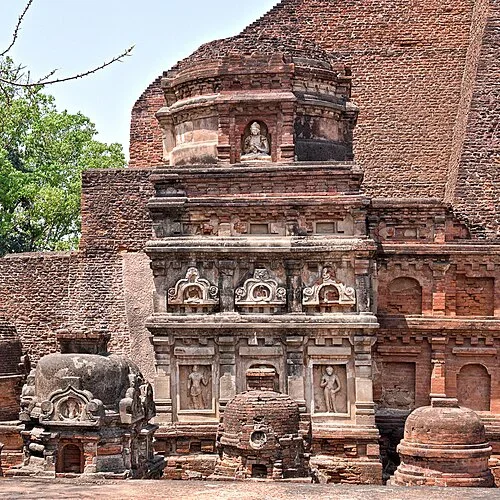 Temple 3 – The Great Sariputta Stupa
The Corner Tower and Its Stucco Art
The fifth of the temple's layered buildings is the best preserved, and its corner towers are the prize. Four towers once stood at the corners; three have been exposed. Their faces and the sides of the stairs carry panels of Gupta-era stucco. There are figures of Buddha and the Bodhisattvas, and scenes from the Jataka tales, the stories of the Buddha's earlier lives. The modelling is delicate enough that faces and ornaments survive centuries of weather. Near the bottom of the staircase, a shrine once held a large image of Avalokiteshvara. That image now stands in the museum nearby. The stucco figures remain on the tower itself.
Listen in the appRohit Sharma · CC BY-SA 4.0
10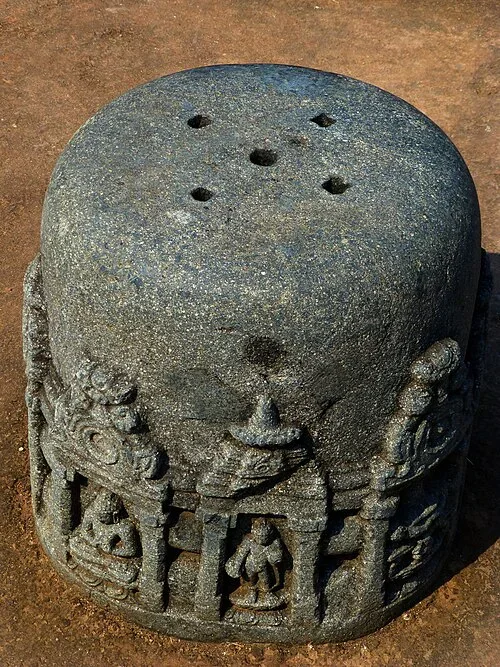 Temple 3 – The Great Sariputta Stupa
A Votive Stupa
Around the great temple stand numerous votive stupas, small monuments of personal devotion. A pilgrim or a monk would leave one at the sacred precinct as an act of piety. Some were built with bricks inscribed with passages from sacred Buddhist texts, so the prayer was part of the fabric itself. This one is carved with rows of miniature shrines, each holding a small figure. Around the main monument, devotion accumulated one such offering at a time.
Listen in the appPhoto Dharma from Penang, Malaysia · CC BY 2.0
- 11
Temple 2 and Its Relief Base
A temple base carved with 211 panels, and the unresolved debate over whether it was Hindu or Buddhist.
- 12
Gods on the Temple Base
Shiva, Parvati and Makaras on the temple base, and the iron clamps that reveal when they were added.
- 13
Everyday Life in Stone
Musicians, couples and scenes of daily life carved into the sacred base of a monastic temple.
- 14
The Western Temple Row
The ornamental brick temples west of the avenue, where style echoes style and fire left its mark more than once.
- 15
The Seal and the Living Legacy
The clay seal of Nalanda, its nine-storey library, and the teachers who carried its tradition to Tibet and back to life.
Nalanda mahavihara
Frequently asked questions
How much does the guide cost?
Free app download. Listed guide price: $2.99. Guide price shown in the app. Audio guide only. Venue admission is separate.
Can I listen without internet?
Yes. Download the guide’s audio, images, and maps in the app before your visit. Your downloaded content is then available offline.
Can I listen in my language?
This audio guide is available in 15 languages, including English.
Do I need to follow a schedule?
No. This is a self-guided experience. Choose your stops, pause whenever you like, and return to a story at your own pace.
At your own pace
Explore Nalanda mahavihara.
Download Stanza, then search for “Nalanda mahavihara”.
Free app download · Guide price shown in the app
Keep exploring
Audio guides — India
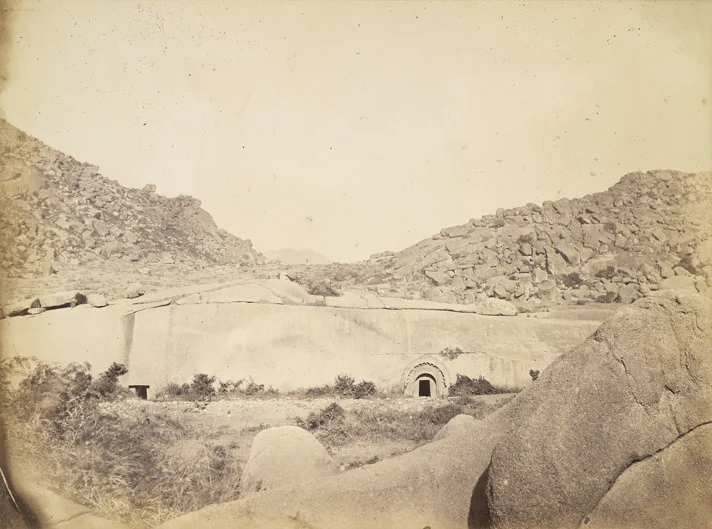
Makhdumpur · 41 km
Barabar Caves
Content & sources
Thomas Fraser Peppé · Public domain
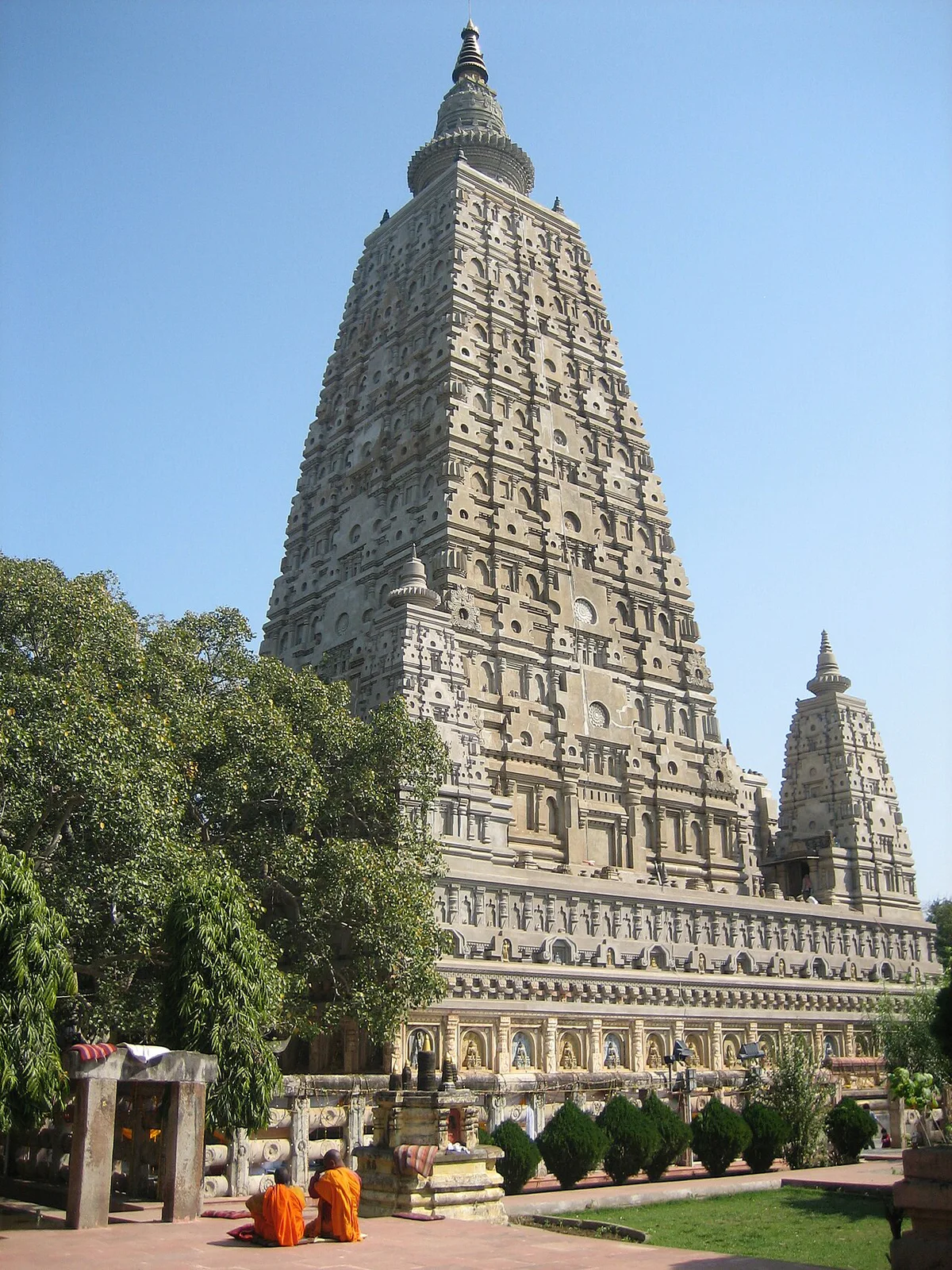
Bodh Gaya · 67 km
Mahabodhi Temple
Content & sources
Photo: Bpilgrim · CC BY-SA 2.5
Vaishali · 100 km
Vaishali
Content & sources
mself · CC BY-SA 2.5
Mathurapur
Vikramashila
Content & sources
Photo: Alokprasad · CC BY 2.0