Languages
15Potala Palace Audio Guide
Potala Palace is a landmark in Chengguan District, China. Explore it with Stanza's GPS-triggered offline audio guide — available in 15 languages.
Quick Facts
22
Stops
15
Languages
100%
Offline
📍 Chengguan District, China · 29.6578°N, 91.1169°E
About Potala Palace
The Potala Palace is a historic fortress-palace in Lhasa, Tibet. Formerly the winter palace of the Dalai Lamas, it is now a UNESCO World Heritage site, museum, and significant Buddhist temple.
Potala Palace is also known as Potala, Botala, Budala, Budalagong, and 4 other names in various languages.
This self-guided audio tour features 22 narrated stops organized across 8 sections. As a palace, Potala Palace offers a unique cultural experience in the heart of Chengguan District, China.
The Stanza audio guide is available in 15 languages and works entirely offline — download the complete tour including audio narration, maps, and images before your visit. As you walk through Potala Palace, GPS-triggered narration plays automatically at each point of interest.
Last updated:
What you will hear
The Fortress on the Red Mountain
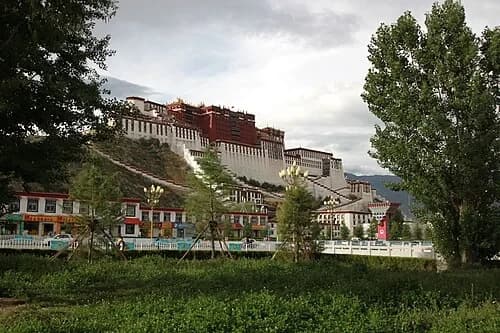
Establishing the grand scale of the palace and its location on Marpo Ri. Using the verified World Heritage Site image as the primary anchor.
The Fortress on the Red Mountain
This massive structure sits at a staggering 3,700 meters above sea level on Marpo Ri, also known as the Red Mountain. Rising 117 meters above the summit, it dominates the Lhasa Valley. Construction of the modern palace you see today began in 1645 under the authority of the 5th Dalai Lama. It was conceived as the earthly abode of Avalokiteśvara, the Bodhisattva of Compassion, who is a central figure in Tibetan Buddhism. The site’s spiritual history stretches back even further, as a smaller fortress existed here centuries before. As you look up, notice how the building appears to grow directly out of the mountain itself. The scale is truly monumental, housing over a thousand rooms and countless religious artifacts. This fortress served as both the winter residence of the Dalai Lamas and the political heart of Tibet for centuries. Its elevation and position were chosen for strategic defense as well as symbolic proximity to the heavens.
Marpo Ri: The Sacred Hill
Focusing on the spiritual and strategic significance of the Red Mountain itself.
The Historic Village of Zhol
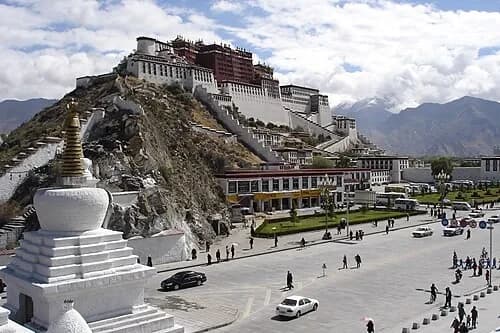
In the foreground, you can see the whitewashed buildings and the distinctive white chorten that mark the entrance to Zhol Village. While the high palace above was the domain of spiritual and political leaders, Zhol was the center of daily life for those who supported them. It housed government officials, administrative offices, workshops for artisans, and even a prison. It functioned as a secular support system, managing the logistical needs of the massive complex on the hill. The village was once a bustling hub where the earthly affairs of the state were handled before one entered the sacred space of the palace. Today, many of these buildings have been restored to show how the village operated during the centuries of the Dalai Lamas' rule. The contrast between these lower structures and the soaring walls above illustrates the traditional hierarchy of Tibetan society, where the mundane world literally sat at the feet of the sacred.
Zhol Village: The Ancient Base
Exploring the historic administrative village at the foot of the palace walls.
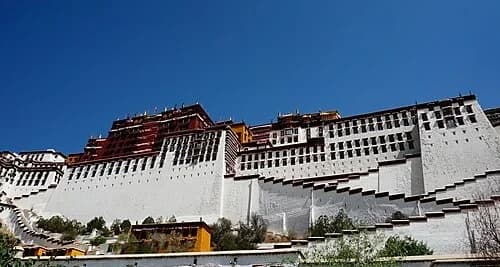
Foundations of the Fortress
Look at the sheer scale of the white walls forming the palace's base. These foundations average three meters in thickness, reaching five meters at the very bottom. Such bulk is necessary not just to support the weight of the structure above, but also to withstand the seismic activity frequent in the Himalayan region. Notice the 'battered' design, where the walls slope slightly inward as they rise. This architectural feature lowers the center of gravity and provides significant stability against tremors. Throughout history, these walls have successfully protected the palace's treasures through numerous earthquakes that damaged other buildings in the valley. The construction involved pouring molten copper into the foundations to further strengthen the masonry, though this is hidden beneath the stone. The whitewash applied to these walls is a mixture of lime, sugar, and honey, which helps protect the stone from the harsh mountain elements while maintaining its brilliant appearance against the deep blue sky.
The Great Ascent: 1,000 Stone Steps
Illustrating the physically demanding climb required to reach the palace entrance at 3,700 meters.
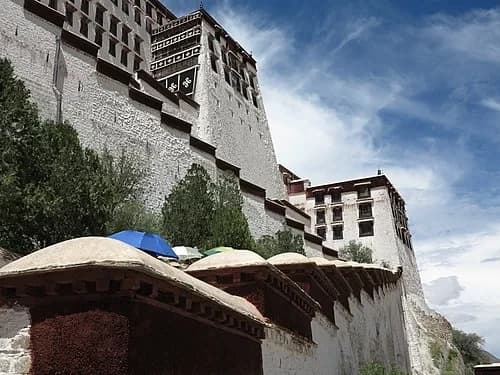
The Path of a Thousand Steps
The winding stone staircases that lead up the side of the mountain are a defining feature of the approach. Visitors must climb over 1,000 steps to reach the main entrance, a task that is physically demanding at an altitude of nearly 4,000 meters. This ascent was intentionally designed as more than just a path; it serves as a meditative transition from the valley floor to the sacred heights of the palace. The zigzagging pattern forces a slow, rhythmic pace, allowing the mind to quiet before entering the temples. Historically, high officials would be carried up these steps in palanquins, but the majority of visitors made the journey on foot as a form of pilgrimage. As the steps wind higher, the view of Lhasa expands, reminding you of the palace's role as a watchtower over the land. The stone steps are worn smooth from centuries of use, marking the path of countless devotees who have made this same climb in search of spiritual blessing or political audience.
The White Palace: Seat of Government
Focusing on the administrative and residential section of the complex, known as Potrang Karpo.
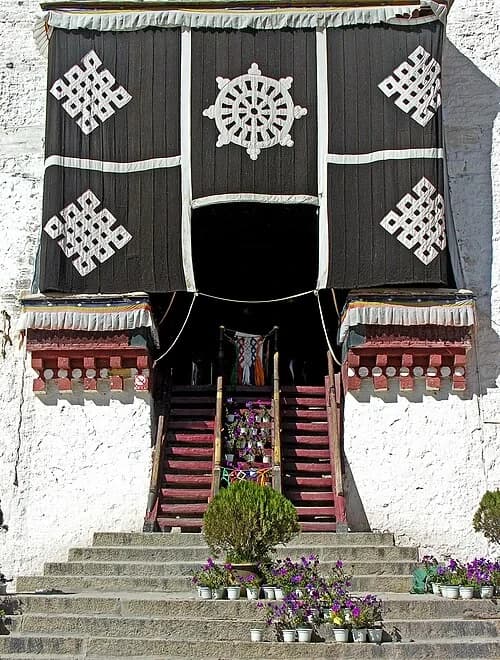
Entrance of the High Priest
Above the main doorways, you will see large, heavy curtains made from woven black yak hair. This material is a staple of Tibetan architecture because it is exceptionally tough and resistant to the intense ultraviolet rays at high altitudes. Beyond durability, these curtains provide crucial temperature control, keeping the interior cool in the summer and trapping heat during the frigid winters. Look closely at the fabric above the entrance to see traditional symbols appliquéd onto the surface. You can find the Dharma Wheel, or Dharmachakra, representing the Buddha's teachings, and the endless knot, known as the Srivatsa, which symbolizes the interconnectedness of all things and the union of wisdom and compassion. These motifs greet every visitor, signaling the transition into a sacred space. The curtains are often fringed with colorful fabric, adding a vibrant touch to the somber black hair. Their movement in the wind is one of the few dynamic elements on the palace's otherwise stoic facade.
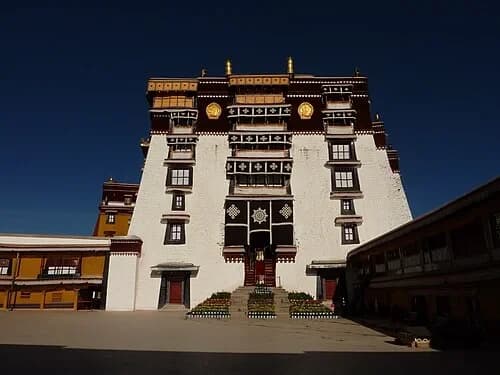
The White Palace Facade
The eastern wing of the complex is known as the White Palace. This section was primarily used for secular and residential purposes. It served as the winter home for the Dalai Lamas from the 17th century until the mid-20th century. Inside, you would find the private living quarters of the religious leader, as well as the administrative offices of the Tibetan government. The White Palace includes the grand reception halls where foreign dignitaries and local officials were received. Its architecture reflects its dual role, with wide windows to let in the winter sun and large assembly halls for state functions. In contrast to the religious focus of the Red Palace, which we will visit later, the White Palace was a center of political power and daily governance. The exterior’s stark white color is periodically refreshed using traditional methods, keeping it bright against the mountain. This part of the complex was the first to be completed during the 17th-century reconstruction initiated by the 5th Dalai Lama.
Deyang Shar: The East Courtyard
The large open courtyard used for religious dances and ceremonies.
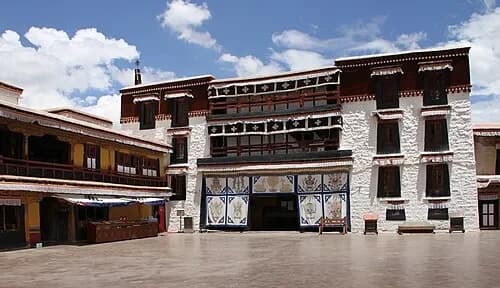
Administrative Wing of the Palace
From the perspective of the inner courtyards, the sheer complexity of the Potala Palace becomes apparent. The interior is a massive labyrinth containing more than 1,000 rooms, connected by narrow corridors and steep wooden ladders. The construction of this entire modern complex was a monumental undertaking that took 45 years to complete. Work began in 1645 but was not finalized until 1694. This means the 5th Dalai Lama, who initiated the project, passed away twelve years before its completion. His death was reportedly kept secret for several years to ensure that the work on this magnificent structure would continue without interruption. The palace is divided into many functional zones, including chapels, libraries, granaries, and living quarters. Its layout was designed to accommodate the thousands of monks, officials, and attendants who lived and worked here at its peak. The construction used traditional materials like stone, timber, and earth, all transported up the mountain by hand or pack animal.
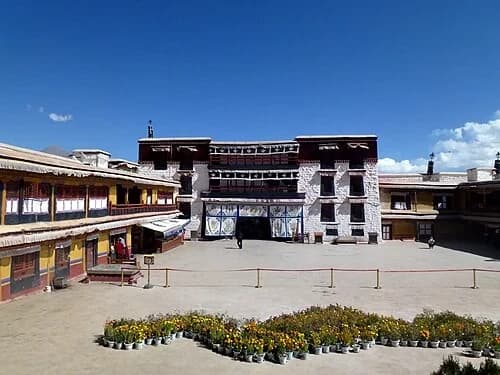
The Great East Courtyard
This expansive open space is the Great East Courtyard, or Deyang Shar. It was the primary venue for religious dances, known as Cham, which were performed by monks during major festivals. These ceremonies were attended by the Dalai Lama, who would watch from the balconies above, and by the public who filled the courtyard floor. Surrounding the courtyard are yellow buildings, a color traditionally reserved for religious or high-ranking secular structures. These buildings housed the administrative staff responsible for the palace's complex logistics. Additionally, this wing contained a prestigious school specifically for monk-officials, who were trained here in both religious scripture and the intricacies of government administration. The courtyard’s flat, open design contrasts with the verticality of the surrounding walls, providing a rare sense of breathing room within the dense fortress. On festival days, the air here would be filled with the sound of long horns and cymbals as masked dancers moved across the stones in ancient ritual patterns.
The Red Palace: The Spiritual Heart
Transitioning to the central crimson section dedicated to religious study and the tombs of the Dalai Lamas.
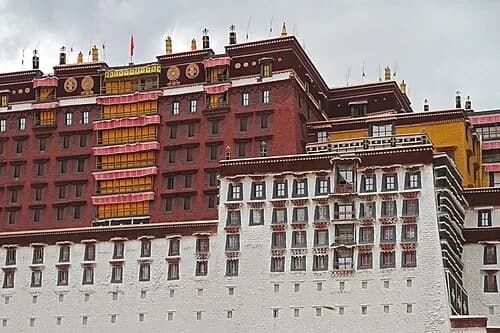
The Religious Red Palace
Standing at the center of the complex, the Red Palace is the spiritual core of the entire Potala. Unlike the White Palace, which handled the affairs of state, this section is dedicated to religious study, prayer, and the preservation of Tibet's most sacred relics. Its deep crimson walls house numerous chapels and the Great West Hall, where major religious ceremonies were held. Perhaps most significantly, the Red Palace contains the elaborate funerary stupas of several past Dalai Lamas. These stupas are monumental structures encrusted with gold and precious gems, serving as final resting places and objects of intense veneration. The interior is also home to vast libraries of Buddhist scriptures and historical records. The atmosphere inside the Red Palace is one of quiet devotion, often filled with the scent of juniper incense and the soft glow of butter lamps. Its central position in the architecture mirrors its central role in the spiritual life of the nation, acting as a bridge between the earthly palace and the divine.
Chapel of the Dharma King
The Chogyel Drupuk, the meditation cave of King Songtsen Gampo, one of the oldest parts of the structure.
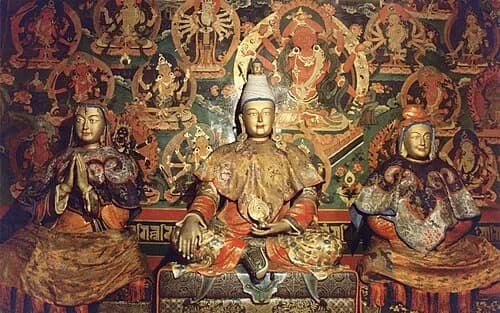
The Royal Trio of Tibet
In this inner chapel, you can see a significant royal trio. In the center is King Songtsen Gampo, the 7th-century ruler who unified the Tibetan tribes. He is flanked by his two most famous wives: Princess Wencheng from China’s Tang Dynasty and Princess Bhrikuti from Nepal. These women are revered in Tibetan history for their roles in introducing Buddhism to the kingdom. Tradition holds that each princess brought with her a sacred statue of the Buddha as part of her dowry, which became the focus of the first temples built in Lhasa. Princess Wencheng is often credited with bringing advanced agricultural techniques and the art of silk making to Tibet, while Princess Bhrikuti is celebrated for her deep devotion. The statues are dressed in elaborate traditional robes and adorned with jewelry, reflecting their high status. This royal group represents the historical foundation of the Tibetan state and its long-standing cultural connections with its neighbors. Their presence in the palace honors the moment when Tibet first embraced the Buddhist faith.
Want to hear the rest?
Download the Stanza app to unlock all 22 stops and full GPS-guided navigation.
Frequently Asked Questions
How long does the Potala Palace audio tour take?
The Potala Palace audio guide includes 22 narrated stops. Most visitors spend 45 minutes to 1.5 hours exploring the complete tour, though you can listen at your own pace and skip or revisit any stop.
Is the Potala Palace audio guide available in my language?
Stanza supports 15 languages: English, Spanish, French, German, Italian, Portuguese, Russian, Japanese, Chinese, Korean, Arabic, Hindi, Polish, Dutch, Hebrew. Check the guide in the app to confirm the languages currently available for this tour.
Can I use the audio guide offline at Potala Palace?
Yes! Download the complete Potala Palace tour — including all audio, maps, and images — before your visit. The Stanza app works completely offline, so you don't need WiFi or mobile data at the venue.
How much does the Potala Palace audio guide cost?
The Stanza app is free to download. The current listed price for the Potala Palace audio guide is $2.99; app-store region and currency may affect the final price.
How do I use the Stanza audio guide at Potala Palace?
Download the free Stanza app, search for "Potala Palace", and download the tour. When you arrive at the venue, the app uses GPS to detect your location and automatically plays the relevant narration as you move between points of interest — completely hands-free.
What makes the Stanza audio guide different from other Potala Palace tours?
Stanza offers GPS-triggered narration that plays automatically as you walk through Potala Palace — no need to manually select stops. The tour is available in 15 languages, works fully offline, and includes 22 expertly narrated stops with images and historical context.
What other audio guides are available near Potala Palace?
Stanza offers multiple audio guides in Chengguan District, China and nearby areas. After downloading the app, browse the map to discover all available tours near Potala Palace. Each guide can be downloaded for offline use.