Stanza · Audio guide
Santuario de Las Lajas Audio Guide
A place to remember. A story to take with you.
A stunning Gothic Revival basilica church built inside the canyon of the Guáitara River. It is a world-famous pilgrimage site known for its dramatic architectural integration with the surrounding gorge.
Download Stanza, then search for “Santuario de Las Lajas”.
About the tour
One guide. Your kind of visit.
A stunning Gothic Revival basilica church built inside the canyon of the Guáitara River. It is a world-famous pilgrimage site known for its dramatic architectural integration with the surrounding gorge.
Ready when you are.
- 01Get the free Stanza app.
iOS & Android
- 02Find your guide.
“Santuario de Las Lajas”
- 03Download before you go.
Works offline
Audio guide / 12 narrated stops
Inside the guide
Get to know a few of the stories before you go. Open a stop to read more.
01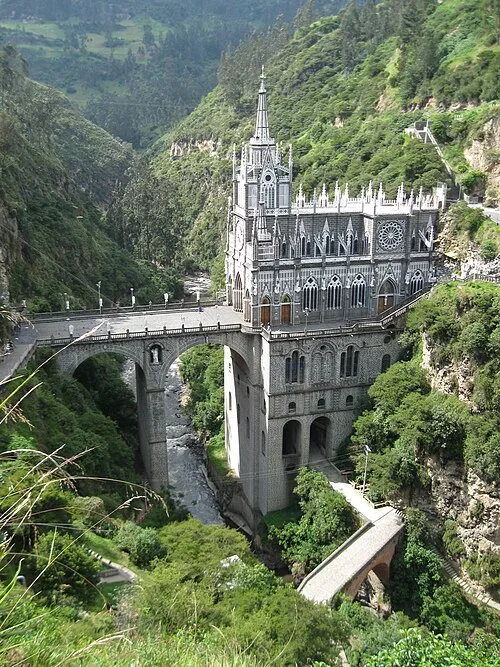 Canyon Rim Overlook and Apparition Trail
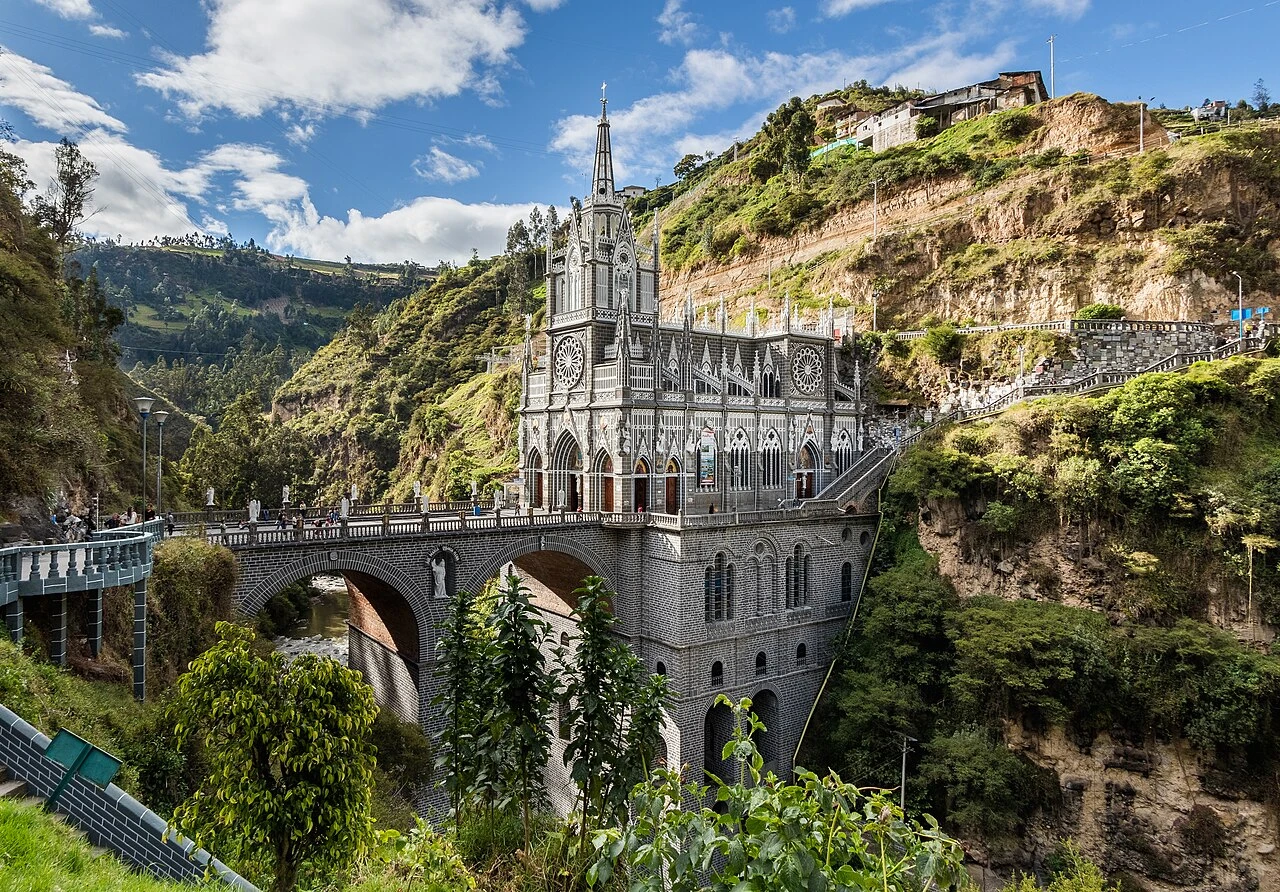
The Sanctuary in the Guáitara Canyon
A church stands above the Guáitara River, deep in a canyon in southern Colombia. It is the Sanctuary of Las Lajas, a Catholic minor basilica in the town of Ipiales, in the Nariño department. A minor basilica is a title the Church gives to churches of special importance. The church rises one hundred metres from the floor of the canyon. Its three tall spires and round rose window stand out against the green slopes, and an arched bridge runs beneath it. The sanctuary is dedicated to Our Lady of the Rosary and is built around a revered painting of the Virgin Mary. Pilgrims have come here since the eighteenth century. A Spanish friar's travel account is possibly the oldest mention of the shrine. Pilgrims come from Colombia and neighbouring Ecuador, and the church lies less than eleven kilometres from the border. By some measures, it is the second most popular pilgrimage site in Colombia. It is protected as a national monument.
Photo: Bernardo Andrade Tapia · CC BY-SA 3.0
02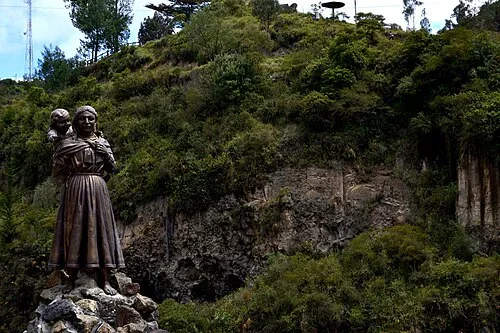 Canyon Rim Overlook and Apparition Trail
Statue of María Mueses and Rosa
A statue shows María Mueses, an Indigenous woman, carrying her daughter on one shoulder. The story behind it goes back to around 1754. On their way home from Ipiales to Potosí, the two were caught in a violent storm. They took shelter between the lajas, the flat stone slabs that mark this part of the canyon. Until then, Rosa had been considered deaf and mute. Then she called out. In one telling, she cries, “Mother, the Virgin is calling me!” In another, she says, “The Mestiza is calling me.” Mestiza means a woman of mixed Indigenous and European descent. Rosa pointed to a silhouette over the stone, lit by a flash of lightning.
Photo: Lombana · CC BY-SA 3.0
03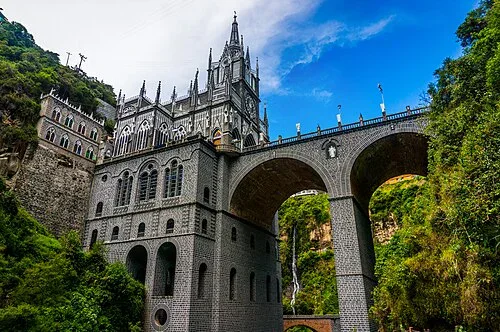 The Guáitara Canyon Bridge and Plaza
Two-Arched Stone Bridge Beneath the Church
The sanctuary sits on a bridge fifty metres high, spanning the Guáitara River. Its grey stone arches carry the crossing over the gap where the water runs, and railings line the top. The first shrine on this spot was made of straw and wood, and a brick chapel later replaced it. In 1802, worshippers built a larger shrine. They also put up the first version of the bridge that gives access to the church. Later in the nineteenth century, the shrine was extended and joined by a bridge to the far side of the canyon.
Listen in the appPhoto: GameOfLight · CC BY-SA 3.0
04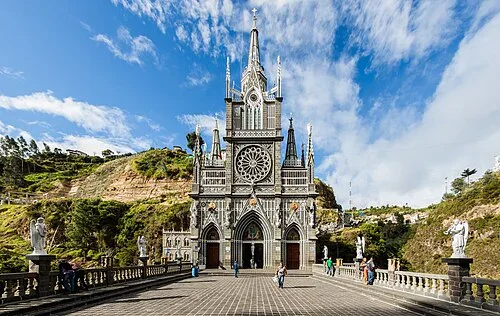 The Guáitara Canyon Bridge and Plaza
Bridge Plaza Before the Facade
The paved terrace on the bridge serves as a forecourt for the church. White statues stand along its balustrades, and the three-towered facade rises behind them. Pilgrimage to the sanctuary comes in waves. One of three peak periods comes in September, for the feast days of the sanctuary's patroness. The main feast days are the fifteenth of September and the day after. On Holy Thursday, pilgrims have traditionally come on foot. Many come from Pasto, from Túquerres and nearby towns, and from Ecuador. Their walk can take more than twelve hours. Pilgrims also come in December and in the first days of January.
Listen in the appDiego Delso · CC BY-SA 4.0
05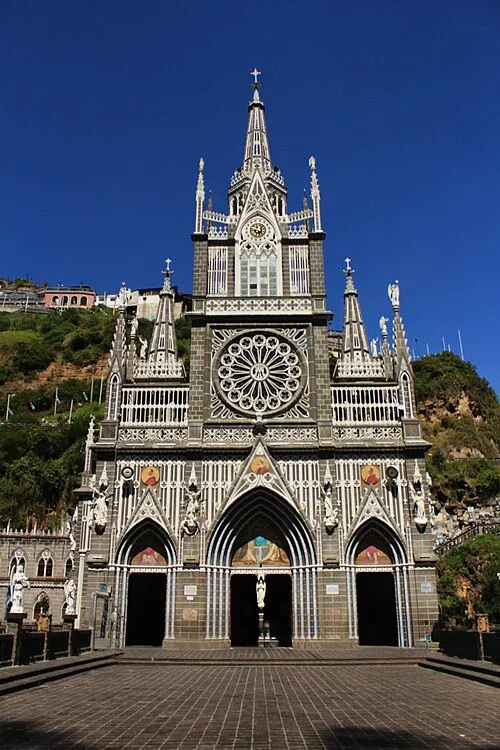 The Neo-Gothic Facade and Main Portal
Neo-Gothic Facade and Three Towers
Work on the present church began in 1916, paid for by donations from devotees, above all from Colombia and Ecuador. The work was led by the Ecuadorian engineer Gualberto Pérez and the Colombian architect Lucindo Espinosa. The style is neo-Gothic, a revival of the Gothic churches of medieval Europe. Building was finished in 1949. Its three towers end in pointed spires. A large rose window fills the centre of the facade, above the arched doorways. In 2015, the British newspaper The Daily Telegraph chose the sanctuary as the most beautiful church in the world. The newspaper picked it from a list of twenty-three churches, for its location and architecture.
Listen in the appPhoto: Felipeortegag · CC BY-SA 4.0
06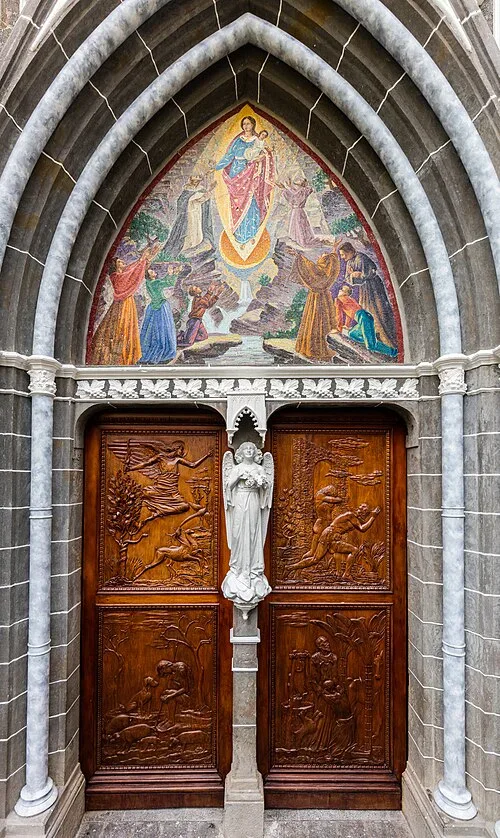 The Neo-Gothic Facade and Main Portal
Main Portal: Mosaic Panel, Carved Doors and Angel Statue
Carved wooden doors close this entrance, each carved with relief panels. Above them, a mosaic fills the pointed arch, with a central figure ringed by pale light and a group of standing and kneeling figures around it. In Gothic churches, the doorway was often where the carving was richest. A white angel stands on a pedestal between the two doors.
Listen in the appDiego Delso · CC BY-SA 4.0
07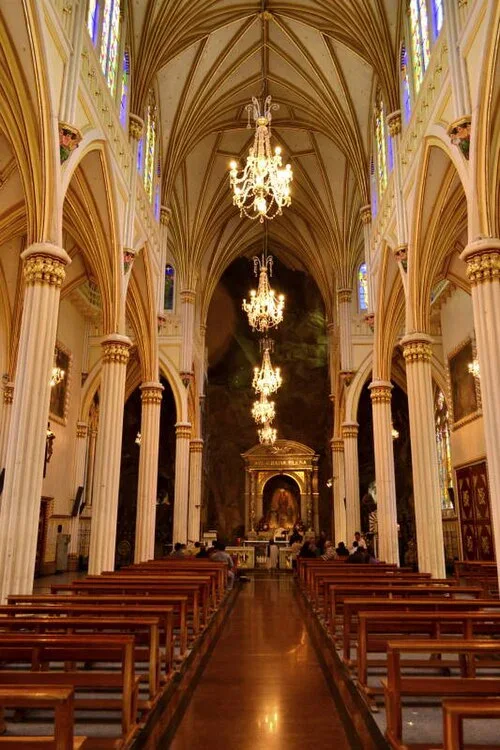 The Main Nave and Walter Wolf Stained Glass
Main Nave Looking Toward the Altar
Long pews run toward the altar at the far end of the church. The interior is twenty-seven and a half metres deep. It is fifteen metres wide. Three naves run side by side along that length. Tall columns with decorated tops line the aisles, and chandeliers hang from the ceiling. The central nave leads the eye straight to the altar.
Listen in the appDiego Tirira from Quito, Ecuador · CC BY-SA 2.0
08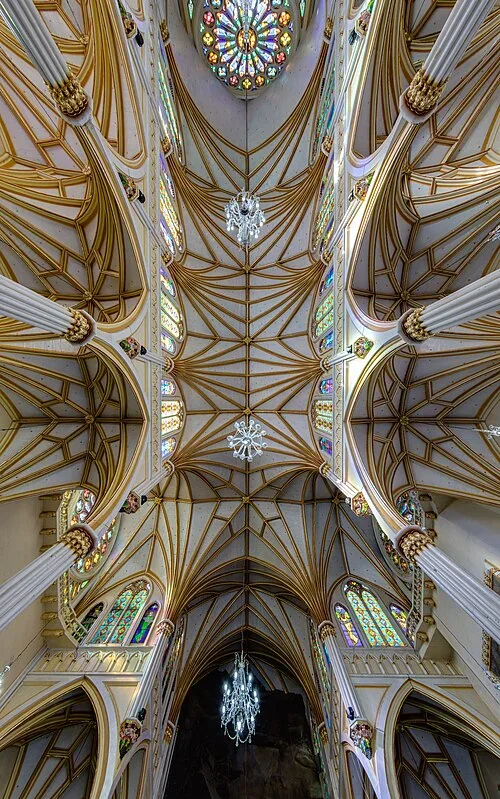 The Main Nave and Walter Wolf Stained Glass
Ribbed Vaults and Stained Glass Above the Nave
The ceiling is built on a framework of ribs that branch out from slender columns. Tall, narrow windows run down the sides, and a rose window glows at the top. Daylight comes through stained glass made by the German artisan Walter Wolf.
Listen in the appDiego Delso · CC BY-SA 4.0
09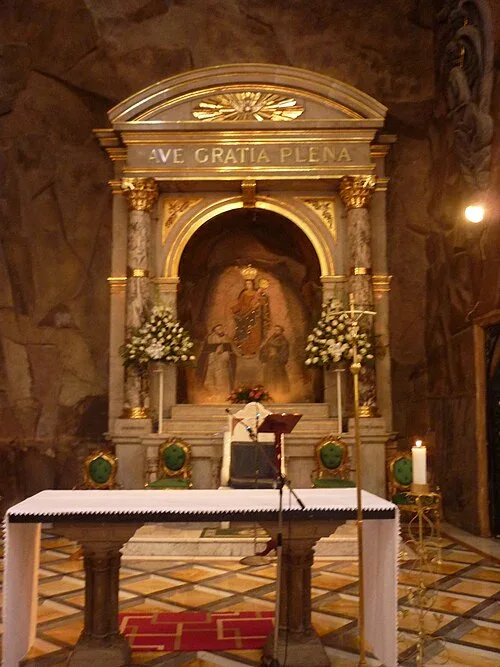 The High Altar and Miraculous Laja Rock
High Altar and Retable with Ave Gratia Plena Inscription
The altar stands against a back wall that is said to be the natural stone of the canyon. The stone around it looks rough and uneven. White flowers and candles stand beside the altar. Above it, a gold-coloured retable, the decorated frame behind an altar, carries the Latin words Ave gratia plena. They mean hail, full of grace. Inside the arch, a painted figure stands with companions gathered around her. The naves end at this wall of stone.
Listen in the appPhoto: William Sosa · CC BY-SA 3.0
10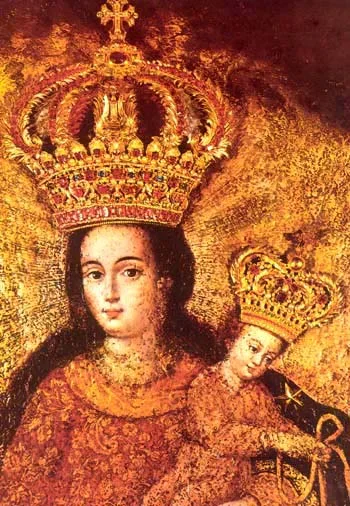 The High Altar and Miraculous Laja Rock
Image of Our Lady of the Rosary (Close View)
The painted Virgin wears a red mantle against a gold background, and she holds the Christ Child. The story goes further than the storm. Rosa died, and her mother went back to the rock to pray for her soul. Tradition has it that the Virgin then revived Rosa, and after that the two could not keep the miracle secret. Some accounts say the painting came to light when the mother showed a priest and local people the spot where Rosa had been revived. Nobody knows who made it. Descriptions differ on what it is painted on. Some describe a flat stone slab. Others call it a mural of unknown origin, and a traveller named Santiago Pérez Manosalva described oil paint on a slab. Popular belief holds that the figure reaches several feet into the stone, though no one has verified it. Pope Pius the Twelfth gave the painted Virgin official recognition in a decree. That decree came in 1951. It gave her the Latin title Sancta Virgo de Rupe, meaning Holy Virgin of the Rock. She was formally crowned in 1952.
Listen in the appop unknown · Public domain
- 11
Lower Interior: Brick Arch and Stair
A lower crypt built into the bridge's arches, dedicated to the Sacred Heart of Jesus.
- 12
Riverside Waterfall Viewpoint
A traveller's description of a chapel over the gorge, and a waterfall above the river.
Santuario de Las Lajas
Frequently asked questions
How much does the guide cost?
Free app download. Listed guide price: $0.99. Guide price shown in the app. Audio guide only. Venue admission is separate.
Can I listen without internet?
Yes. Download the guide’s audio, images, and maps in the app before your visit. Your downloaded content is then available offline.
Can I listen in my language?
This audio guide is available in 15 languages, including English.
Do I need to follow a schedule?
No. This is a self-guided experience. Choose your stops, pause whenever you like, and return to a story at your own pace.
At your own pace
Explore Santuario de Las Lajas.
Download Stanza, then search for “Santuario de Las Lajas”.
Free app download · Guide price shown in the app
Keep exploring
Audio guides — Colombia
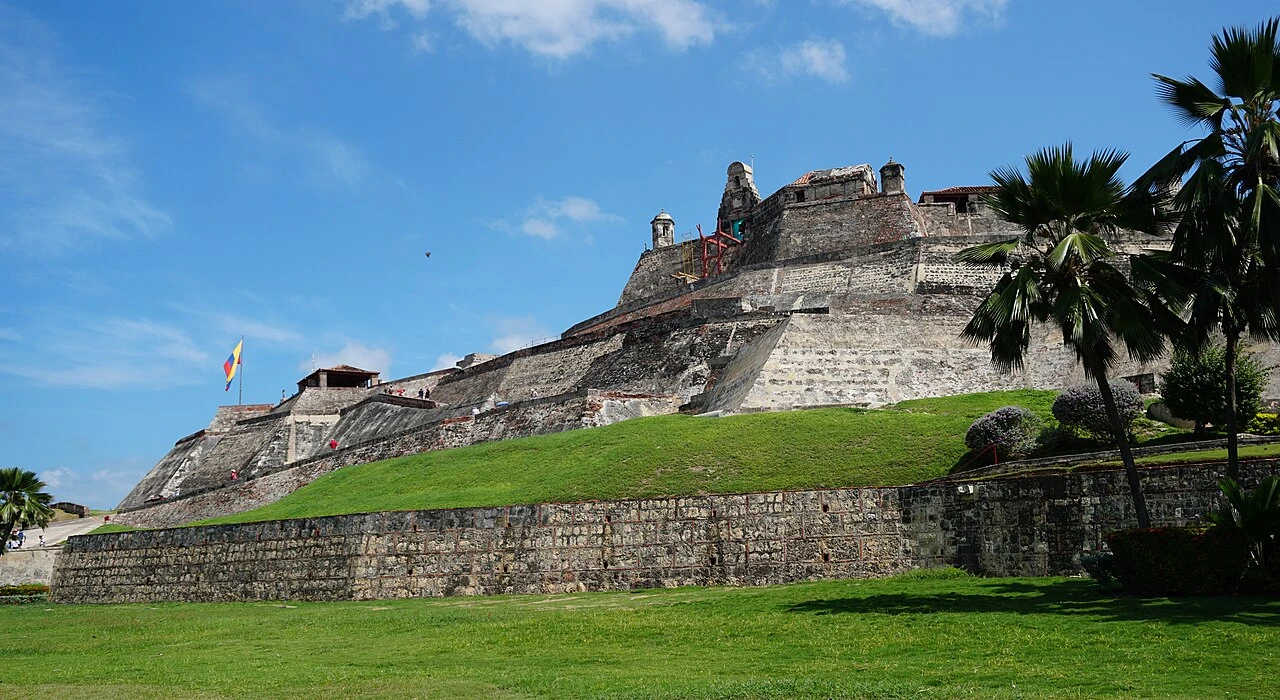
Cartagena
Castillo de San Felipe de Barajas
Content & sources
Mariordo (Mario Roberto Durán Ortiz) · CC BY-SA 4.0
Santa Marta
Ciudad Perdida
Content & sources
Gavin Rough from Waterloo, Canada · CC BY 2.0
Ingapirca
Ingapirca
Content & sources
Bernard Gagnon · CC BY-SA 3.0