Stanza · Audio guide
Che Guevara Mausoleum Audio Guide
A place to remember. A story to take with you.
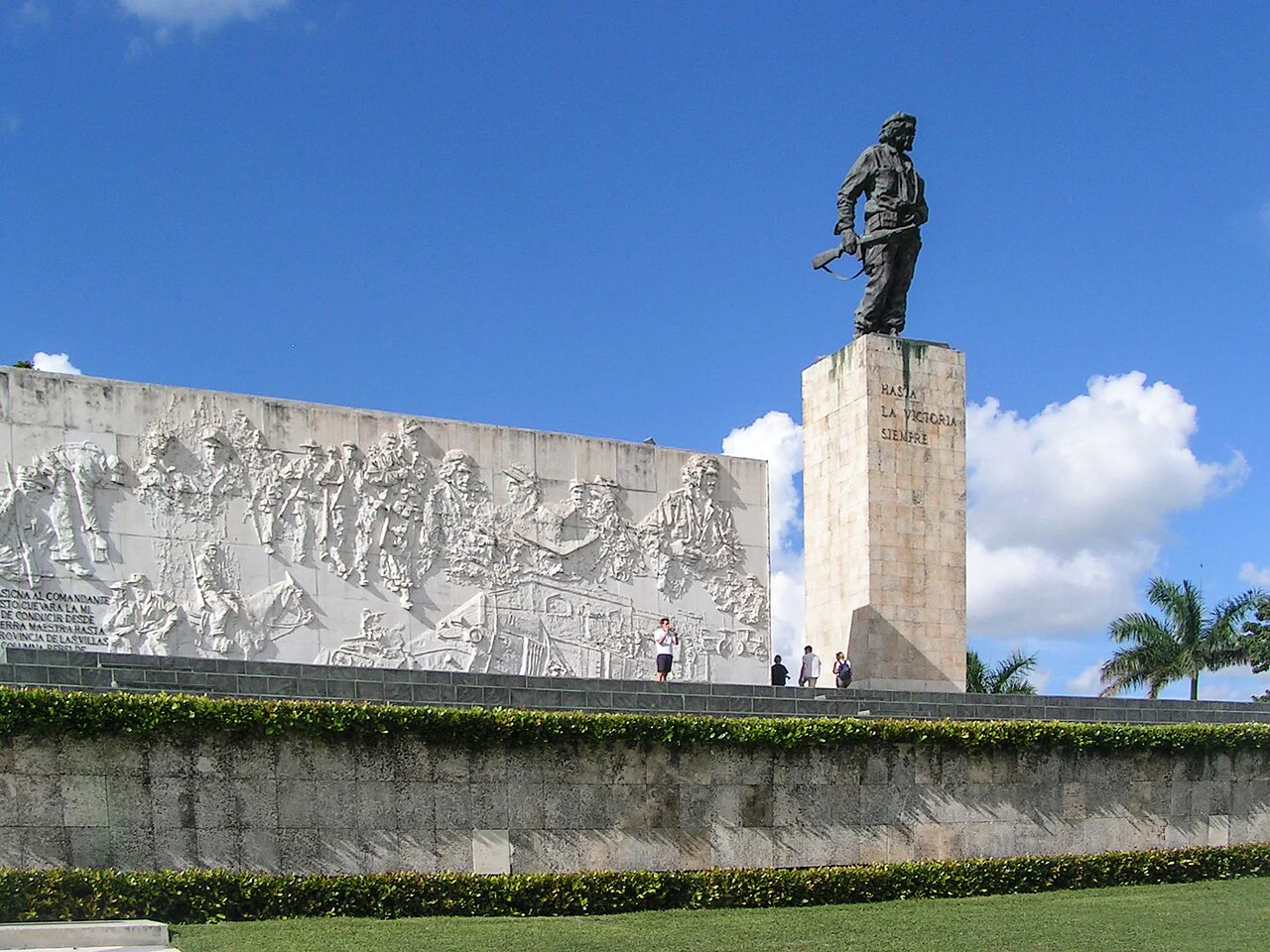
The Che Guevara Mausoleum is a memorial located in Santa Clara, Cuba. It houses the remains of Ernesto "Che" Guevara and 29 fellow combatants who were killed in 1967.
Download Stanza, then search for “Che Guevara Mausoleum”.
About the tour
One guide. Your kind of visit.
The Che Guevara Mausoleum is a memorial located in Santa Clara, Cuba. It houses the remains of Ernesto "Che" Guevara and 29 fellow combatants who were killed in 1967.
Ready when you are.
- 01Get the free Stanza app.
iOS & Android
- 02Find your guide.
“Che Guevara Mausoleum”
- 03Download before you go.
Works offline
Audio guide / 9 narrated stops
Inside the guide
Get to know a few of the stories before you go. Open a stop to read more.
01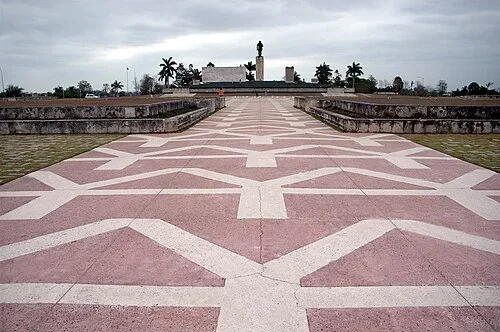 Plaza Che Guevara and Ceremonial Grounds
Plaza Che Guevara: Approach to the Memorial
Welcome to the Che Guevara Mausoleum in Santa Clara, in the heart of Cuba. Ahead, a wide paved plaza stretches toward a hilltop complex, and a bronze figure rises at its far end. This ground belongs to the memory of Ernesto Che Guevara, the Argentine-born revolutionary who became a commander in Cuba's rebellion. Santa Clara was chosen for a reason. It was here, on the last day of 1958, that Guevara's troops took the city in the final battle of the Cuban Revolution. His fighters derailed an armoured government supply train during the fighting. That defeat broke the back of the dictatorship. Fulgencio Batista fled into exile, and the revolution had won. The derailed train still lies where it fell, elsewhere in the city, kept as it was that day. This plaza, though, became the place Cuba chose to honour the man who led the charge.
Photo: Gorupdebesanez · CC BY-SA 3.0
02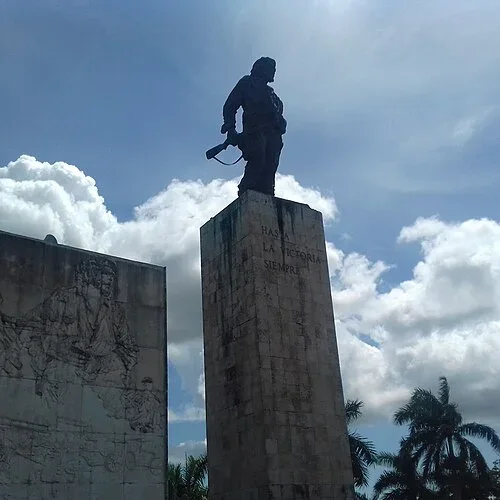 Plaza Che Guevara and Ceremonial Grounds
Inscriptions on the Plinth: Hasta la Victoria Siempre
Che Guevara had a motto, and it is carved into the stone at the base of this monument: Hasta la Victoria Siempre. It means something like, onward until victory, always. The whole complex speaks through written words like this. Elsewhere in the stonework, a longer reflection of his is carved, going back to his days in Guatemala under President Arbenz. There he learned, as the inscription puts it, that if he was to be a revolutionary doctor, or simply a revolutionary, first there must be a revolution. And at the edge of the plaza, two large billboards carry lines by Fidel Castro. One of them reads: we want everyone to be like Che. Stone, bronze and steel all carry the same voice here.
Photo: Ad.rondon.94 · CC BY-SA 4.0
03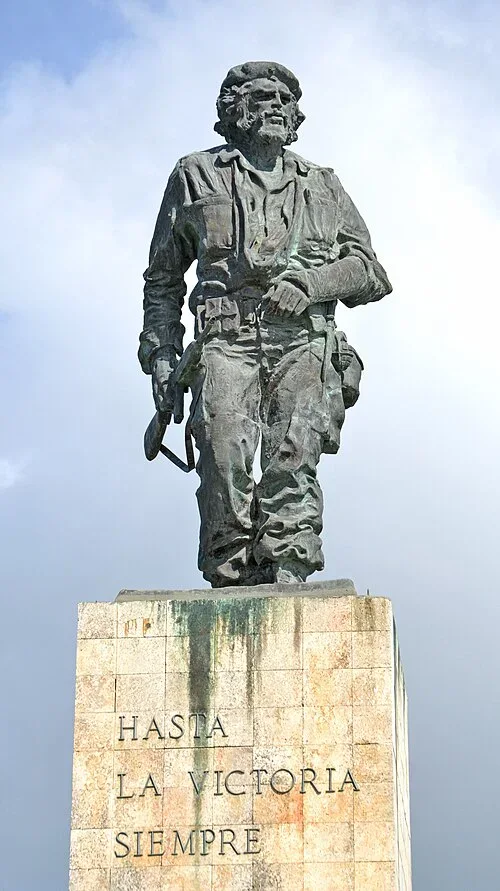 The Monumental Bronze Statue and High Plinth
The 22-Foot Bronze Statue of Che Guevara
The bronze figure at the top of the plinth stands twenty-two feet tall, and the sculptor was José Delarra, the memorial's prime creator. Che strides forward with his rifle cradled in one hand. He carries his gun rather than aiming it. That pose was chosen on purpose, to say that he is continuing onward. The whole monument holds another hidden meaning in its placement. It is oriented at one hundred and ninety degrees, so that Che's figure points directly toward South America. That turn reflects his ideal of one united Latin America, the cause that eventually took his life. The stone plinth beneath him carries his motto in carved letters.
Listen in the appAnemone123 · CC0
04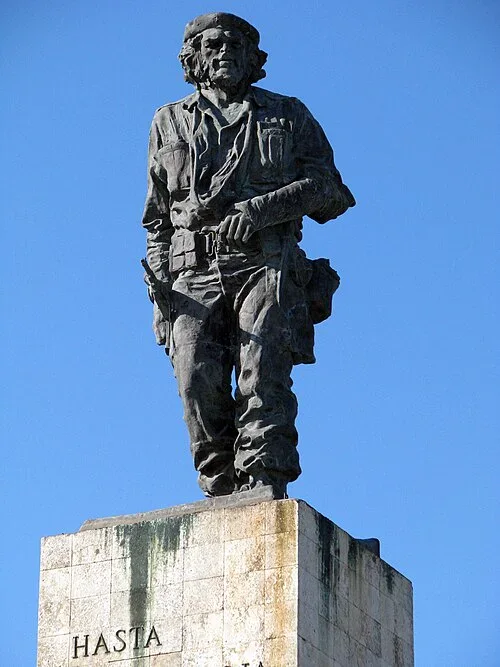 The Monumental Bronze Statue and High Plinth
The Arm Sling: A Man Rebelling Even Against Himself
There is a small detail in the bronze uniform that is easy to miss. Faintly etched into the sleeve is the outline of an arm sling, but the arm itself hangs free, outside it. Che really did fight the Battle of Santa Clara with a broken arm, strapped in a sling. Delarra knew that. He put the sling into the bronze, then deliberately left the arm out of it. The sculptor explained the choice in his own words. It stood for a part of Che's personality, he said, a man rebelling even against himself. A wound remembered, and a defiance of the wound, in the same slab of bronze.
Listen in the appPhoto: Hyppolyte de Saint-Rambert · CC BY-SA 4.0
05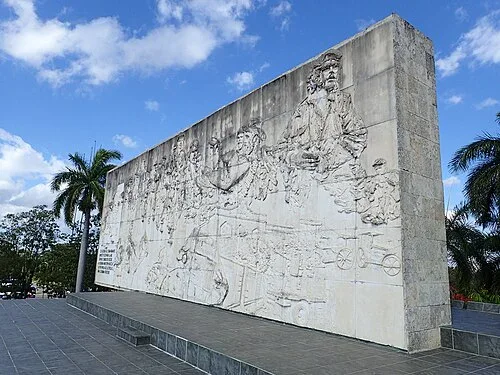 The Historical Bas-Relief and Farewell Letter
The Carved Chronicle of a Life
Beside the statue runs a long stone wall, carved from end to end with scenes, and it reads like a chronicle of a life. It begins in the guerrilla years. Che appears in the Sierra Maestra mountains consulting with Fidel Castro, beside Camilo Cienfuegos, another legendary commander of the rebellion, and on horseback in the mountains. The carving follows him onward through his travels, to Guatemala and to the United Nations, before he returned to Cuba. Then comes the statesman. He is shown as Minister of Industry, doing the voluntary labour he insisted on joining himself. The wall closes in the present tense, with literacy tutors, schoolchildren and young pioneers. They give the salute that Cuban children recite each morning: we will be like Che.
Listen in the appPhoto: Kaldari · CC0
06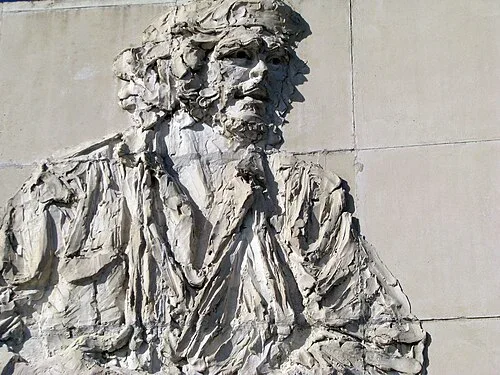 The Historical Bas-Relief and Farewell Letter
Making the Memorial: Delarra, the Foundry and 400,000 Volunteer Hours
The face carved into this relief was shaped by hand, and the story of how all of it was made is its own chapter. Work on the complex began in 1982. A team of three architects conceived it, Jorge Cao Campos, Blanca Hernández and José Ramón Linares, working with the sculptor José Delarra, born José de Lázaro Bencomo. Around half a million residents of Santa Clara took part, giving more than four hundred thousand hours of volunteer labour. They worked alongside the skilled artisans of the Eliseo Díaz Machado Foundry in Guanabacoa, where the bronze was cast. Delarra described his approach simply. I used very pure geometrical elements, he said, rectangles and squares, representing Che's persona, very steady, very strong. The complex was inaugurated on 28 December 1988, with Raúl Castro in attendance.
Listen in the appPhoto: Hyppolyte de Saint-Rambert · CC BY-SA 4.0
07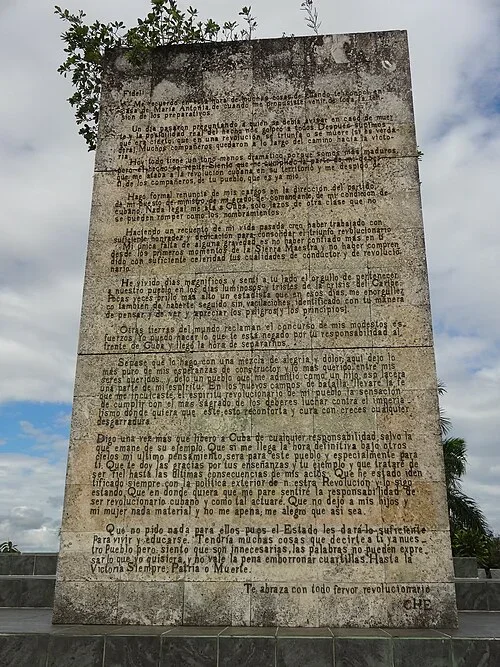 The Historical Bas-Relief and Farewell Letter
The Farewell Letter to Fidel, Inscribed in Full
One face of this memorial carries a whole document, word for word. It is the farewell letter Che wrote to Fidel Castro in 1965, and it is inscribed here in full. In it he renounced every post he held in the Cuban government, gave up his Cuban citizenship, and announced that he was leaving to fight elsewhere. It was his way of explaining a departure that had taken the country by surprise, before he vanished from public life. The stone has weathered over the years, and plants now grow over its top edge. The letter ends with his signature, Che, carved at the bottom of the block.
Listen in the appPhoto: Z thomas · CC BY-SA 4.0
08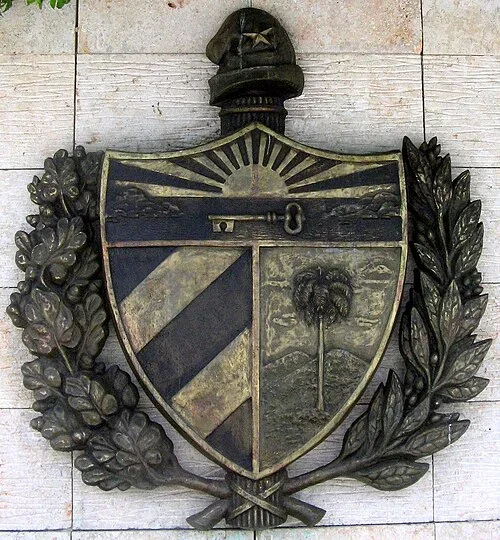 The Memorial Plinth and Resting Place
The Coat of Arms: A National Memorial
Set into the stonework here is the coat of arms of Cuba, modelled in dark metal with its shield, key and royal palm. Its presence marks the rank of this place. This is a national monument of the Cuban state, not a local memorial. People come to it from far beyond the island. Between October 1997 and October 2009, more than three million visitors came from over a hundred countries. The complex holds one more thing worth knowing about. A museum nearby displays objects from Che's childhood, including the asthma inhaler he relied on as a boy and the books he read in school.
Listen in the appDэя-Бøяg · CC BY-SA 4.0
09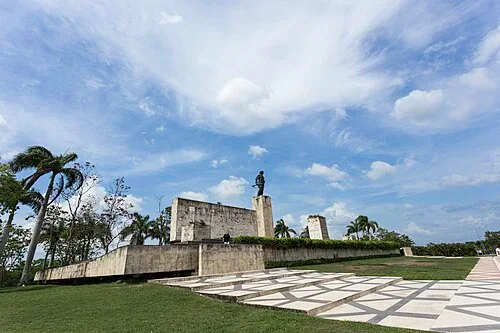 The Memorial Plinth and Resting Place
The Mausoleum Beneath: The Return of the Guerrillero
The story this whole memorial leads to lies beneath it. A subterranean mausoleum holds the remains of Che Guevara and twenty-nine fellow combatants, all killed in 1967 during his attempt to spark an armed uprising in Bolivia. After his execution in October 1967, his body lay hidden for roughly thirty years in an unmarked grave near the airstrip at Vallegrande. In 1997, forensic anthropologists recovered the remains. On 17 October 1997, Che and six of his comrades were buried here with full military honours. The remains had come from Havana in small wooden caskets aboard trailers towed by green jeeps, and a crowd of several hundred thousand gathered as they were unloaded. A choir of schoolchildren sang Hasta Siempre, Carlos Puebla's elegy for Che, and an eternal flame was lit by Fidel Castro in his memory. More burials followed over the next three years, until thirty guerrillas rested here by 2000. A plaza, a statue, a carved life and a grave: Santa Clara holds all of it, on the ground his column won in the last battle of the revolution.
Listen in the appPhoto: Baldo Simone · CC BY-SA 4.0
Che Guevara Mausoleum
Frequently asked questions
How much does the guide cost?
Free app download. Listed guide price: $0.99. Guide price shown in the app. Audio guide only. Venue admission is separate.
Can I listen without internet?
Yes. Download the guide’s audio, images, and maps in the app before your visit. Your downloaded content is then available offline.
Can I listen in my language?
This audio guide is available in 15 languages, including English.
Do I need to follow a schedule?
No. This is a self-guided experience. Choose your stops, pause whenever you like, and return to a story at your own pace.
At your own pace
Explore Che Guevara Mausoleum.
Download Stanza, then search for “Che Guevara Mausoleum”.
Free app download · Guide price shown in the app
Keep exploring
Audio guides — Cuba
San Juan
Castillo San Felipe del Morro
Content & sources
Joshua Wood · CC BY-SA 3.0