Stanza · Audio guide
Orangerieschloss Audio Guide
A place to remember. A story to take with you.
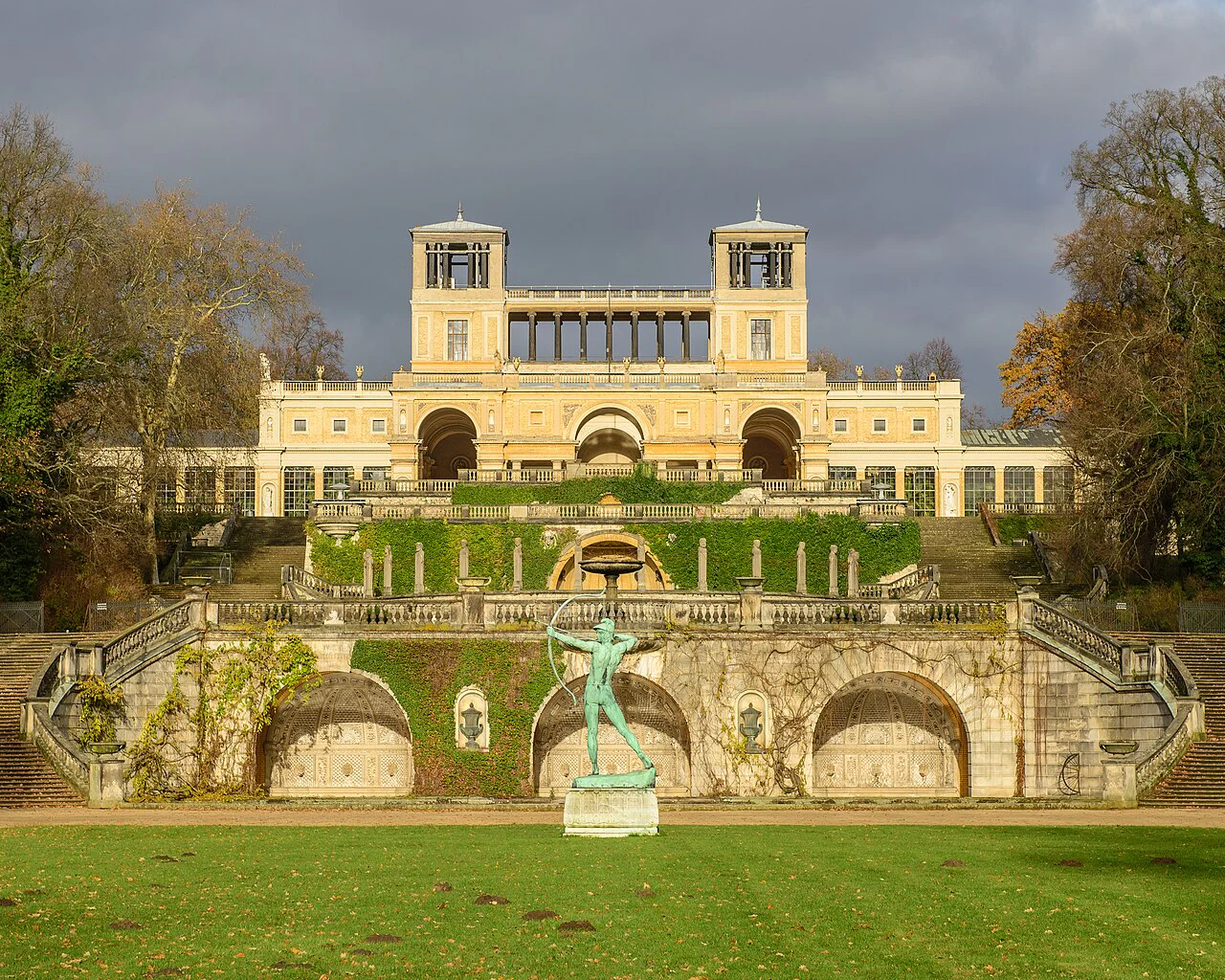
The Orangery Palace is a palace located in the Sanssouci Park of Potsdam, Germany. It was built between 1851 and 1864 at the behest of King Frederick William IV of Prussia.
Download Stanza, then search for “Orangerieschloss”.
About the tour
One guide. Your kind of visit.
The Orangery Palace is a palace located in the Sanssouci Park of Potsdam, Germany. It was built between 1851 and 1864 at the behest of King Frederick William IV of Prussia.
Ready when you are.
- 01Get the free Stanza app.
iOS & Android
- 02Find your guide.
“Orangerieschloss”
- 03Download before you go.
Works offline
Audio guide / 14 narrated stops
Inside the guide
Get to know a few of the stories before you go. Open a stop to read more.
01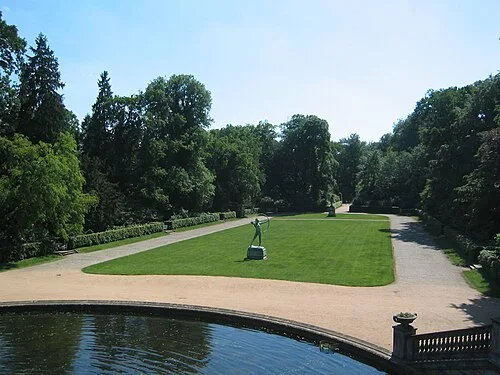 The Southern Terraces and Jubilee Terrace
The View from the Neues Stück
Welcome to the Orangery Palace in Sanssouci Park, Potsdam. From this lawn the whole building shows itself at once: a front of roughly three hundred and four metres, the longest in the entire park. King Frederick William IV of Prussia had it built between 1851 and 1864, in the style of the Italian Renaissance. Three very different jobs share this one roof. The long glass halls shelter exotic tub plants through the winter. Behind the portico lies a museum hall hung with copies of Raphael. And on either side of that hall lie royal guest apartments. The tour climbs from here: up the terraces, into the halls of the central building, and at the end up a tower. The lawn itself is called the Neues Stück, shaped like a hippodrome and reaching south into the older part of the park.
Moody 75 from Phoenix, AZ (currently) · CC BY-SA 2.0
02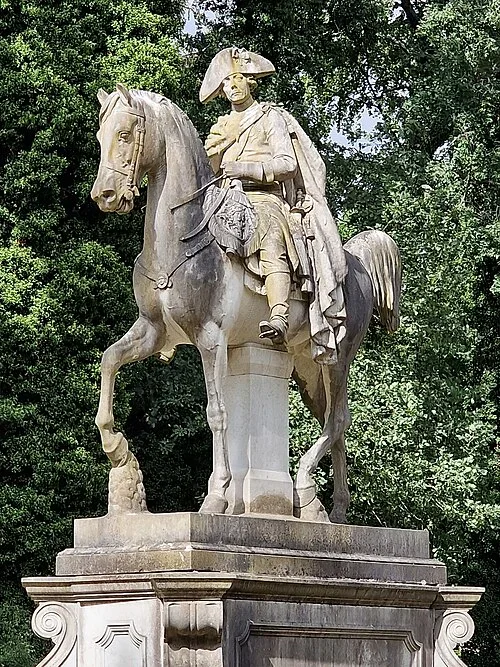 The Southern Terraces and Jubilee Terrace
Frederick the Great Equestrian Statue
The rider here is Frederick the Great, the king who made Sanssouci famous. When Frederick William IV took the throne in 1840, he felt a deep devotion to this ancestor. He began using Sanssouci as his own summer residence. To make it worthy of a royal seat, he had the buildings modernised and restored. The park received working fountains and fresh copies of sculptures. For the architecture he relied at first on Ludwig Persius, a pupil of Schinkel, and after Persius died in 1845 on Friedrich August Stüler and Ludwig Ferdinand Hesse. The gardens went to Peter Joseph Lenné. The palace waiting up on the ridge was born from this same spirit of reverence for Frederick.
Photo: Rigorius · CC BY-SA 4.0
03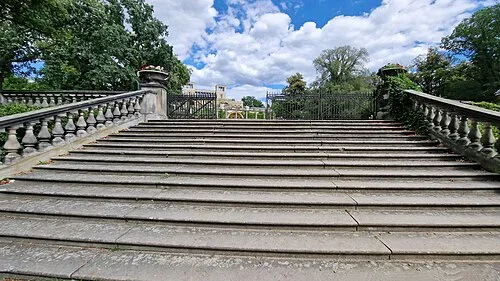 The Southern Terraces and Jubilee Terrace
The Southern Terraces
Frederick William IV sketched the south terraces himself, borrowing motifs from the garden of the Villa d'Este in Tivoli. His first plan was generous: strict Renaissance geometry, fountains and statuary. After his Italian journey in 1859, shortly before his death, he corrected the design with his own hand. Friedrich August Stüler then drew new plans on reduced lines, much as the terraces appear today. The work was carried out between 1860 and 1862, more sparingly than first intended. The king was too ill to oversee the decoration, and his brother William I wanted the project finished quickly and cheaply. One later addition had a strange fate. In 1901 Kaiser Wilhelm II placed astronomical instruments on the uppermost terrace, seized by a German expedition in China during the Boxer Rebellion. Under the Treaty of Versailles they had to be returned to China in 1920.
Listen in the appPhoto: Rigorius · CC BY-SA 4.0
04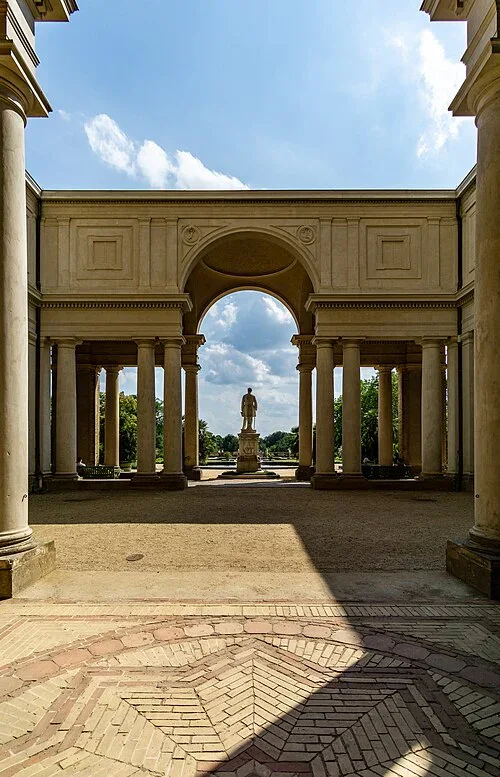 The Central Säulenhof and Portico
The Central Building and Säulenhof
The twin towers mark the actual palace, the centrepiece of the whole long facade. Its models stand far to the south: the Villa Medici in Rome and the Uffizi in Florence. The first plant hall went up in 1851, but work on this central building began only in 1853, following the king's own sketches, with designs by Stüler and Hesse on earlier plans by Persius. Work went slowly. When the king died in 1861, the eastern corner pavilion was only a shell and the western one had not been started. His successor William I completed the building in 1864, though statues and facade decoration kept going into the 1870s. The arcaded courtyard served as the arrival court, its floor laid in patterned brick. Round reliefs in the courtyard show the four seasons, and the portal facade carries terracotta copies of ancient heads.
Listen in the appPhoto: Rainer Halama · CC BY-SA 4.0
05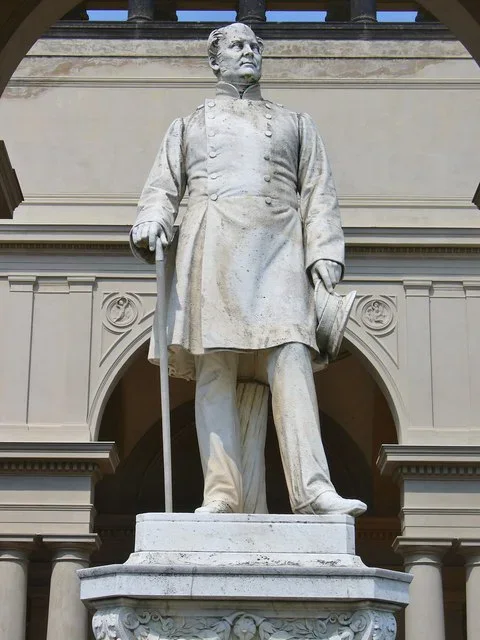 The Central Säulenhof and Portico
Statue of Frederick William IV
Frederick William IV was called the Romantic on the Throne, and this statue shows the dreamer at his most ambitious. He imagined a triumphal street nearly two kilometres long, like the via triumphalis of Rome. It was to begin at a triumphal arch east of the park, climb the heights, pass the north side of Sanssouci and the Historic Mill, and end at the Belvedere on the Klausberg. Viaducts would balance the differences in height, and Italianate buildings would line the way, with the Orangery Palace as its crowning piece. It never happened. Landowners on the ridge haggled over their plots from 1842 to 1847, the March Revolution of 1848 brought unrest, and the money ran out. Only fragments were realised: the Triumphtor, a few smaller buildings and gardens, and the Orangery Palace itself. After the king died, his wife Elisabeth had this statue raised here in his memory. It replaced a copy of the Germanic princess Thusnelda, which the queen had admired in the Uffizi in Florence and which had stood in the courtyard below.
Listen in the appColin Smith on geo.hlipp.de · CC BY-SA 2.0
06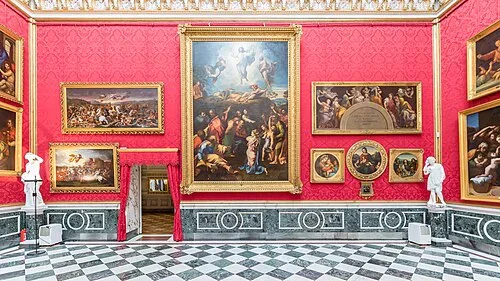 The Raphael Hall (Raffaelsaal)
The Raphael Hall
Behind the portico waits the artistic heart of the palace, the Raphael Hall. It rises through two storeys and takes the Sala Regia in the Vatican as its model. A skylight in the high barrel vault drops even, indirect daylight onto the walls and paintings. The walls themselves have no windows. Black-green marble panels the lower part, and above it hangs carmine silk damask. White and gold stucco bands divide the vault into fields, decorated with allegories of Rome and Florence, the cities where Raphael worked. More than fifty copies of his paintings and frescoes hang on the red silk. Frederick William IV inherited them from his father, Frederick William III, and gathered them here. Similar painting halls of that era in Munich, Dresden and Berlin lost their original appearance to war. This one kept it, which makes the room one of the notable museum interiors of nineteenth-century Germany.
Listen in the appRaimond Spekking · CC BY-SA 4.0
07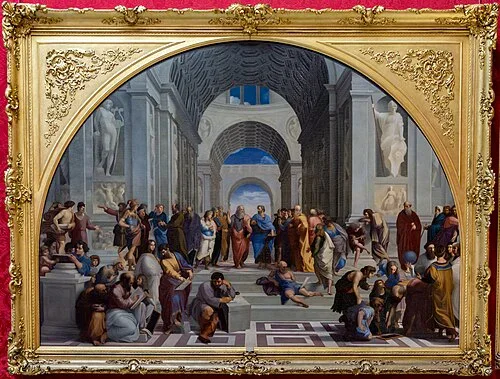 The Raphael Hall (Raffaelsaal)
The School of Athens Copy
Here hangs the School of Athens, Raphael's great fresco of the ancient philosophers. This version is a painted copy, made slightly reduced like the other semicircular Vatican frescoes in the hall. In its day such a copy was no poor relation. Originals by Raphael rarely came onto the art market, so painted replicas were highly esteemed substitutes, and the Prussian court could live with Raphael's masterpieces without ever owning them. The original works the family did buy went a different way. They were meant for the planned public picture gallery in Berlin, to compete with the collections of other European museums. The copies stayed royal, made by painters such as Carl Joseph Begas and Adolf Senff. The whole hall is less a gallery of acquisitions than a monument to the nineteenth century's veneration of Raphael.
Listen in the appRaphael · CC0
08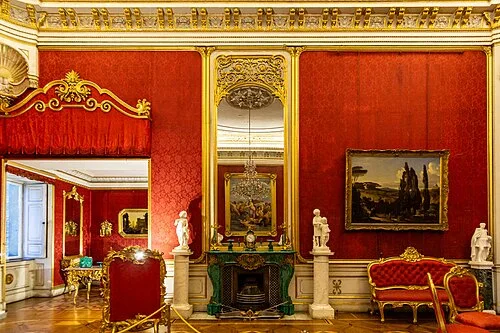 The Eastern Royal Apartments
The Malachite Room
Red silk, gilded stucco and a fireplace of deep green stone: the Malachite Room was made to impress an emperor. The apartments flanking the Raphael Hall were fitted out in the second Rococo style and intended as guest rooms for Tsar Nicholas I and his wife Alexandra Feodorovna. She had been born Charlotte of Prussia, the king's favourite sister, who gave up her name and her homeland when she married the tsar. Guidebooks long claimed the whole palace was built as a residence for this Russian couple. Neither the original plans nor any contemporary description mentions such an intention. The tsarina in fact stayed here only once, in 1859. The Russian connection in the room itself is real enough: the malachite fireplace, the table and several decorations were gifts from Russia, and the ceiling allegories of gardening, astronomy, music and poetry crown it all.
Listen in the appPhoto: Rainer Halama · CC BY-SA 4.0
09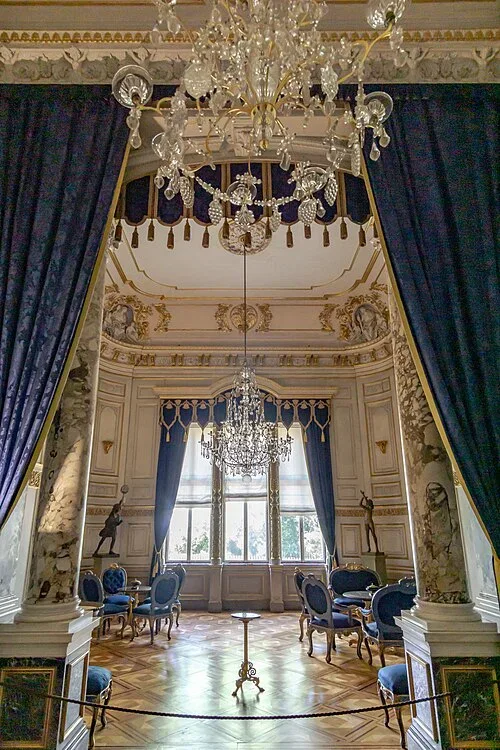 The Eastern Royal Apartments
The Lapis Lazuli Room
Blue silk draperies and crystal chandeliers set the tone in the Lapis Lazuli Room, the anteroom of the guest apartment. After the tsarina's single stay, crowned heads kept arriving well into the monarchy's last decades. The Shah of Persia, Naser al-Din, slept here in 1889. King Umberto I of Italy followed in 1892. And in September 1901 came Prince Zaifeng, sent from China after the Boxer Rebellion and remembered as the atonement prince. A king of Romania had stayed before them, in 1883. For a building begun as a hothouse for plants, the guest list reads like a page of European diplomacy.
Listen in the appPhoto: Rainer Halama · CC BY-SA 4.0
10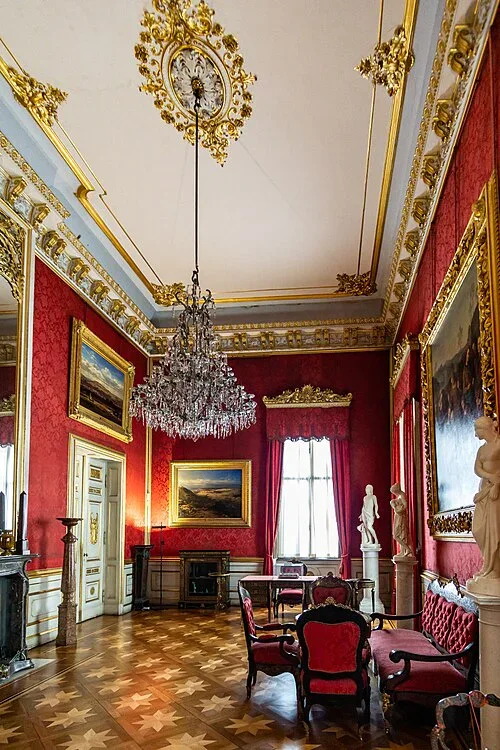 The Western Royal Apartments
The Boulle Room
By 1858 illness had caught up with the king. In October he handed the regency to his brother Wilhelm and spent the following winter in Italy. Even there he kept buying works from painters and sculptors for this palace, sending written instructions home for the building's continuation. This room holds some of what he gathered. Eduard Hildebrandt painted his views of Jerusalem, Bethlehem and Nazareth in 1853, after the king funded his study travels in the Near East. In 1859 the king bought the sculpture Girl with Doves in the Roman studio of the Hungarian sculptor József Engel. A copy of the Entombment of Christ, painted in 1852 after Perugino, the teacher of Raphael, has hung here since 1864. Around them stands furniture in the marquetry technique of André-Charles Boulle, worked in ebony, ivory, mother-of-pearl and tortoiseshell with inlaid metal. The oldest piece, a desk, dates from the eighteenth century.
Listen in the appPhoto: Rainer Halama · CC BY-SA 4.0
- 11
Inside the Plant Hall
The hidden heating ducts that keep a thousand citrus trees and palms alive through the German winter.
- 12
The Western Plant Hall Exterior
A hundred metres of glass, a war it survived, and the archive that lived among the plants.
- 13
The Tower Colonnade
The painted walkway that joins the twin towers high above the roof.
- 14
View from the Tower Gallery
What the panorama means: the built fragment of a romantic's Italy, now world heritage.
Orangerieschloss
Frequently asked questions
How much does the guide cost?
Free app download. Listed guide price: $0.99. Guide price shown in the app. Audio guide only. Venue admission is separate.
Can I listen without internet?
Yes. Download the guide’s audio, images, and maps in the app before your visit. Your downloaded content is then available offline.
Can I listen in my language?
This audio guide is available in 15 languages, including English.
Do I need to follow a schedule?
No. This is a self-guided experience. Choose your stops, pause whenever you like, and return to a story at your own pace.
At your own pace
Explore Orangerieschloss.
Download Stanza, then search for “Orangerieschloss”.
Free app download · Guide price shown in the app
Keep exploring
Nearby audio guides
Potsdam · 1 km
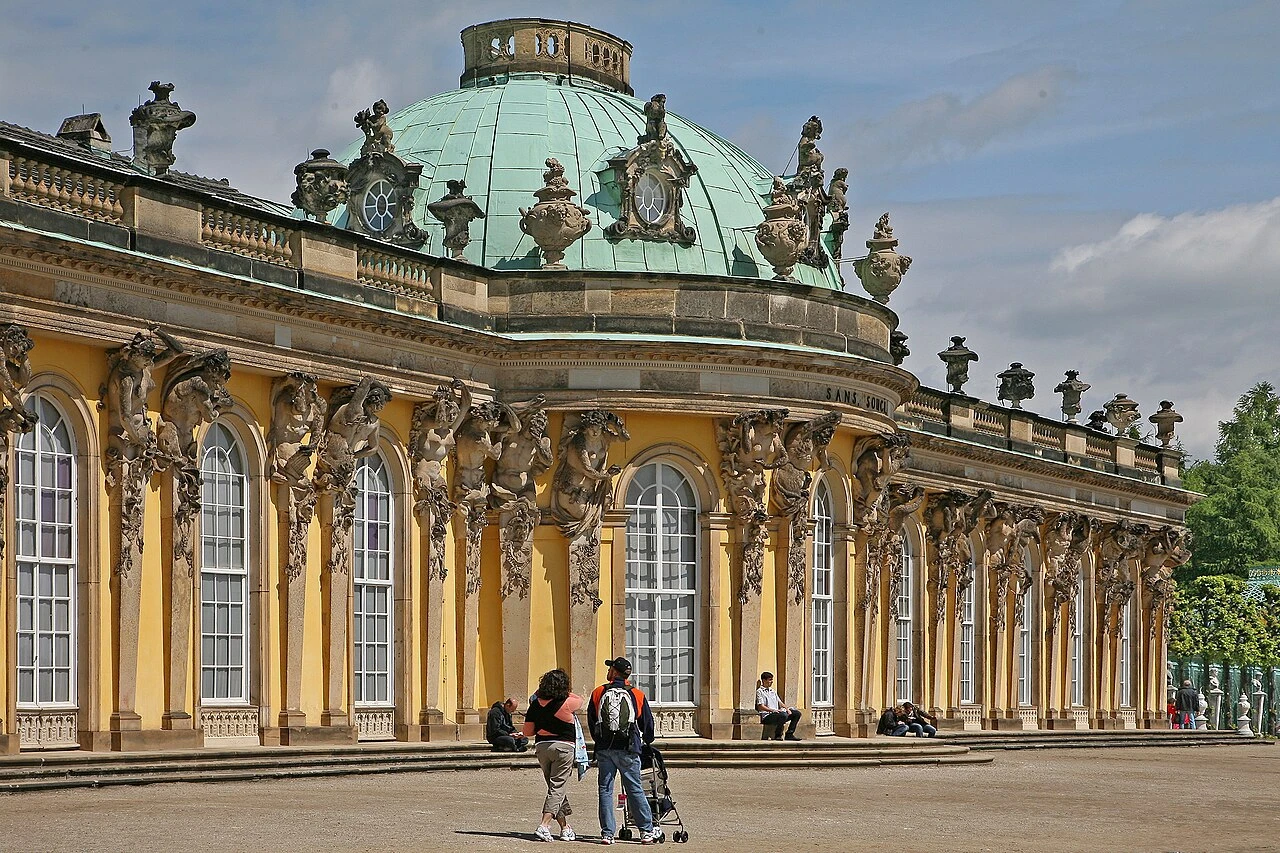
Sanssouci Palace
Content & sources
Photo: W. Bulach · CC BY-SA 4.0
Potsdam · 4 km
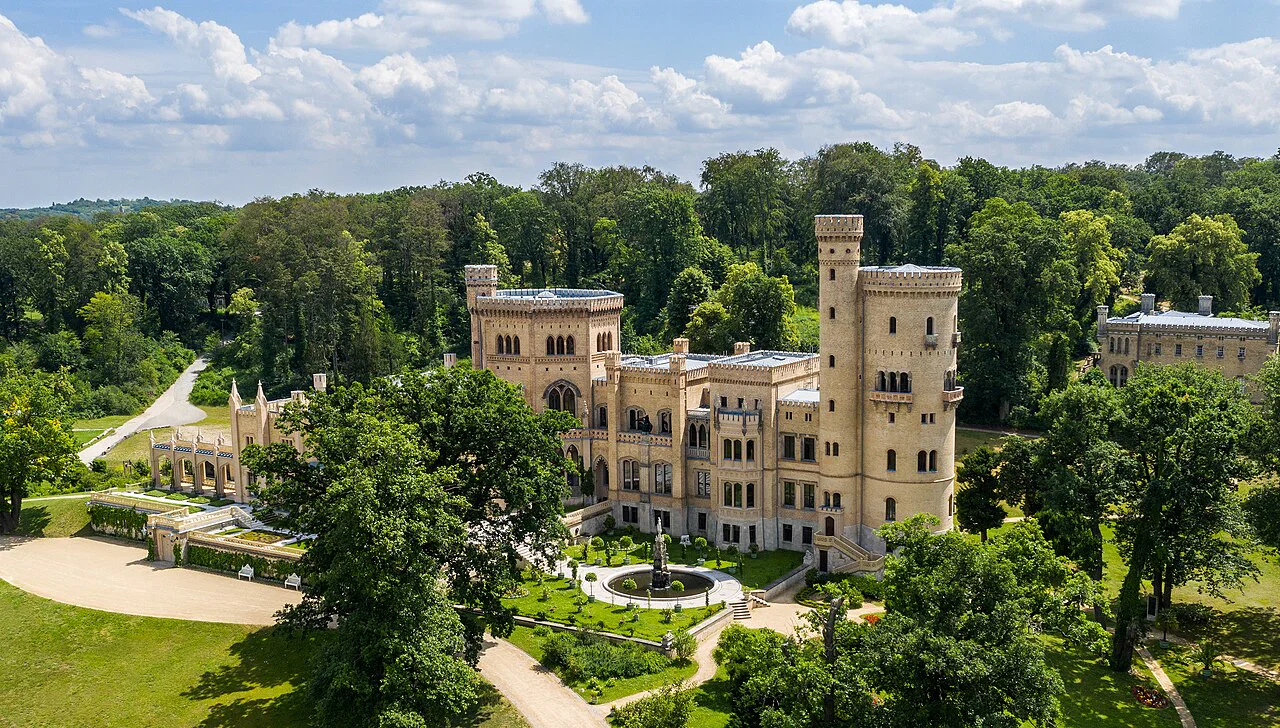
Schloss Babelsberg
Content & sources
Quelle: Raimond Spekking & Superbass / Bildbearbeitung & Retusche von Auge=mit · CC BY-SA 4.0
Berlin · 23 km
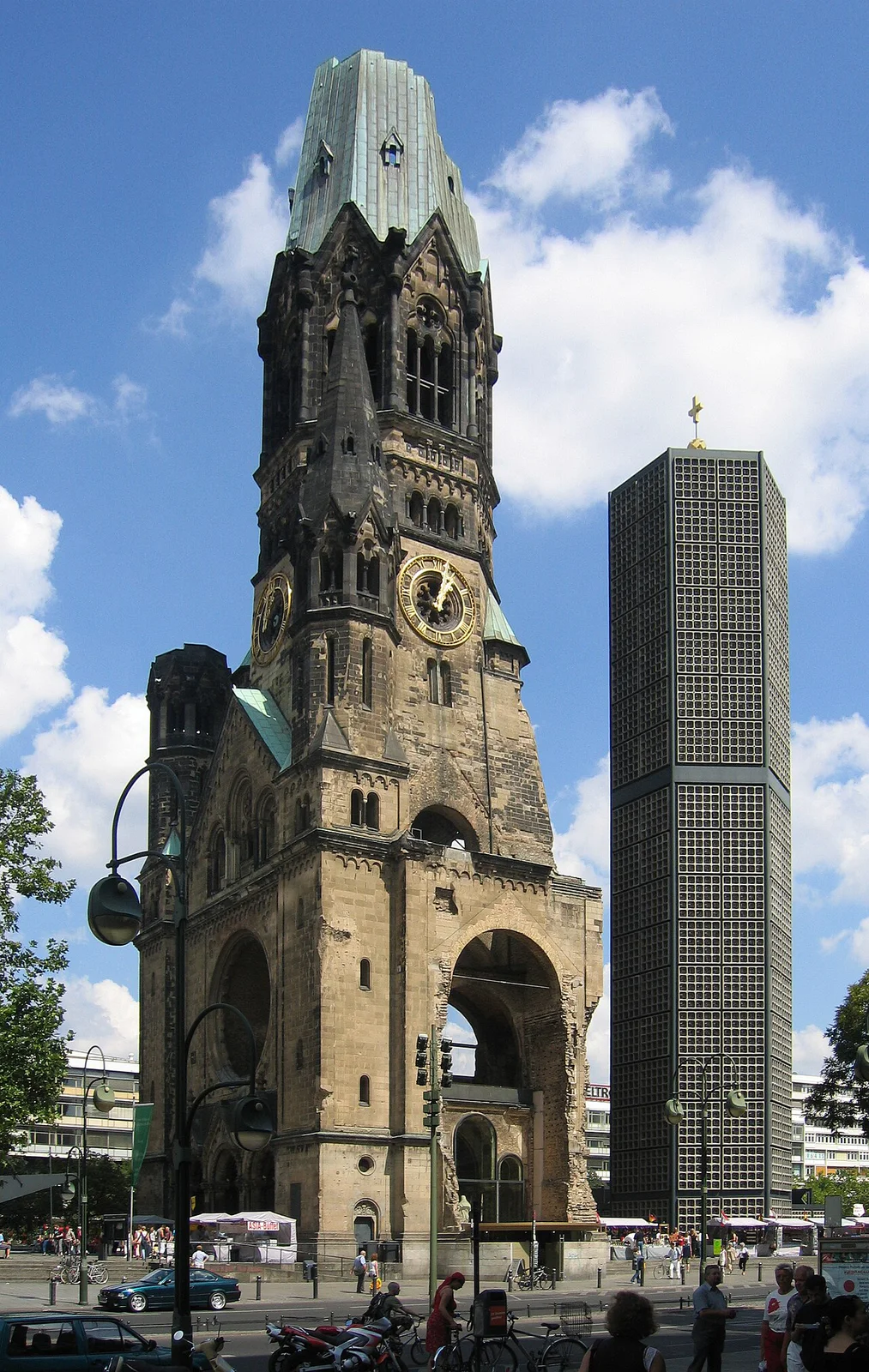
Kaiser-Wilhelm-Gedächtniskirche
Content & sources
nl:User:GerardM · CC BY-SA 3.0
Berlin · 25 km
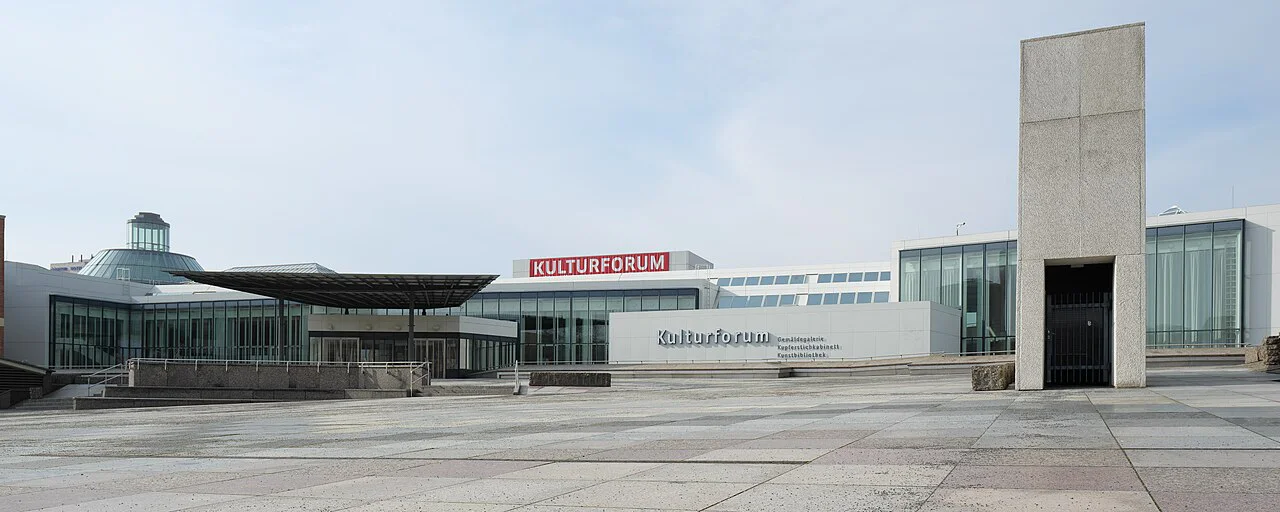
Gemäldegalerie, Berlin
Content & sources
Photo: Membeth · CC0