 Stanza / Audio guide
Stanza · Audio guide
Schloss Babelsberg Audio Guide
A place to remember. A story to take with you.
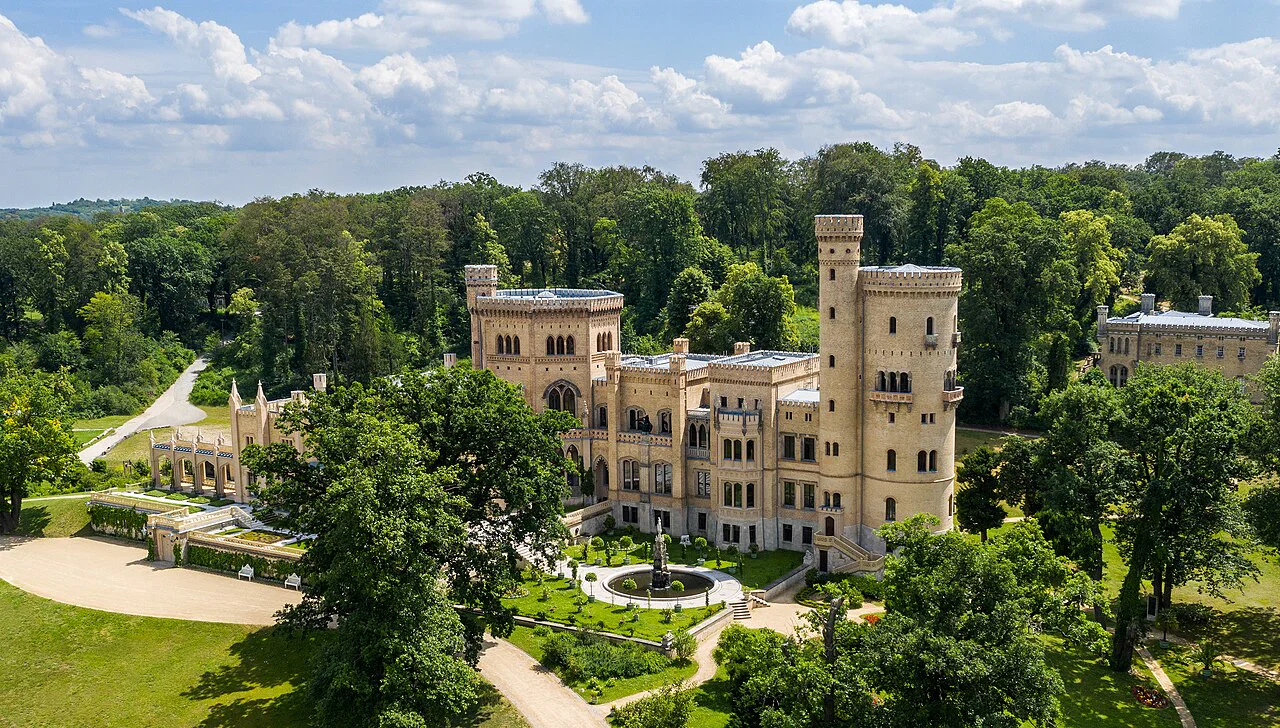
Babelsberg Palace is a palace located in Potsdam, Germany. It served as the summer residence of Prince William and his wife Augusta for over 50 years and is part of a UNESCO World Heritage site.
Download Stanza, then search for “Schloss Babelsberg”.
About the tour
One guide. Your kind of visit.
Babelsberg Palace is a palace located in Potsdam, Germany. It served as the summer residence of Prince William and his wife Augusta for over 50 years and is part of a UNESCO World Heritage site.
Ready when you are.
- 01Get the free Stanza app.
iOS & Android
- 02Find your guide.
“Schloss Babelsberg”
- 03Download before you go.
Works offline
Audio guide / 15 narrated stops
Inside the guide
Get to know a few of the stories before you go. Open a stop to read more.
01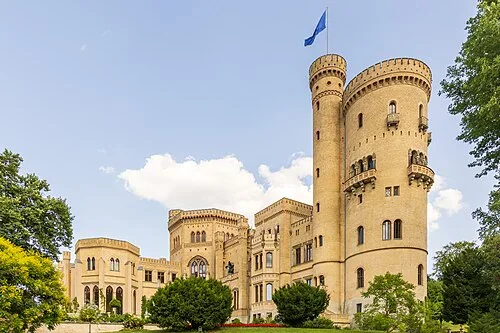 The Palace Facade and Tudor Silhouette
Schloss Babelsberg: A Gothic Revival Summer Palace
Welcome to Schloss Babelsberg, a summer palace on a hill above the Havel near Potsdam. This tour follows the house and its terraces, from the first stone to the Cold War border that later ran along this water. The palace was built for Prince Wilhelm of Prussia and his wife Augusta, the couple who would become German emperor and empress. They spent more than fifty summers here. The building went up in two phases, from 1833 to 1849. Karl Friedrich Schinkel led the design until his death in 1841. Ludwig Persius and Johann Heinrich Strack carried the work on. What they built looks unlike any other German royal house: towers of uneven heights, bay windows, crenellated battlements, an outline that refuses to sit straight. That irregular silhouette may come straight from a pattern book. The landscape gardener Humphry Repton printed an ideal design titled 'A design to exemplify irregularity of outline in castle Gothic', and researchers think the builders took their cue from that very sheet. Since 1990 the palace and the Potsdam parkland have belonged to the UNESCO World Heritage list, honoured for the unity of architecture and landscape.
Photo: Matthias Süßen · CC BY-SA 4.0
02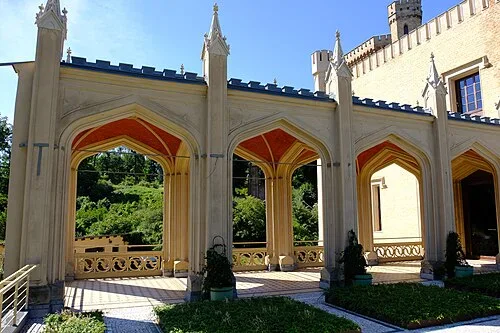 The Pergola and Blue Terrace
The Pergola: Augusta's English Dream
Princess Augusta wanted this to be an English house. She favoured the English Gothic style and pushed for the palace to follow Windsor Castle, residence of the British kings. An English-style palace and landscape garden, in her eyes, would declare her sympathy for liberal-ruled Britain. She went further than taste. Augusta submitted her own design for a cottage, drawn so closely from a plate in Robert Lugar's book on architectural sketches that only small changes tell the two apart: she flattened one gable, added a flagpole and a staircase down to a terrace. Then she handed her drawings to the architect Persius to rework. So the summer residence of a future German emperor began as a princess's pencil sketch after an English model. The Gothic arcade of the Pergola belongs to that first building phase, under Schinkel. Its roof was made to be walked on, and from up there Wilhelm fed the deer and pheasants of a small menagerie that stretched along the south-east side of the palace.
Photo: Haplochromis · CC BY-SA 4.0
03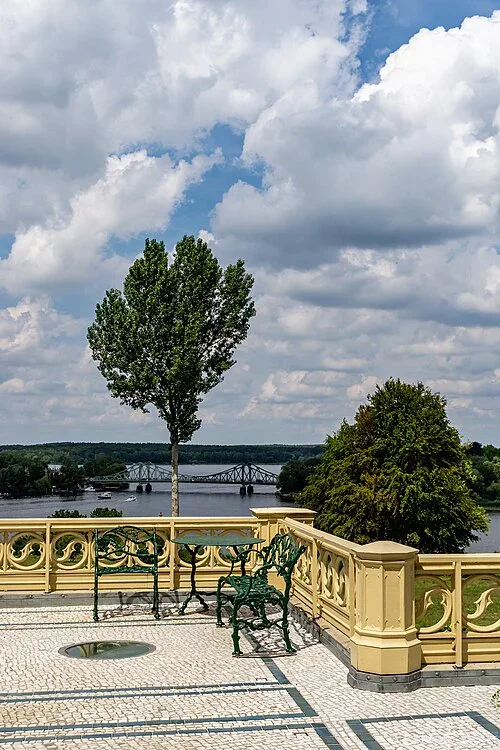 The Pergola and Blue Terrace
The Blue Terrace and the Havel View
The Blue Terrace was built around a view. From its cobblestones and cast-iron railing, the Havel opens into its chain of lakes, and the palace was arranged to make the most of exactly this sight. In 1826 the royal garden director Peter Joseph Lenné pointed Prince Wilhelm to this sandy hill, across the water from his brother's palace at Glienicke. The site was chosen half-way up the slope so that the panorama would run a full half-circle over the Potsdam lake landscape. House and terraces were meant as one composition, an outdoor room where the rooms inside flow into the scenery. The brickwork took hard wear over the decades, blackened by polluted air. Between 2013 and 2016 the foundation restored the facade and the terraces with funding of nearly ten million euros from the federal government and the states. Ordinary cleaning failed, but laser beams vaporised the dirt from the brick surface and gave the walls an even colour again. Since 2019 the interiors have been under restoration, to be prepared for visitors as a museum.
Listen in the appPhoto: Rainer Halama · CC BY-SA 4.0
04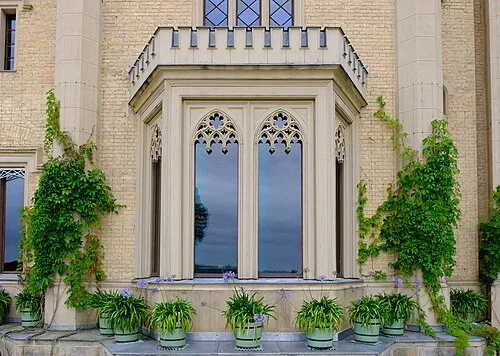 Empress Augusta's Suite and Library
Augusta's Study Bay Window
The pointed tracery of this bay window belongs to Augusta's study, in the wing that held her rooms and Wilhelm's from the very first building phase. The English Gothic language the princess had asked for ran straight into her private apartments. In the summer of 1858 the wing received the most famous guests the palace ever hosted. Queen Victoria of Britain came with her husband, Prince Albert, to visit their daughter, also named Victoria, who had married the Prussian crown prince. The young couple had actually been assigned the New Palace in Potsdam, but renovations there were still running, so Babelsberg stepped in. The palace owned no furniture fit for a reigning queen, so chairs and sofas had to be fetched from other residences. Mother and daughter stayed a fortnight, took boat trips on the Havel and visited the sights of the area. Both women sketched the view from the terraces, and those drawings survive in the Royal Collection, one dated the twenty-fourth of August 1858.
Listen in the appHaplochromis · CC BY-SA 4.0
05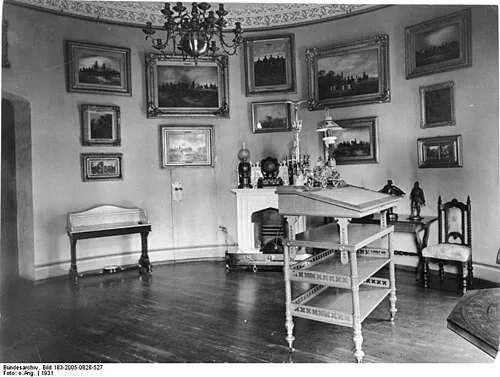 Emperor Wilhelm I's Private Study
The Emperor's Study: A Collector's Cabinet
Upstairs, between his bedroom and his wife's apartments, King Wilhelm kept a study that said more about him than any throne room. He became King of Prussia in 1861. He was sixty-three, and he never ordered himself grander rooms, keeping Babelsberg and the Old Palace in Berlin as his chief residences. For the study floor he had the old parquet of his Berlin winter residence, then under renovation, brought here and reused. Samuel Wittwer, a director of the Prussian palaces, described the room as the cabinet of a collector. Portraits of the Hohenzollerns hung on the walls, and keepsakes crowded the desk. Among them stood a marble hand, kept, it is thought, in memory of Elisa Radziwiłł, the aristocrat Wilhelm had loved as a young man and been forbidden to marry on dynastic grounds. A watercolour of her, painted in 1835, was fitted with a lid, so the story goes, that he could close against visitors' eyes. Then, in September 1862, this private retreat turned political. King and parliament were locked in conflict over the army, and the war minister, Albrecht von Roon, pressed Wilhelm after a church service to receive Otto von Bismarck. The meeting took place the next afternoon, in the palace and its park, and it ended with Bismarck's appointment as Minister President of Prussia.
Listen in the appUnknown author · CC BY-SA 3.0 de
06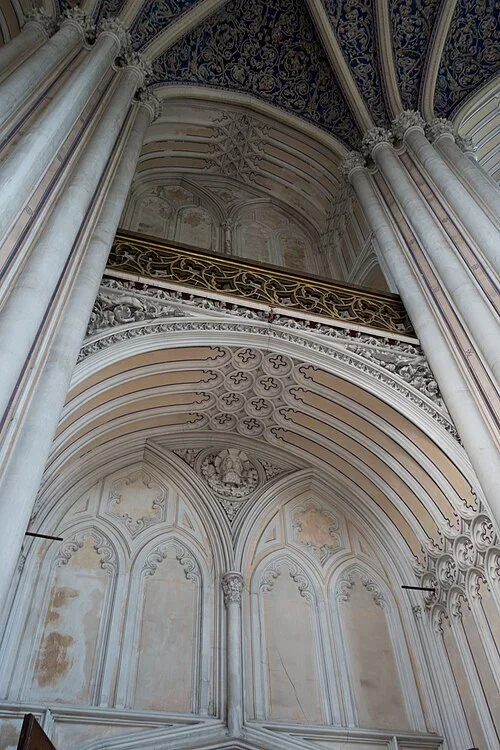 The Grand Tanzsaal (Dance Hall)
The Tanzsaal: Ceremonial Heart of the Palace
The painted ribs of this vault belong to the Tanzsaal, the ceremonial hall at the heart of the palace. When building resumed in 1844, the architect Ludwig Persius was already a dying man. He died in July 1845 with only the foundations of the extension standing, yet the west wing rose largely to his design. It added rooms for the two royal children, Friedrich Wilhelm and Luise, and a dining hall reaching through two storeys. The Tanzsaal itself fills the second octagonal tower and rises through both floors; a gallery circles the upper level, its shape borrowed from the walkways around cathedral choirs. Strack painted the vault after medieval manuscripts, with little putti making music among the leaves, a fitting decoration for a fest hall. Its great moment came on 2 June 1880, when the future Emperor Wilhelm II and Auguste Viktoria of Holstein celebrated their betrothal here. Politics had shadowed the match, because her father had raised claims to the duchies Prussia had annexed; only his death in January 1880 eased the quarrel. Count von Schleinitz spoke the formal words of betrothal beneath this vaulting, and the company went on to a banquet in the dining hall.
Listen in the appThomas Quine · CC BY 2.0
07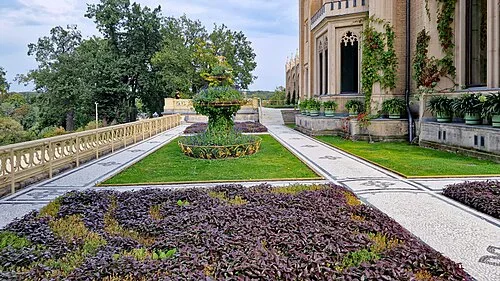 The Golden Terrace and Flower Fountain
The Golden Terrace
Gold gives this terrace its name. The edgings around the flower and lawn beds here were covered with gilding, a flourish unusual even among royal gardens. The Golden Terrace lies west of the Blue Terrace, in front of the eastern range that Schinkel built. A cast-iron balustrade with fish-bladder ornament encloses it, and the ground around the beds is paved in marble. Terraces like this worked as stage sets for a residence: the garden arranged as carefully as any room in the palace, so that a summer's day at court unfolded against flowers, gilded edges and a view of the water.
Listen in the appPhoto: Rigorius · CC BY-SA 4.0
08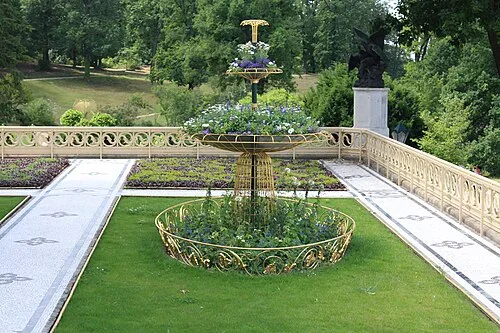 The Golden Terrace and Flower Fountain
Pueckler's Flower Fountain
The curiosity of the Golden Terrace is a fountain made of flowers. Prince Hermann von Pückler-Muskau, the garden artist who took over the park from Lenné, was responsible for the palace terraces. Augusta had known him since her grandfather's court in Weimar, where he served as adjutant. Pückler disliked the modest grassed slope that had surrounded the palace, and by 1844 he had four great terraces laid out instead, held by walls and dressed with flowers and sculpture. His invention here is the so-called Blumenvontaine, the flower fountain. Its frame is built partly of gold wire and planted with blue blooms, arranged so that the flowers seem to pour downward like jets of water into a basin. A fountain of blossoms instead of water, exactly the sort of conceit the Romantic garden loved.
Listen in the appDCB, Wikimedia Commons · CC BY-SA 4.0
09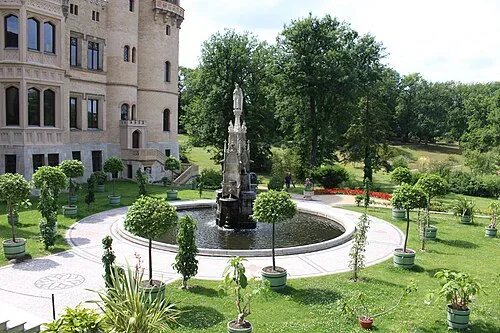 The Porcelain Terrace and Cologne Cathedral Fountain
The Porcelain Terrace
One step down from the Golden Terrace lies the Porcelain Terrace, a metre lower and named for what once stood on it: sculptures and seats made of porcelain. The terraces of Babelsberg descend towards the water in a deliberate hierarchy, each with its own character and its own fountain. Augusta herself was delighted with the house in its early years. Writing to her former governess in 1837, she said: 'The Babelsberg has become very pretty, the little castle is quite small but nicely and comfortably arranged, and the view is really beautiful.' The fountain at its centre is the subject of the next stop.
Listen in the appDCB, Wikimedia Commons · CC BY-SA 4.0
10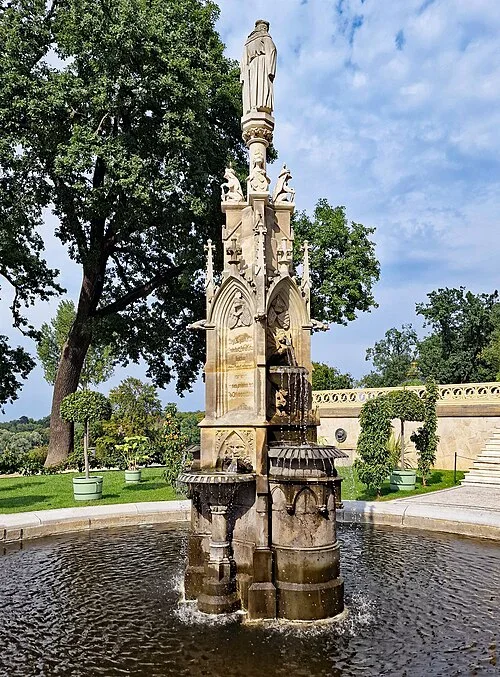 The Porcelain Terrace and Cologne Cathedral Fountain
The Cologne Cathedral Fountain
The Gothic pinnacles of this fountain began their life as a gift from far away. The cathedral workshop of Cologne presented it to King Wilhelm in 1863, in thanks for his contribution to the funding of the cathedral's completion. The interior of the cathedral was finished by then, but money still had to be raised for the west facade with its two great towers. The gift is called the Städtebrunnen, the cities' fountain, or the Gerhardsbrunnen after Master Gerhard, the first master builder of the cathedral, whose figure crowns the top. Its stones come partly from the cathedral's original wall fabric and partly from material never used for the building itself. The presentation was designed with a purpose: to draw the king to Cologne. It worked. On 10 May 1864 Wilhelm appeared on the Neumarkt in Cologne, and after a parade the fountain was ceremonially handed over.
Listen in the appPhoto: Rigorius · CC BY-SA 4.0
- 11
The Eagle and Vulture Sculpture
A signed French bronze of eagle against vulture over a chamois, made to startle strollers into conversation.
- 12
The Voltaire Terrace
A terrace named for Voltaire's lime trees, with a marble fountain that spells out a royal wedding day and its silver jubilee.
- 13
The Michael Monument
The Archangel Michael overcoming a dragon that stands for the revolution of 1848, set up by the king whose brother crushed it.
- 14
The Palace Kitchen and the Secret Tunnel
The palace kitchen stood outside on purpose, and dinner reached the dining hall through a tunnel under the lawn.
- 15
Across the Havel: The Palace in a Divided World
From across the Havel: the emperor's recovery, the Socialist Law signed here, film students in the imperial flats, and the border at the water's edge.
Schloss Babelsberg
Frequently asked questions
How much does the guide cost?
Free app download. Listed guide price: $1.99. Guide price shown in the app. Audio guide only. Venue admission is separate.
Can I listen without internet?
Yes. Download the guide’s audio, images, and maps in the app before your visit. Your downloaded content is then available offline.
Can I listen in my language?
This audio guide is available in 15 languages, including English.
Do I need to follow a schedule?
No. This is a self-guided experience. Choose your stops, pause whenever you like, and return to a story at your own pace.
At your own pace
Explore Schloss Babelsberg.
Download Stanza, then search for “Schloss Babelsberg”.
Free app download · Guide price shown in the app
Keep exploring
Nearby audio guides
Potsdam · 4 km
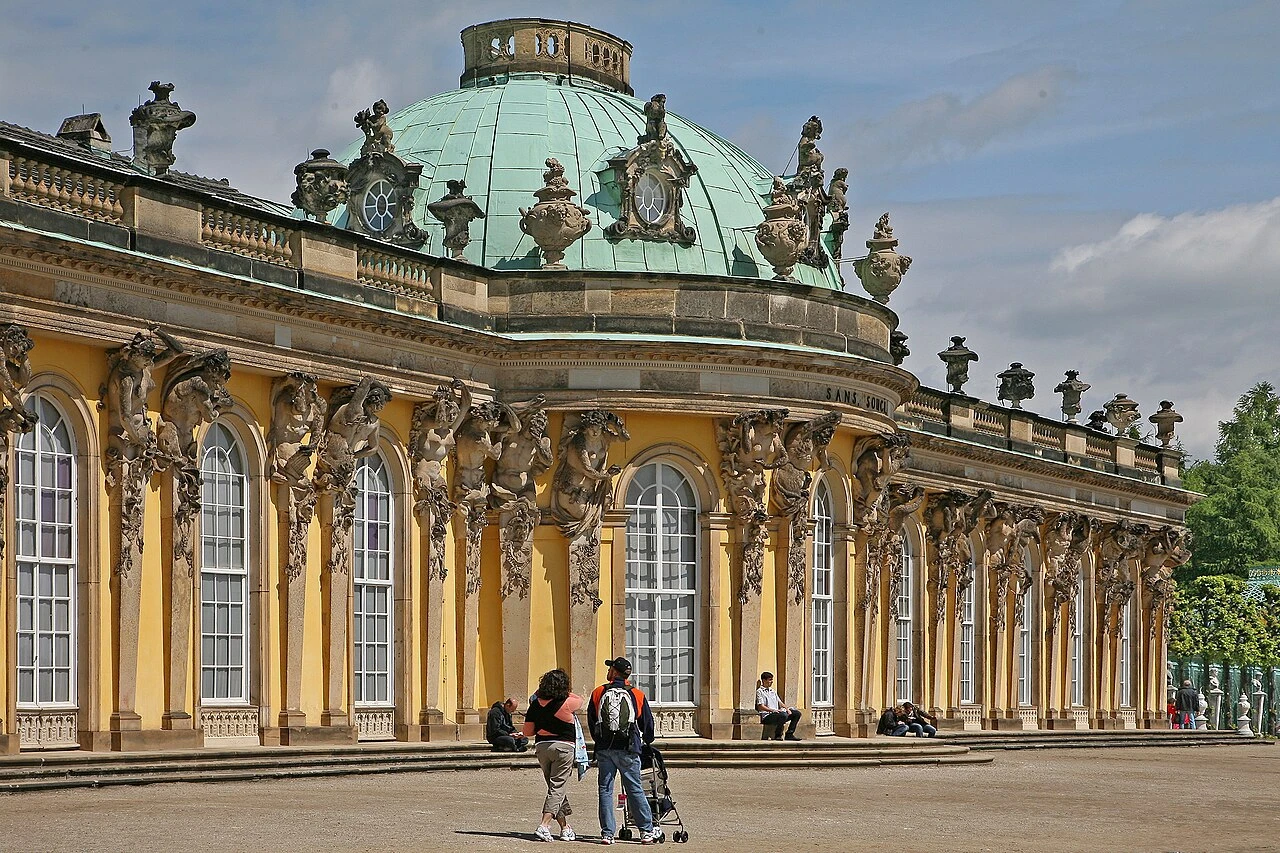
Sanssouci Palace
Content & sources
Photo: W. Bulach · CC BY-SA 4.0
Potsdam · 4 km
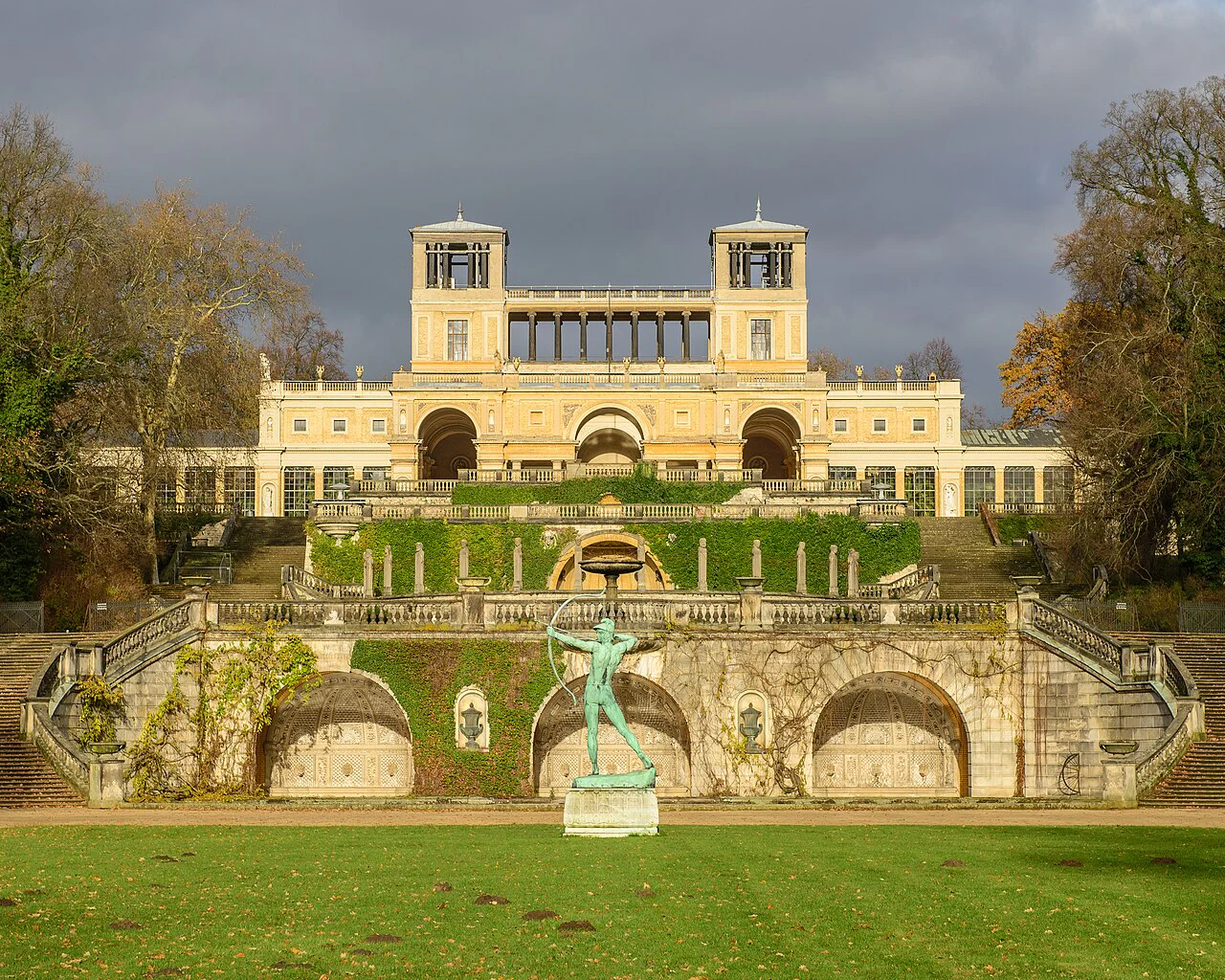
Orangerieschloss
Content & sources
Arild Vågen · CC BY-SA 3.0
Berlin · 20 km
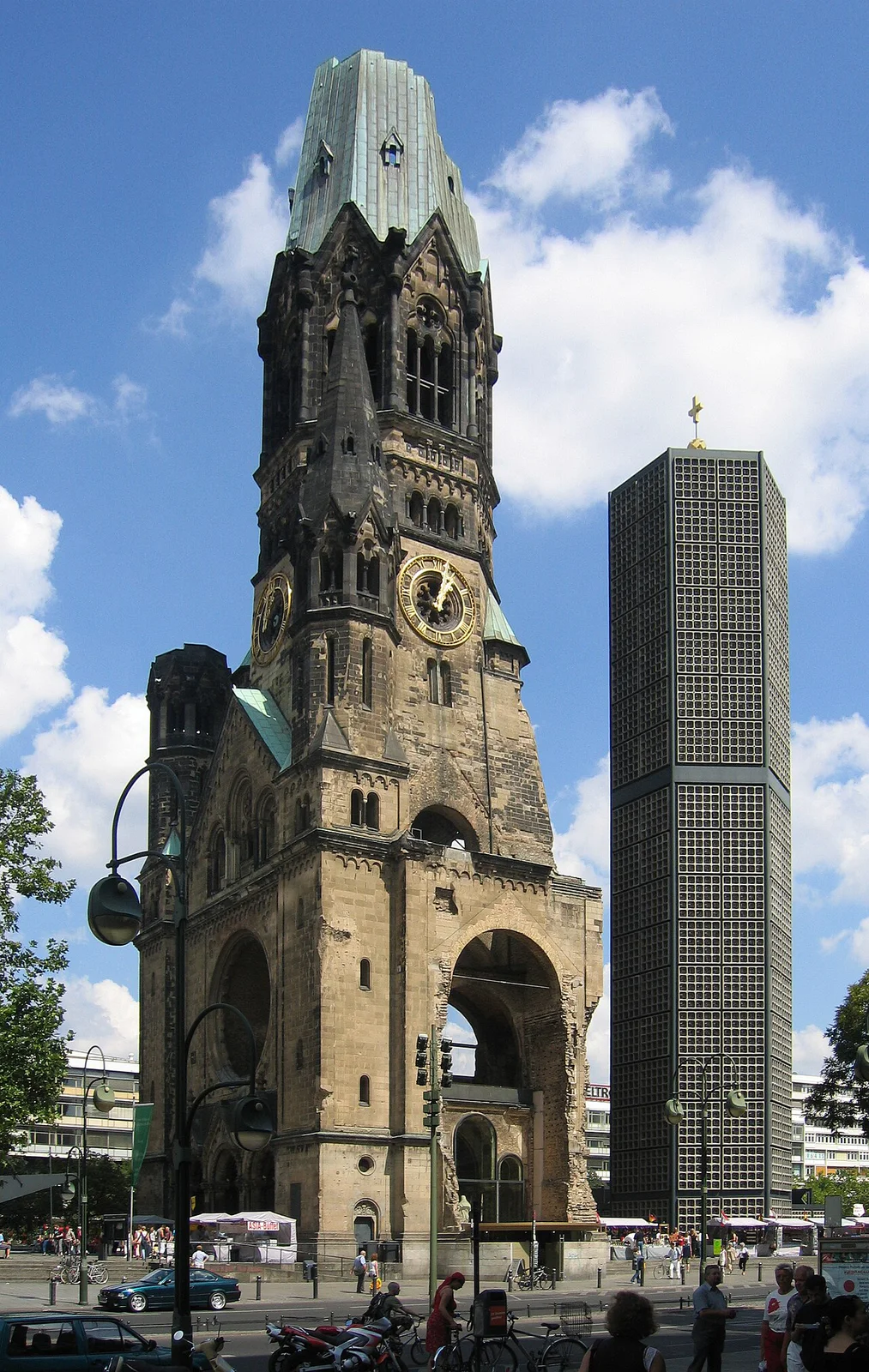
Kaiser-Wilhelm-Gedächtniskirche
Content & sources
nl:User:GerardM · CC BY-SA 3.0
Berlin · 22 km
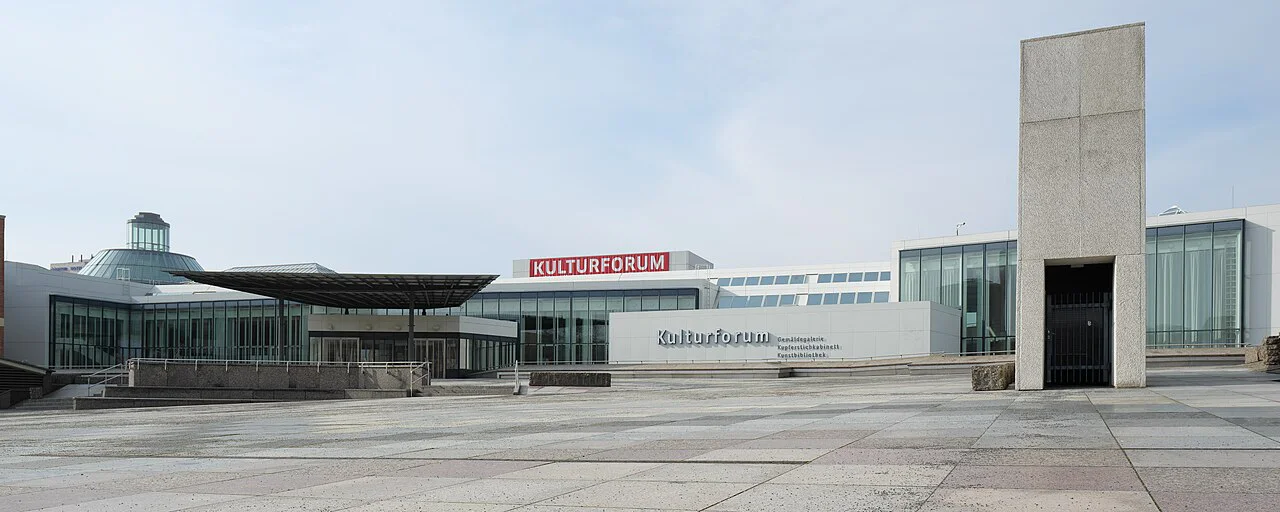
Gemäldegalerie, Berlin
Content & sources
Photo: Membeth · CC0