Stanza · Audio guide
Elmina Castle Audio Guide
A place to remember. A story to take with you.
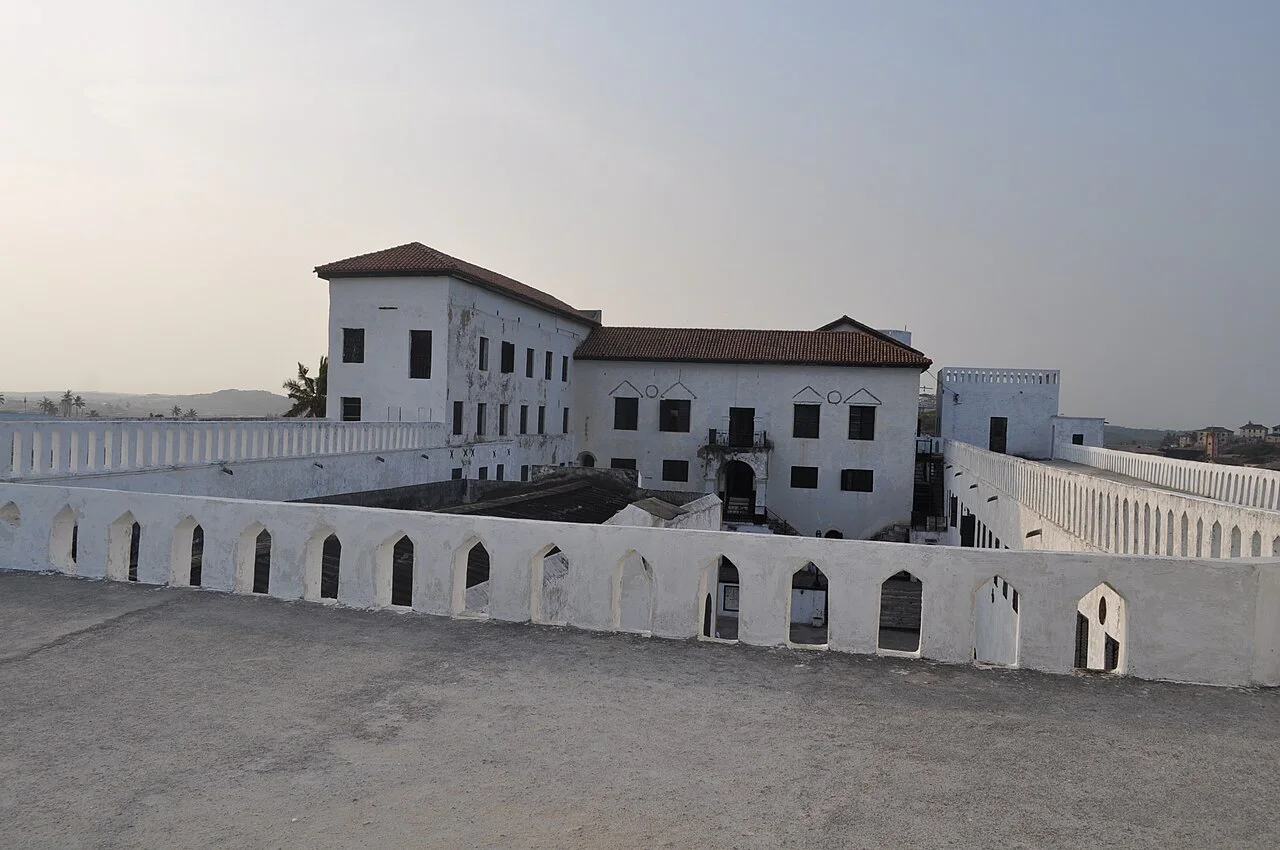
Elmina Castle is a fortified colonial trading post in Ghana that was erected by the Portuguese in 1482. It is the first trading post built on the Gulf of Guinea and the oldest extant European building in…
Download Stanza, then search for “Elmina Castle”.
About the tour
One guide. Your kind of visit.
Elmina Castle is a fortified colonial trading post in Ghana that was erected by the Portuguese in 1482. It is the first trading post built on the Gulf of Guinea and the oldest extant European building in Sub-Saharan Africa.
Ready when you are.
- 01Get the free Stanza app.
iOS & Android
- 02Find your guide.
“Elmina Castle”
- 03Download before you go.
Works offline
Audio guide / 15 narrated stops
Inside the guide
Get to know a few of the stories before you go. Open a stop to read more.
01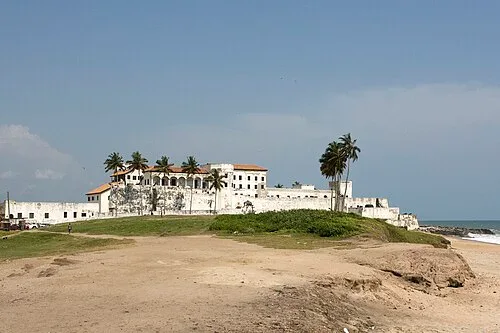 Outer Moat and Main Entrance Gate
Elmina Castle from the Shore
Welcome to Elmina Castle, on the Ghanaian coast. The whitewashed fortress behind the palms is St. George's Castle, raised by the Portuguese in 1482. It is the oldest European building still standing in Sub-Saharan Africa. Portuguese ships first reached this shore in 1471, drawn by rumours of gold and ivory and by the search for a sea route to India. They called this stretch of coast the Gold Coast, and its trade was a royal monopoly. King John the Second decided a fort had to secure it. What he shipped out was a fortress in a box: every foundation stone and roof tile sent pre-cut and pre-fitted, with provisions for six hundred men. The fleet that carried it all numbered ten caravels and two transport ships. The castle that came out of those crates also became a depot in the Atlantic slave trade, and that darker story is the one this tour traces through the courtyard, the dungeons and the door that leads to the sea.
Damien Halleux Radermecker · CC BY-SA 2.0
02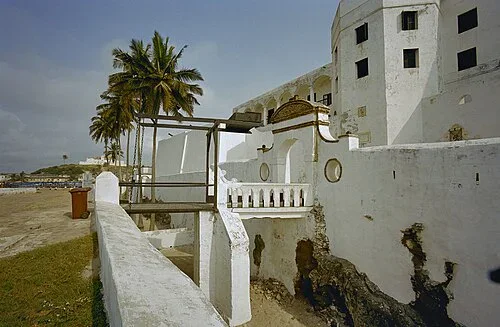 Outer Moat and Main Entrance Gate
The Drawbridge and Main Entrance
The fleet that carried the stones anchored off Elmina on the nineteenth of January, 1482, under the commander Diogo de Azambuja. Some historians say a young Christopher Columbus sailed with that voyage. Azambuja hired a Portuguese trader who already lived here to arrange a meeting with the local chief, Kwamin Ansah. The two sides held a great peace ritual, with a feast and musicians, Portuguese and villagers together. Azambuja promised the chief protection from the powerful king of Portugal. Kwamin Ansah received him as he had received any trader before, but he was wary of a permanent settlement. Gifts were meant to smooth the way: brass basins, shawls and other presents for the chief and the villagers. To build on the most defensible point of the peninsula, the Portuguese tore down village homes, and they began to quarry a rock the people of Elmina held sacred, the home of the god of the river Benya. The man who carried the gifts, João Bernaldes, delivered them only after construction had begun, when the villagers had already seen their shrine cut into without warning or payment. The castle and the town lived on side by side, uneasily.
Loek Tangel · CC BY-SA 4.0
03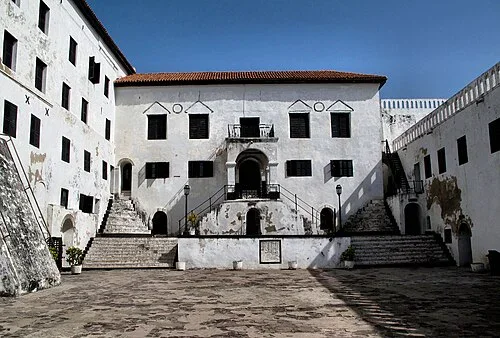 Central Courtyard and Historic Church
The Central Courtyard
The Portuguese laid out this yard as the heart of a gold factory. Trade in gold was the crown's monopoly, enforced with force and alliances: any people who traded with another nation risked attack, often through Portuguese pacts with that nation's enemies. At the height of the trade in the early sixteenth century, about twenty-four thousand ounces of gold left the Gold Coast every year, a tenth of the world's supply. Slave-taking was another matter. The Portuguese authorities decided from the outset that St. George would not raid for captives itself, fearing the wars this would bring to the gold routes of the interior. Instead the castle served as a transshipment point, trading captives onward with states on the Slave Coast and with São Tomé. By the seventeenth century the balance had tipped. Most trade in West Africa concentrated on the sale of captives, and the castle became a depot where enslaved people were brought in and held. The rest of the tour traces what that change meant inside these walls.
Listen in the appFrancisco Anzola · CC BY 2.0
04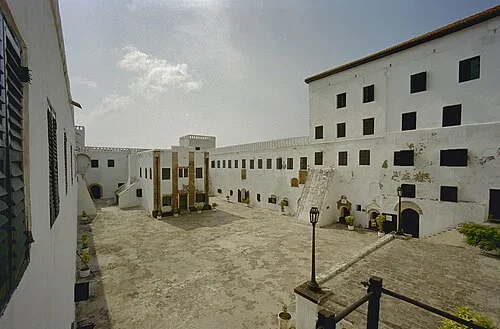 Central Courtyard and Historic Church
The Portuguese Chapel, Later Dutch Auction Hall
Against the edge of the courtyard stands the small building that began life as a Portuguese chapel, a place of Catholic worship inside a fortress. Under Dutch rule the same room was put to different work: it became an auction hall, where enslaved people were sold. Worship and commerce in human beings succeeded one another within the same walls, under the same roof. Few rooms in the castle tell its changing uses so plainly.
Listen in the appLoek Tangel · CC BY-SA 4.0
05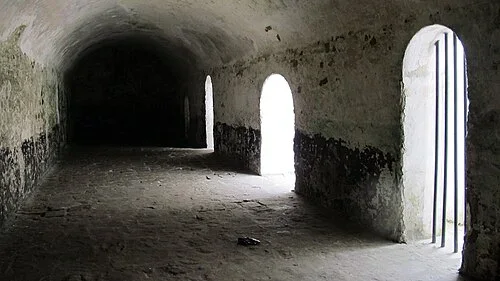 Male Slave Dungeons
The Male Slave Dungeons
The vaulted cells of the men's dungeons sit within the castle's thick walls. Ceilings of heavy stone arches, floors of bare stone. Light and air enter only through a few small openings, some of them barred with iron. Men captured in the interior were held here while they waited for the slave ships. The conditions were overcrowded and unsanitary, and the wait could stretch to weeks. Confinement in the dark, awaiting the sea, was the governing idea of the room.
Listen in the appPhoto: Kurt Dundy · CC BY-SA 3.0
06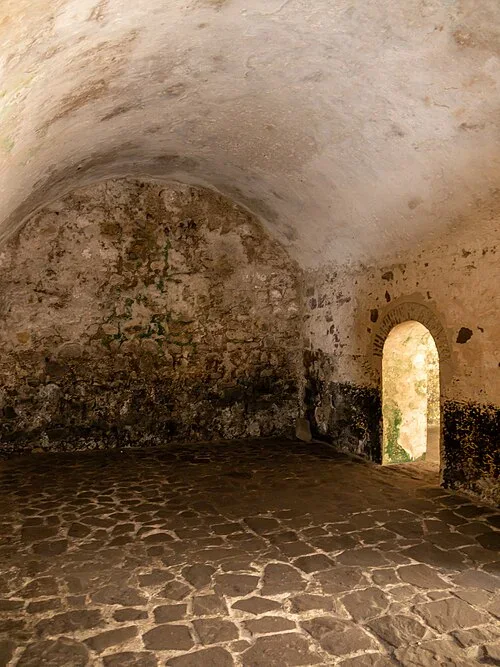 Male Slave Dungeons
Inside the Dungeon Vaults
These vaults were the receiving end of a trade network that stretched far inland. Enslaved people were brought to Elmina from different West African kingdoms, often captured in the interior by slave-catchers from the coastal peoples. Along the Gold Coast alone, more than twenty independent kingdom-states existed, and Elmina itself lay between two Fante kingdoms, Fetu and Eguafo. The captives were sold to the Portuguese, and later to the Dutch, in exchange for goods such as textiles and horses. European involvement also reshuffled older networks, disrupting traditional trade routes between coastal peoples and northern peoples by cutting out the African middlemen. Wars, markets and routes hundreds of miles away all funnelled into these stone rooms.
Listen in the appMatti Blume · CC BY-SA 4.0
07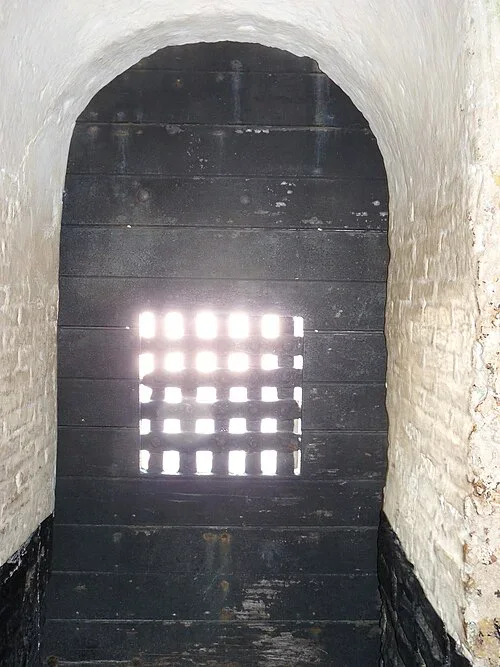 The Door of No Return
The Door of No Return is the narrow, sea-facing portal through which captives passed out of the castle and down to the transport boats. Its heavy timber planks, dark with age, fill the archway, and a small barred grille lets in a little light. The name says what the door meant. Whoever passed through it left Africa for an unknown ocean, with no expectation of return. For the millions of people forced through doors like this one, it was the last threshold between home and exile. That is why the door has become the castle's most powerful symbol.
Listen in the appcotterillmike · CC0
08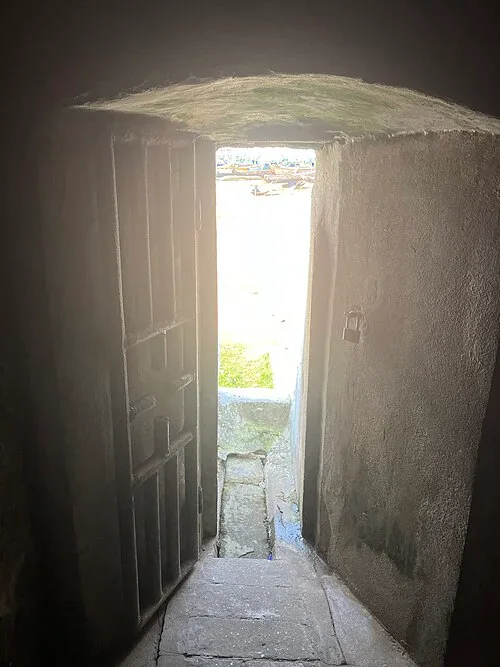 The Door of No Return
Through the Door to the Sea
Through the open doorway the view runs straight to the water. From the black of the dungeons the passage narrows, then opens onto bright daylight and the sea. At the bottom, small boats waited to carry captives out to ships anchored offshore. For each person who made that passage, the light and the waves marked the final step of a journey that had begun far inland.
Listen in the appPhoto: Afus199620 · CC0
09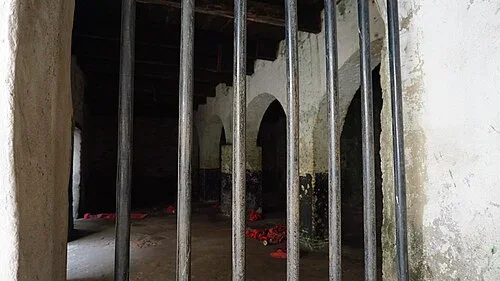 Female Slave Dungeons and Memorial Shrine
The Female Slave Dungeons
Behind iron bars, low arched chambers open off a dark corridor. These were the women's holding cells, and their position tells the castle's brutality plainly: they sit directly beneath the governor's quarters. Women held here faced abuse as well as confinement. Suffering hidden directly beneath colonial comfort was built into the castle itself.
Listen in the appPhoto: Noahalorwu · CC BY-SA 4.0
10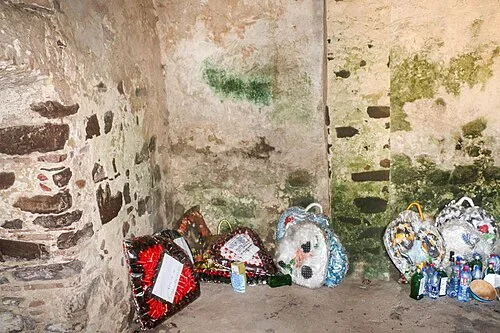 Female Slave Dungeons and Memorial Shrine
Memorials Left in the Dungeon
Against the dungeon wall lie wreaths, bottled water, written messages and other offerings, left by the people who come here. Elmina is a place of pilgrimage, especially for African Americans seeking to connect with their heritage. The tributes are grief and remembrance made visible, left in the dungeons where captives were held.
Listen in the appPhoto: Esthee2010 · CC BY-SA 4.0
- 11
The Condemned Cell
The solitary cell marked with a skull and crossbones above its arch.
- 12
The Governor's Residence
The governor's grand stair and balcony, stacked above the dungeons.
- 13
The Governor's Ocean-Facing Room
A dim upper room with shutters and glazed doors made for sea light and wind.
- 14
Cannon Battery and the Dutch Seizure
The guns, the Dutch capture of 1637, and the end of their slave trade in 1814.
- 15
The Ramparts: What Elmina Means
From British handover to Ghanaian museum: what Elmina has become.
Elmina Castle
Frequently asked questions
How much does the guide cost?
Free app download. Listed guide price: $1.99. Guide price shown in the app. Audio guide only. Venue admission is separate.
Can I listen without internet?
Yes. Download the guide’s audio, images, and maps in the app before your visit. Your downloaded content is then available offline.
Can I listen in my language?
This audio guide is available in 15 languages, including English.
Do I need to follow a schedule?
No. This is a self-guided experience. Choose your stops, pause whenever you like, and return to a story at your own pace.
At your own pace
Explore Elmina Castle.
Download Stanza, then search for “Elmina Castle”.
Free app download · Guide price shown in the app
Keep exploring
Audio guides — Ghana
Larabanga
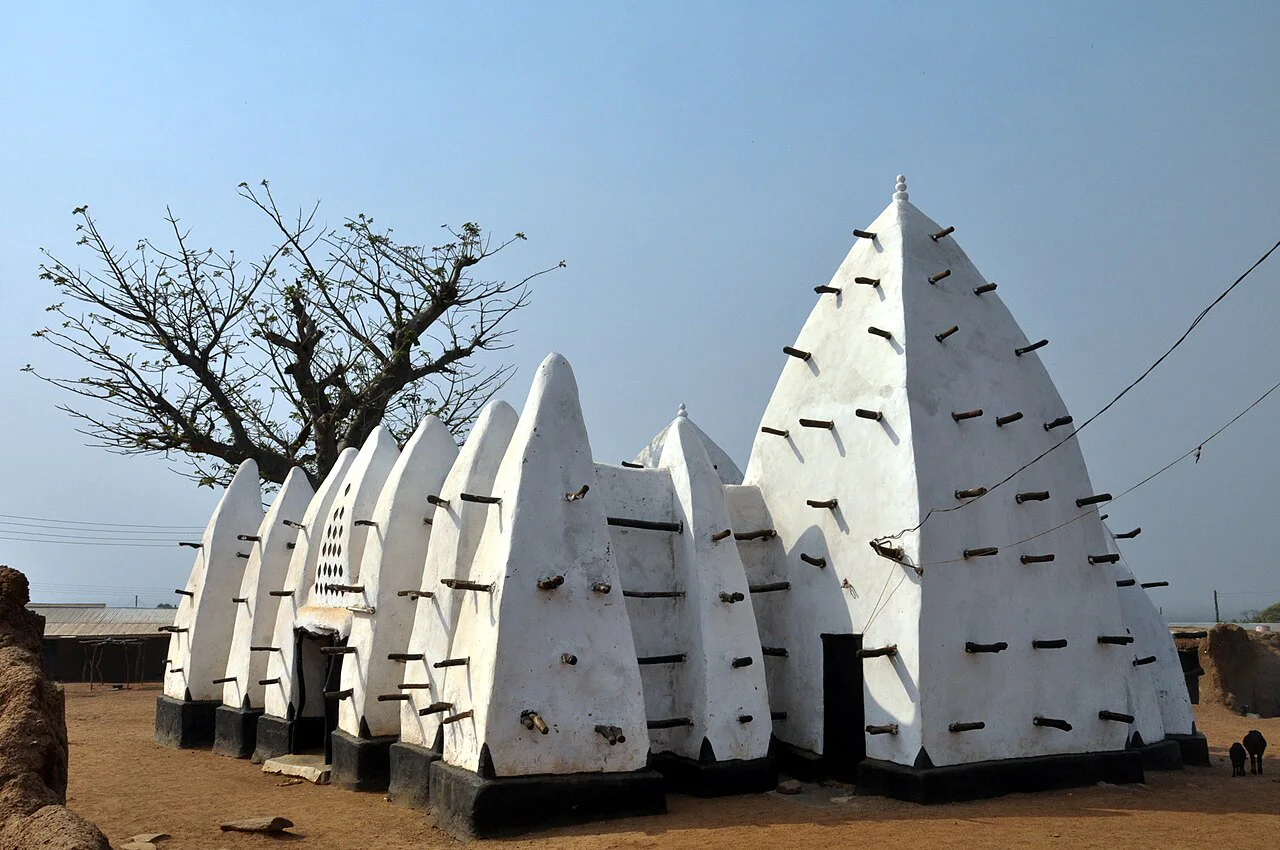
Larabanga Mosque
Content & sources
Sathyan Velumani · CC BY-SA 3.0