Stanza · Audio guide
St. Patrick's CathedralAudio guide
A place to remember. A story to take with you.
St. Patrick's Cathedral is the National Cathedral of the Church of Ireland, located in Dublin. It is an Anglican or Episcopal cathedral, founded in 1191.
Download Stanza, then search for “St. Patrick's Cathedral”.
About the tour
One guide. Your kind of visit.
St. Patrick's Cathedral is the National Cathedral of the Church of Ireland, located in Dublin. It is an Anglican or Episcopal cathedral, founded in 1191.
Ready when you are.
- 01Get the free Stanza app.
iOS & Android
- 02Find your guide.
“St. Patrick's Cathedral”
- 03Download before you go.
Works offline
Audio guide / 18 narrated stops
Inside the guide
Get to know a few of the stories before you go. Open a stop to read more.
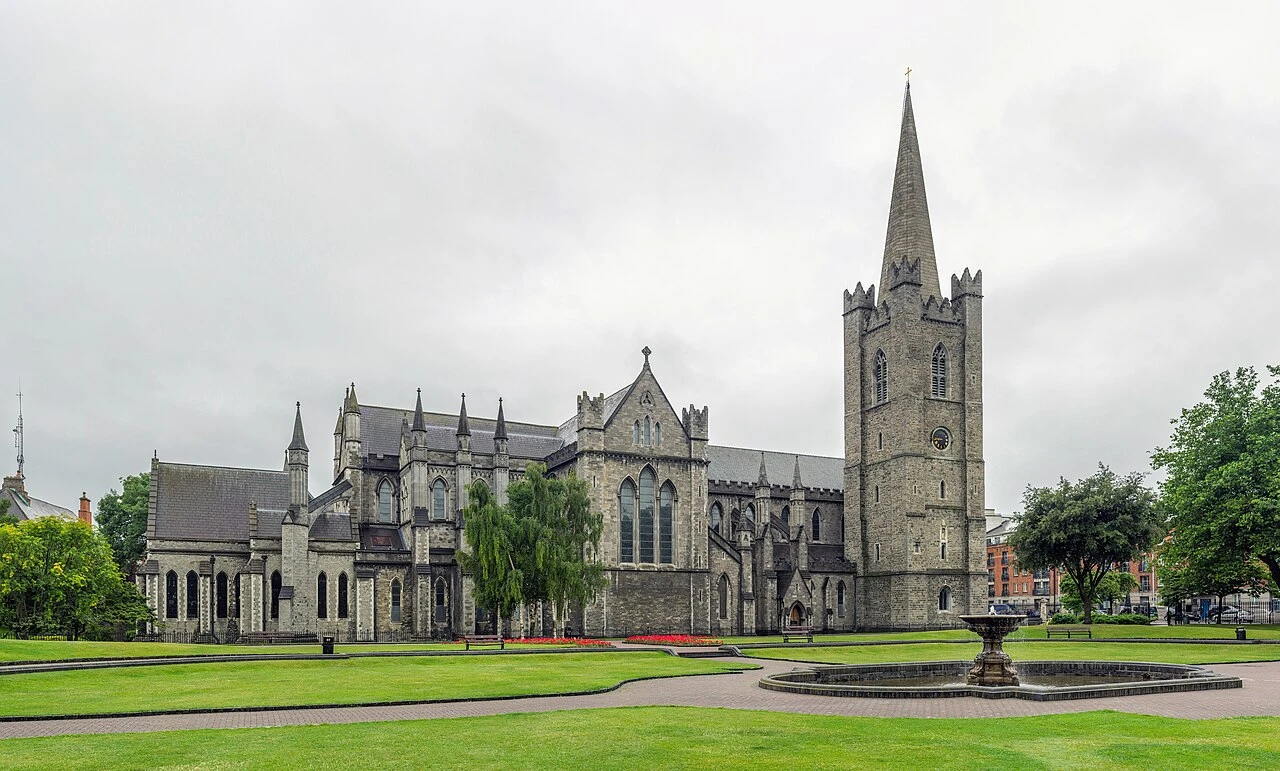
01 St. Patrick's Park and the Holy WellThe Spire and Facade
Welcome to St. Patrick’s Cathedral, the largest church in Ireland and one of the country's most significant historical sites. This location has served as a place of worship for over 800 years. Construction on the stone building you see today began in 1191, and by 1270, the bulk of the original structure was complete. Standing at the base, you can truly appreciate its scale; the spire alone rises to a height of 69 meters. However, the exterior appearance is somewhat misleading regarding its age. In the mid-19th century, the building had fallen into such severe disrepair that a massive restoration project was required. Much of the grey limestone facade and the crisp Gothic details are the result of this Victorian-era work. This restoration effectively saved the cathedral from collapse, blending original medieval elements with 19th-century craftsmanship. Today, it stands as the National Cathedral for the Church of Ireland, representing all twelve dioceses on the island.
Photo: Diliff · CC BY-SA 3.0
02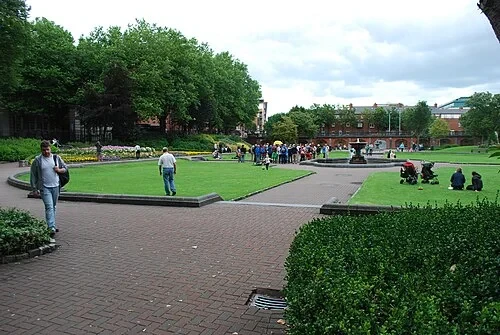 St. Patrick's Park and the Holy WellSt. Patrick's Park
The lush parkland surrounding the cathedral provides a necessary breath of air in the city center, but its history is far from tranquil. In the 19th century, this area was a crowded and impoverished slum. Its transformation into a public park was part of the wider restoration efforts for the cathedral. More importantly, tradition holds that this specific spot is the site of an ancient holy well. Legend says that Saint Patrick himself used the waters from this well to baptize local converts in the 5th century. This religious significance is the primary reason the cathedral was built here, in a location that was originally marshy and situated outside the safety of the medieval city walls. The ground was so soft that the structure required deep foundations to remain stable over the centuries. Today, the park serves as a reminder of the cathedral's deep roots in Irish Christian tradition, predating the stone building by hundreds of years.
Jean Housen · CC BY-SA 3.0
03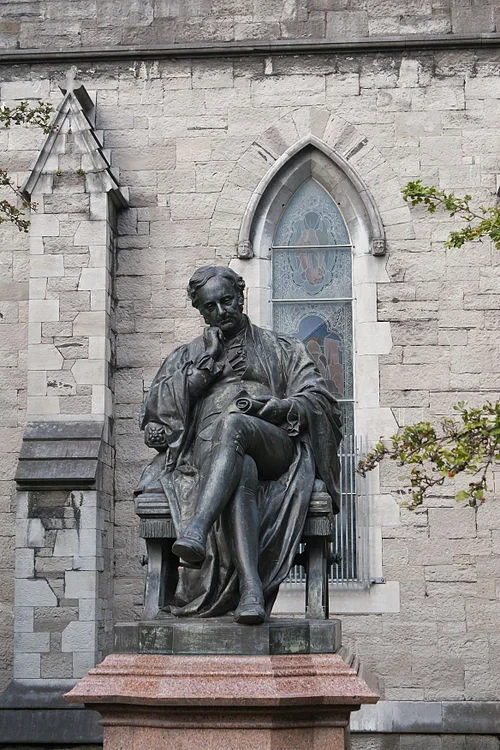 The West Front and Guinness RestorationStatue of Benjamin Lee Guinness
Sitting in quiet contemplation, the figure in this sculpture represents Sir Benjamin Lee Guinness. By the 1860s, St. Patrick’s Cathedral was in a state of near-collapse, with several sections of the roof having already fallen in. The city simply did not have the funds to save it. Sir Benjamin, a member of the famous Guinness brewing family, stepped in and personally funded the entire restoration, which cost roughly 150,000 pounds—an astronomical sum at the time. The sculpture captures him in his later years, dressed in the formal attire of a high-status Victorian gentleman. If you look at the details of the chair and his pose, it suggests a man of both immense wealth and serious civic duty. His intervention was so complete that he even acted as his own contractor for much of the work. Without the personal wealth and dedication of this one businessman, it is highly likely that the cathedral would be a ruin today.
Listen in the appAndreas F. Borchert · CC BY-SA 4.0
04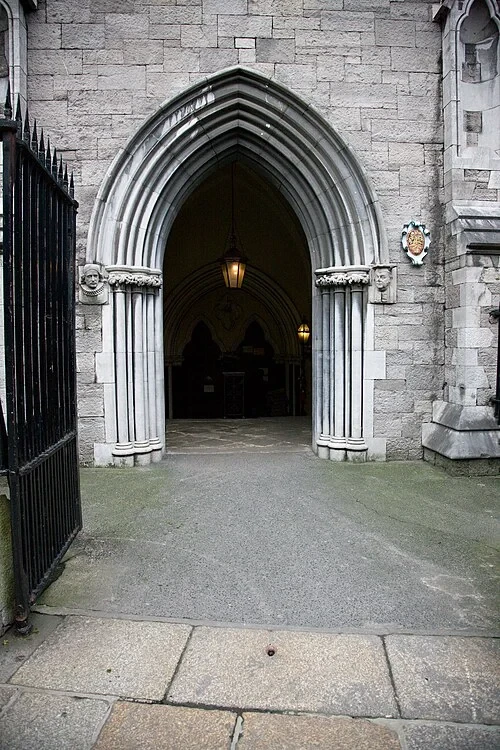 The West Front and Guinness RestorationThe West Portal
The main entrance, or West Portal, showcases the classic Early English Gothic style that defines much of the cathedral’s architecture. As you look at the entrance, notice the series of recessed arches that draw the eye inward toward the doors. This layering of stone was a popular technique in the 13th century to create a sense of depth and grandeur for those entering the sacred space. Crossing this threshold, you enter a space of immense proportions. The internal length of the cathedral stretches 87 meters from the west door all the way to the Lady Chapel at the far end. This makes it the longest church interior in the country. The floor is covered in intricate tiling, much of which was replaced during the 19th-century restoration to match the original medieval patterns. The heavy stone walls and high vaulted ceilings above create a natural acoustics that have been a cornerstone of the cathedral’s musical tradition for centuries.
Listen in the appWilliam Murphy from Dublin, Ireland · CC BY-SA 2.0
05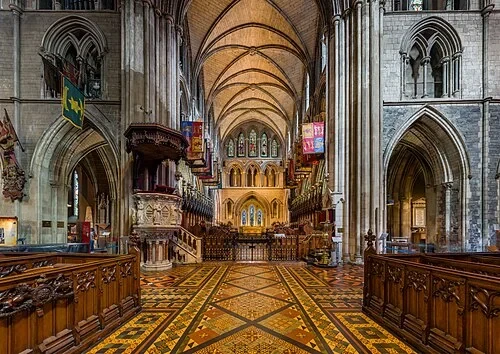 The Great NaveThe Great Nave
Standing in the nave, the scale of the cathedral’s interior is fully realized. This space holds a unique status as the National Cathedral of the Church of Ireland. Because it represents all twelve dioceses across the island, it is a neutral ground that does not have its own resident bishop, unlike most other cathedrals. The history of this floor has not always been one of quiet prayer. In the mid-17th century, during the Cromwellian conquest of Ireland, Oliver Cromwell’s troops occupied the building. To demonstrate their contempt for the established local religion, the soldiers used the nave as a stable for their horses. They even used parts of the wooden interior for firewood. This period of desecration left deep scars on the building's history, which took decades to repair. Today, the nave is a place of assembly for major national events, reflecting its role as a shared site of heritage for the entire island of Ireland.
Listen in the appPhoto: Diliff · CC BY-SA 3.0
06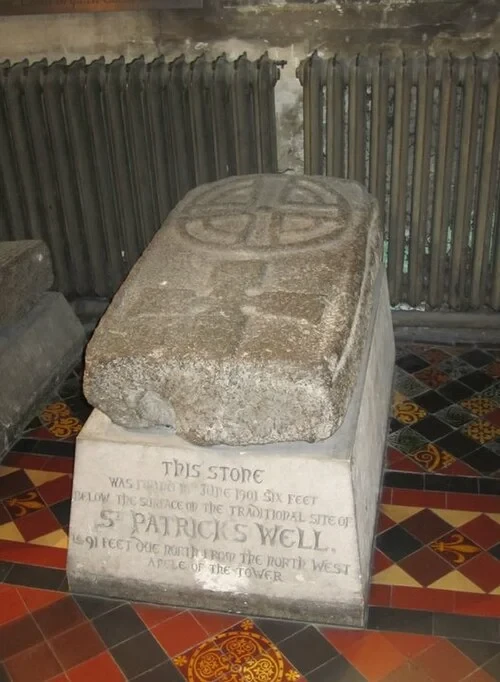 The Baptistry and Medieval RootsThe Ancient Well Marker
This rectangular stone slab serves as a rare physical bridge back to the earliest days of Irish Christianity. In 1901, workers conducting excavations near the North West aisle of the tower discovered this stone buried six feet below the surface. According to the inscription on its base, it was found at the traditional site of St. Patrick’s Well. For centuries, the exact location of the well where Saint Patrick supposedly performed baptisms was known only through oral tradition and legend. Finding this stone provided a tangible connection to that story. The stone itself is weathered from centuries of being underground, but its primary feature remains clear: a simple, carved Celtic cross. It is believed to date from a period long before the current stone cathedral was built, potentially marking a site of worship that existed here when the area was still a marshy island between two branches of the River Poddle.
Listen in the appPhoto: Amockens · CC BY-SA 4.0
07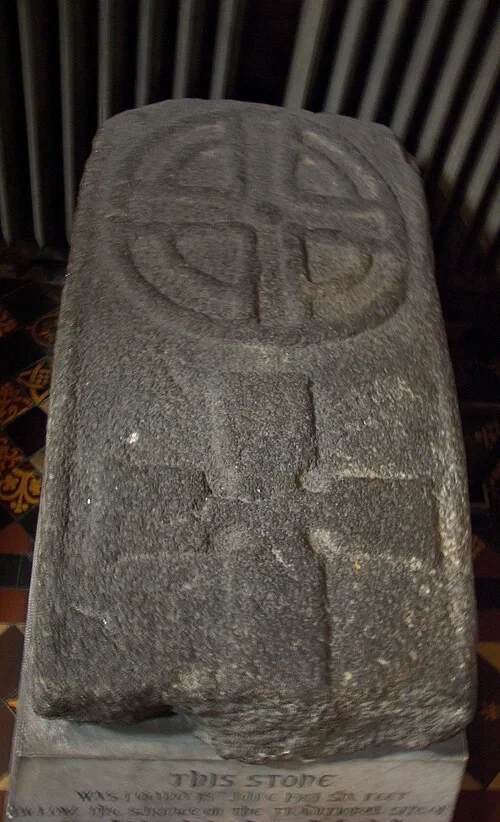 The Baptistry and Medieval RootsCeltic Cross Carving
A closer look at this ancient marker reveals the characteristic shape of an early Irish Celtic cross. The design features a traditional cross shape with a ring encircling the intersection of the arms. This ring is a signature element of early medieval Irish art, though historians still debate its original purpose—some believe it provided structural support for large stone crosses, while others suggest it symbolized the sun or eternity. The surface of the stone is rough and heavily pitted, showing the effects of the damp soil where it lay hidden for hundreds of years. The carving is not deeply ornate, which suggests it may have been a functional marker rather than a purely decorative monument. Its discovery at a depth of six feet indicates how much the ground level around the cathedral has risen since the 5th century. This simple carving remains one of the oldest artifacts found on the site, anchoring the cathedral's history to the early Christian era.
Listen in the appPhoto: Wknight94 · CC BY-SA 3.0
08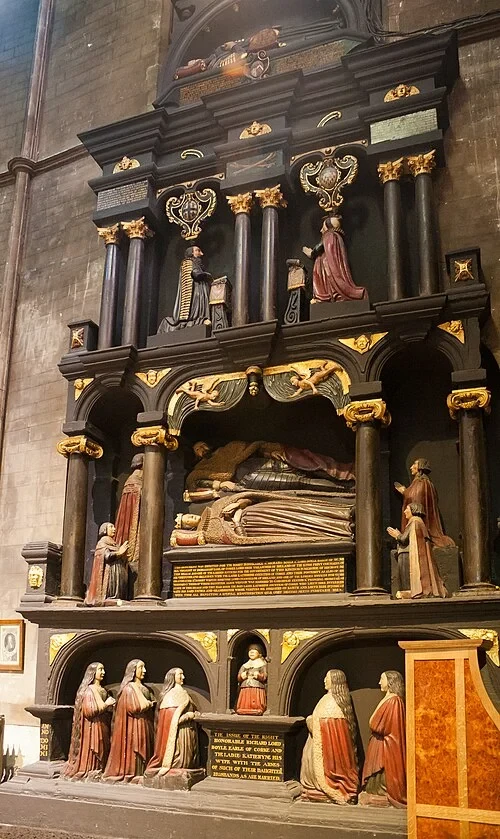 The Boyle MonumentThe Boyle Monument
Commissioned in the 1630s, the Boyle Monument is one of the largest and most intricate funerary structures in Ireland. It was built to honor Richard Boyle, the 1st Earl of Cork, and his family. The monument is organized in tiers, featuring various members of the Boyle family carved in kneeling or reclining positions. It is a striking example of Jacobean era memorial art, using a variety of colored stones to create a vibrant, multi-layered appearance. While the Earl himself is the central figure, the most famous person depicted here is actually the small figure of a child at the very bottom tier. This is Robert Boyle, Richard's youngest son. Robert grew up to become a world-renowned scientist, often called the 'Father of Chemistry.' He is best remembered for his work on the properties of gases, specifically Boyle's Law. Seeing him as a small boy on his father's monument provides a human link to one of the most influential figures in the history of science.
Listen in the appAndreas F. Borchert · CC BY-SA 4.0
09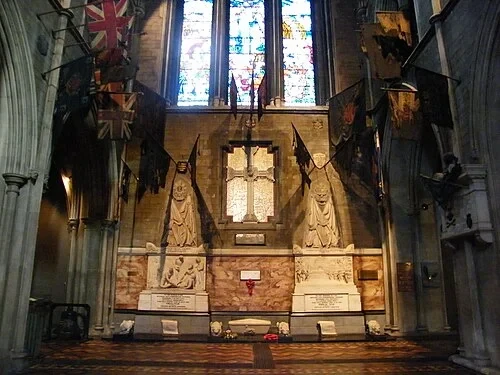 The North Transept and Musical HeritageThe North Transept
The North Transept of the cathedral feels distinctly different from the rest of the building. Often referred to as the 'warrior's corner,' its high walls are lined with the tattered remnants of military banners and regimental colors. These are not merely decorations; they are the retired flags of various Irish regiments of the British Army. By tradition, when a military unit is disbanded or receives new colors, the old ones are 'laid up' in a church for safekeeping. Over time, the silk of these flags becomes incredibly fragile, often appearing as thin, translucent ghosts of their former selves. The atmosphere here is one of somber reflection, serving as a memorial to those who served in conflicts around the globe. Many of these banners saw action in major world events, from the Napoleonic Wars to the World Wars of the 20th century. The cathedral provides a final, peaceful sanctuary for these symbols of national and military history.
Listen in the appPhoto: Pilgab · CC BY-SA 3.0
10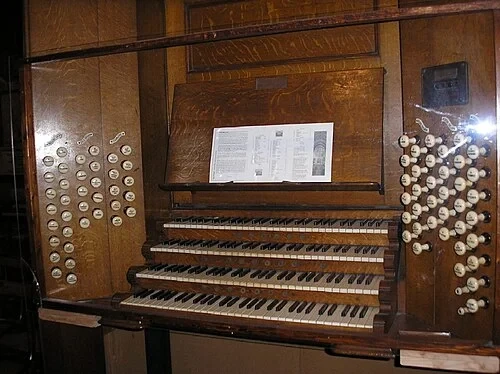 The North Transept and Musical HeritageThe Cathedral Organ
Music has been at the heart of St. Patrick’s Cathedral since the choir was officially founded in 1432. The current organ is a testament to this long-standing tradition. With over 4,000 pipes, it is one of the largest and most complex musical instruments in Ireland. While much of the visible casing dates from the late 19th century, portions of the organ's internal components are much older, having been rebuilt and expanded several times to suit the evolving needs of the cathedral services. The quality of music here has long been internationally recognized. In 1742, when George Frideric Handel arrived in Dublin to premiere his masterpiece, 'Messiah,' he recruited singers from this very choir to perform in the debut. To this day, the cathedral remains the only one in Ireland or the UK to hold two sung services every day. The organ provides the powerful harmonic foundation for these daily performances, filling the vast stone nave with sound.
Listen in the appNo machine-readable author provided. Valdoria~commonswiki assumed (based on copyright claims). · Public domain
St. Patrick's Cathedral
Frequently asked questions
How much does the guide cost?
Free app download. Listed guide price: $0.99. Guide price shown in the app. Audio guide only. Venue admission is separate.
Can I listen without internet?
Yes. Download the guide’s audio, images, and maps in the app before your visit. Your downloaded content is then available offline.
Can I listen in my language?
Stanza supports 15 languages. Check the app for the languages available for this guide.
Do I need to follow a schedule?
No. This is a self-guided experience. Choose your stops, pause whenever you like, and return to a story at your own pace.
At your own pace
Explore St. Patrick's Cathedral.
Download Stanza, then search for “St. Patrick's Cathedral”.
Free app download · Guide price shown in the app
Keep exploring
Nearby audio guides
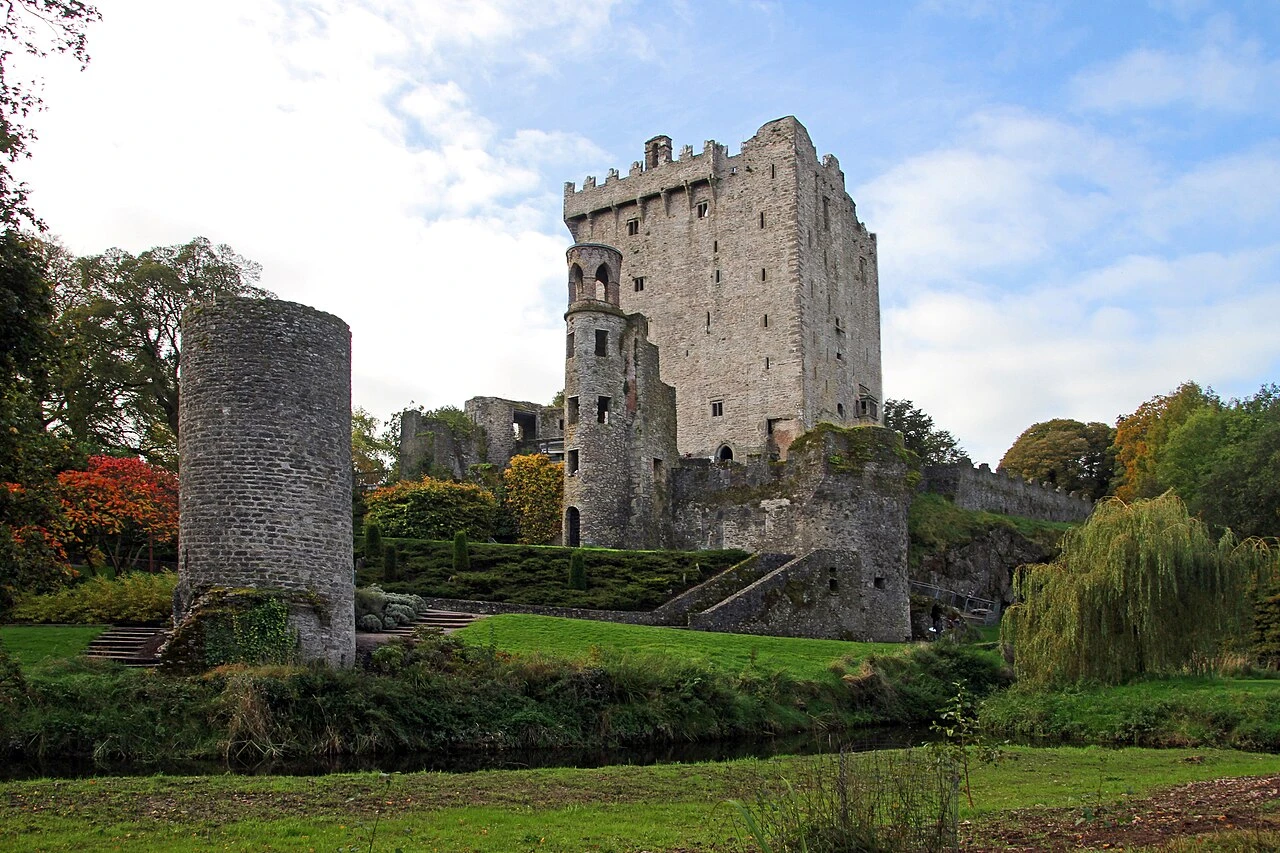
Cork
Blarney Castle
Content & sources
Photo: Gerd Eichmann · CC BY-SA 4.0
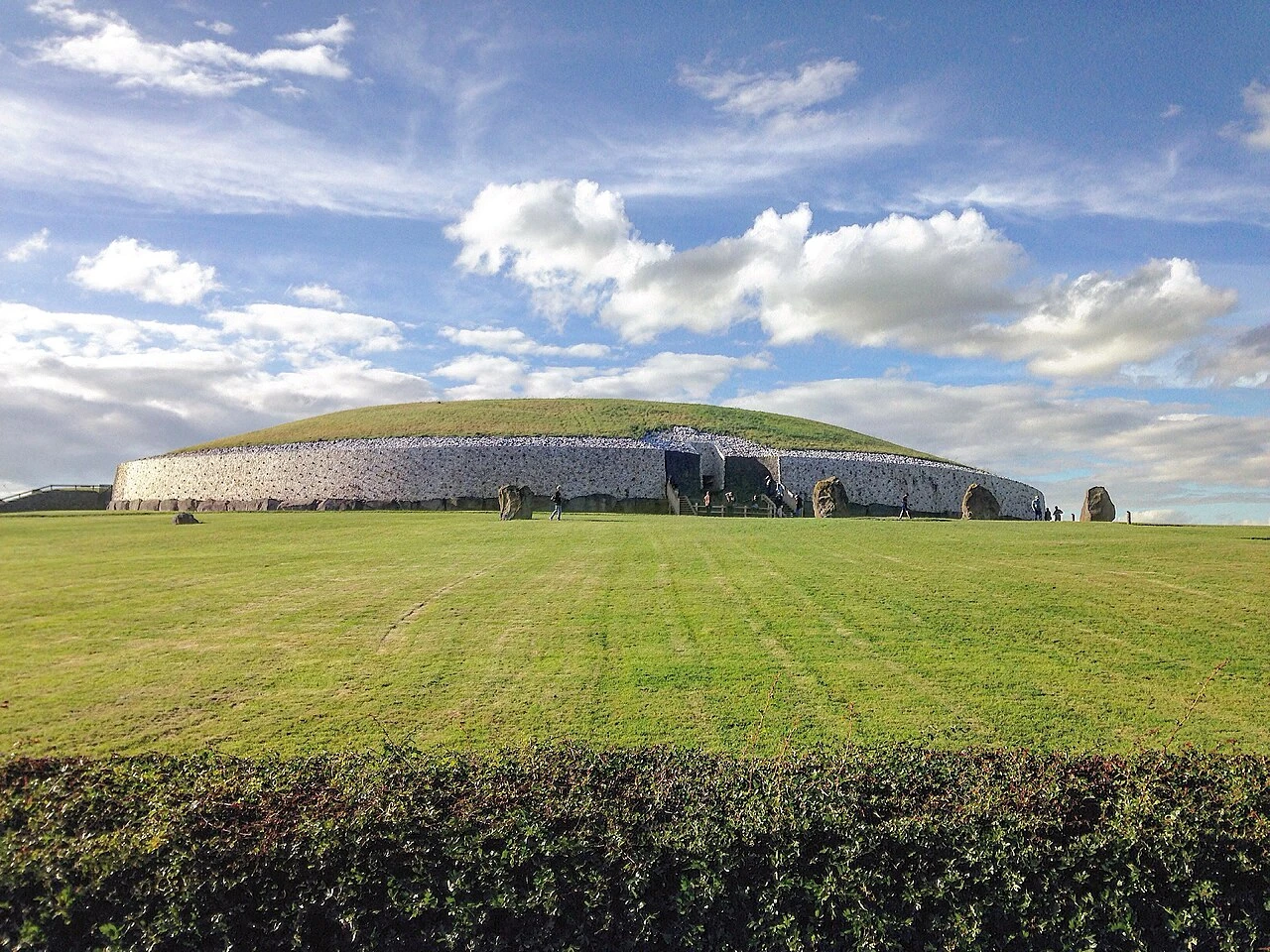
County Meath
Newgrange
Content & sources
Photo: Tjp finn · CC BY-SA 4.0