Stanza · Audio guide
Mausoleum of Khoja Ahmed Yasawi Audio Guide
A place to remember. A story to take with you.
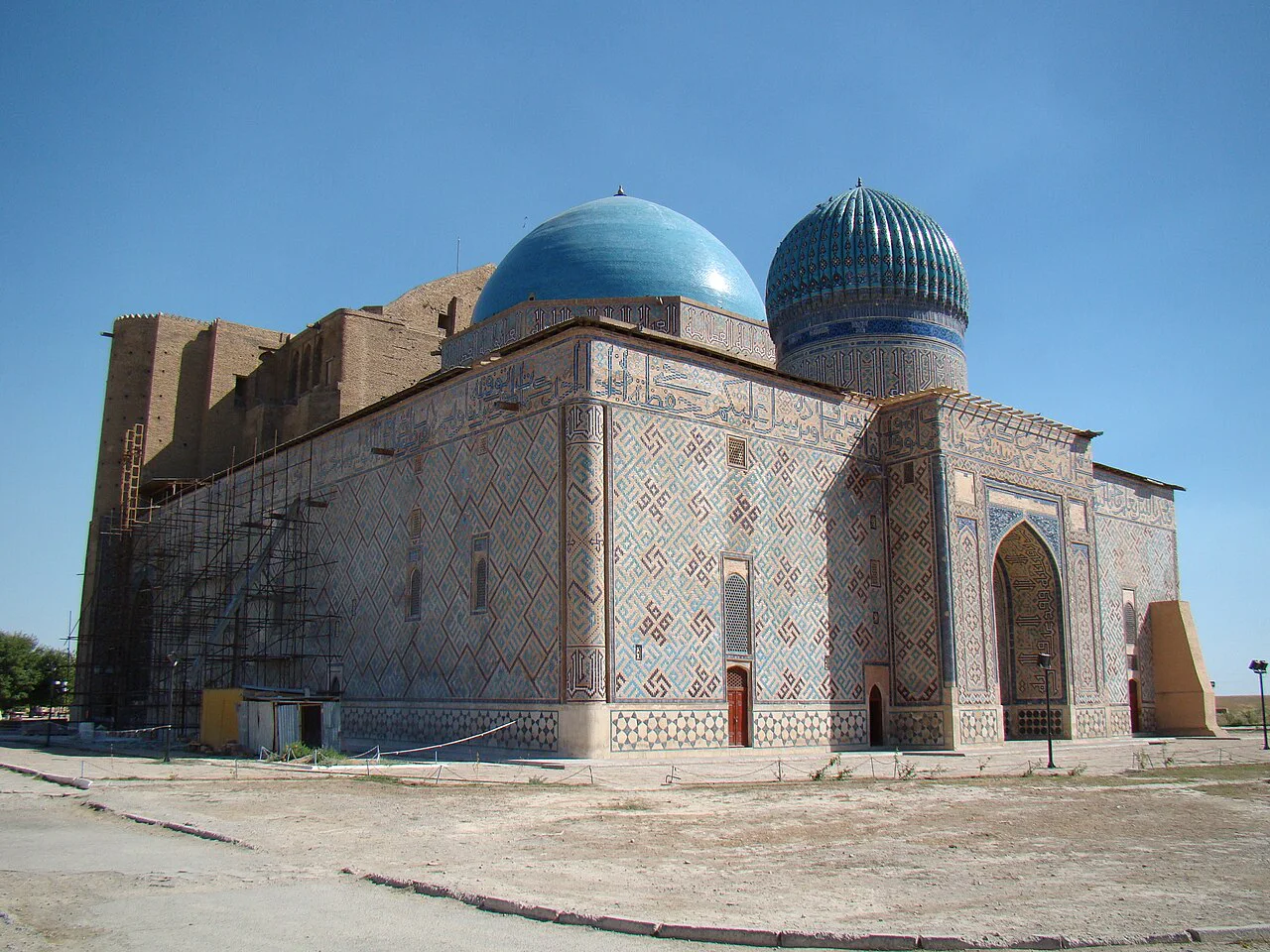
The Mausoleum of Khawaja Ahmed Yasawi is a mausoleum located in the city of Turkestan, Kazakhstan. It was commissioned in 1389 by Timur to replace a smaller 12th-century mausoleum of the Sufi mystic Khoja…
Download Stanza, then search for “Mausoleum of Khoja Ahmed Yasawi”.
About the tour
One guide. Your kind of visit.
The Mausoleum of Khawaja Ahmed Yasawi is a mausoleum located in the city of Turkestan, Kazakhstan. It was commissioned in 1389 by Timur to replace a smaller 12th-century mausoleum of the Sufi mystic Khoja Ahmed Yasawi.
Ready when you are.
- 01Get the free Stanza app.
iOS & Android
- 02Find your guide.
“Mausoleum of Khoja Ahmed Yasawi”
- 03Download before you go.
Works offline
Audio guide / 12 narrated stops
Inside the guide
Get to know a few of the stories before you go. Open a stop to read more.
01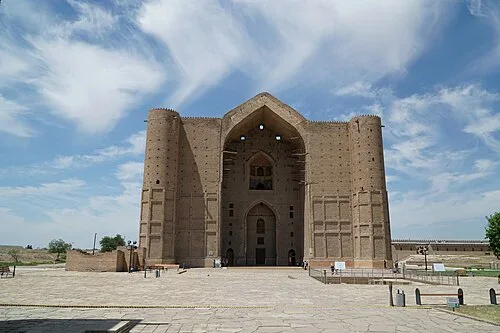 Southern Grand Portal (Peshtak)
The Mausoleum of Khoja Ahmed Yasawi from the Plaza
Welcome to the Mausoleum of Khoja Ahmed Yasawi in Turkestan, southern Kazakhstan. This vast brick building rises over the grave of a twelfth-century Sufi poet and mystic. Yasawi spent most of his life in the town then called Yasi, and died there in 1166. His small tomb became a place of pilgrimage, and in 1389 the emperor Timur ordered a far grander mausoleum built over it. He meant the shrine to glorify Islam and to bind the region to his rule. Pilgrims came from across Central Asia in such numbers that Turkestan earned the name of a second Mecca. The town's very old name, Hazrat-e Turkestan, means Saint of Turkestan, and it points to Yasawi. In 2003 UNESCO listed the mausoleum as a World Heritage Site, the first in Kazakhstan. The main entrance faces south-east, across the open plaza of the Azret-Sultan reserve.
Photo: Adam Harangozó · CC BY-SA 4.0
02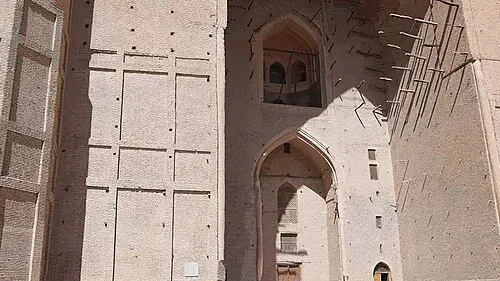 Southern Grand Portal (Peshtak)
The Unfinished Portal (Peshtak)
The great entrance arch was never finished. Work on the mausoleum began in 1389 and went on for roughly sixteen years. Then, in 1405, Timur died, and the building stopped where it stood. The southern portal, the peshtak, rises about thirty-seven and a half metres, and its brick is bare. No glazed facing was ever applied, and the planned minarets were never built. Small rows of holes pockmark the brickwork, where wooden scaffolding poles once slotted in during construction. Because the facade was left raw, the building shows how it was made, layer by layer. In the late sixteenth century the ruler Abdullah Khan the Second carried out further works on the structure. But the portal was never clad, and it has stood unfinished ever since.
t_y_l · CC BY-SA 2.0
03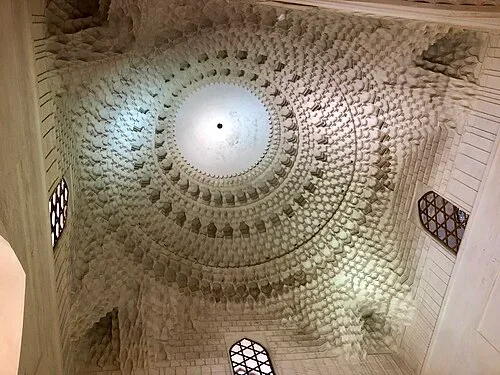 The Kazandyq Central Dome and Cauldron Hall
The Dome of the Kazandyk Hall
The hall at the centre of the building is called the Kazandyk, the copper room. Its dome spans eighteen metres across, and it is the largest brick dome still standing anywhere in Central Asia. The hall below it is square, with no columns to hold the roof up. Timurid builders solved that with a squinch, a bracket across each corner that carries the square room up into the round dome. Inside, the corners dissolve into tiers of little alabaster niches called muqarnas, a form borrowed from Persian architecture. The building itself is fired brick, bonded with mortar of gypsum and clay. That material was produced at Sauran, a town that supplied the great construction sites of the empire.
Listen in the appDavide Mauro · CC BY-SA 4.0
04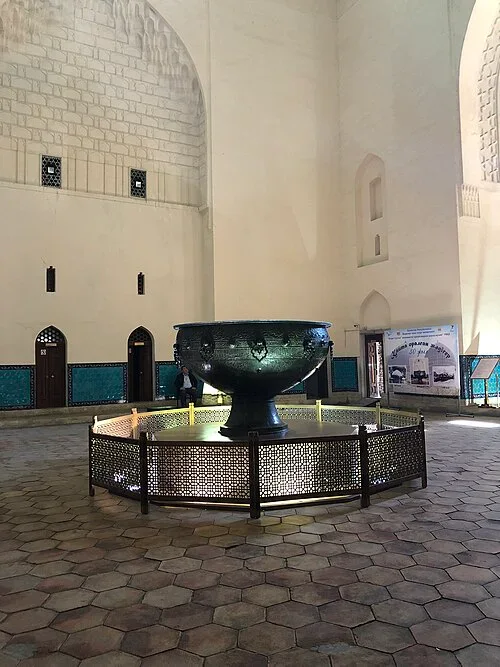 The Kazandyq Central Dome and Cauldron Hall
The Bronze Taiqazan Cauldron
At the centre of the Kazandyk stands a huge bronze cauldron, the taiqazan. It was used for religious purposes, and its work was simple and generous: holy water, shared with pilgrims. People who had travelled to Turkestan gathered in this hall, around the vessel, to receive it. The hall took its very name, the copper room, from the cauldron that stood in it. For centuries this was the devotional heart of the shrine, the point where a long journey ended with a cup of blessed water.
Listen in the appDavide Mauro · CC BY-SA 4.0
05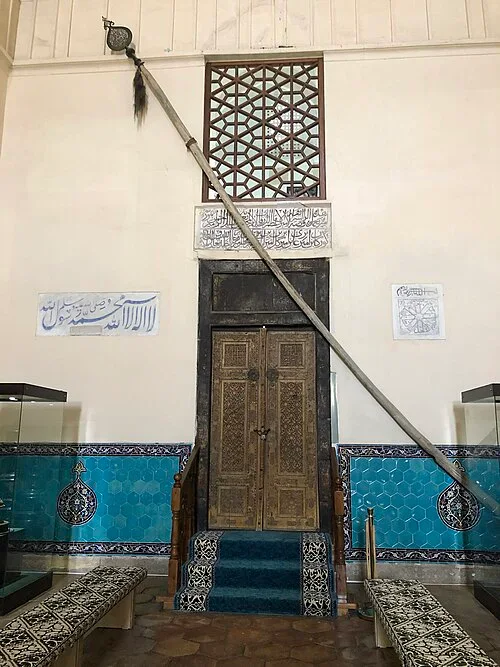 Threshold of Yasawi's Tomb (Qabirkhana)
Threshold of the Tomb Chamber
A carved doorway leads out of the central hall towards the tomb chamber, and pilgrims view the tomb through this threshold rather than entering it. Rulers came here too, and what they sought was the saint's blessing on their power. In the early sixteenth century, Ubaydullah Khan of the neighbouring Uzbek Khanate stopped at the mausoleum before marching against Babur, the man who would later found the Mughal Empire. He swore that if he won the battle, his rule would fully follow sharia law. The vow tells what this doorway meant: a promise made at the saint's tomb carried weight that no throne room could match.
Listen in the appDavide Mauro · CC BY-SA 4.0
06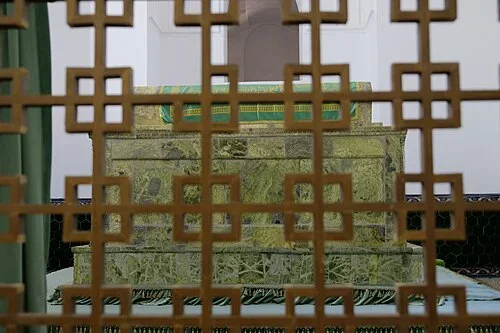 Threshold of Yasawi's Tomb (Qabirkhana)
The Sarcophagus of Khoja Ahmed Yasawi
The man at the centre of all this was Khoja Ahmed Yasawi, born in 1093 in Ispidjab, the modern town of Sayram. He led a regional school of Sufism, the mystical current in Islam. He popularised the movement among the Turkic peoples, and his school made Yasi the most important centre of learning in the region. He was also a poet and philosopher, and he died here in 1166. His sarcophagus stands exactly on the building's central axis, at the far end from the entrance. Over it rises a double dome, the inner shell seventeen metres high and the outer one twenty-eight. The exterior is clad in hexagonal green glazed tiles with gold patterns. Visitors meet the tomb through a wooden lattice screen, catching glimpses of the green-draped sarcophagus beyond.
Listen in the appDavide Mauro · CC BY-SA 4.0
07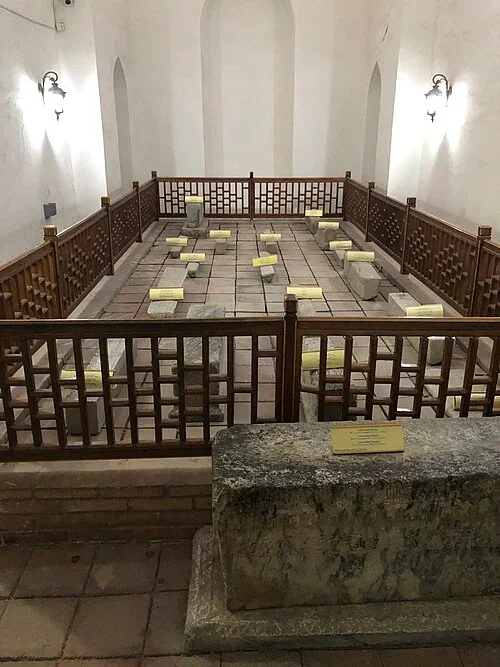 Kazakh Royal Pantheon (Kishi Aqsaray)
The Kazakh Royal Pantheon
When the Timurid Empire broke apart, its lands here passed to the Kazakh Khanate, which made Turkestan its capital in the sixteenth century. The khans were raised to the throne in this town, and the nobility held their most important councils here. Being buried near Yasawi consecrated a ruler's standing, and prominent figures chose graves beside the saint. Among them were Abulkhair, Rabi'i Sultan-Begim, Zholbarys-khan and Esim-khan. The best remembered is Ablai Khan, under whom the khanate reached its height. The rows of carved stone memorials behind the wooden railing in this chamber are the result: a royal pantheon gathered around a mystic's grave.
Listen in the appDavide Mauro · CC BY-SA 4.0
08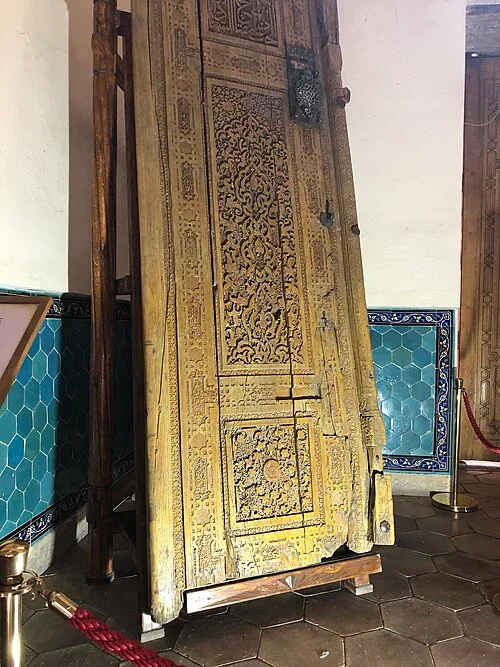 Kazakh Royal Pantheon (Kishi Aqsaray)
A Carved Timurid Door
The carving on this old wooden door gives a sense of the workshops that built the mausoleum. Timur imported his craftsmen from cities he had conquered. Mosaic-workers came from Shiraz, stonemasons and stucco-workers from Isfahan. The master builders were led by Khwaja Hosein Shirazi, who came from Iran. Tradition holds that Timur himself took part in the design, introducing experimental arrangements of spaces, vaults and domes. Whatever his exact share, the ideas tested here were later used in religious buildings across the empire. A door like this one, covered edge to edge in deep ornament, shows the calibre of craft those workshops delivered.
Listen in the appDavide Mauro · CC BY-SA 4.0
09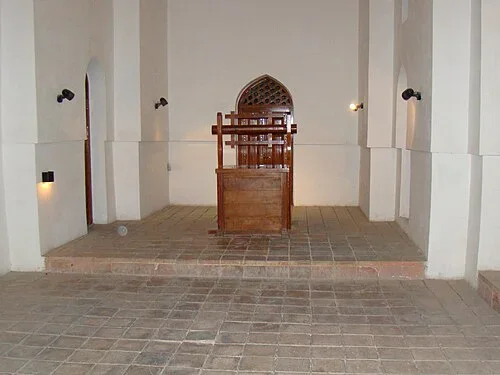 The Holy Well Chamber (Qudyqkhana)
The Well Chamber (Qudyqkhana)
A great shrine needs plumbing as much as splendour. This chamber, the qudyqkhana or well room, held the well that, by one account, was dug to supply water to the builders during construction. More than thirty-five rooms fill the building, each with its own work: meeting rooms, a refectory, a library, a mosque. They are arranged in blocks around the central hall, connected one to another. The well chamber sat at the practical end of that system, keeping water ready for the pilgrims the whole building existed to serve.
Listen in the appPhoto: Yuriy75 · CC BY-SA 3.0
10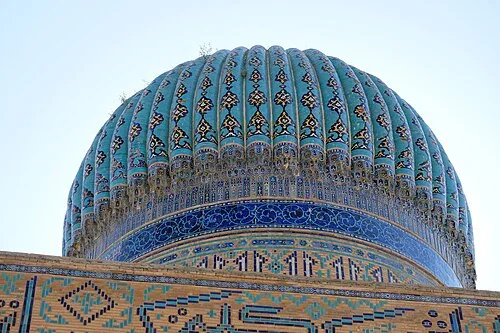 Northern Façade and the Ribbed Turquoise Dome
The Ribbed Turquoise Dome
Over the tomb chamber rises the building's most graceful feature, a ribbed dome in turquoise and blue. Its shape comes from the double shell you met over the tomb. The gap between the two shells lets the exterior soar far higher than the inner ceiling, producing a strong vertical effect. The Timurids carried the idea to their later monuments, including Timur's own tomb in Samarkand. Turquoise and azure were chosen deliberately, to blaze against the bright sunlight of the Central Asian desert.
Listen in the appYuriy75 · CC BY-SA 3.0
- 11
Banna'i Brickwork and Quranic Epigraphy
Glazed and plain bricks woven into geometry, with Quranic bands meant to be read from afar.
- 12
Survival and Meaning: The Mausoleum Today
Shelled in 1864, repaired, closed under Soviet rule, and still a place of pilgrimage today.
Mausoleum of Khoja Ahmed Yasawi
Frequently asked questions
How much does the guide cost?
Free app download. Listed guide price: $0.99. Guide price shown in the app. Audio guide only. Venue admission is separate.
Can I listen without internet?
Yes. Download the guide’s audio, images, and maps in the app before your visit. Your downloaded content is then available offline.
Can I listen in my language?
This audio guide is available in 15 languages, including English.
Do I need to follow a schedule?
No. This is a self-guided experience. Choose your stops, pause whenever you like, and return to a story at your own pace.
At your own pace
Explore Mausoleum of Khoja Ahmed Yasawi.
Download Stanza, then search for “Mausoleum of Khoja Ahmed Yasawi”.
Free app download · Guide price shown in the app
Keep exploring
Audio guides — Kazakhstan
Zhambyl District
Tanbaly
Content & sources
Jonas Satkauskas · Attribution