Stanza · Audio guide
Tanbaly Audio Guide
A place to remember. A story to take with you.
Tamgaly is a petroglyph site located in the Zhetysu region of Kazakhstan. It became a UNESCO World Heritage Site in 2004.
Download Stanza, then search for “Tanbaly”.
About the tour
One guide. Your kind of visit.
Tamgaly is a petroglyph site located in the Zhetysu region of Kazakhstan. It became a UNESCO World Heritage Site in 2004.
Ready when you are.
- 01Get the free Stanza app.
iOS & Android
- 02Find your guide.
“Tanbaly”
- 03Download before you go.
Works offline
Audio guide / 14 narrated stops
Inside the guide
Get to know a few of the stories before you go. Open a stop to read more.
01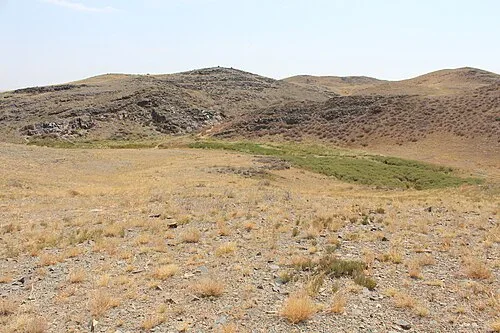 Reserve Entrance and Tanbaly Gorge Landscape
The Gorge of the Marked Place
Welcome to Tanbaly, a gorge of carved stone in the steppe country of southeastern Kazakhstan. The name comes from Kazakh and other Turkic languages, and it means painted or marked place. The site lies about 170 kilometres northwest of Almaty, in the dry hills of Zhetysu. Across the dark rock of this small canyon and the land around it, archaeologists have counted close to five thousand petroglyphs. They are spread over forty-eight separate sites. Five of the richest clusters sit in this one ravine. Together those five hold about three thousand carvings. In 2004 UNESCO added the petroglyphs and their landscape to the World Heritage List, as a place bearing unique testimony to a cultural tradition. The gorge itself explains why people came here with tools. Its dark, split cliffs offer smooth faces that hold a pecked image well, and the open valley in front leaves room to stand back and read them. What follows is the story of the people who made these images: their animals, their gods, and their dead.
Photo: Kiwiodysee · CC BY-SA 3.0
02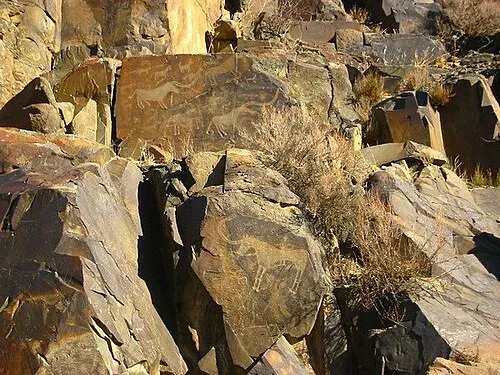 Reserve Entrance and Tanbaly Gorge Landscape
A Gallery Reborn: The 1957 Discovery
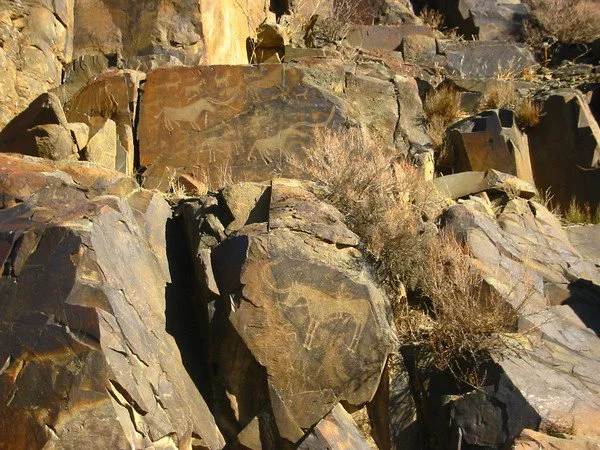
A sunlit rock face covered with faint animal figures marks the beginning of Tanbaly's modern story. On the nineteenth of September, 1957, a survey team reached this gorge and began recording its carvings. They were the Zhetysu detachment of the South Kazakhstan archaeological expedition. Their leader, Anna Georgievna Maksimova, is remembered as Kazakhstan's first professional archaeologist. The gallery they brought to light proved to be one of the great rock art sites of Central Asia. Study here never stopped after that first season. In the 1970s and 1980s, geologists and archaeologists carried the work forward. From 1988, the archaeologist Aleksei Rogozhinsky led the next long campaign of research. The carved animals scattered over this very rock face are part of the gallery those first researchers came to record.
Jonas Satkauskas · Attribution
03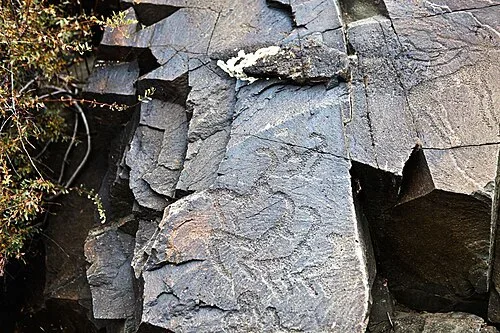 Group I - Desert Varnish and Layered Palimpsests
Pecking Through the Desert Varnish
The deep black colour of these rocks is not the stone's own. Exposed rock in a dry climate slowly builds a dark mineral skin, known as desert varnish. It takes millennia to form, which is why it survives on surfaces untouched for thousands of years. Ancient artists worked against that skin. They pecked the surface dot by dot, with a pointed tool, until the brighter rock underneath showed through. The pale figure standing out against the dark face here is the result. Bronze Age work cut deepest, reaching three to five millimetres into the stone. Later carvers often went shallower, and their images read fainter for it. Without that contrast between dark skin and pale cut, hardly any of Tanbaly's images would be readable at all.
Listen in the appNinara from Helsinki, Finland · CC BY 2.0
04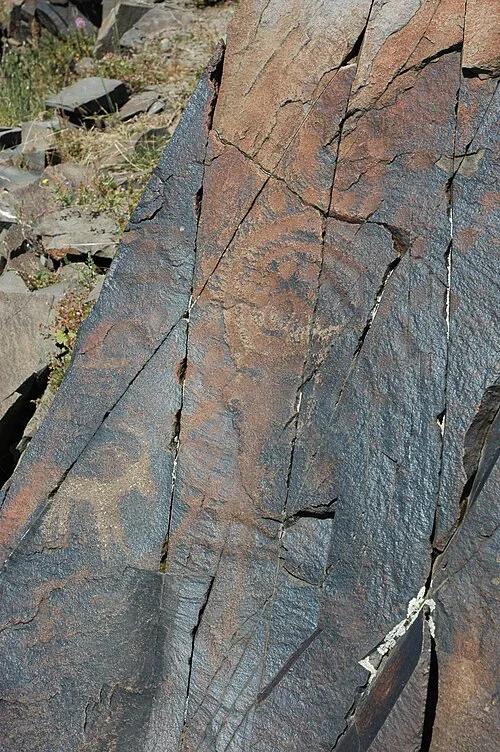 Group I - Desert Varnish and Layered Palimpsests
A Stone Palimpsest: 3,000 Years of Carving
A single rock face here carries figures that do not belong to the same century. Generations of carvers reused the panels of their predecessors, cutting new images beside the old and sometimes straight across them. The result is a palimpsest, a stone page written over many times with every layer still visible. Scholars recognise four distinct epochs of carving at Tanbaly. The oldest images date to the Bronze Age, roughly three thousand years ago. The newest were made as late as the early twentieth century. Between those ends lies the whole history of the steppe, recorded on stone by the people who lived it. The spiral and animal figures layered on this vertical slab show how crowded such a shared surface could become.
Listen in the appRon Van Oers · CC BY-SA 3.0 igo
05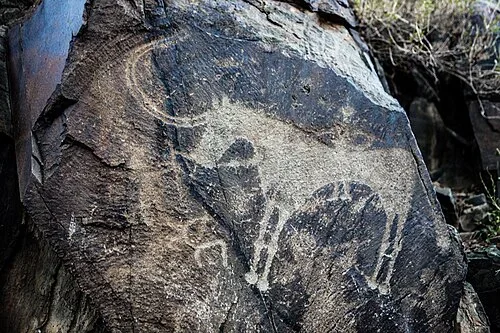 Group II - Bronze Age Animal Panels and Domestication
The Great Bull of the Bronze Age
A bull with horns that sweep across the rock like crescents is among the finest images at Tanbaly. It belongs to the Middle Bronze Age, the first great era of carving here. Most figures of that period measure twenty-five to thirty centimetres. The exceptional ones reach a full metre. They are drawn naturalistically, with a confidence no later hand at the site quite matched. So alike are the Bronze Age panels across the gorge that they seem to come from a single master's hand. The animal repertoire was wide, taking in wild bulls, horses, wild asses, deer, boars and wolves. Some of the species those carvers recorded no longer exist. Alongside the animals, the Bronze Age artists also carved human and fantastic beings, in the same confident style.
Listen in the appPhoto: Ninaras · CC BY-SA 4.0
06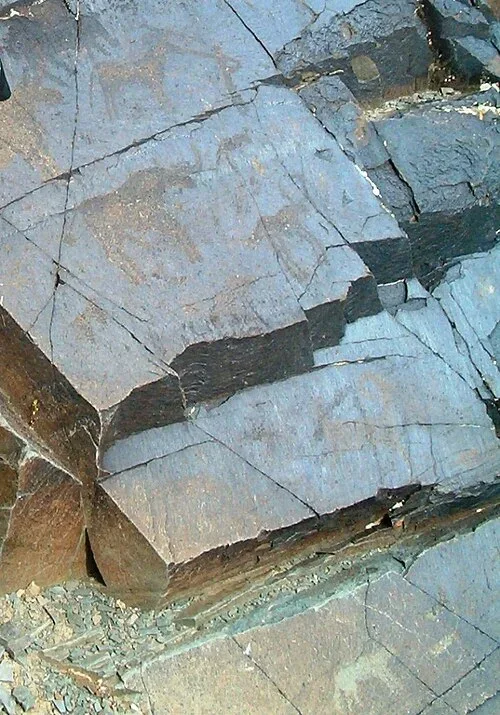 Group II - Bronze Age Animal Panels and Domestication
Reading a Wide Animal Panel
The first carvers at Tanbaly had no shortage of rock. They took the widest, flattest faces the cliffs offered and filled them. A panel like this one is not a single picture but a gallery, with herds, lines and pairs of animals spread across the whole surface. The natural fracture lines of the stone shaped where they worked. Figures follow the edges of the slabs, and whole compositions are built around them. Images of different ages often share one surface, so reading a panel means sorting the layers by depth and style. The faint, broad spread of animals here gives a sense of how much rock a single Bronze Age composition could claim.
Listen in the appPhoto: Khamit.berdali · CC BY-SA 4.0
07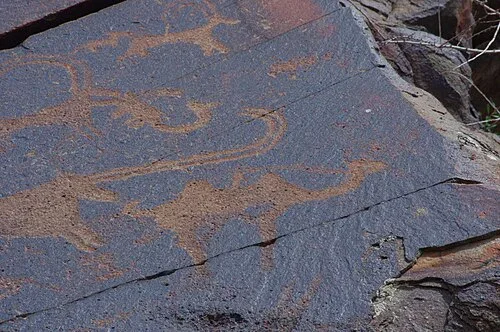 Group III - Pastoral Life and Steppe Travel
The Camel Rider: A Changing World
A lone figure rides a dromedary camel across this slab of dark stone. The carving dates from the late Bronze Age or the early Iron Age, and it marks a change in the imagery. From this transition onward, images grow smaller, generally under fifteen centimetres. They are pecked more shallowly, to a depth of only one or two millimetres. Variety narrows, and complex subjects become rare. Horses, bulls and wild animals remain, but scenes of herding and pastoral life join them. The camel itself says the most. A beast of burden from the southern routes now walks through the rock art of the steppe, with a rider on its back.
Listen in the appKen and Nyetta · CC BY 2.0
08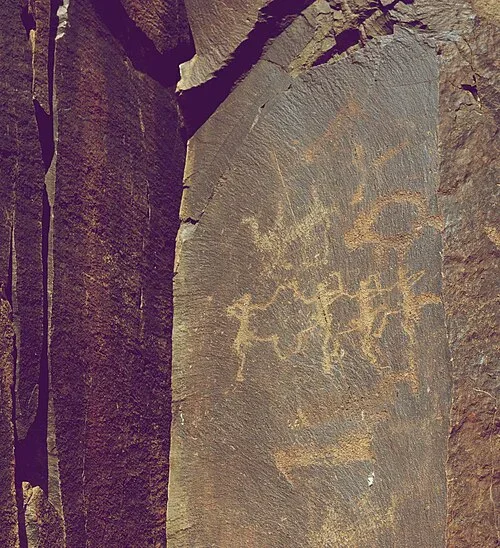 Group III - Pastoral Life and Steppe Travel
Dancers and Caravans: Life in the Valley
Small human figures crowd beside the camels on this panel. They stand in rows, some with arms raised, some moving in step. In the later imagery, people take their place next to the animals. Groups gather, herds move, and figures travel together across the rock. These are modest compositions, close to the ground of everyday life. They are not the ceremonial dancers of the great sanctuary cliff, whose ordered ranks belong to a different, sacred scheme. Here the stone records people simply in company, with their animals around them.
Listen in the appPhoto: Tokatosha · CC BY-SA 4.0
09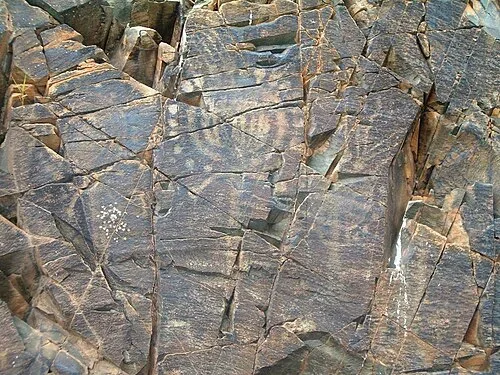 Group IV - Open-Air Sanctuary and Solar Pantheon
The Sun-Headed Deity
A human figure whose head is not a head at all, but a sun. Rays radiate from the skull in a great halo, enclosing the whole head. This sun-headed being is one of the most distinctive creations of Central Asian Bronze Age art. Figures like it belong to the largest scale of Tanbaly's carving, far above the small ordinary images of herds and riders. The sacred figures of the gorge were drawn to be seen from a distance, and their size carried their importance. It is this motif, more than any other, that made Tanbaly's name in the study of rock art. The cracked dark slab around the figure only sharpens the pale burst of the halo.
Listen in the appPhoto: Khamit.berdali · CC BY-SA 4.0
10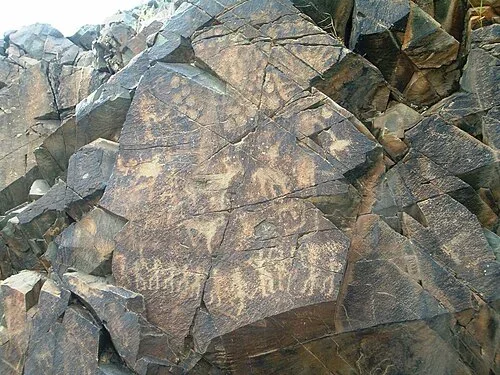 Group IV - Open-Air Sanctuary and Solar Pantheon
The Pantheon and the Dancers
High on the sacred cliff, the sun-headed beings stand in a row above the world of humans. Below them, armed dancers move in ordered ranks, and worshippers lift their hands. The whole composition is arranged in strict vertical order. Scholars suggest it may picture how Bronze Age people imagined the world. Gods and ancestors occupy the upper register, holding the order of nature. Humans, dancing and praying, stand beneath them in strict rank. The panel gathers divine figures, armed warriors and supplicants into one scheme, carved to be read as a single statement. No other panel here sets out so complete a picture of that order.
Listen in the appPhoto: Khamit.berdali · CC BY-SA 4.0
- 11
An Open-Air Sanctuary
The open-air sanctuary of Group IV, built to be read whole from twenty to forty metres back.
- 12
Saka Hunters: The Animal Style
The Saka world takes over the stone, with predators chasing deer and goats at full stretch.
- 13
Horsemen of the Middle Ages
The final carvers: mounted nomads, banners and duels, and the quiet end of the tradition.
- 14
Where the Ancestors Lie
Stone cist tombs on the valley floor, where the dead of the gorge lay near the sacred rock.
Tanbaly
Frequently asked questions
How much does the guide cost?
Free app download. Listed guide price: $1.99. Guide price shown in the app. Audio guide only. Venue admission is separate.
Can I listen without internet?
Yes. Download the guide’s audio, images, and maps in the app before your visit. Your downloaded content is then available offline.
Can I listen in my language?
This audio guide is available in 15 languages, including English.
Do I need to follow a schedule?
No. This is a self-guided experience. Choose your stops, pause whenever you like, and return to a story at your own pace.
At your own pace
Explore Tanbaly.
Download Stanza, then search for “Tanbaly”.
Free app download · Guide price shown in the app
Keep exploring
Audio guides — Kazakhstan
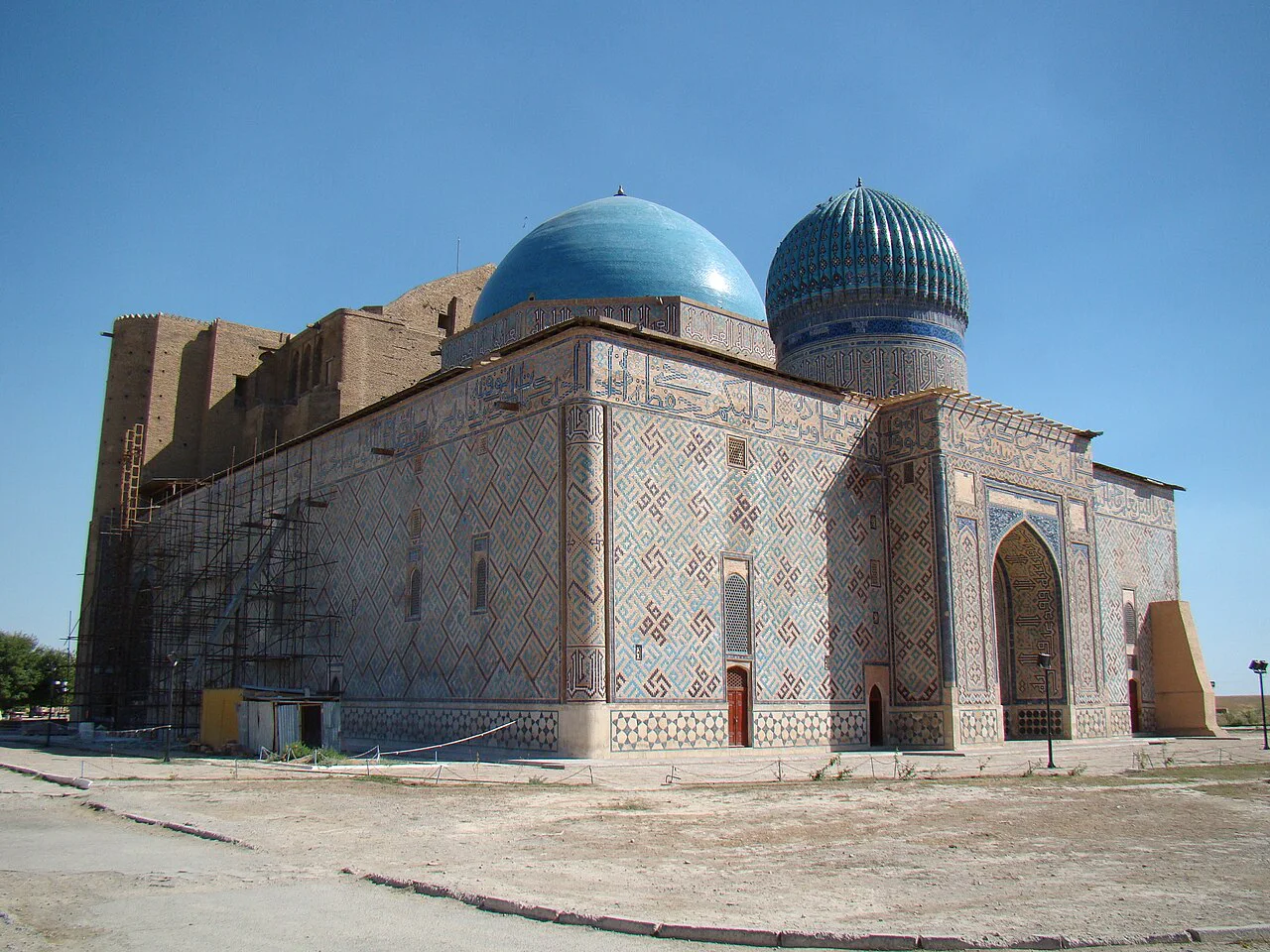
Turkistan
Mausoleum of Khoja Ahmed Yasawi
Content & sources
Photo: Yuriy75 · CC BY-SA 3.0