Stanza · Audio guide
Old Orhei Audio Guide
A place to remember. A story to take with you.
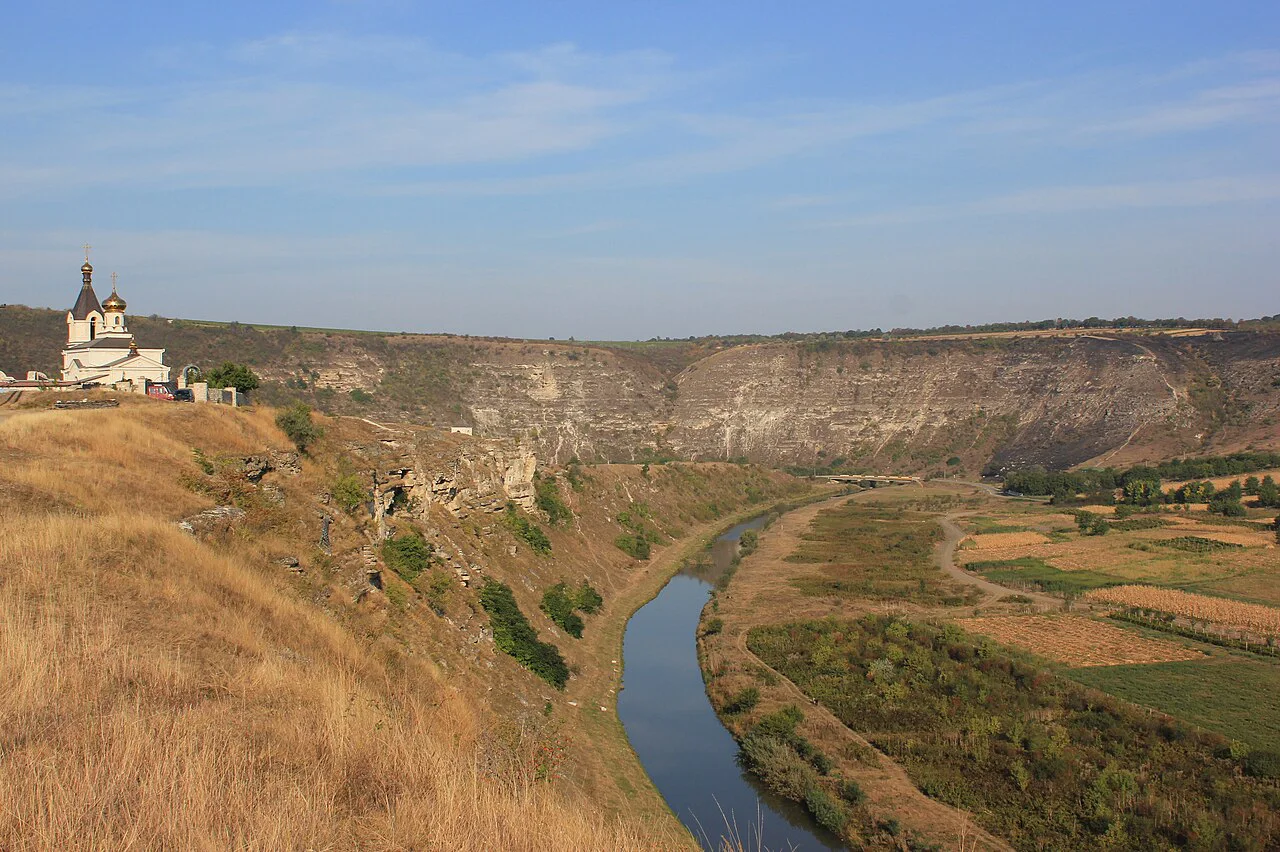
Old Orhei is a historical and archaeological complex located in Trebujeni, Moldova. It is situated approximately 60 kilometres north-east of Chișinău on the Răut River.
Download Stanza, then search for “Old Orhei”.
About the tour
One guide. Your kind of visit.
Old Orhei is a historical and archaeological complex located in Trebujeni, Moldova. It is situated approximately 60 kilometres north-east of Chișinău on the Răut River.
Ready when you are.
- 01Get the free Stanza app.
iOS & Android
- 02Find your guide.
“Old Orhei”
- 03Download before you go.
Works offline
Audio guide / 16 narrated stops
Inside the guide
Get to know a few of the stories before you go. Open a stop to read more.
01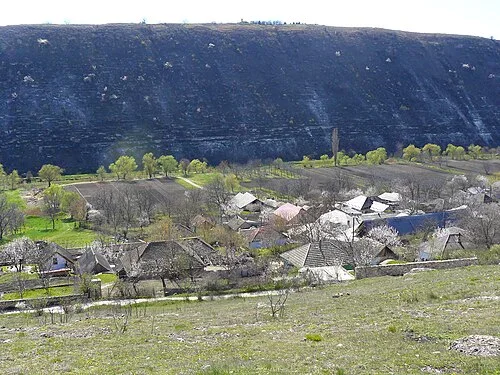 Butuceni Village
 Beneath the Cliffs
A village huddles under a sheer wall of limestone, and that wall is the reason the place exists. Old Orhei, in Romanian Orheiul Vechi, lies on a narrow bend of the Răut River, about sixty kilometres north-east of Chișinău. The Răut loops and coils here, cutting a gorge through Sarmatian limestone laid down roughly thirteen million years ago. That left near-vertical cliffs wrapping a valley up to about a hundred and thirty metres deep, like an amphitheater. Each loop of the river turns the land inside it into a promontory with cliffs on three sides. For anyone building a stronghold, nature did most of the work. People noticed early: the layers here run from the Paleolithic and the Trypillian world, through a Geto-Dacian fortress, a Golden Horde city, a Moldavian fortress and town, to monasteries carved into the rock. The site is now the core of Orhei National Park, created in 2013, and sits on Moldova's tentative list for UNESCO World Heritage. And it is not an abandoned ruin. A village still lives inside the amphitheater, its houses tucked at the foot of the cliffs.
Photo: Jbuket · CC BY-SA 4.0
02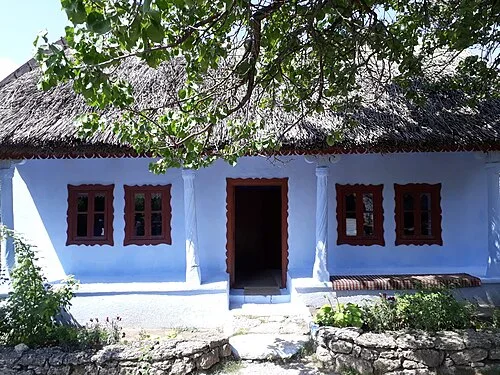 Butuceni Village
A Traditional Peasant House
Not every building here is a fortress or a church. This is a peasant homestead from the nineteenth and twentieth centuries, the kind of house ordinary families lived in while empires came and went above them. The house keeps its open porch, the prispă, carried on columns of local limestone. The roof is thatched with reed, cut from the valley wetlands. Both materials came from within walking distance, which is the quiet logic of vernacular building: the cliff gave stone, the river gave reed. The walls are washed in pale blue, a colour traditional in Moldovan villages. Homesteads like this are preserved within the reserve so that the rural side of Old Orhei stays visible alongside its archaeology. The complex here is described as a single system, where ancient landscape and traditional rural habitation belong together. People never stopped living in this valley. That continuity is part of what the site protects.
Photo: TotalAnarchy · CC BY-SA 4.0
03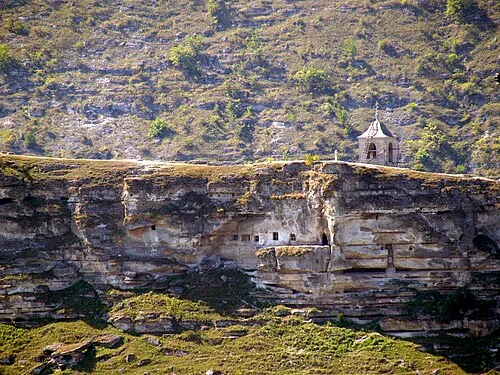 Butuceni Cave Hermitage, Bell Tower, and Stone Cross
The Cave Hermitage and Bell Tower
High on the cliff face, openings are cut into the rock, and a small bell tower stands freestanding at the edge. This is a cave hermitage, and the work of carving it was enormous. Orthodox monks hollowed cells and chapels directly out of the limestone, and rock-cut monastic life here reaches back to around the fourteenth century. The reason was the character of monasticism itself. A hermit sought distance from the world, and a cliff offered the purest form of it: a room with no neighbours, reachable only by a hard climb. In troubled times the height and seclusion served a second purpose, shelter. The caves here have served as working chapels for centuries, and monks still maintain the church on the hilltop. In the 1690s the chambers even gave refuge to hajduks, outlaws hiding from the Ottoman authorities, a story written on the walls in Old Church Slavonic. The bell tower beside the caves is a later addition, calling worshippers to a church that has no walls of its own.
Listen in the appDave Proffer · CC BY 2.0
04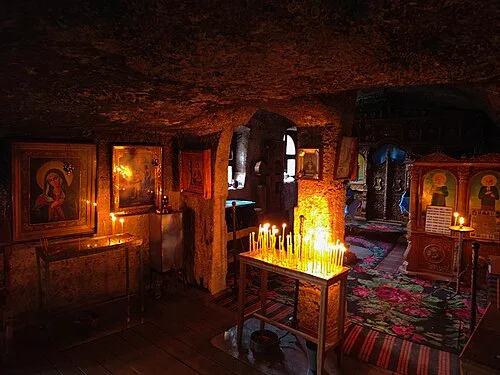 Butuceni Cave Hermitage, Bell Tower, and Stone Cross
Inside the Cave Chapel
Inside the rock, the darkness is lit by dozens of candles. This is the nave of a cave monastery, and it is not a museum piece. A handful of Orthodox monks still live at Old Orhei and maintain the church here, and the carved chambers remain chapels in use. The signs of living worship are everywhere in the room. Icons stand in wooden frames against the rough stone. A stand near the centre holds a crowd of thin candles, their flames reflected in the gilt of the icons. Carpets cover the uneven floor, and a screen of icons separates the nave from the altar. Everything is arranged for a service, not for visitors. The walls were cut by hand centuries ago, yet the space still does what it was carved to do. Prayer continues here without interruption of purpose, only of generations.
Listen in the appPhoto: AntyLegit · CC BY-SA 4.0
05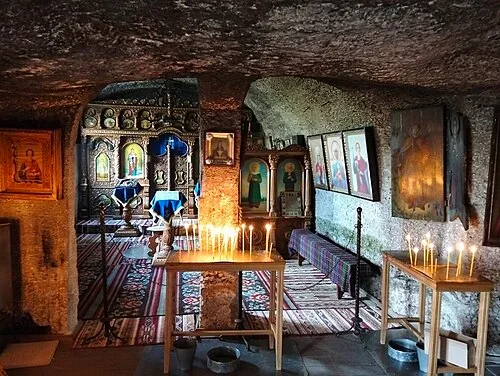 Butuceni Cave Hermitage, Bell Tower, and Stone Cross
Icons in the Rock
A rock chapel carries the standard furnishings of Orthodox worship, adapted to its strange setting. Painted icons hang on walls that were never meant to be flat. Brass vessels catch the wax from the candles. The stone around it all is crude, hacked out of the cliff with tools, uneven and dark. That contrast is the point of the space. The finest work of human hands, gilding and pigment and carved wood, set against the bare rock that God made. The icons glow against their rough backdrop in a way no plastered church wall allows. The chamber does not decorate the worship. It frames it.
Listen in the appPhoto: MOs810 · CC BY 4.0
06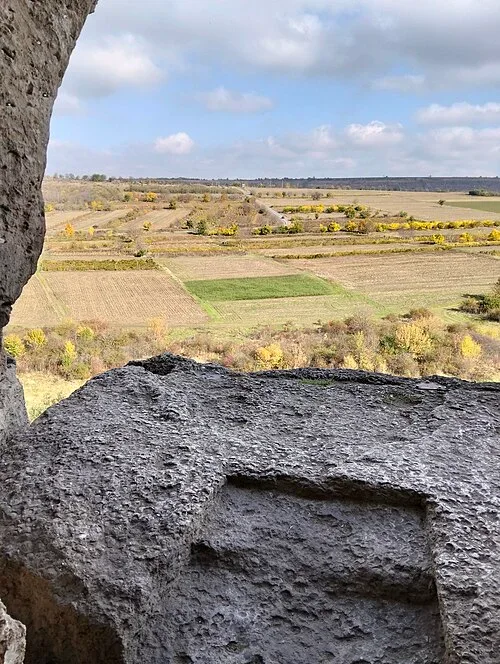 Butuceni Cave Hermitage, Bell Tower, and Stone Cross
The View from a Hermit's Window
From a cave opening high in the cliff, the valley opens out in a patchwork of fields. Ploughed land, green strips, yellow autumn trees, the road running along the far side of the Răut. The stone sill of the opening is worn smooth, and steps were cut into the rock beside it. A cell placed here turned solitude into a discipline. The hermit could see the villages below and the farmland that fed them, and remain apart from both. The world stayed in view, close enough to pray for, far enough to resist. That balance, between withdrawal and watchfulness, was the whole idea of the eremitic life. The window frames it exactly: sky above, fields below, and a narrow stone room in between.
Listen in the appPhoto: MOs810 · CC BY 4.0
07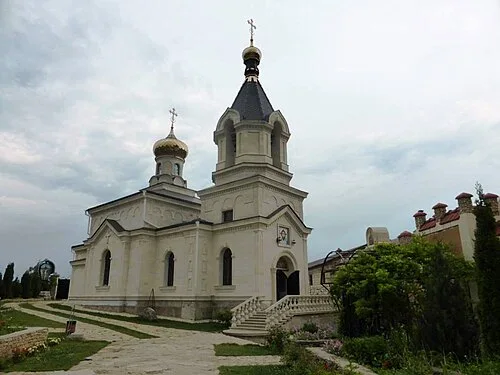 Church of the Nativity of the Virgin Mary
Pale stone walls, dark roofs, and two domes crowned with gilt: this is the Church of the Nativity of the Virgin Mary, standing on the crest of the Butuceni promontory. It was built in 1904, and its purpose was a change of address for worship. The cave sanctuaries below, carved into the cliff, were damp and cramped, and the community raised a conventional church on the hilltop instead. The style is Russian-Byzantine, unmistakable in the onion domes with their shining caps and the soft cream of the masonry. A stepped entrance with a balustrade leads up to the arched doorway. After centuries of praying inside the rock, the congregation could now worship above ground, in the open air. The caves below kept their chapels, but the parish had a proper church at last.
Listen in the appAgenția de Inspectare și Restaurare a Monumentelor din Republica Moldova · CC BY-SA 4.0
08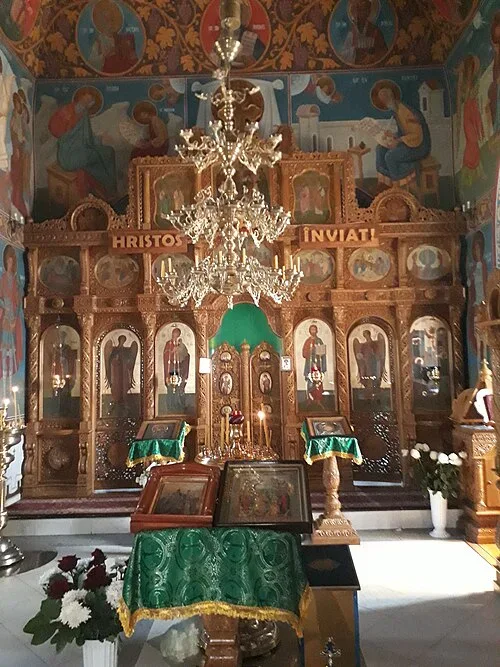 Church of the Nativity of the Virgin Mary
The Iconostasis
Facing the altar in the church stands the iconostasis, a wall of carved wood covered in painted icons. In an Orthodox church this screen does two things at once. It separates the nave, where the congregation stands, from the sanctuary, the holiest space around the altar. And it connects them, because the icons on it are the faces of Christ, the Mother of God and the saints, looking out towards the people. This one is built in tiers, each row of images framed by gilded carving that curls around the panels. Royal doors at the centre open onto the altar. A great chandelier hangs before it, and flowers stand at its foot. The carved wood glows warm against the painted walls behind it. It is the artistic heart of the church's interior.
Listen in the appPhoto: TotalAnarchy · CC BY-SA 4.0
09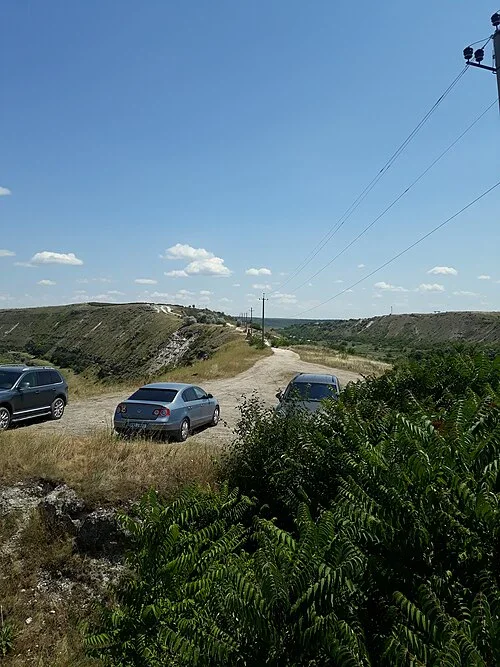 Getic Fort of Butuceni
The oldest stronghold here was never built of stone. Iron Age communities of the Geto-Dacian world fortified the Butuceni promontory, raising a settlement whose remains stretch across the entire plateau, all the way past the monastery at its tip. It was not the first settlement here: Paleolithic and Eneolithic people had lived at Old Orhei long before. When it began is debated. Some accounts place the Geto-Dacian fortress between the sixth and the first centuries BC, others between the fourth and the third. What is not in doubt is the logic of the place. The river had already cut sheer cliffs around most of the promontory, so the defenders needed to protect only the approaches on the open land side. Earthworks closed those gaps, and the heights did the rest. A stronghold of this kind took little to defend and much to attack, which is why the spot was worth fortifying at all. The people who lived here left no chronicles and no names, only the layers their settlement pressed into the ground. Excavations on the plateau trace their walls and their daily life, the earliest builders of a place that others would fortify again and again.
Listen in the appPhoto: TotalAnarchy · CC BY 4.0
10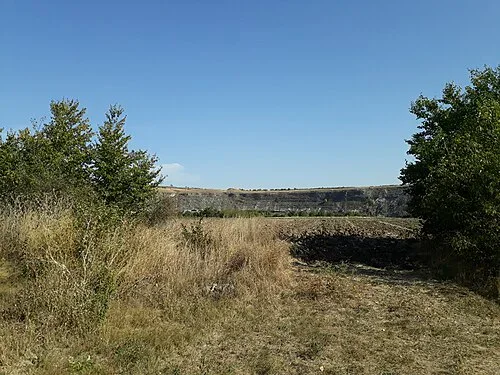 Getic Fort of Butuceni
The Rampart and Ditch
Where the cliffs end, the defense had to be built by hand. Across the north-eastern side of the promontory runs a rampart and ditch, the part of the Getic fort still visible as a shape in the ground. From a distance it reads as a low swell crossing the fields, easy to walk past without a second glance. It was a simple earthwork: a bank raised from soil, fronted by a ditch dug deep into the same ground. The Geto-Dacians built fortresses of earth and wood throughout these lands, and this was the standard answer to a simple problem. A bank and a ditch closed the landward approaches, turning the whole plateau into a closed stronghold. Attackers coming overland had to cross the ditch, climb the bank, and face whatever stood on top, all in the open. The work seems modest today, a ripple in the grass, but it is what made the heights defensible from every direction.
Listen in the appPhoto: TotalAnarchy · CC BY 4.0
- 11
Cave Monastery of Bosie — the Outlaws' Shelter
How abandoned cave chambers became a hiding place for outlaws in the 1690s, and what their inscriptions still say.
- 12
Inside a Rock Cell
The raw reality of a rock-cut cell: walls, benches and recesses shaped straight out of the limestone.
- 13
The Pârcălab Bosie Monastery
Why a fortress governor of Orhei put his name on a monastery carved into the cliff.
- 14
Shehr al-Jedid — the Golden Horde City
The Golden Horde city of Shehr al-Jedid, its stone baths and caravan-serai, and the khan who resided here.
- 15
The Medieval Town of Orhei
How the Moldavians turned a Tatar city into a town of churches and caravan inns, and why they finally left it.
- 16
Orheiul Vechi Citadel — the Border Stronghold
Stephen the Great's border fortress, its governor's seat, its destruction by Lăpușneanu, and the failed rebuild of 1600.
Old Orhei
Frequently asked questions
How much does the guide cost?
Free app download. Listed guide price: $1.99. Guide price shown in the app. Audio guide only. Venue admission is separate.
Can I listen without internet?
Yes. Download the guide’s audio, images, and maps in the app before your visit. Your downloaded content is then available offline.
Can I listen in my language?
This audio guide is available in 15 languages, including English.
Do I need to follow a schedule?
No. This is a self-guided experience. Choose your stops, pause whenever you like, and return to a story at your own pace.
At your own pace
Explore Old Orhei.
Download Stanza, then search for “Old Orhei”.
Free app download · Guide price shown in the app
Keep exploring
Audio guides — Moldova
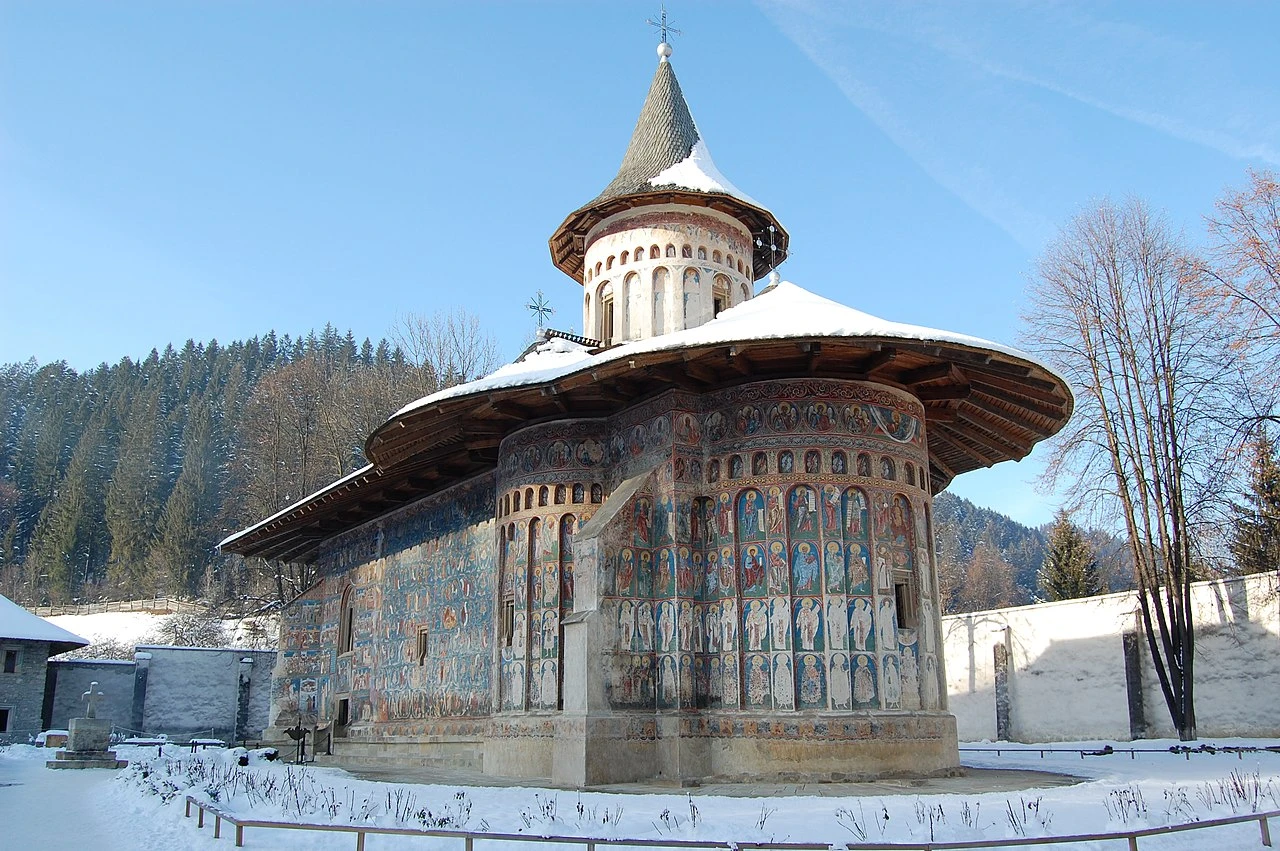
Gura Humorului
Voroneț Monastery
Content & sources
Dstefanescu · Public domain