Stanza · Audio guide
Bagan Audio Guide
A place to remember. A story to take with you.
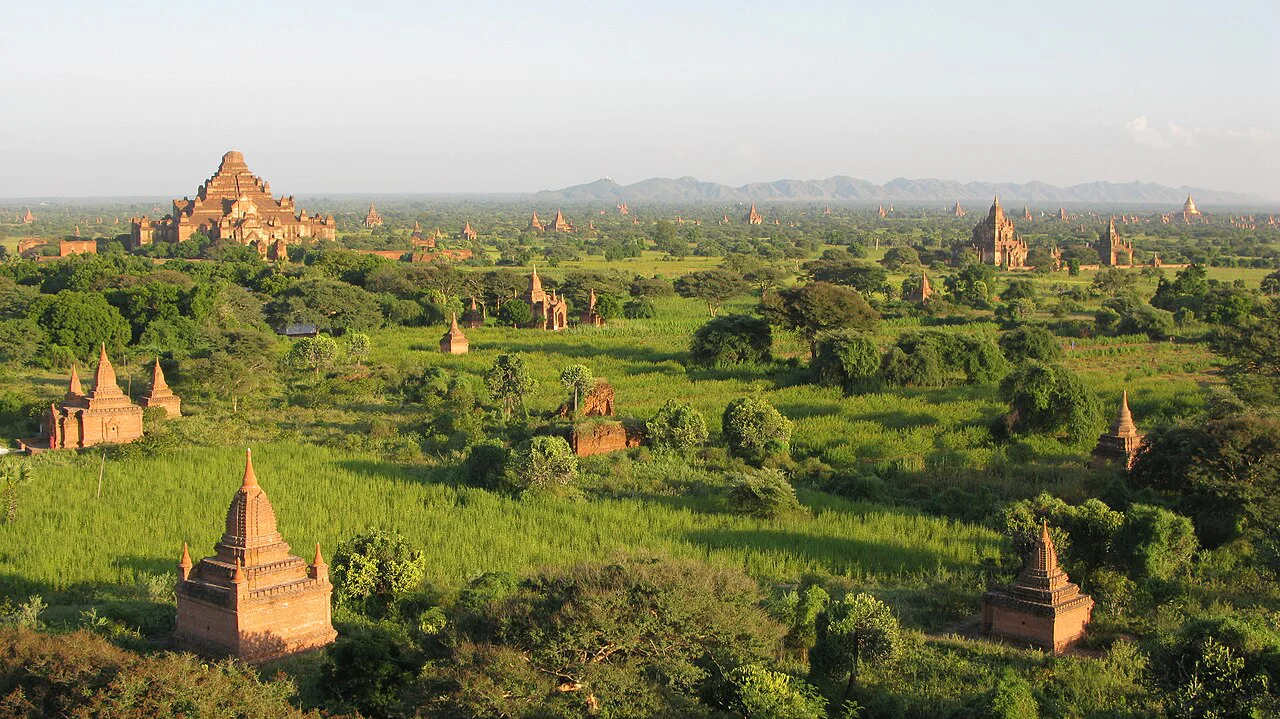
Bagan is a medieval city and a UNESCO World Heritage Site in the Mandalay Region of Myanmar. It served as the capital of the Pagan Kingdom, where over 2,200 Buddhist temples and pagodas still survive today.
Download Stanza, then search for “Bagan”.
About the tour
One guide. Your kind of visit.
Bagan is a medieval city and a UNESCO World Heritage Site in the Mandalay Region of Myanmar. It served as the capital of the Pagan Kingdom, where over 2,200 Buddhist temples and pagodas still survive today.
Ready when you are.
- 01Get the free Stanza app.
iOS & Android
- 02Find your guide.
“Bagan”
- 03Download before you go.
Works offline
Audio guide / 51 narrated stops
Inside the guide
Get to know a few of the stories before you go. Open a stop to read more.
01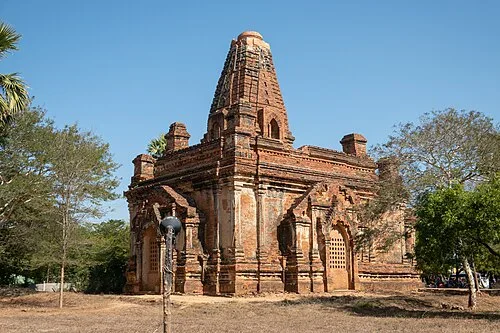 Wetkyi-in Gubyaukgyi Temple
Gubyaukgyi (Wetkyi-in)
A red-brick temple rises among the trees at Wetkyi-in, compact and crowned with a tall, sweeping spire. That spire is the giveaway. It copies the shikhara, the tapering tower of the temples of India, and early Bagan builders borrowed the silhouette freely. Burmese temple design evolved out of Indian and Pyu styles before it grew into a language of its own. The word gu marks the hollow kind of temple, built for worship inside, rather than a solid stupa. This one, from the early thirteenth century, pairs the Indian crown with plain, well-laid Bagan brickwork. Among the thousands of monuments on the plain, the silhouette makes it easy to spot.
Photo: No(0)GoodNamesLeft · CC BY-SA 4.0
02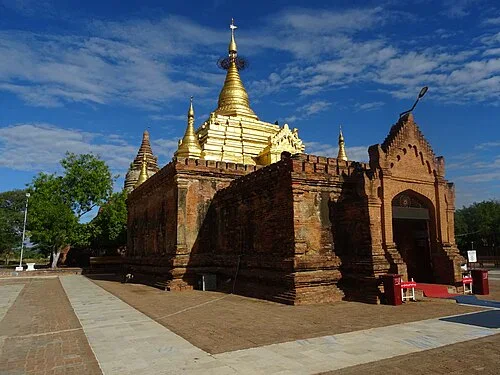 Alodawpyi Pagoda
Alopyi-gu-hpaya (Alodawpyi Pagoda)
Not every temple at Bagan is a royal monument. This one is small: an old hollow temple of brick, its spire sheathed in gold, its gateway gilded to match. The bright gold is a sign of use, not neglect. Over the centuries, regular pilgrimage at Bagan narrowed to a score or so of the most famous temples, and thousands of others fell into disrepair. Smaller shrines like this stayed alive another way, through local devotion. Worshippers still come, and the paintings inside still serve the faithful rather than only visitors.
Photo: Christophe95 · CC BY-SA 4.0
03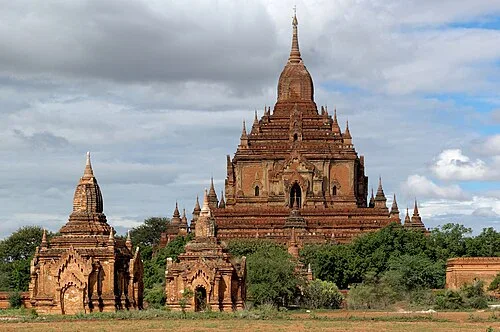 Htilominlo Temple
King Htilominlo built this temple around 1218, late in the great age of royal construction at Bagan. It is a massive brick pile on three storeys. It rises about forty-six metres, laid out with the settled symmetry of a mature style. By then the plain was already crowded. The ground around Old Bagan was packed with monuments, and new building had shifted east, into clusters around monasteries. The donors were changing too. Researchers suggest that endowing a small monument of one's own had become more widely accessible, so more private individuals paid for modest shrines, and monasteries multiplied. Royal temples of this size grew rarer as the century went on. One modern note: when a major earthquake struck near Bagan in March 2025, Htilominlo came through without structural damage.
Listen in the appJakub Hałun · CC BY-SA 4.0
04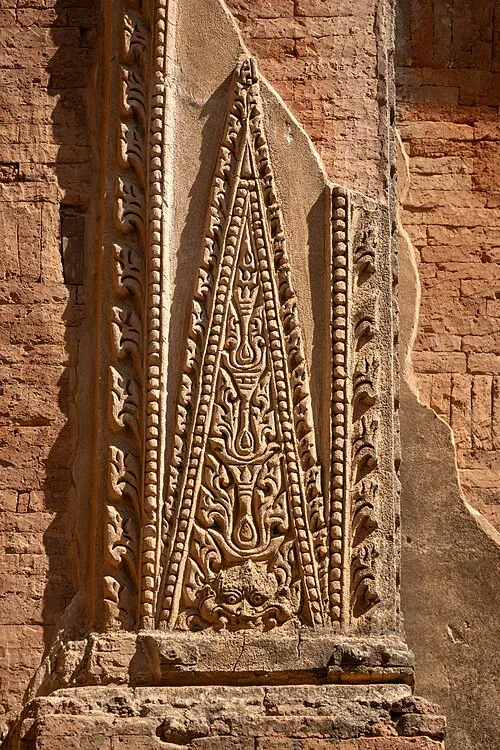 Htilominlo Temple
Stucco Decoration at Htilominlo Temple
Bagan's builders loved plaster. Over bare brick they laid fine stucco and carved it into relief, and the pediments of the temples were often dressed this way. The panel here shows the craft at its best: a tall tapering ornament of foliage scrolls, edged with rows of moulded beads, all worked over brick. At its base crouches a small guardian face, wide-eyed and fanged. Guardian figures of this kind were a favourite theme of the period, with ogres set in pairs or series along temple walls. Much of Bagan's stucco has weathered away. What survives here shows how richly the temples were once finished.
Listen in the appPhoto: No(0)GoodNamesLeft · CC BY-SA 4.0
05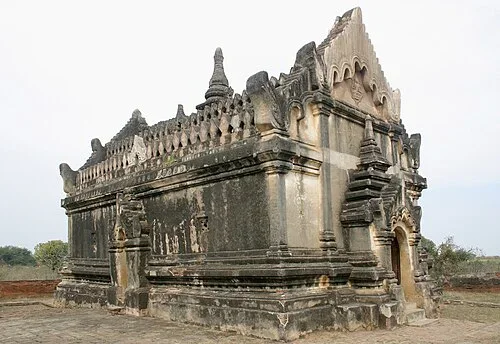 Upali Ordination Hall
An ordination hall is where new monks are received into the Buddhist order, and Upali Thein is a rare survivor of one built in brick. Its bright interior paintings are not from Bagan's imperial centuries. They belong to the Konbaung dynasty, which ruled Burma in the eighteenth and nineteenth centuries and sponsored systematic renovations of the old monuments. The renovators repainted temples with new frescoes laid over the originals, set up new Buddha statues, and added many painted inscriptions. They were not always gentle with the fabric. Critics dismissed some of the finished work as "a rude plastered surface, scratched without taste, art or result", and some temple interiors were simply whitewashed. Still, the campaigns kept the monuments in worship, and this hall's walls now carry some of the brightest painting left at Bagan.
Listen in the appPhoto: Gerd Eichmann · CC BY-SA 3.0
06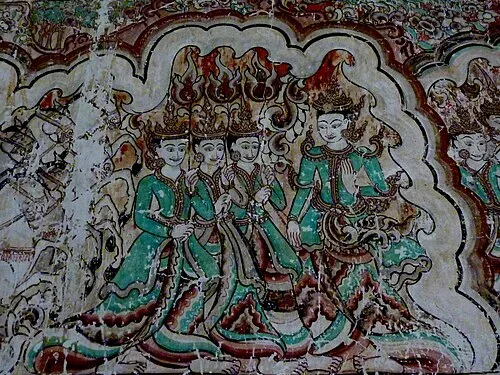 Upali Ordination Hall
Mural of Buddha Gotama's Renunciation, Upali Ordination Hall
One panel here catches the young prince at the moment he leaves palace life behind. A crowned figure moves through a crowd of attendants, each under a flaming aureole, the fiery halo of a sacred departure. The painters dressed the scene in the courtly style of their own day: green and red silk, jewelled crowns, faces turned toward the prince. The subject is the renunciation of Gotama, the moment the future Buddha gave up his royal life for the search that ended in awakening.
Listen in the appPhoto: Anandajoti · CC BY-SA 3.0
07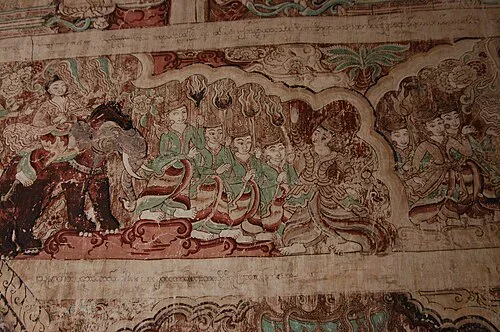 Upali Ordination Hall
Mural Frieze with Elephant, Upali Ordination Hall
Along another wall runs a frieze of a procession. An elephant walks at the left, with riders and seated figures in green and red following behind. Beneath the whole band runs a line of painted script. That pairing was typical of the later renovation campaigns, when murals were added together with painted inscriptions. The words sit beside the picture, so the painting and its text travel along the wall as one.
Listen in the appChris and Denis Luyten-De Hauwere · CC BY 4.0
08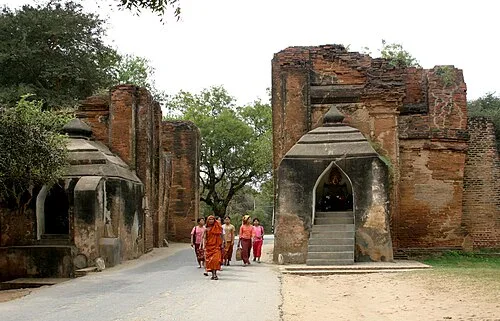 Tharabha Gate
The old city wall of Bagan survives in one place, and this gate is it. Two accounts tell how the city began. The Burmese chronicles say Bagan was fortified in 849 by King Pyinbya, the thirty-fourth successor of the city's founder. Western scholarship tells it differently: the city was founded in the mid-to-late ninth century by the Mranma, the Burmans, who had recently come down into the Irrawaddy valley from the kingdom of Nanzhao. Either way, the walled town grew into the capital of an empire. Its classical Pali name was Arimaddanapura, the City that Tramples on Enemies. The walls enclose only a small part of the monument field, far smaller than the walled area of the old Pyu cities. That has led researchers to call Old Bagan an elite core, not an urban boundary. Most people lived and worshipped outside these walls, along the riverbank.
Listen in the appPhoto: Gerd Eichmann · CC BY-SA 3.0
09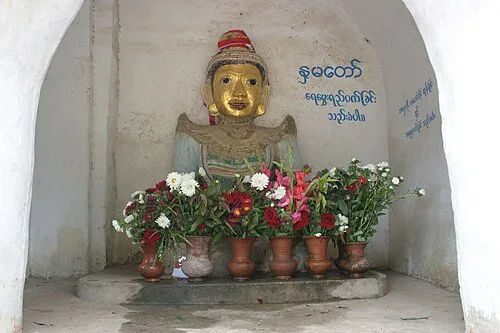 Tharabha Gate
Nat Shrine at Tharabha Gate
Inside the arch of the old gate sits a gilded spirit figure, wreathed in fresh flowers. The figure is a nat, a spirit of the native Burmese tradition. Religion at Bagan was fluid and, by later standards, unorthodox. From the Pyu era onward, Theravada Buddhism shared the ground with Mahayana and Tantric Buddhism, with Hindu schools, and with the nat cults. Royal patronage made Theravada dominant from the mid-eleventh century, but the other traditions kept thriving through the Pagan period, to degrees later unseen. A spirit shrine at the city gate made perfect sense to the people who passed beneath it. The flowers are renewed, and the spirit keeps its post.
Listen in the appPhoto: Gerd Eichmann · CC BY-SA 3.0
10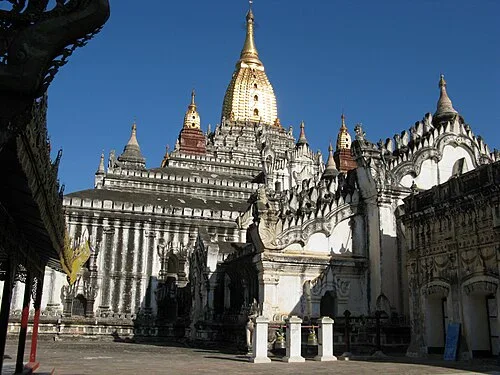 Ananda Temple
King Kyansittha raised the Ananda Temple in 1105, and it remains one of the most celebrated temples at Bagan. The design is traditionally credited with Mon influence, part of the mixing of styles that shaped early building on the plain, and its proportions have been admired ever since. Terraces rise in tiers to a golden spire, and ornate niches pattern the pale walls below. Kyansittha's reign consolidated the unified kingdom, and a temple of this scale announced it. Through the imperial period and after, the Ananda stayed one of the few temples pilgrims made a point of visiting, which is why it kept its upkeep while thousands around it crumbled.
Listen in the appVyacheslav Argenberg · CC BY 4.0
- 11
Ananda Temple Corridor
Inside the vaulted corridor circuit of a hollow gu temple.
- 12
Great Standing Buddha, Ananda Temple
One of Ananda's towering gilded standing Buddhas, layered with gold by generations of devotees.
- 13
East Shrine, Ananda Temple
Why Ananda keeps a great Buddha at each of the four cardinal points.
- 14
Shwesandaw Pagoda
The five-tiered relic pagoda of King Anawrahta, and the story of the whole temple plain in miniature.
- 15
Reclining Buddha near Shwesandaw
A monumental reclining Buddha resting under a vaulted brick ceiling, flowers at its head.
- 16
Pitaka Taik Library
The royal library built to house the scriptures carried off from conquered Thaton.
- 17
Shwegugyi Temple
The elegant temple of King Alaungsithu, where the old king was killed by his own son.
- 18
Mahazedi Pagoda
A stepped, bell-shaped stupa that shows mid-period Bagan geometry at its most balanced.
- 19
Ngakywenadaung Pagoda
A rare bulbous stupa of glazed brick, a survivor from before the empire's great age.
- 20
Nathlaung Kyaung Temple
One of the surviving Hindu temples at Bagan, standing in a sea of Buddhist monuments.
- 21
Vishnu Statue, Nathlaung Kyaung
A four-armed Vishnu carved in an arched niche, a trace of Hindu worship at Bagan.
- 22
Thatbyinnyu Temple
The tallest temple on the Bagan plains, rising more than sixty metres in white stucco.
- 23
Pahto-tha-mya Temple
An early temple whose dark, window-filtered interior makes a chamber for quiet thought.
- 24
Mahabodhi Temple, Bagan
A brick pyramid of niched Buddhas, built as a replica of the temple at Bodh Gaya itself.
- 25
Bupaya Pagoda
A golden bulb on the riverbank, the oldest shape of stupa at Bagan, rebuilt after the 1975 earthquake.
- 26
Gawdawpalin Temple
A late royal masterpiece that shows the two great family lines of Bagan's hollow temples.
- 27
Bagan Archaeological Museum
The museum that keeps the Myazedi inscription, the four-language stone often called the Rosetta Stone of Burma.
- 28
Birth of Buddha Relief, Bagan Archaeological Museum
A carved stone relief of the Buddha's birth, one piece of the museum's Bagan-period sculpture.
- 29
Statue of King Kyansittha
A modern bronze of King Kyansittha, the builder of the Ananda, remembered today with a spear and a carved arch.
- 30
Mingalazedi Pagoda
The last of the great royal stupas, and the story of how Bagan's empire fell and the city faded into a quiet backwater.
- 31
Gubyaukgyi Temple (Myinkaba)
The 1113 temple of Prince Yazakumar, whose dark corridors carry some of the oldest Jataka murals at Bagan.
- 32
Row of Disciples Mural, Gubyaukgyi (Myinkaba)
Ranks of haloed disciples painted shoulder to shoulder in ochre and white, deep in a dark corridor.
- 33
Bodhisattva Mural, Gubyaukgyi (Myinkaba)
A multi-armed bodhisattva painted beside the sanctuary passage, evidence of Mahayana currents under Bagan's Theravada surface.
- 34
Sanctuary Passage, Gubyaukgyi (Myinkaba)
The dim passage toward the sanctuary, where painted arches and seated Buddhas surface out of the gloom.
- 35
Manuha Temple
The temple of the captive Mon king Manuha, built in 1067 and tied to Bagan's most human legend.
- 36
Great Seated Buddha, Manuha Temple
The giant gilded Buddha at Manuha, pressed into a chamber barely large enough to hold him.
- 37
Nanpaya Temple
A rare sandstone temple beside the Manuha complex, traditionally the residence of the captive king.
- 38
Brahma Relief, Nanpaya Temple
The celebrated sandstone relief of a three-faced Brahma, framed in lotus petals and scrolling vine.
- 39
Abeyadana Temple
The temple traditionally ascribed to Queen Abeyadana, holding some of Bagan's rarest Mahayana and Tantric paintings.
- 40
Bodhisattva Painting, Abeyadana Temple
A crowned, lotus-holding bodhisattva glowing in gold and deep red on the walls of a queen's temple.
- 41
Nagayon Pagoda
An elegant early temple of the Myinkaba district, traditionally the work of King Kyansittha himself.
- 42
Naga-Canopy Buddha, Nagayon
A gilded Buddha seated beneath the spread hood of a serpent, one of Bagan's most distinctive sacred images.
- 43
Somingyi Monastery
A rare surviving brick monastery, a glimpse of the residential Bagan behind the famous temples.
- 44
Seinnyet Ama and Nyima Pagodas
A temple and stupa pair scanned with lasers after the 2016 earthquake, part of Bagan's digital rescue record.
- 45
Lawkananda Pagoda
A golden, still-worshipped stupa on the riverbank, marking where the old capital met the Irrawaddy.
- 46
Dhammayangyi Temple
The largest temple on the plain, and the darkest story attached to any of Bagan's kings.
- 47
Buddha Mural, Dhammayangyi
A quiet painted Buddha with his alms bowl, deep inside Bagan's biggest temple.
- 48
Sulamani Temple
The vaulted masterpiece that proves Bagan's masons knew a building trick the world later forgot.
- 49
Fresco of a Kneeling Devotee, Sulamani
A kneeling devotee offering flowering branches, painted into the temple he helped to endow.
- 50
Dhammayazika Pagoda
A pentagonal stupa built to honor five Buddhas at once, an architectural idea born at Bagan.
- 51
Payathonzu Temple
Three temples joined into one building, a late-empire experiment rising in the eastern plain.
Bagan
Frequently asked questions
How much does the guide cost?
Free app download. Listed guide price: $4.99. Guide price shown in the app. Audio guide only. Venue admission is separate.
Can I listen without internet?
Yes. Download the guide’s audio, images, and maps in the app before your visit. Your downloaded content is then available offline.
Can I listen in my language?
This audio guide is available in 15 languages, including English.
Do I need to follow a schedule?
No. This is a self-guided experience. Choose your stops, pause whenever you like, and return to a story at your own pace.
At your own pace
Explore Bagan.
Download Stanza, then search for “Bagan”.
Free app download · Guide price shown in the app
Keep exploring
Audio guides — Myanmar
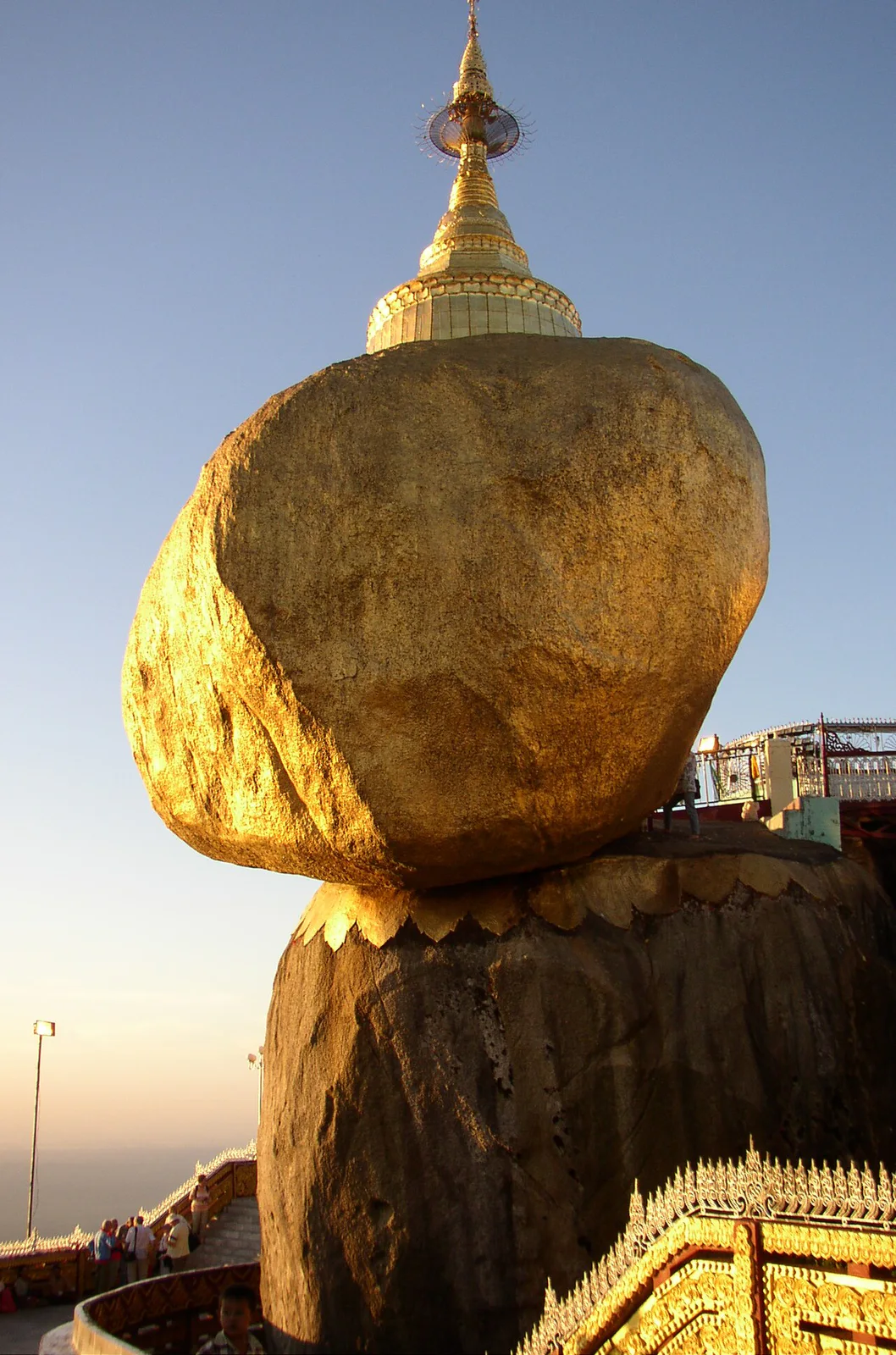
Kyaiktiyo
Kyaiktiyo Pagoda
Content & sources
Photo: Andre Lettau · Attribution
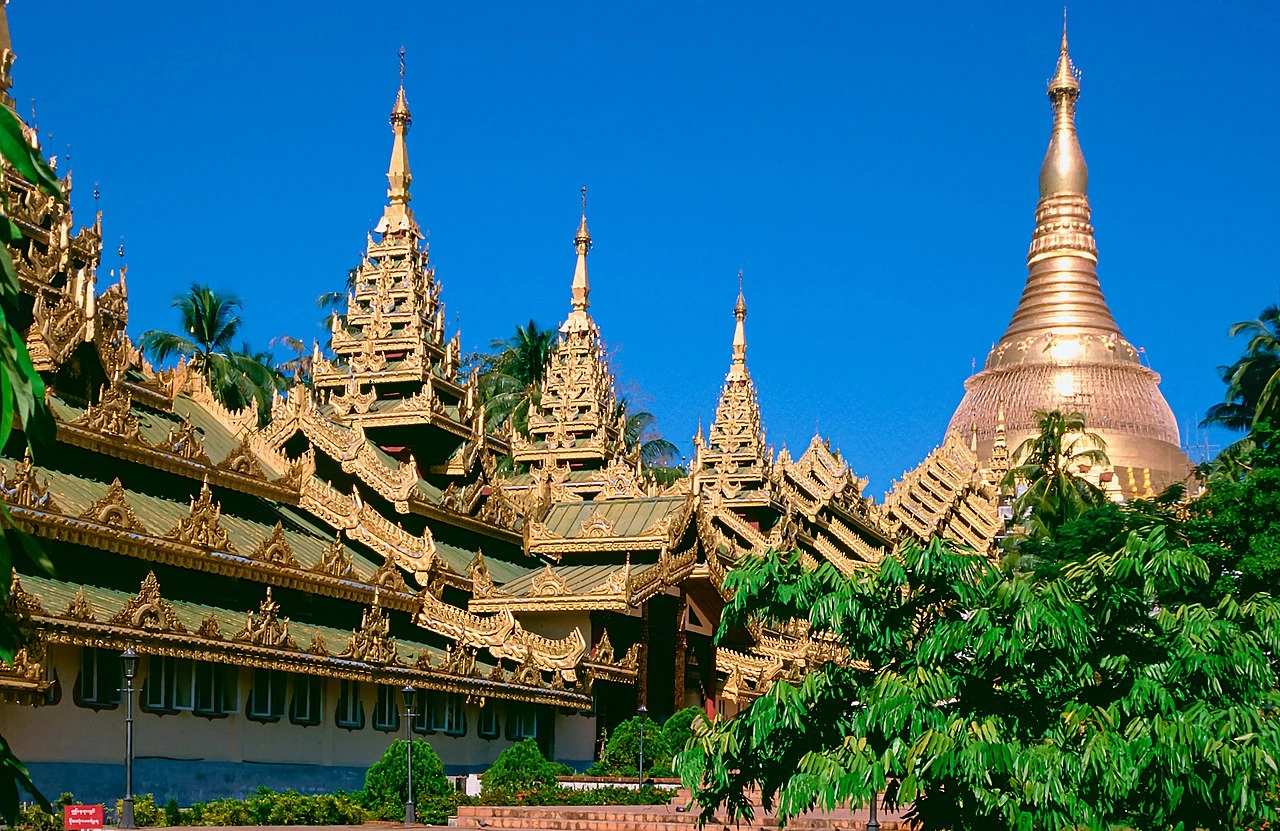
Yangon
Shwedagon Pagoda
Content & sources
Stefan Fussan · CC BY-SA 3.0