Stanza · Audio guide
Twyfelfontein Audio Guide
A place to remember. A story to take with you.
Twyfelfontein is a site of ancient rock engravings located in the Kunene Region of Namibia. It consists of a spring in a valley flanked by the slopes of a sandstone table mountain.
Download Stanza, then search for “Twyfelfontein”.
About the tour
One guide. Your kind of visit.
Twyfelfontein is a site of ancient rock engravings located in the Kunene Region of Namibia. It consists of a spring in a valley flanked by the slopes of a sandstone table mountain.
Ready when you are.
- 01Get the free Stanza app.
iOS & Android
- 02Find your guide.
“Twyfelfontein”
- 03Download before you go.
Works offline
Audio guide / 13 narrated stops
Inside the guide
Get to know a few of the stories before you go. Open a stop to read more.
01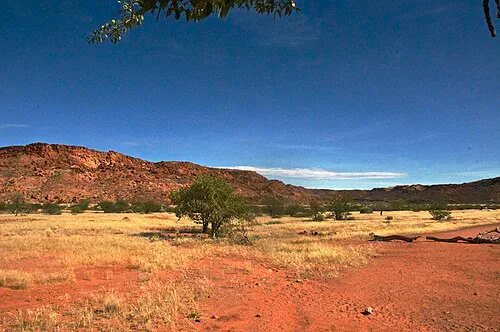 Valley Entrance and Trailhead
Valley Entrance Across the Dry Sandstone Setting
Welcome to Twyfelfontein, a valley in the Kunene Region of north-western Namibia. This tour follows the valley's rock art, from the spring at its heart to the engravings and paintings on its stone. The land is dry, a mix of semi-desert, savanna and scrubland. The valley gets less than a hundred and fifty millimetres of rain a year. Its water comes from an aquifer, a layer of rock that holds water underground. The aquifer sits on a layer of shale that water cannot pass through, which keeps a spring running in this dry country. The valley is flanked by the slopes of a sandstone mountain with a flat top. People have lived here for about six thousand years, first hunter-gatherers and later Khoikhoi herders. The Damara and Nama people call the place ǀUi-ǁAis, which means jumping waterhole. The Afrikaans name is Twyfelfontein. In 2007 UNESCO approved the valley as Namibia's first World Heritage Site, for one of the largest concentrations of rock engravings in Africa.
Photo: Lidine Mia · CC BY-SA 4.0
02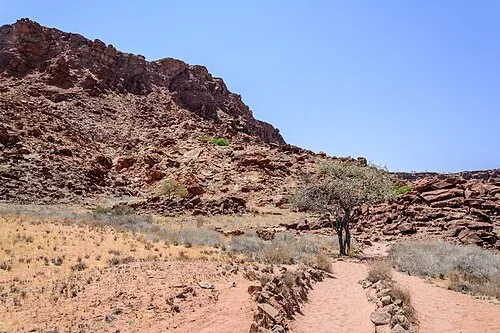 Valley Entrance and Trailhead
Stone-Edged Path Below the Escarpment
In 1952 the South West African administration declared the area a National Monument. Even so, the site was left without guards until 1986, when the whole area became a nature reserve. In those years many of the engravings were damaged or removed, and visitors left their own graffiti on the sandstone slabs. The hiking trail also allowed visitors unsupervised access, and it ran too close to many of the rock-art sites. Site management has improved since the valley applied for World Heritage status, and unsupervised hiking is no longer allowed. UNESCO also voiced concern about a lodge that sits inside the buffer zone, in an area called the Place of Ceremonies. It said the lodge had severely compromised the integrity of the engravings in that area. The buffer zone, about ninety-two square kilometres, was drawn to protect the valley's visual setting.
Domenico Convertini from Zurich, Schweiz · CC BY-SA 2.0
03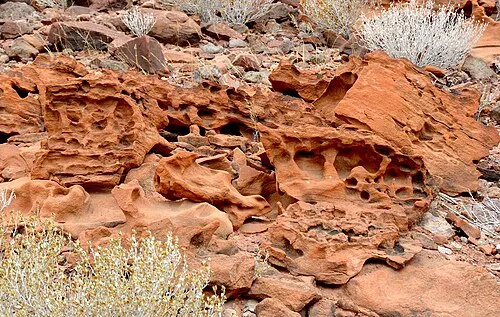 Sandstone Escarpment and Desert Varnish
Tafoni Weathering in Red Sandstone
Some of the rock at Twyfelfontein is pitted with hollows that look like a honeycomb. The name for this kind of weathering is tafoni. Up close, the hollows can look almost like carvings, but they formed naturally. Nobody cut them. An engraving is different, a line that someone cut into the rock. The sandstone with these hollows is the same stone that carries the engravings.
Listen in the appPhoto: Olga Ernst · CC BY-SA 4.0
04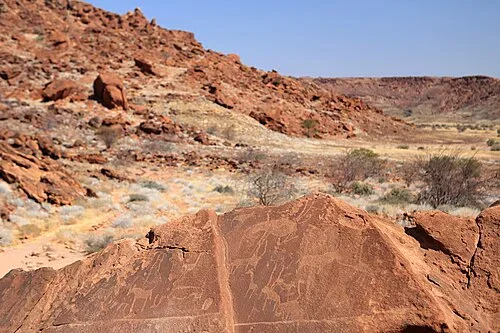 Sandstone Escarpment and Desert Varnish
Engraved Sandstone Boulder Above the Valley
The engravings here were made by chiselling through a dark skin on the rock. That skin is desert varnish, a hard coat that looks brown or dark grey. Beneath it, the sandstone is much paler. Each cut through the varnish shows as a light line on dark stone. The marks built up slowly, over thousands of years. In 1950 Ernst Rudolph Scherz began the scientific study of the rock art. He described over two thousand five hundred engravings. They lay across two hundred and twelve sandstone slabs. Today the estimate is more than five thousand depictions.
Listen in the appMartin Cígler · CC BY-SA 3.0
05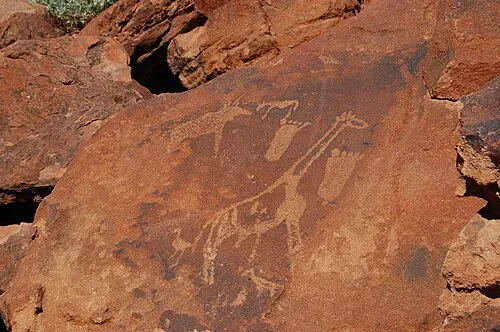 The Seven Slabs (Die Sieben Tafeln)
Giraffe Engraving Among Other Figures
The Seven Slabs hold a clear giraffe with a long, curving neck, engraved among many other figures. Nearby are rounded marks. They could be footprints or animal spoor, the tracks an animal leaves behind. Which is which remains uncertain.
Listen in the appUploaded on 7. Januar 2009 by jthetzel · CC BY 2.0
06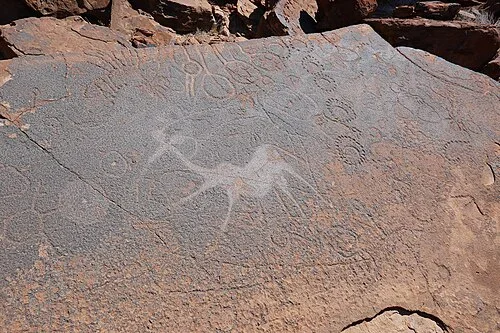 The Seven Slabs (Die Sieben Tafeln)
Pecked Circles Over an Animal Engraving
The circles on this slab lie over an animal, so the animal was engraved first. The hunter-gatherers of the Wilton culture made most of the valley's engravings, and this older animal probably belongs to their work. Much later, Khoikhoi herders, a people related to the San, occupied the valley two to two and a half thousand years ago. The pecked circles may belong to that later layer. The herders made the valley's geometric designs, which probably show herder groups. For this slab, though, the link is hard to be sure of. New carvings probably stopped around the year 1000, when other pastoral tribes arrived.
Listen in the appPhoto: Ji-Elle · CC BY-SA 4.0
07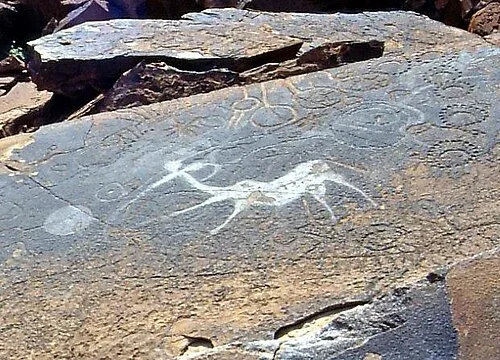 The Large Living Area (Die Große Wohnfläche)
The Dancing Kudu Engraving
The Dancing Kudu is one of the valley's most striking engravings. The site's own label for it is Fabeltier, a German word for a mythical creature. Its body is that of a horned kudu bull, a large antelope, but its legs are those of a giraffe. The figure is stretched and arched, with long legs reaching out, and pecked circles surround it. Joining one animal's body to another animal's legs suggests a figure of the imagination rather than one animal drawn from life. The engraving sits in a part of the valley called the Large Living Area.
Listen in the appThomas Schoch · CC BY-SA 3.0
08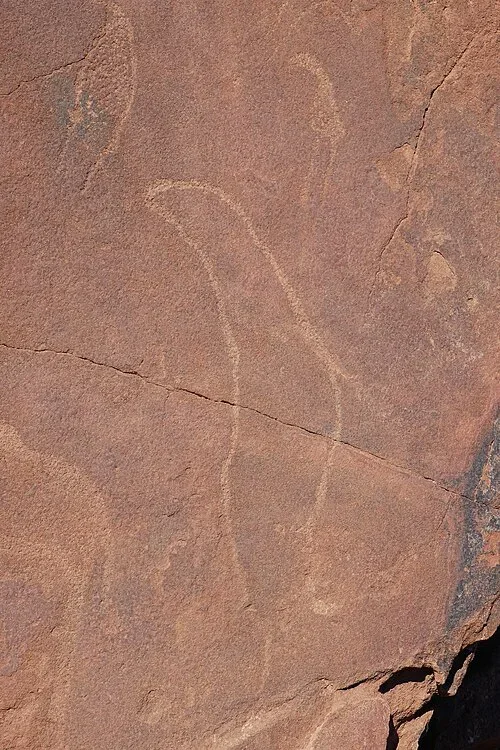 The Large Living Area (Die Große Wohnfläche)
Engraving Traditionally Identified as a Sea Lion
A long, finely cut engraving here has traditionally been called a sea lion. Scherz, the surveyor, also reported an engraving resembling a penguin. Animals like these do not live in this area, and the coast is more than a hundred kilometres away. Some people suggested that the hunter-gatherers might have ventured to the coast. A later survey led by Sven Ouzman questions Scherz's descriptions. It calls these figures rough depictions of creatures that did live in this valley.
Listen in the appPhoto: Ji-Elle · CC BY-SA 4.0
09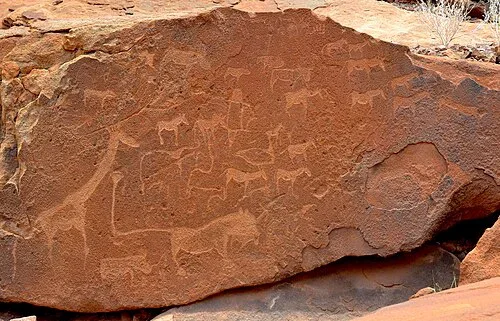 The Right Valley Side and Lion Man Slab
Lion Plate with the Lion Man Engraving
This slab, known as the Lion's Slab, carries the valley's most prominent figure, the Lion Man. It shows a lion with human-like toes and an extremely long, rectangular tail. The tail has a kink in it and ends in a pugmark, which is an animal's footprint. The figure probably shows a human being turned into an animal. Together with the animal tracks in the valley, that transformation makes it likely the engravings were made during shamanist rituals.
Listen in the appPhoto: Olga Ernst · CC BY-SA 4.0
10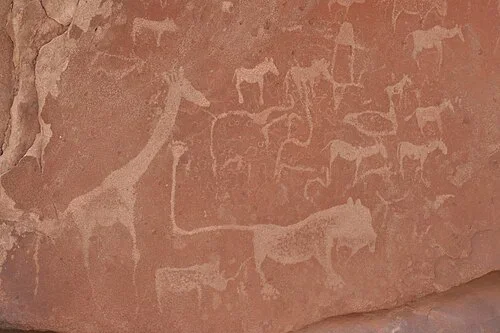 The Right Valley Side and Lion Man Slab
Giraffe and Lion Engraving Panel
A giraffe stands on the left of this crowded slab, and a large cat-like figure, probably a lion, sits low in the middle. Many smaller animals fill the spaces around them. One simple reading is that scenes like this show what hunters wanted to catch. That reading is now thought too simple. The bones dug up at Twyfelfontein do not match the large animals carved here. The food remains from the site are bones of small antelope, rock dassies, which live among rocks, and even lizards.
Listen in the appPhoto: Ji-Elle · CC BY-SA 4.0
- 11
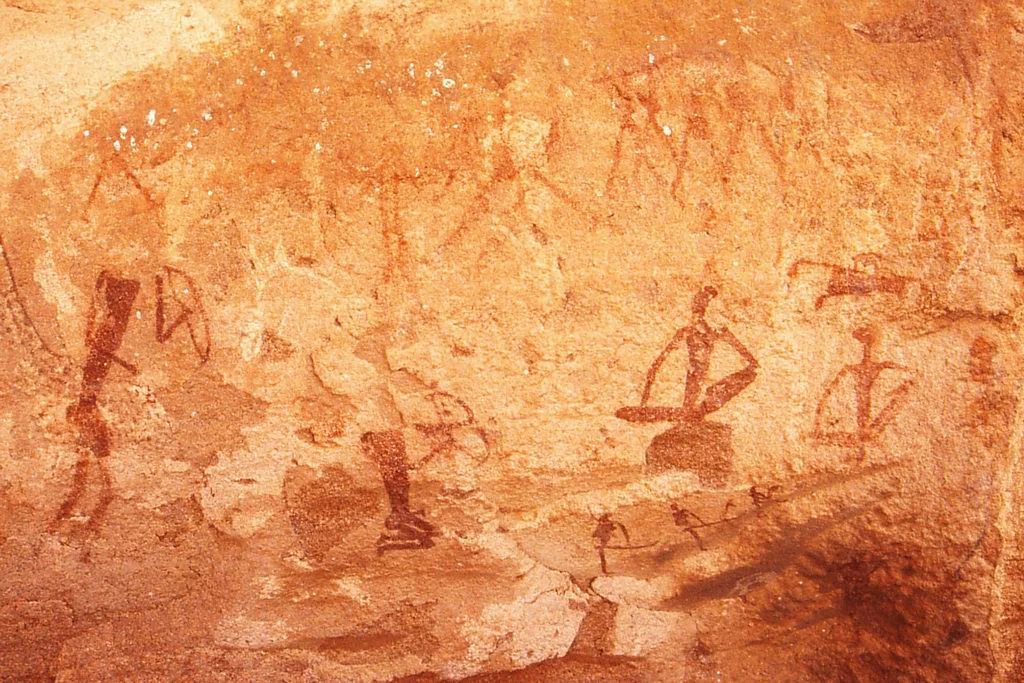
Red Ochre Painted Figures in a Rock Shelter
Red ochre figures painted under a rock overhang, a rare pairing with the valley's engravings.
- 12
Ruined Farm Walls in the Valley
How a farmer's doubts about his spring gave the valley its name.
- 13
Lion's Mouth Rock Formation
A sandstone outcrop with a dark arched hollow, and a last look at what the valley meant to the people who made its art.
Twyfelfontein
Frequently asked questions
How much does the guide cost?
Free app download. Listed guide price: $1.99. Guide price shown in the app. Audio guide only. Venue admission is separate.
Can I listen without internet?
Yes. Download the guide’s audio, images, and maps in the app before your visit. Your downloaded content is then available offline.
Can I listen in my language?
This audio guide is available in 15 languages, including English.
Do I need to follow a schedule?
No. This is a self-guided experience. Choose your stops, pause whenever you like, and return to a story at your own pace.
At your own pace
Explore Twyfelfontein.
Download Stanza, then search for “Twyfelfontein”.
Free app download · Guide price shown in the app
Keep exploring
Audio guides — Namibia
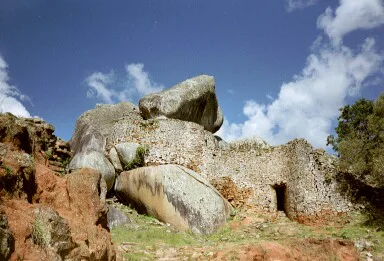
Nemanwa Growth Point
Great Zimbabwe
Content & sources
Photo: Atamari · CC BY-SA 3.0