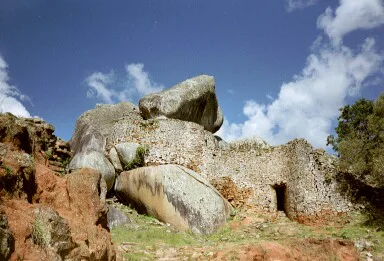
Stanza · Audio guide
Great Zimbabwe Audio Guide
A place to remember. A story to take with you.
Great Zimbabwe is a ruined city in the south-eastern hills of Zimbabwe that served as the capital of the Kingdom of Great Zimbabwe from the 13th century. It is the largest stone structure in precolonial…
Download Stanza, then search for “Great Zimbabwe”.
About the tour
One guide. Your kind of visit.
Great Zimbabwe is a ruined city in the south-eastern hills of Zimbabwe that served as the capital of the Kingdom of Great Zimbabwe from the 13th century. It is the largest stone structure in precolonial Southern Africa and is recognised as a World Heritage Site by UNESCO.
Ready when you are.
- 01Get the free Stanza app.
iOS & Android
- 02Find your guide.
“Great Zimbabwe”
- 03Download before you go.
Works offline
Audio guide / 18 narrated stops
Inside the guide
Get to know a few of the stories before you go. Open a stop to read more.
01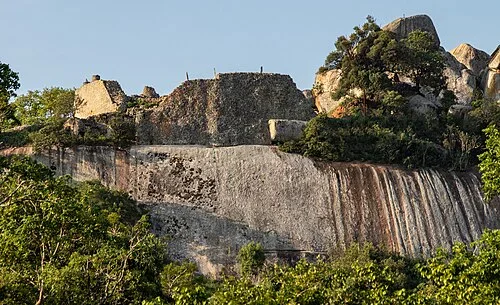 Site Museum & Spiritual Roots
The Hill Complex from Below
Welcome to Great Zimbabwe, in the south-eastern hills of the country that now carries its name. The ruins rising over this granite dome were once a royal capital, the largest stone structure in precolonial Southern Africa. People settled here from around the year 1000, and from the thirteenth century the city ruled a kingdom that stretched across some fifty thousand square kilometres. Its builders were ancestors of the Shona people. The city was made of three great parts, and the tour follows all of them. The Hill Complex crowns the hilltop. The Valley Complex spreads across the ground below, where most citizens lived. And the Great Enclosure, with its immense curved walls, stands further on. Together they cover more than seven square kilometres, an area close to that of medieval London. UNESCO lists the site as World Heritage. The story begins on the hill.
Andrew Moore · CC BY-SA 2.0
02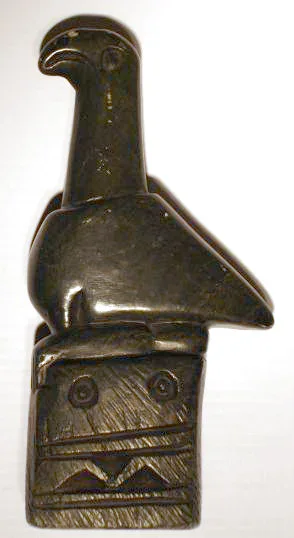 Site Museum & Spiritual Roots
The Soapstone Zimbabwe Bird
Eight carved birds of soapstone are the most treasured finds from these ruins. Each was cut from the top of a monolith as tall as a person, like the one here. They are thought to represent the bateleur eagle, in Shona belief a good omen, a protective spirit, and a messenger of God. Slots cut into a platform in the Eastern Enclosure of the hill seem designed to hold the monoliths. But none of the birds was found standing in place, so their original arrangement can no longer be known. Willi Posselt was the first looter to reach them. He removed one bird and hid others, meaning to come back for them. After him came W. G. Neal's Ancient Ruins Company, which stripped the ruins of anything saleable and destroyed much of what it could not carry. Seven of the eight birds have since been returned to Zimbabwe.
J. Patrick Fischer · CC BY 3.0
03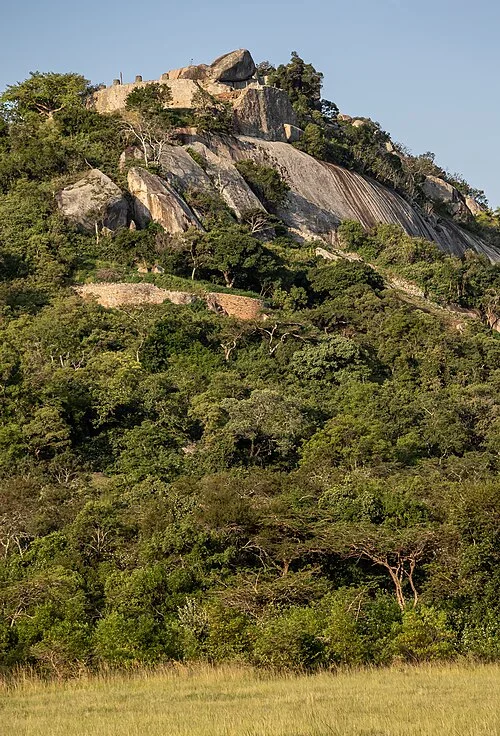 Ancient Ascent Path
Approaching the Hill Complex
The hill came first. Of the city's three sectors, the Hill Complex is the oldest, occupied from the eleventh to the thirteenth centuries. Only later did power spread down to the valley and to the Great Enclosure. So this summit was the city's first seat of rule, chosen long before the grandest walls were dreamed of. The builders worked with the rock rather than against it, raising their walls among and around the natural granite boulders. Structures cling to terraces partway up the slope, with more waiting at the top. From below, the walls and the living rock are hard to tell apart, which is very much the point of the place.
Listen in the appandryn2006 · CC BY-SA 2.0
04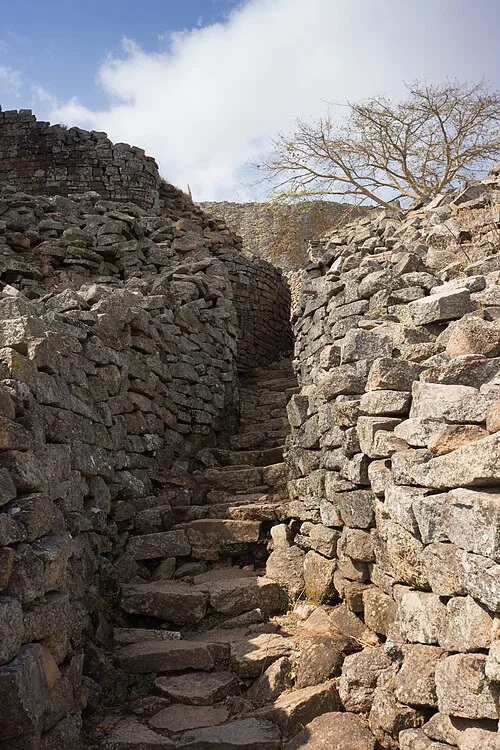 Ancient Ascent Path
The Stone Stairway
The climb to the summit still asks for effort, and it did in the city's day too. These rough stone steps were laid by the city's own masons, squeezed between two dry-stone walls that narrow the way to a single file. They probably formed part of the original access to the hilltop, one of several stairways built into the rock. A climb like this shaped who came and went. Anyone heading for the summit did it slowly, in view of the walls above, one person at a time. The path itself sorted the visitors from the residents.
Listen in the appFanny Schertzer · CC BY 3.0
05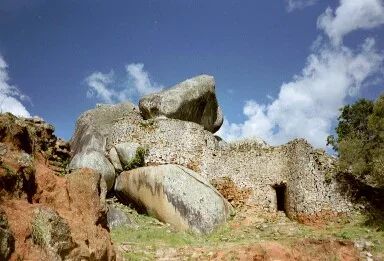 The Hill Complex Royal Shrines
The Boulder Walls
Here the walls are woven between the boulders, stone laid against living rock as if the two had grown together. That fusion carried the political idea that held the whole city together. The king was called the mambo, and his authority rested on a chain of connection between the rulers, their ancestors, and God, known as Mwari. Building stone permanently onto the eternal granite made that claim visible to everyone who climbed the hill. The architecture said what the ideology said: this rule was not new, and it would not pass. Scholars still debate what these summit enclosures were for, whether the royals actually lived here or the hill served them in other ways. Either way, the message in the masonry is the same.
Listen in the appPhoto: Atamari · CC BY-SA 3.0
06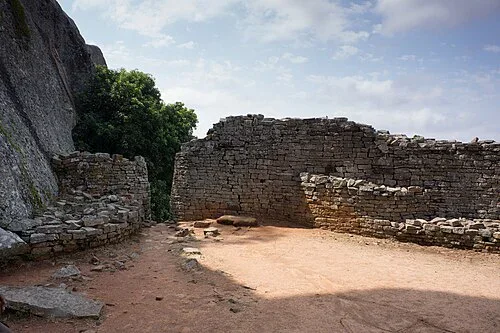 The Hill Complex Royal Shrines
The Sacred Enclosure
This enclosure was the shrine at the heart of the hill. The scholar Ken Mufuka has argued that it was home to the svikiro, the spirit mediums of the kingdom. Their task, in his account, was to act as the conscience of the state, speaking for the ancestors to the living. They also kept the traditions of the founding dynasties, among them Chigwagu Rusvingo, remembered as the first mambo. The mediums stood between the king's daily power and something older than any king. Whatever else happened on this hilltop, it answered to that authority.
Listen in the appFanny Schertzer · CC BY 3.0
07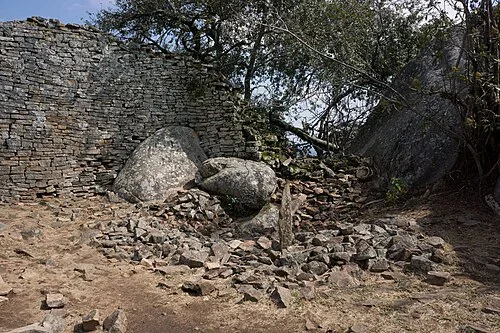 The Hill Complex Royal Shrines
The Presumed Funeral Chamber
The traditional name of this spot speaks of royal death: a funeral chamber. It is a chamber-like space, shut in between a wall and the boulders behind it. But the identification as a royal tomb rests on little, and it should be held loosely. No burials have been found anywhere at Great Zimbabwe to confirm how or where the kings were laid to rest. A Portuguese writer, João de Barros, recorded in the fifteen-thirties that the locals called the whole place Symbaoe, meaning a royal court. Royal it certainly was. Whether anyone was buried in this particular chamber, no one can say.
Listen in the appFanny Schertzer · CC BY 3.0
08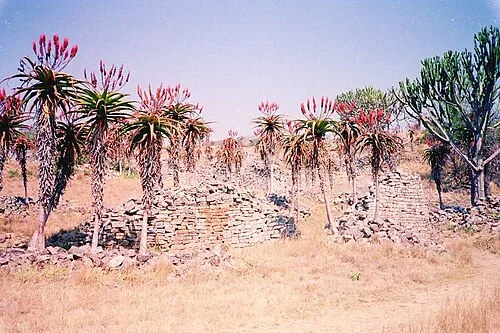 The Valley Complex & Commoner Life
The Valley Ruins
The aloes blooming among these low walls mark the ground of the commoner city. At its height in the fourteenth century, earlier guesses put the population near eighteen thousand. A more recent survey concluded it likely never exceeded ten thousand. Either way, most of those people lived not in stone but in houses of mud built on wooden frames. Their homes have all but vanished, leaving only the low stone remnants scattered across this ground. The stone structures that survive were the royal and official buildings, and the dwellings of the elite. More than four hundred smaller stone-walled sites of the same kind are known across Southern Africa, each called a zimbabwe, a word thought to mean houses of stone. That is why the word great was added to this one's name.
Listen in the appctsnow (Flikr user) · CC BY 2.0
09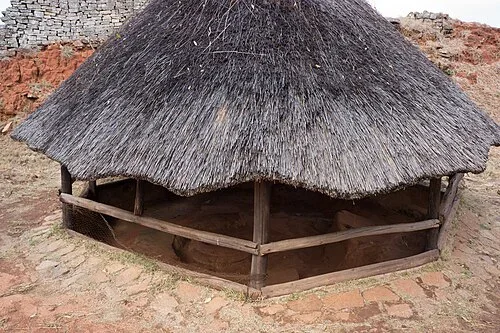 The Valley Complex & Commoner Life
The King's Room Reconstruction
The thatched roof and wooden posts of this round house are a modern reconstruction, raised over the archaeological remains. It shows how the elite built, because the city's real material for most buildings was earth and thatch, not stone. The ruling dynasty used its wealth to have houses made of thick daga, a heavy earthen daub, rather than the simple pole-and-daga of ordinary people. A thick daga wall took resources and labour that a commoner household could not command. The elite paired these grand houses with stone walls, raised to shield themselves from public view. So wealth in this city showed in two ways: in the height of an earthen wall, and in the stone that kept the wealthy out of sight.
Listen in the appFanny Schertzer · CC BY 3.0
10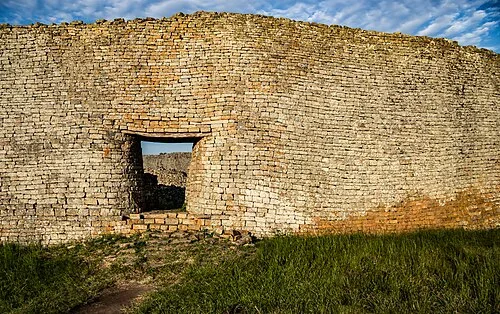 The Great Enclosure Outer Curtain Wall
Western Entrance to the Great Enclosure
Kings came and went through this gateway. The Great Enclosure was raised in the thirteenth and fourteenth centuries, and it probably served as the royal residence, with set-aside spaces for public ritual. Its curved outer wall is the most formidable in the city, reaching eleven metres at its highest. The entrance itself is a modest gap in all that stone: a lintel laid across the opening, more courses stacked above, and nothing else to announce who lived inside. Entry was the announcement. In the residence of the king, crossing this threshold marked a person as one of the permitted few. Early Portuguese accounts add a mystery: two of them mention an inscription above the entrance, written in characters the Arab merchants who saw it could not read. Whatever it said is gone. The scale leaves little doubt that this was where power lived in its day.
Listen in the appAndrew Moore from Johannesburg, South Africa · CC BY-SA 2.0
- 11
The Great Enclosure Wall
How a wall eleven metres high and a quarter of a kilometre long was built with nothing binding it.
- 12
The East Wall
The gold and ivory routes to the Indian Ocean that paid for a stone metropolis.
- 13
The Narrow Passage
Narrow, bending corridors built so that no one saw the king who was not meant to.
- 14
Between the Walls
The enclosure's plan in miniature: an inner wall, a younger outer wall, and the passages between.
- 15
The Conical Tower
A solid stone cylinder with no door and no answer, and the 1891 excavation that destroyed its dating evidence.
- 16
The Tower Enigma
Why the tower was built remains an open question, and the grain silo is the shape behind the leading theory.
- 17
The Enclosure from Above
How a capital of stone came to stand empty, and the ancestors said to have stayed behind.
- 18
The Exit Gate
From Sheba legends and censorship to World Heritage: the fight over who built Great Zimbabwe, and the nation that took its name.
Great Zimbabwe
Frequently asked questions
How much does the guide cost?
Free app download. Listed guide price: $2.99. Guide price shown in the app. Audio guide only. Venue admission is separate.
Can I listen without internet?
Yes. Download the guide’s audio, images, and maps in the app before your visit. Your downloaded content is then available offline.
Can I listen in my language?
This audio guide is available in 15 languages, including English.
Do I need to follow a schedule?
No. This is a self-guided experience. Choose your stops, pause whenever you like, and return to a story at your own pace.
At your own pace
Explore Great Zimbabwe.
Download Stanza, then search for “Great Zimbabwe”.
Free app download · Guide price shown in the app
Keep exploring
Audio guides — Zimbabwe
Ambohimanga Rova
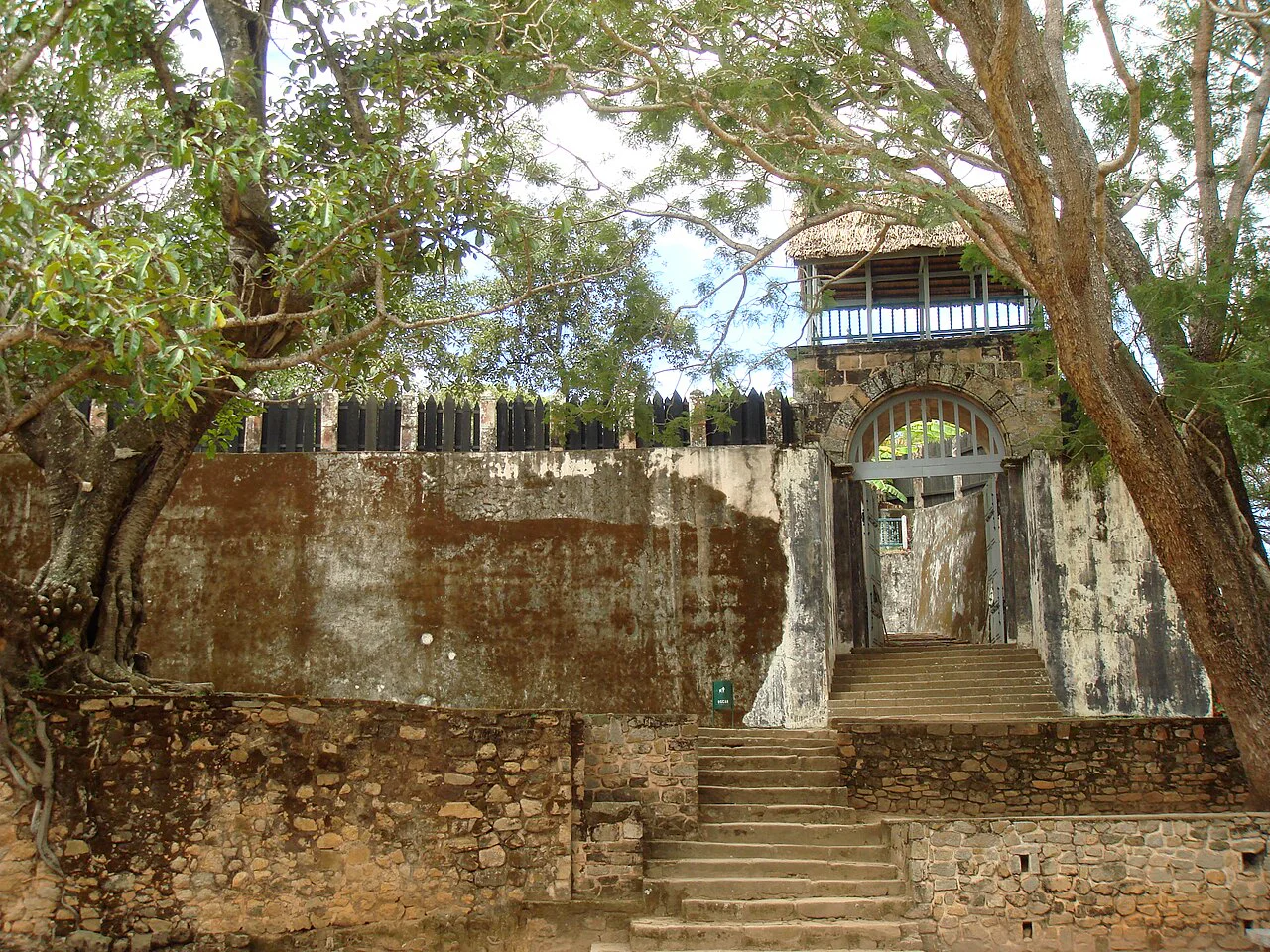
Ambohimanga
Content & sources
Olivier Lejade · CC BY-SA 2.0
Kunene Region
Twyfelfontein
Content & sources
Thomas Schoch · CC BY-SA 3.0