Stanza · Audio guide
Chagres and Fort San Lorenzo Audio Guide
A place to remember. A story to take with you.
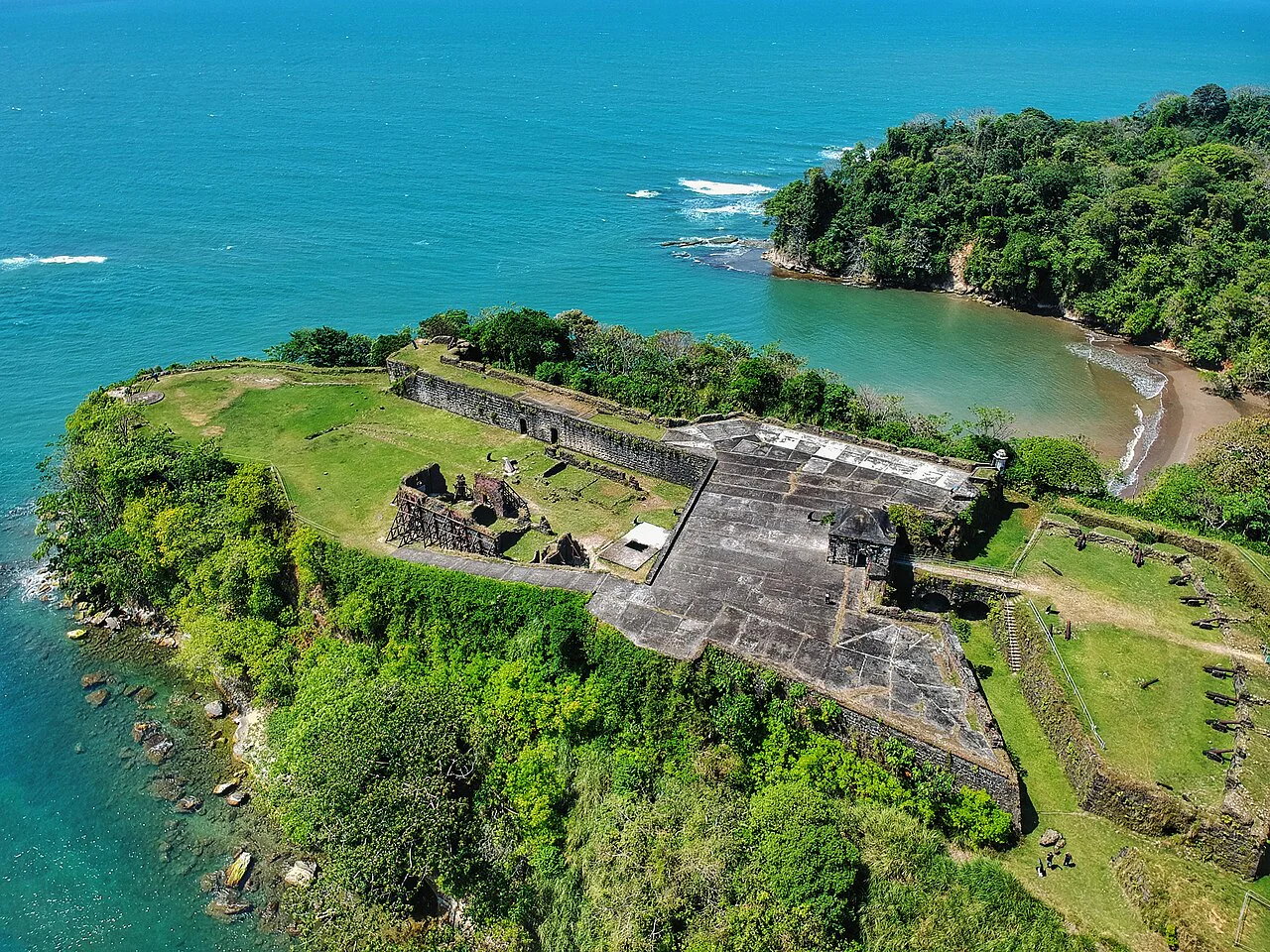
Fort San Lorenzo is a fort located on a promontory overlooking the mouth of the Chagres River in Panama. It is situated near the site of Chagres, which was once the chief Atlantic port on the isthmus.
Download Stanza, then search for “Chagres and Fort San Lorenzo”.
About the tour
One guide. Your kind of visit.
Fort San Lorenzo is a fort located on a promontory overlooking the mouth of the Chagres River in Panama. It is situated near the site of Chagres, which was once the chief Atlantic port on the isthmus.
Ready when you are.
- 01Get the free Stanza app.
iOS & Android
- 02Find your guide.
“Chagres and Fort San Lorenzo”
- 03Download before you go.
Works offline
Audio guide / 11 narrated stops
Inside the guide
Get to know a few of the stories before you go. Open a stop to read more.
01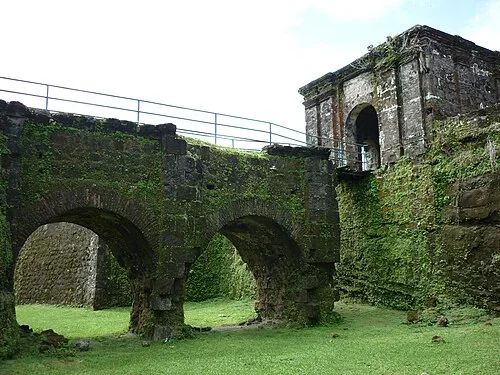 Landward Approach and Dry Moat
The Two-Arched Entrance Bridge
Welcome to Fort San Lorenzo, the Spanish fortress that guarded the mouth of the Chagres River on Panama's Caribbean coast. The stone bridge ahead crosses a deep dry moat, the first obstacle any attacker met from the land side. Behind it rises a heavy stone fort on a clifftop, watching over the river's entrance. Spain built this place for one reason: treasure. After conquering Peru, the Spanish Crown moved its silver and gold across the isthmus on mule trains, down the Chagres River, and out to the Atlantic ports of Nombre de Dios and later Portobelo. From about 1560, pirates began raiding Panama's coast, drawn by that same cargo. So King Philip the Second ordered fortifications here, and work began in 1598. The plans for the massive fortress came from Battista Antonelli, an Italian military engineer in Spanish service. The first works were finished in 1601 as a battery at sea level. The Spanish gave the fort a proud name: the sentinel of the great strategic triangle of the Isthmus. That idea of a watcher, guarding the meeting of river and sea, runs through everything here.
Rolando Armuelles Velarde · CC BY-SA 3.0
02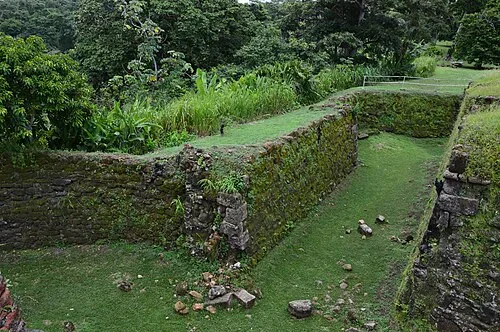 Landward Approach and Dry Moat
The Dry Moat and Outer Walls
The walls and moat here tell of a second, later fortress. What stands today is largely the work of the 1700s, after two centuries of pirate raids and enemy attacks had shown the old defenses wanting. In 1739 and 1740 the British admiral Edward Vernon struck at the Spanish strongholds of Portobelo and Chagres. Spain answered by shifting its weight: as Portobelo declined, Chagres rose to be the chief Atlantic port of the isthmus, and its defenses had to match. Under the Bourbon reforms, a program of renewal across the Spanish empire, engineer Manuel Hernández directed the rebuilding of this fortress between 1761 and 1768. He deepened the moat that was already here. He completed the hornwork and its bastions, the angled outworks that let defenders fire along the walls instead of only outward. He raised the high platform and the sea-facing batteries too. Everything was shaped by the progress of artillery and the new tactics of siege and assault. The works bent to the terrain, but they also brought the latest engineering of the age to this clifftop.
Ivo Kruusamägi · CC BY-SA 4.0
03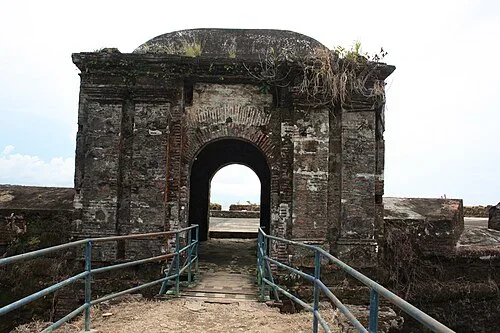 Hornwork Gatehouse and Spanish Royal Crest
The Hornwork Gatehouse
The gate is a heavy vaulted archway, layered with brick and rough masonry, adapted to every bend of the ground around it. This doorway carries the meaning of Hernández's whole project. Before his rebuild, the fort's parts stood separately, each defended on its own. He joined them into one stronghold, a closed fortress with its perimeter fully walled, so there was no way in except through a gate like this one. Every soldier, every supply cart, every order from Spain passed under an arch such as this, past guards who decided what entered and what stayed out. That single controlled entrance was the whole point of the design. A fortress with one door is a fortress that can be held by few men.
Listen in the appPhoto: Xeas23 · CC BY-SA 3.0
04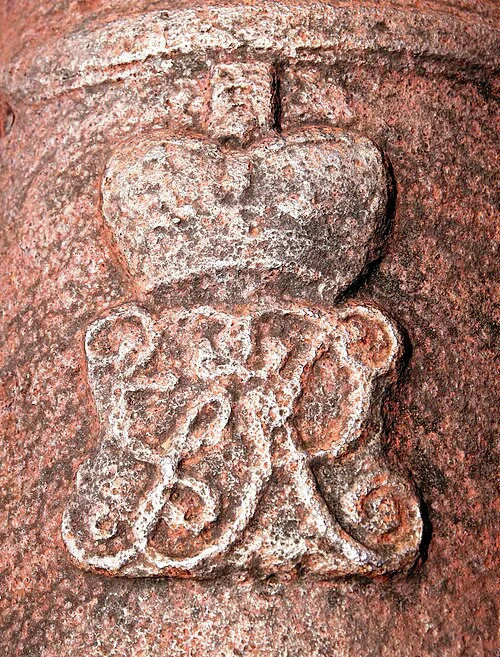 Hornwork Gatehouse and Spanish Royal Crest
The Royal Cypher on the Cannon
A crown, and beneath it a tangle of royal letters, carved in high relief and worn shallow by weather and time. This is the mark of the Spanish Crown, set into the stonework by the entrance. Royal arms like these announced whose authority the fortress served and whose treasury had paid for it. Which king's initials these are cannot be said with certainty now; the carving has softened too far. But the message was clear enough to any soldier or any enemy. This clifftop belonged to the King of Spain, and its guns held the river mouth in his name.
Listen in the appPhoto: Magela Cabrera Arias · CC BY-SA 3.0
05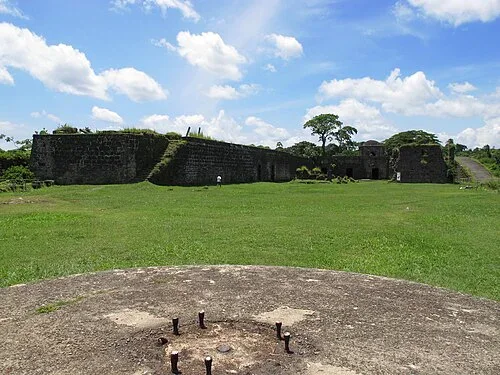 Central Parade Ground and Cistern
The Parade Ground
A broad green courtyard, ringed by walls and the low ranges of ruined buildings. In forts of this kind, this open ground was the parade ground, the garrison's common heart. Here the soldiers mustered for inspection and drilled with their arms. Here they took their meals, traded their duties, and passed the long stretches between watches on the walls. A posting at San Lorenzo meant a small company of men living inside a ring of stone, with the sea on one side and the river below. The space was kept clear on purpose, so that a hundred men could form up in minutes if a warning came from the towers. It is quiet grass now, but the layout still shows what it was for.
Listen in the appTomas Mendizabal · CC BY-SA 3.0
06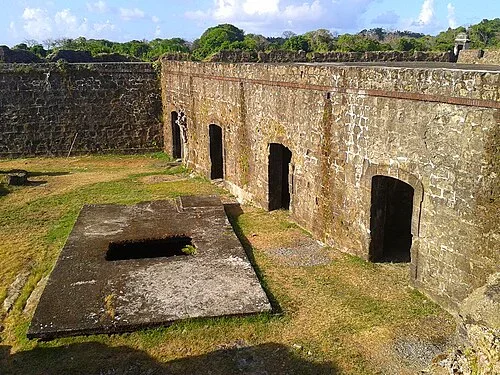 Central Parade Ground and Cistern
Storehouses and the Rainwater Cistern
In the courtyard there is a cistern of considerable diameter, built to collect rainwater from the roofs and channels of the fort. That one feature explains how this place survived. A post on a clifftop, supplied from across the sea, could not count on help arriving in time. When a blockade closed the river or a siege cut the roads, the garrison lived on what it had stored. Water was the most precious of all, and the cistern caught it from the sky, season after season. Beside it open the dark, vaulted doorways of the storehouses, where powder, biscuit, salt meat and tools were kept against the day they were needed. Together they made the fortress self-sufficient, able to hold out long after the last ship had gone.
Listen in the appTalia Madeleine · CC BY-SA 3.0
07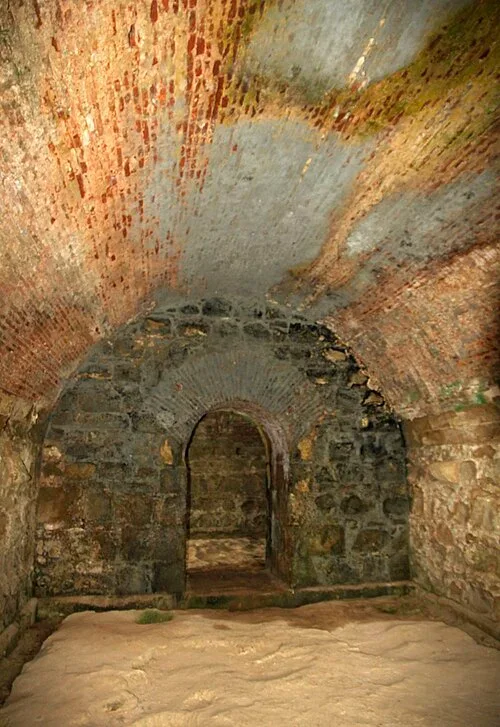 Subterranean Vaults and State Prison
The Underground Galleries
Underground, the fort keeps a second life. These galleries run under the walls in brick vaults, dim and cool, still evoking the colonial dungeons they became. In its later decades, San Lorenzo served the Spanish Crown as a state prison. One of its captives was Pedro José de Guzmán-Dávalos, Marquis of the Mina and Governor of the Kingdom of Tierra Firme, a high official of the empire now held in its own fortress. He lived in the dark cells here together with his wife, sharing the confinement. The pits of the prison also held Francisco Antonio de Zela, a Peruvian patriot of the American emancipation movement, imprisoned for rising against Spanish rule. The vaults may have stored gunpowder before they held prisoners, though that part of their story is not certain. What is sure is that the fort built to guard treasure ended its working years guarding men.
Listen in the appPhoto: Magela Cabrera Arias · CC BY-SA 3.0
08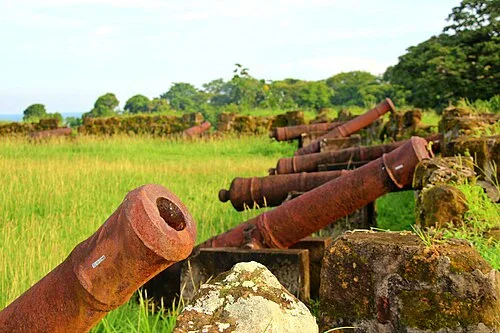 Upper Artillery Battery and Colonial Cannons
The Cannon Battery
Row after row of heavy iron cannons lie on their stone emplacements at the seaward batteries, green with age, still pointing over the grass toward the water. These are the last physical argument of the fortress, the guns that made the river mouth dangerous to approach. They stayed in place long after the soldiers left. In 1908 the historian Juan Bautista Sosa visited the fort and found the equipment still lying about: remains of the gun carriages, culverins and mortars, household utensils, and chains and shackles from the prison days. That same year Panama passed a law protecting historical monuments, and San Lorenzo was included among the sites it covered. The guns were left where they had been mounted, and there most of them remain.
Listen in the appPhoto: Hector alcibiades · CC BY-SA 3.0
09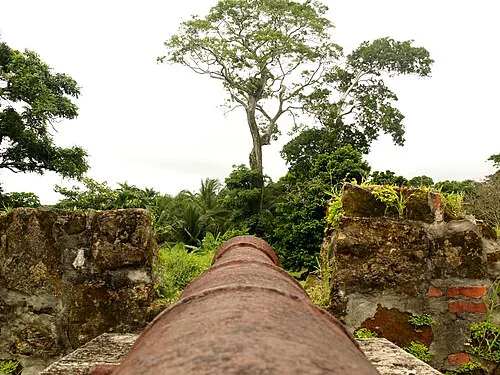 Upper Artillery Battery and Colonial Cannons
The Aimed Cannon and the 1671 Assault
This cannon looks straight out over the parapet, and its aim tells the fort's most famous story. The high cliff made the seaward side nearly impossible to attack, exactly as Antonelli had calculated when he chose the site. So when the pirates came, they agreed with him. On the sixth of January, 1671, Joseph Bradley took the fort, acting on orders from Henry Morgan. Bradley would not try the sea approach. He landed some four hundred men at a small port near the castle and came at it overland instead. The fort fell, and its destruction was the first move in Morgan's plan to strike old Panama City by way of the Chagres River. The attack left its mark on the defenses too. Excavations in 1966 uncovered a gun emplacement on the landward side, built to command the ground in front of the fort and prevent a surprise from behind, as had happened in 1671.
Listen in the appYorel Escovar · CC BY-SA 4.0
10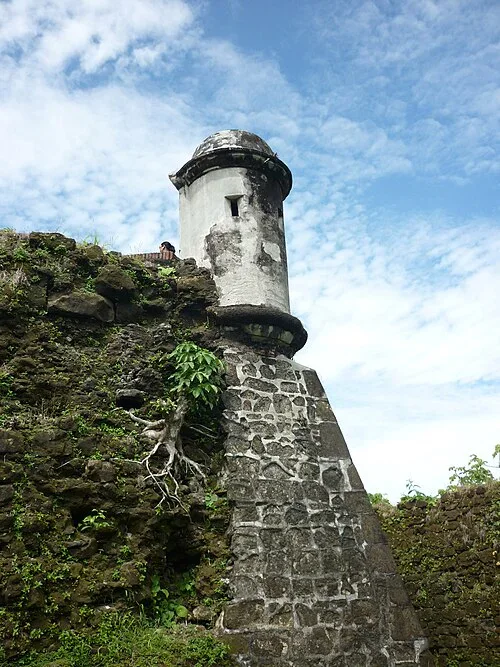 Clifftop Sentry and Chagres River Lookout
The Sentry Tower and the Spiral Stair
The little tower rises from the cliff edge, whitewashed and domed, with a single slit for watching the horizon. Watching was this fort's daily work. San Lorenzo kept signal stations and observation posts to warn of approaching fleets, giving Panama City and the ports time to prepare. The tower at the tip of the cliff holds a secret below. A stone spiral staircase winds down through it to a level under the earth, and on to the lower sea batteries at the base of the cliff, where guns sat almost at the waterline. Some say the tower itself was Antonelli's work, though that is a possibility rather than a certainty. Either way, the stair is the fort's hidden spine, a thread of stone connecting the watchman at the top to the gunners at the water's edge.
Listen in the appRolando Armuelles Velarde · CC BY-SA 3.0
- 11
The Chagres River Lookout
The river from the clifftop: Peru's silver, the gold rush boomtown, the canal that sealed the water, and the UNESCO verdict of 1980.
Chagres and Fort San Lorenzo
Frequently asked questions
How much does the guide cost?
Free app download. Listed guide price: $0.99. Guide price shown in the app. Audio guide only. Venue admission is separate.
Can I listen without internet?
Yes. Download the guide’s audio, images, and maps in the app before your visit. Your downloaded content is then available offline.
Can I listen in my language?
This audio guide is available in 15 languages, including English.
Do I need to follow a schedule?
No. This is a self-guided experience. Choose your stops, pause whenever you like, and return to a story at your own pace.
At your own pace
Explore Chagres and Fort San Lorenzo.
Download Stanza, then search for “Chagres and Fort San Lorenzo”.
Free app download · Guide price shown in the app
Keep exploring
Nearby audio guides
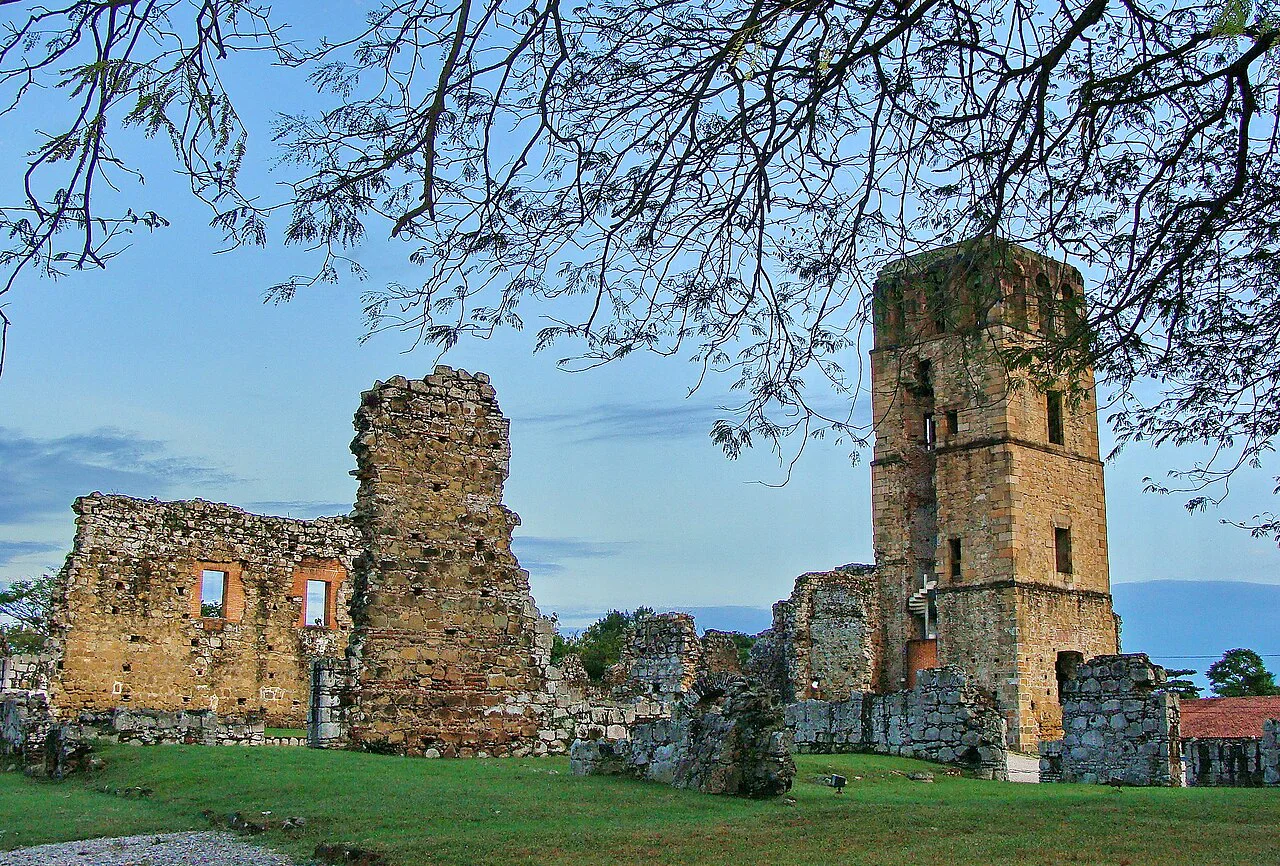
Parque Lefevre · 67 km
Panamá Viejo
Content & sources
Photo: Editorpana · CC BY-SA 3.0