Stanza · Audio guide
Panamá Viejo Audio Guide
A place to remember. A story to take with you.
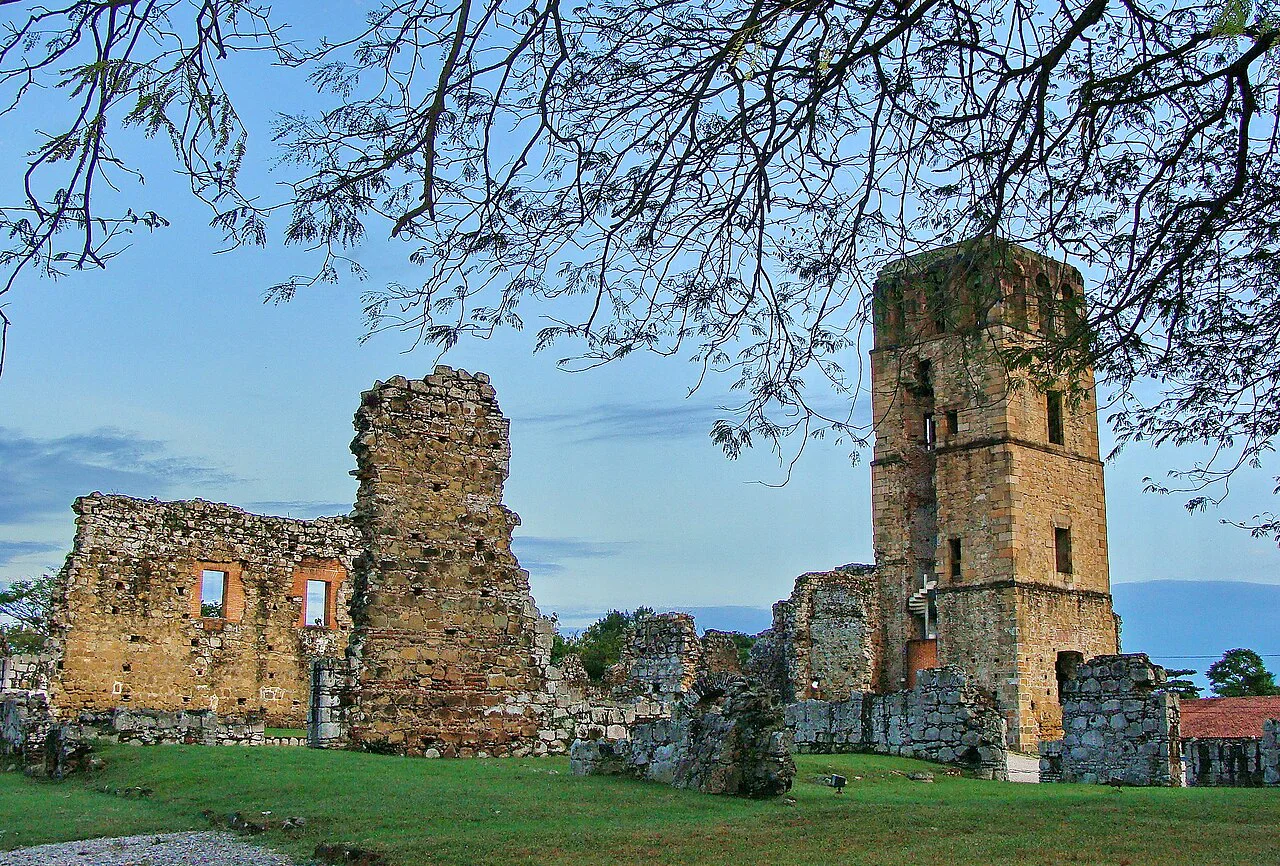
Panamá Viejo is the remaining part of the original Panama City, which was destroyed in 1671. It has been a UNESCO World Heritage Site since 1997.
Download Stanza, then search for “Panamá Viejo”.
About the tour
One guide. Your kind of visit.
Panamá Viejo is the remaining part of the original Panama City, which was destroyed in 1671. It has been a UNESCO World Heritage Site since 1997.
Ready when you are.
- 01Get the free Stanza app.
iOS & Android
- 02Find your guide.
“Panamá Viejo”
- 03Download before you go.
Works offline
Audio guide / 28 narrated stops
Inside the guide
Get to know a few of the stories before you go. Open a stop to read more.
01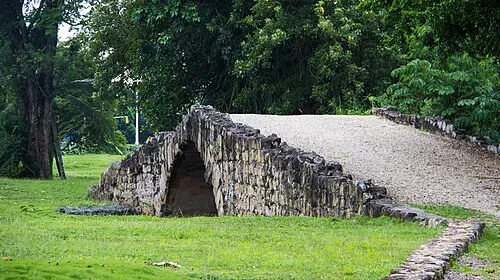 King's Bridge
Puente del Rey
A single stone arch carries the old road across the river once called the Gallinero, today the Río Abajo, at the northern edge of Panama City. This is the Puente del Rey, the King's Bridge, the formal entrance to the city for travelers arriving on the Camino Real from the Caribbean side. The city it served was founded on 15 August 1519 by Pedro Arias Dávila with about a hundred settlers. It was the first permanent European settlement on the Pacific coast of the Americas. Its position made it rich: everything moving between the Caribbean and the Pacific crossed here. In 1671 the city was destroyed, and a new Panama rose on a different site. In 2003 UNESCO added these ruins to the World Heritage List, joining them in one site with the old quarter of the city that replaced them.
Photo: Ssaucedoc · CC BY-SA 4.0
02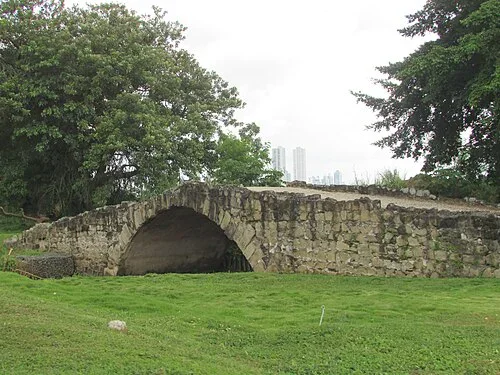 King's Bridge
Puente del Rey: The Growing City
The King's Bridge saw a city grow up around it. By 1610, Panama counted about five thousand inhabitants. There were five hundred houses, along with convents, chapels, a hospital and a cathedral. By 1670 the population had reached roughly ten thousand people. The old arch and the modern towers on the far horizon make an odd pair: the bridge outlived the city it once welcomed, and now faces a skyline its builders never imagined.
Photo: Bacalao9820 · CC BY-SA 4.0
03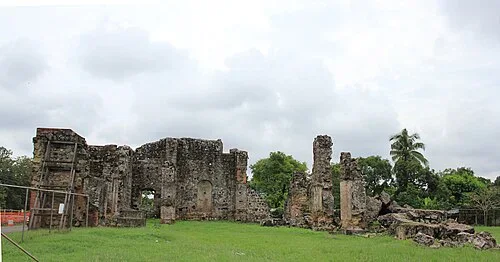 Church and Convent of Saint Joseph
Iglesia y Convento de San José
The convent of San José stood well away from the center of things. It was one of the religious houses farthest from the Plaza Mayor, where the city's life concentrated. Its walls and pillars of rough stone masonry still rise from the grass. Religious orders like this one filled the urban grid all the way out to its edges, so that even the outskirts of Panama kept their churches.
Listen in the appPhoto: Ayaita · CC0
04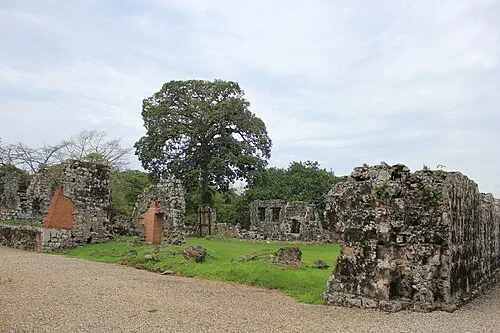 Church and Convent of Saint Dominic
Iglesia y Convento de Santo Domingo
The Dominicans built their church and convent here with a spacious courtyard and a well-made brick archway. They belonged to the mendicant orders, the friars who followed Spanish colonization across the Americas, preaching and settling in the new cities. In Panama, every major order maintained a house of its own. The Dominicans' ruins now stand open to the sky, their low walls tracing the compound they once enclosed.
Listen in the appPhoto: Ayaita · CC0
05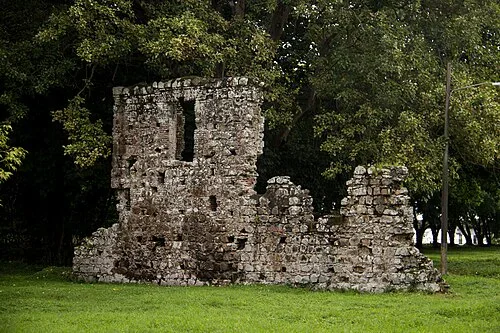 House of the Genoese
Casa de los Genoveses
This estate takes its name from the merchants who worked here: the House of the Genoese. From 1520, Genoese traders controlled much of Panama's Pacific commerce for about a century, holding a concession granted by the Spanish Crown, Genoa being Spain's ally. Merchants such as Domingo Grillo and Ambrosio Lomelin ran the trade in enslaved Africans from this place. People were sold here and sent onward toward Peru. The building's very name preserves the business that was transacted within these walls.
Listen in the appPhoto: Ssaucedoc · CC BY-SA 4.0
06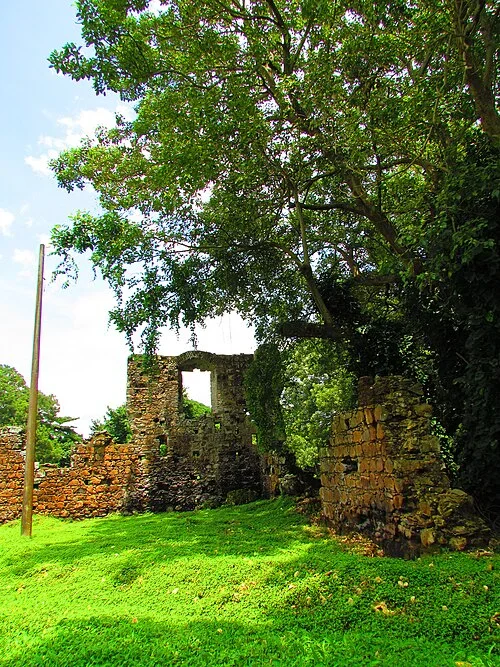 House of the Genoese
Casa de los Genoveses: The Italians Who Stayed
The Genoese were not only passing merchants; some made their lives here. A census taken around 1587 counted 548 inhabitants in Panama City. Of those, 53 were foreigners, and 18 of the foreigners were Italians. Some residents were descendants of the first Genoese settlers. Between 1586 and 1587, eleven Italians were asking for the right to stay and become naturalized. Their ruined house still stands under the big trees, its broken window opening onto the grass.
Listen in the appNazareth Valdespino · CC BY 2.0
07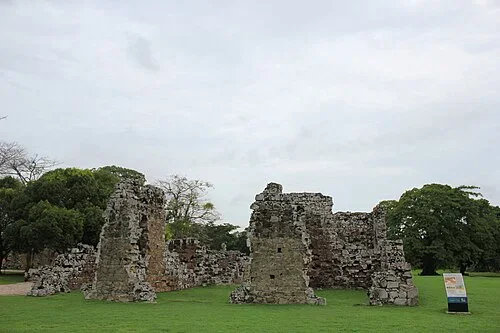 Alarcon House
Casa Alarcón
Casa Alarcón is one of the largest and best-preserved private residences in Panamá Viejo. It belonged to Pedro de Alarcón and was later used as a rental house. A stone residence of this size said a great deal about its owner. In one of the richest cities of Spanish America, a grand town house was a public statement of rank, built to be seen by everyone who passed it.
Listen in the appPhoto: Ayaita · CC0
08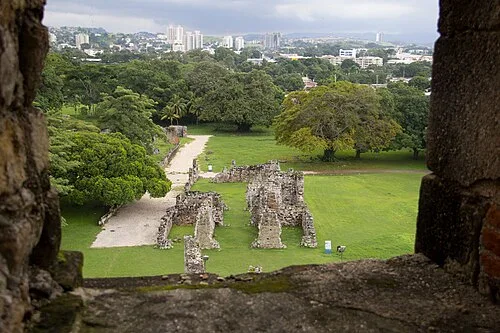 Alarcon House
Casa Alarcón: The City's Grid
In 1609, Cristóbal de Roda drew a map of Panama City. It shows a city that had grown more orderly: streets running straighter, blocks laid out at right angles, and a Plaza Mayor that is clearly rectangular. From an upper opening of a house like Casa Alarcón, that order is easy to read in the ruins below. The low walls follow the old grid, block after block, out toward the trees and the modern city beyond.
Listen in the appPhoto: Ssaucedoc · CC BY-SA 4.0
09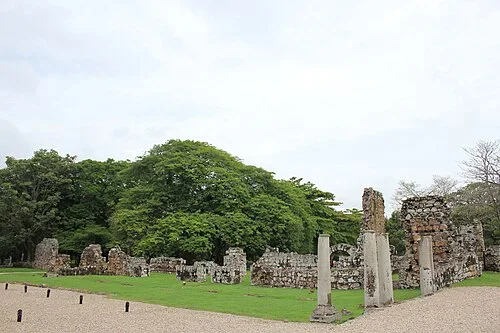 Terrin Houses
Casas Terrin
Francisco Terrín, an influential citizen of the city, built this complex of two-story residences. The ruins show how his builders worked: stone, brick and timber combined in the same structures. Wealthy Panamanians did not build in a single material. They mixed what was available, and the surviving walls make the layering plain — solid stone footings, brick courses, and the places where wooden frames once fitted in.
Listen in the appPhoto: Ayaita · CC0
10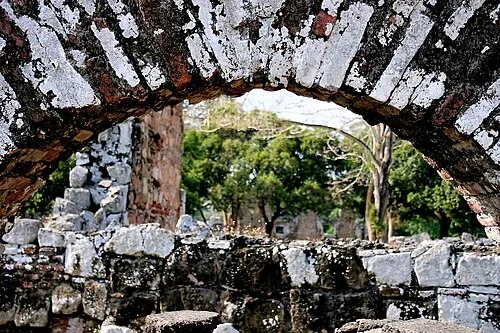 Terrin Houses
Arco en Panamá Viejo
A brick arch springs here from supports of rough, unshaped fieldstone. The two materials alternate plainly: rounded river stones below, neat rows of brick above, forming the vault. The arch holds the weight, and each material does the work it suits best.
Listen in the appPhoto: Nancy507 · CC BY-SA 4.0
- 11
Catedral de Nuestra Señora de la Asunción
The cathedral's fall in 1671, and the burning of the city by its own defenders.
- 12
Mirador de la Torre
Climbing the cathedral's thirty-meter tower, once belfry and watchtower, with the whole ruin field below.
- 13
Cabildo de Panamá Viejo
The town hall beside the cathedral, where Panama governed itself for a century and a half.
- 14
Plaza Mayor
The main square of old Panama, and the museum beside it that tells fifteen hundred years of the site.
- 15
Casas Reales
The fortified seat of the Crown, where the governor, the treasury and the court watched over the silver of the Americas.
- 16
Casas Oeste
A quiet green field where low stone footings mark the best addresses in the old city.
- 17
Iglesia y Convento de la Compañía de Jesús
The Jesuit convent that taught the city and repeatedly served in place of its cathedral.
- 18
Iglesia y Convento de la Compañía de Jesús: Rebuilt in Stone
The bones of a grand Jesuit complex, rebuilt in stone to a priest-architect's plans.
- 19
Iglesia y Convento de las Monjas de la Concepción
The only nunnery in colonial Panama, founded by four nuns from Lima, still unfinished when the city fell.
- 20
Aljibe de la Concepción
Inside the vaulted cistern that kept the nuns' convent supplied in a city short of water.
- 21
Iglesia y Convento de las Monjas de la Concepción: A Second Life
How a ruined convent of cloistered nuns became one of the site's main visitor spaces.
- 22
Hospital de San Juan de Dios
The hospital where the sick, the poor and the travelers of two oceans were cared for.
- 23
Ruinas del Antiguo Hospital San Juan de Dios
A long line of ruined wall that shows how much ground the old hospital once covered.
- 24
Iglesia y Convento de San Francisco
One of the largest religious properties in the city, near the western waterfront.
- 25
Iglesia y Convento de la Merced
The convent whose stones, the story goes, were carried off to build the new city.
- 26
Panamá Viejo and the Modern Skyline
Colonial ruin walls by the tidal flats, with the towers of modern Panama rising across the water.
- 27
Puente del Matadero
The western bridge where the defenses failed and Morgan's men found the way in.
- 28
Fortín de la Natividad
The small fort that stood as the city's main defense on its exposed western side.
Panamá Viejo
Frequently asked questions
How much does the guide cost?
Free app download. Listed guide price: $2.99. Guide price shown in the app. Audio guide only. Venue admission is separate.
Can I listen without internet?
Yes. Download the guide’s audio, images, and maps in the app before your visit. Your downloaded content is then available offline.
Can I listen in my language?
This audio guide is available in 15 languages, including English.
Do I need to follow a schedule?
No. This is a self-guided experience. Choose your stops, pause whenever you like, and return to a story at your own pace.
At your own pace
Explore Panamá Viejo.
Download Stanza, then search for “Panamá Viejo”.
Free app download · Guide price shown in the app
Keep exploring
Nearby audio guides
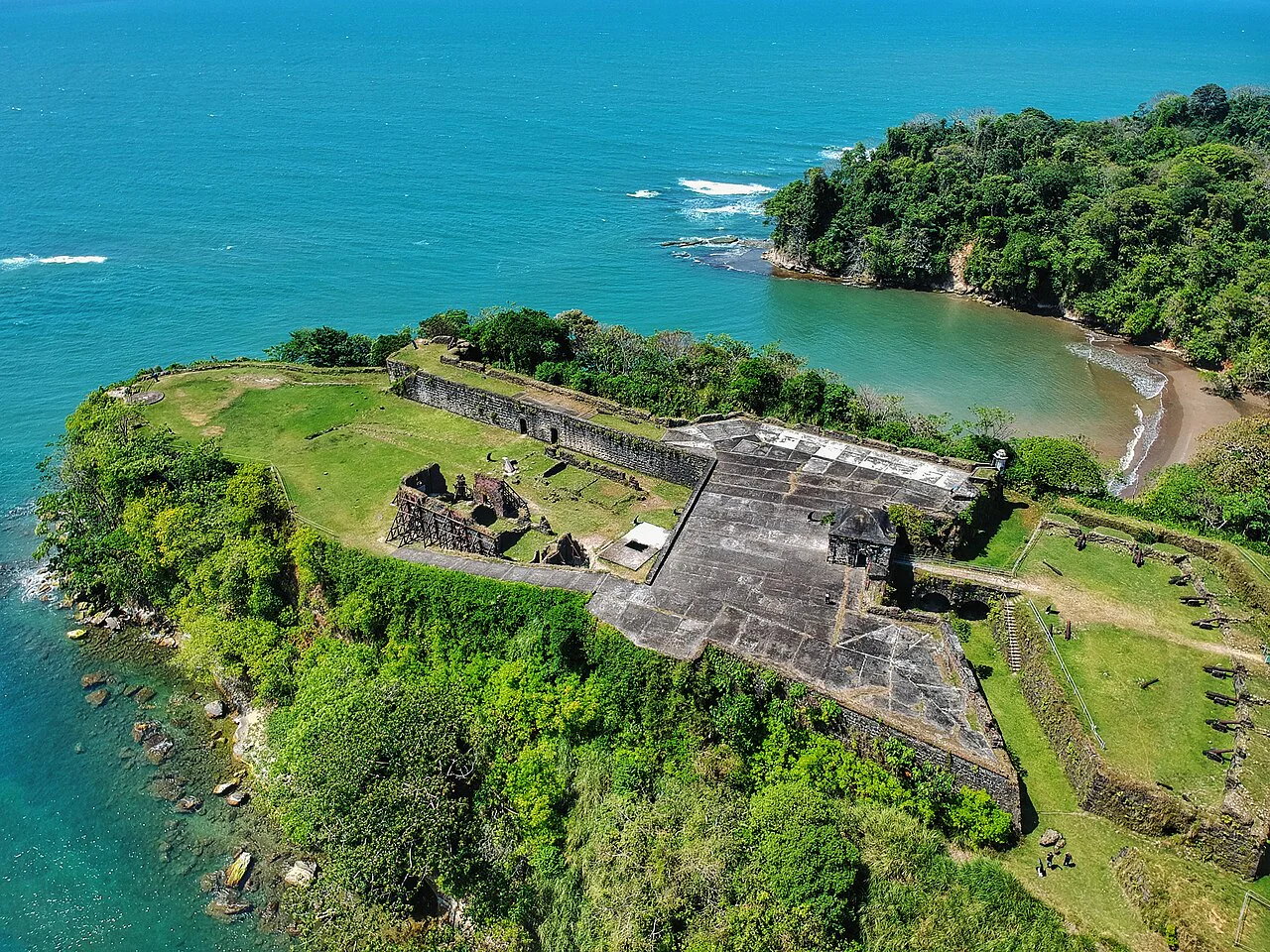
Cristóbal · 67 km
Chagres and Fort San Lorenzo
Content & sources
Photo: Garcia.dennis · CC BY-SA 4.0