Stanza · Audio guide
La Santísima Trinidad de Paraná Audio Guide
A place to remember. A story to take with you.
La Santísima Trinidad de Paraná is a former Jesuit reduction located in Paraguay. It represents one of the many self-contained colonies established by missionaries to integrate indigenous populations with the…
Download Stanza, then search for “La Santísima Trinidad de Paraná”.
About the tour
One guide. Your kind of visit.
La Santísima Trinidad de Paraná is a former Jesuit reduction located in Paraguay. It represents one of the many self-contained colonies established by missionaries to integrate indigenous populations with the Christian faith during the 17th and 18th centuries.
Ready when you are.
- 01Get the free Stanza app.
iOS & Android
- 02Find your guide.
“La Santísima Trinidad de Paraná”
- 03Download before you go.
Works offline
Audio guide / 12 narrated stops
Inside the guide
Get to know a few of the stories before you go. Open a stop to read more.
01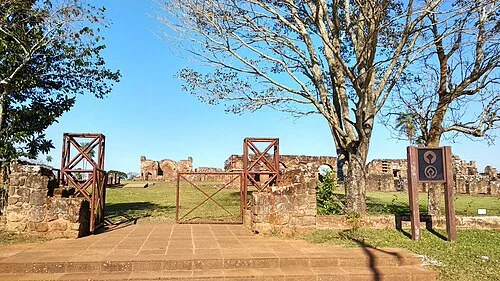 Plaza Mayor and Main Entrance
Entrance to the Mission of Trinidad
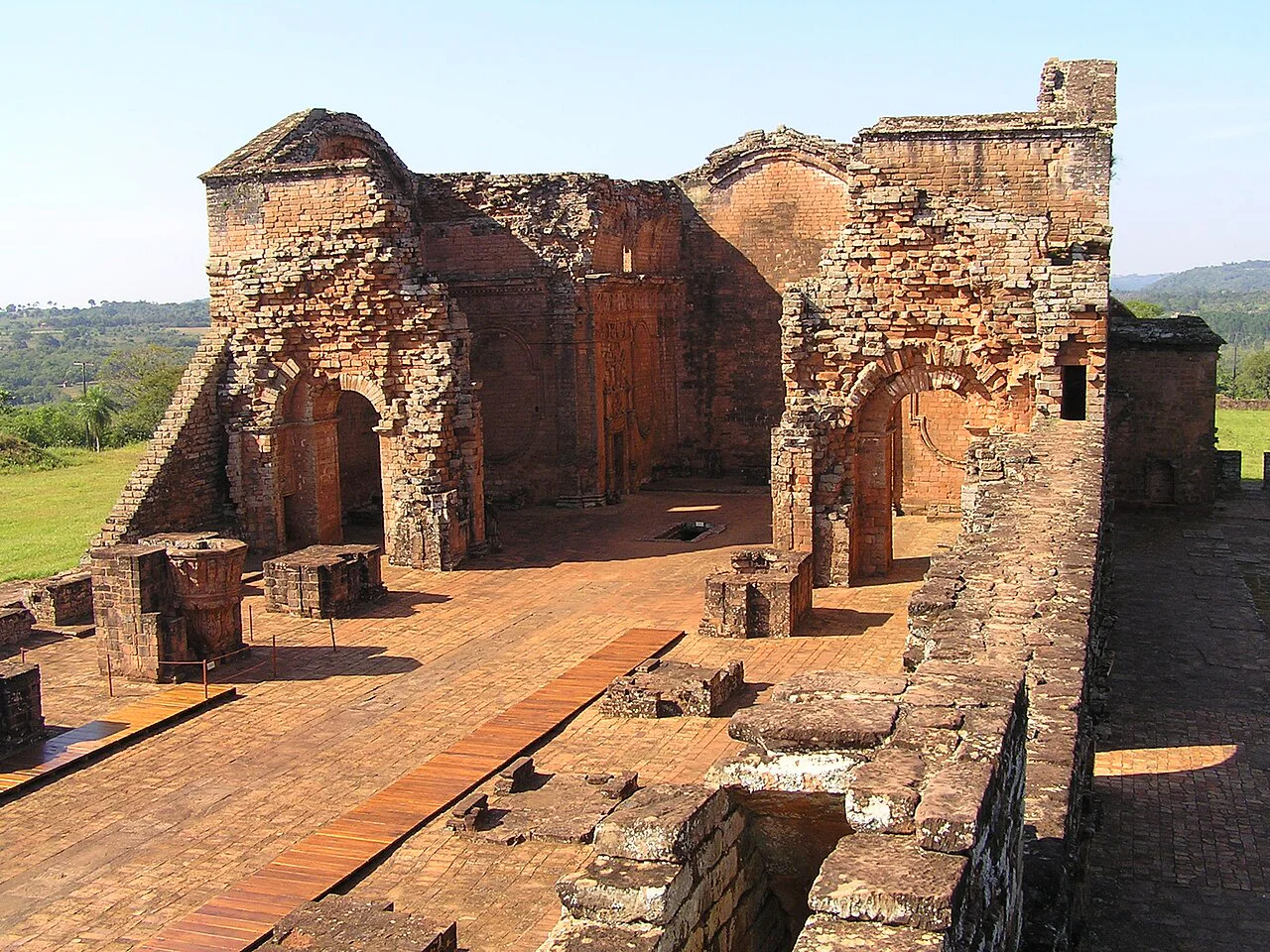
Welcome to La Santísima Trinidad de Paraná, the best preserved of Paraguay's Jesuit missions. Missionaries founded this town in June 1706, on a hill not far from today's city of Encarnación. It was a reduction: one of the small, self-contained colonies the Jesuits established across South America during the seventeenth and eighteenth centuries. These missions were built to exist outside ordinary Spanish colonial life, joining the indigenous Guaraní with the Christian faith. Trinidad was among the last of the reductions raised in the Paraná River region. It was planned as a self-sufficient city, with a central plaza, a large church, a school, workshops and housing for the Guaraní. The ruins spread across about twelve hectares of open ground, flat enough to cover on foot in an hour and a half. In 1993, UNESCO inscribed Trinidad as a World Heritage Site, together with the nearby mission of Jesús de Tavarangue.
Carlos Brys · CC BY-SA 4.0
02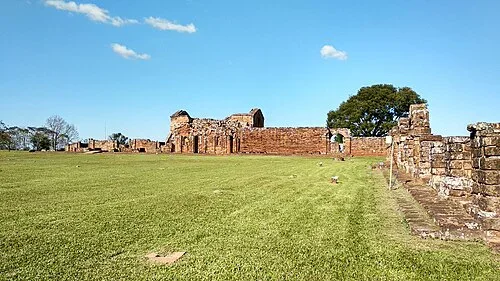 Plaza Mayor and Main Entrance
The Plaza Mayor
The Plaza Mayor was the meeting place of the whole pueblo. Mass, matrimony and the great celebrations all took place on this ground. Around it, the plan of the town still reads clearly. On the main side stood the Iglesia Mayor, the cemetery, the orchard and the principal buildings. The remaining sides carried the indigenous housing and the mirador, the lookout point. By 1728, some three thousand Guaraní lived in the reduction. Its buildings stood complete after roughly two decades of construction. The plaza was never empty for long: it held the town's faith, its weddings and its public life.
Carlos Brys · CC BY-SA 4.0
03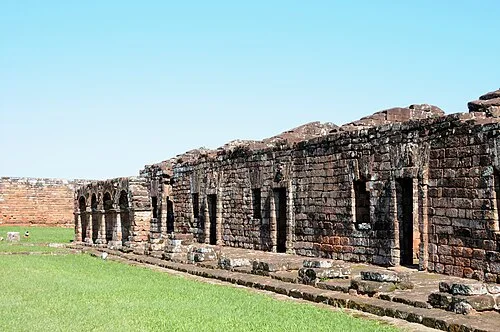 Indigenous Housing and Arched Galleries
Guaraní Housing Blocks
Long blocks of stone rooms housed the Guaraní families of the mission. Each dwelling unit measured twenty meters, and a street separated one block from the next. The doorways repeat down the row in an orderly, standardized rhythm, a residential scheme of European design. Carved stone rosettes crown the space above the door lintels, a small flourish on otherwise plain walls. The account has come down that these houses were particularly envied by the Spaniards who visited the reduction. Whether every visitor felt that way is hard to say, but the remark says something about how well built the blocks were. Stone rooms, straight streets and carved rosettes made for housing few colonial towns could match.
Listen in the appJosep M. Gracia · CC BY-SA 4.0
04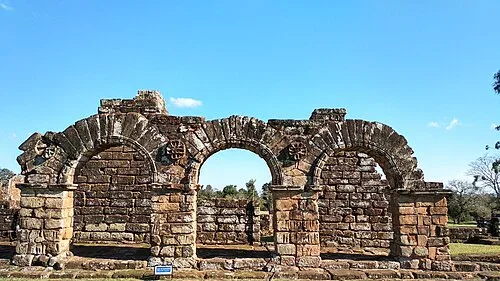 Indigenous Housing and Arched Galleries
The Arquería Galleries
Here, a row of great stone arches rises from the grass, possibly the most striking sight in the whole complex. These are the arquería, the front galleries of the dwelling blocks, each group of rooms opening toward the plaza through a line of arches. People who see them think at once of Roman bridges and aqueducts. The design follows European classical taste, brought across the Atlantic in drawings and ideas. The hands that dressed the stone and raised the arches were Guaraní. The result is a blend that belongs fully to neither continent: a Roman silhouette built with local craftsmanship. Few mission buildings express that partnership as plainly as these galleries do.
Listen in the appCarlos Brys · CC BY-SA 4.0
05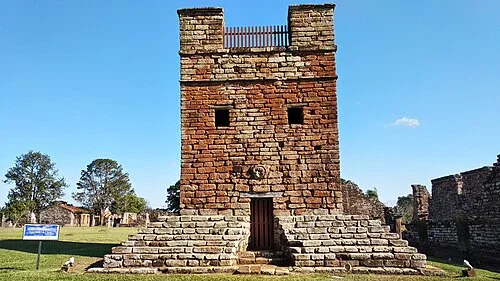 The Isolated Watchtower
One tower stands apart from everything else on the site, at a distance from the church. It rises on a square base of exceptionally solid construction, more massive than any other standalone structure here. What it was for, nobody can say for certain. It may have served as the bell tower of a provisional church, or it may have been a watchtower, an atalaya. The record simply does not settle the question. Beside it stand the remains of a chapel, low walls among the ruins. Whatever its original work, the tower has outlasted nearly everything around it.
Listen in the appCarlos Brys · CC BY-SA 4.0
06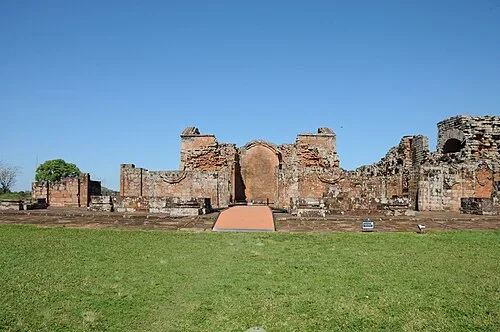 The Great Church Nave
The Great Church Facade
The ruined front belonged to the Iglesia Mayor, the great church of the mission. It remains the largest temple ever constructed among all the Jesuit reductions of South America. Its architect was Juan Bautista Prímoli, a Jesuit who also drew up the design of the entire reduction. The scale of the man's ambition shows in what survived: a broad facade, flanking walls and the mass of stone needed to carry a roof over an immense interior. Nothing else built by the missions in this part of the world matched it. Prímoli's plan gave Trinidad its shape, and the church was meant to be its crown.
Listen in the appJosep M. Gracia · CC BY-SA 4.0
07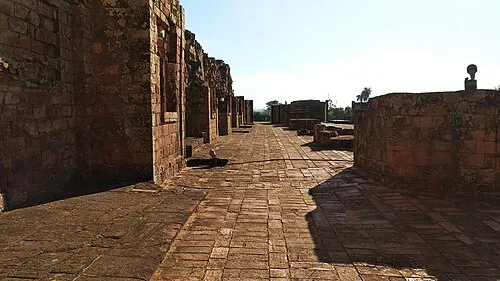 The Great Church Nave
In the Nave of the Iglesia Mayor
The nave runs open to the sky now, its stone floor paving still firm underfoot between standing wall cores. This temple was the center of life in the reduction. Worship, instruction and assembly all gathered the community within these walls, and the plaza outside carried that life onward through the day. Beside the church stood a cell, where historians and guides say Guaraní who broke the mission's rules were held for a time. The paved floor and the thickness of the surviving walls give the measure of the space the builders intended. A congregation of thousands once filled a room like this on feast days.
Listen in the appCarlos Brys · CC BY-SA 4.0
08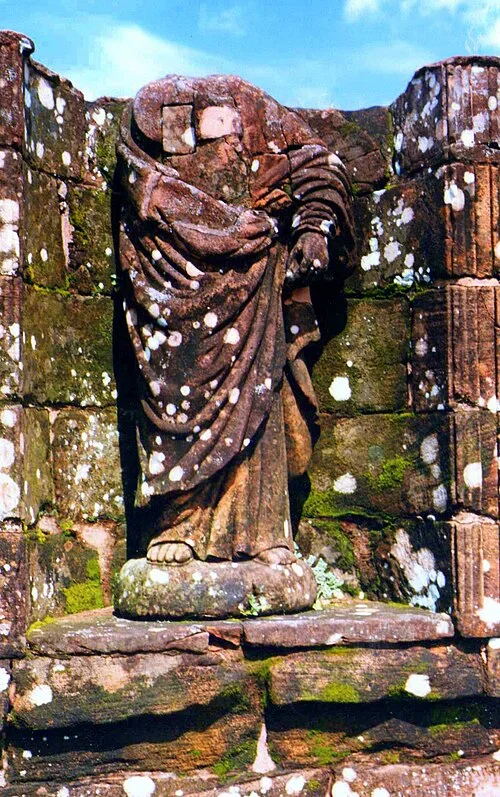 The Decapitated Saints
The Decapitated Saint
The statue in this niche keeps its robes, its carved hands and its bare feet, and nothing above the shoulders. In 1768 the Jesuits were expelled from the Spanish colonies, and the reductions were abandoned and left to decay. A story spread that the missionaries had hidden gold inside the heads of the saints' statues. Sculptures were broken open in the search for it. Almost every statue on the site was left headless; guides say only one survived intact. The damage is generally attributed to people combing the ruins for the supposed gold, though accounts differ on who they were. The rumor proved false, and the saints lost their heads to it.
Listen in the approdoluca · CC BY-SA 3.0
09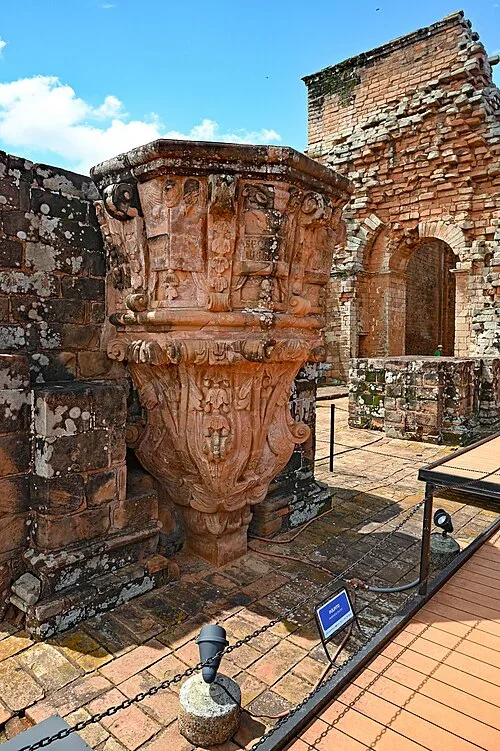 The Stone Pulpit and Crypt
The Stone Pulpit
The stone pulpit was carved in more than a thousand separate pieces, fitted together against the church wall. Figures of the Evangelists decorate its faces, worked into the rich ornament of the polygonal bowl. Traces of its original coloring can still be made out on the stone. The mission's builders generally obtained their pigments from native plants, and traces of that original paint survive on other carved pieces as well. A pulpit of a thousand pieces, carved and colored by Guaraní craftsmen, gives a fair idea of the skill working inside this church.
Listen in the appP. Hughes · CC BY 4.0
10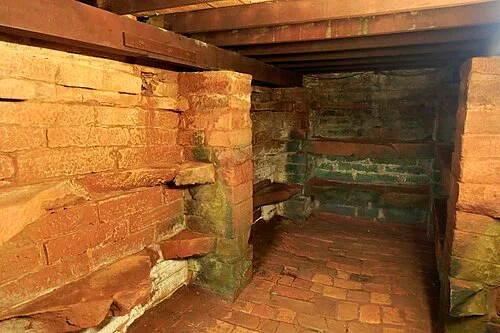 The Stone Pulpit and Crypt
The Stone Crypt
Almost at the center of the complex lies a stone crypt, beneath the level of the church floor. Some of the principal Spanish religious leaders of the mission were buried there. The chamber is built of brick and stone, with niches set into the walls for the dead. What survives today is part original fabric and part modern work: contemporary specialists reconstructed portions of the crypt, including the neat brick niches and the flooring. That mixture of survival and rebuilding is itself a mark of the care the site still receives. The chamber holds both the mission's dead and the story of its rescue.
Listen in the appFalk2 · CC BY-SA 4.0
- 11
The Frieze of the Musical Angels
A stone frieze of angels with clavichords, trumpets and a Paraguayan harp, carved proof of the Guaraní gift for music.
- 12
The Jesuit Museum in the Old Sacristy
Carved heads, angels and painted fragments from the mission, gathered in the old sacristy.
La Santísima Trinidad de Paraná
Frequently asked questions
How much does the guide cost?
Free app download. Listed guide price: $0.99. Guide price shown in the app. Audio guide only. Venue admission is separate.
Can I listen without internet?
Yes. Download the guide’s audio, images, and maps in the app before your visit. Your downloaded content is then available offline.
Can I listen in my language?
This audio guide is available in 15 languages, including English.
Do I need to follow a schedule?
No. This is a self-guided experience. Choose your stops, pause whenever you like, and return to a story at your own pace.
At your own pace
Explore La Santísima Trinidad de Paraná.
Download Stanza, then search for “La Santísima Trinidad de Paraná”.
Free app download · Guide price shown in the app
Keep exploring
Audio guides — Paraguay
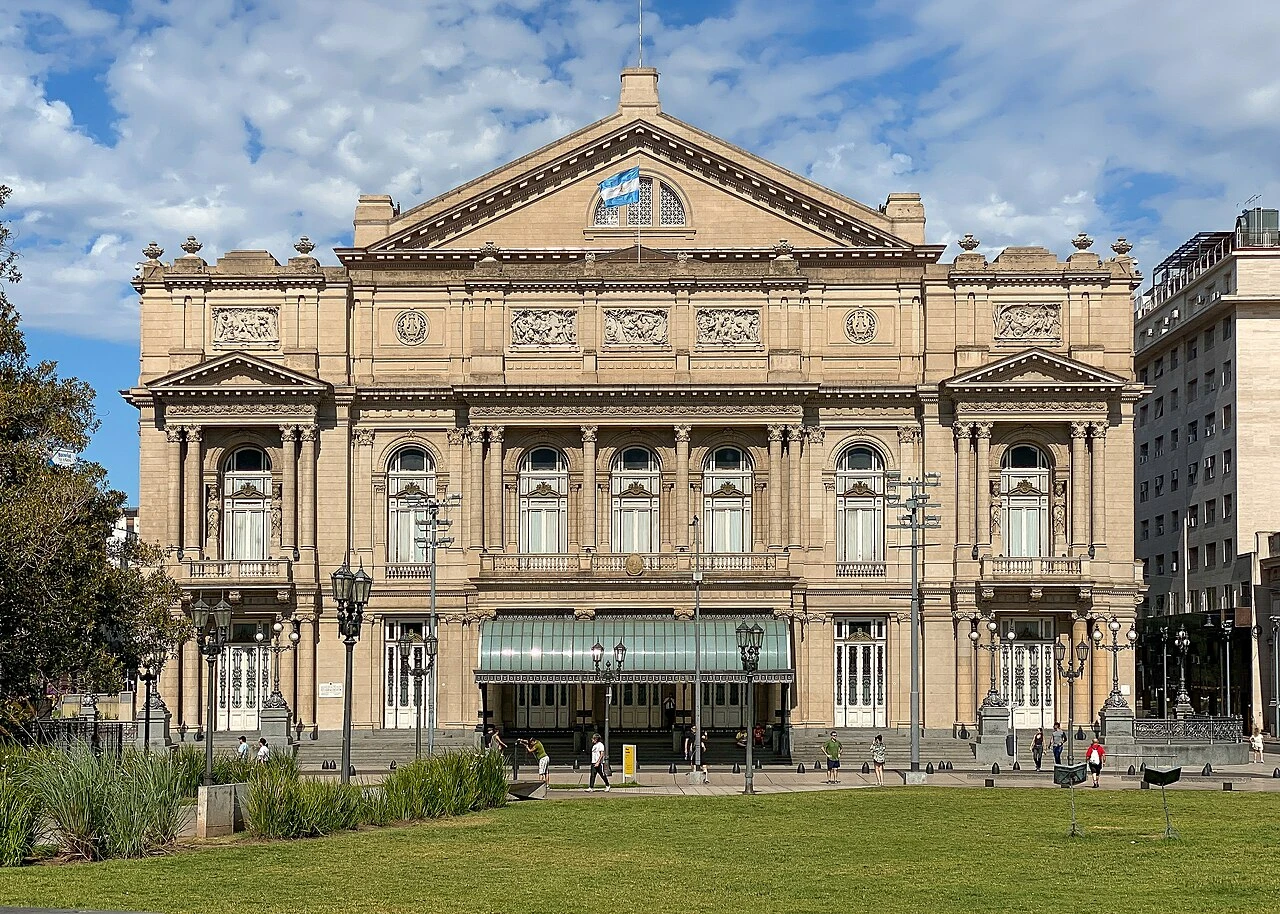
Buenos Aires
Teatro Colón
Content & sources
Photo: EEJCC · CC0