Stanza · Audio guide
HegraAudio guide
A place to remember. A story to take with you.
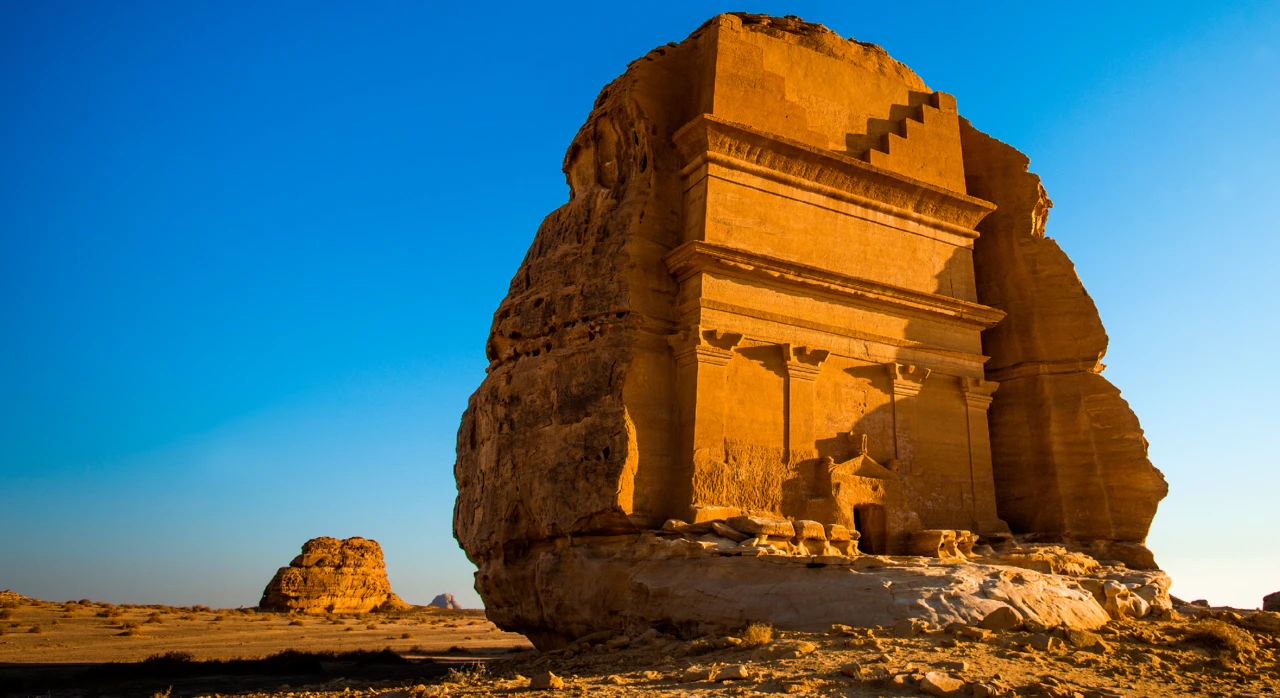
Hegra is an ancient archaeological site featuring well-preserved monumental tombs carved into sandstone outcrops, dating back to the Nabataean Kingdom. It was the first site in Saudi Arabia to be inscribed as…
Download Stanza, then search for “Hegra”.
About the tour
One guide. Your kind of visit.
Hegra is an ancient archaeological site featuring well-preserved monumental tombs carved into sandstone outcrops, dating back to the Nabataean Kingdom. It was the first site in Saudi Arabia to be inscribed as a UNESCO World Heritage site.
Ready when you are.
- 01Get the free Stanza app.
iOS & Android
- 02Find your guide.
“Hegra”
- 03Download before you go.
Works offline
Audio guide / 13 narrated stops
Inside the guide
Get to know a few of the stories before you go. Open a stop to read more.
01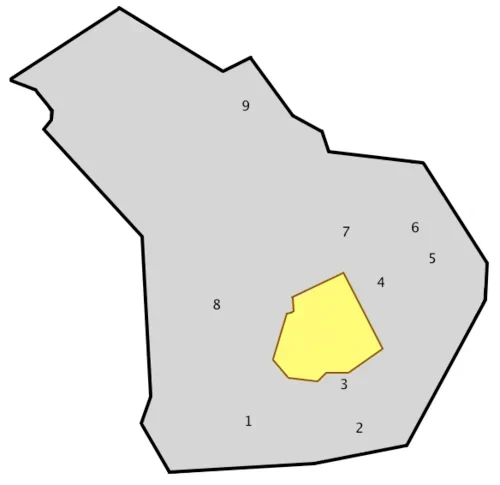 Qasr as-SaniJabal al-Banat
Welcome to one of the most significant archaeological sites in the Arabian Peninsula. You are looking at the layout of Hegra, the southern capital of the Nabataean Kingdom. Between the first century BC and the first century AD, this site served as a vital hub for a powerful trade empire. The Nabataeans grew immensely wealthy by taxing the lucrative incense and spice caravans that traveled from southern Arabia to the Mediterranean. As you look across the horizon, you’ll see 111 monumental tombs carved directly into the living rock of these sandstone outcrops. While the city where people actually lived was constructed from mudbrick and has almost entirely vanished over time, these 'houses for the dead' were intentionally carved into the durable stone to last for eternity. This strategic choice has preserved the intricate architectural details we see today. Each outcrop serves as a separate necropolis, organized by the social standing or family lineages of the ancient inhabitants. The most prominent clusters highlight the sophistication and permanence that the Nabataeans sought for their final resting places, standing as a stark contrast to the shifting sands of the surrounding desert.
Photo: MrJoker07 · CC BY-SA 4.0
02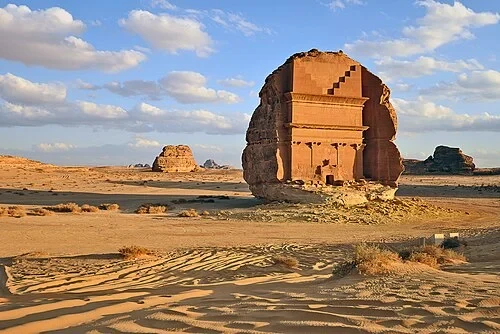 Qasr al-Farid (The Lonely Castle)The Lonely Castle
Qasr al-Farid, or 'The Lonely Castle,' is the undisputed highlight of the Hegra necropolis. Despite its popular name, this structure was never intended to be a fortification or a palace; it is a monumental tomb. What makes it truly unique is that it was carved into a single, massive sandstone monolith that stands completely alone, separated from the main mountain ranges. If you look closely at the lower portion of the facade, you will notice that it remains unfinished. The rough, unpolished rock at the bottom provides a fascinating 'behind-the-scenes' look at ancient engineering. It proves that Nabataean masons worked from the top down, carving the elaborate upper cornice first and moving toward the ground. Had the project been completed, this would have been the grandest and largest tomb in the entire city. Because the carvers stopped mid-way, we are left with a permanent record of their process. The isolation of the monument against the flat desert floor emphasizes the scale of the original ambition. Its four-story facade remains one of the finest examples of Nabataean craftsmanship, even in its incomplete state, showing the narrow tool marks left by ancient masons at the base.
Ahmad AlHasanat · CC BY-SA 4.0
03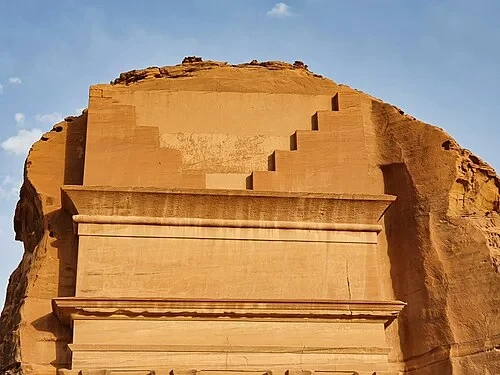 Qasr al-Farid (The Lonely Castle)The Crow-Step Facade
Looking at the very top of these grand facades, you will notice a recurring architectural feature: a series of four-step patterns called 'crow-steps.' This design is a classic Nabataean signature, found on tombs throughout their kingdom, including the famous city of Petra. Beyond their aesthetic appeal, these steps represent a brilliant piece of engineering logic. By starting the carving process at the very top of the cliff face, the masons were able to use the natural ledge of the rock as their primary working platform. This eliminated the need for expensive and cumbersome timber scaffolding, which was a massive advantage in a desert environment where wood was an extremely scarce luxury. The carvers would slowly descend, removing stone as they went. If you look at the smooth, flat surfaces of the stone beneath these steps, you can still see faint, vertical markings. These were achieved using narrow iron chisels, which allowed the craftsmen to create perfectly level planes from the rough sandstone. This top-down method ensured that the most complex decorative elements were finished first, while the stone below supported the weight of the workmen as they moved toward the entrance.
Listen in the appProf. Mortel · CC BY 2.0
04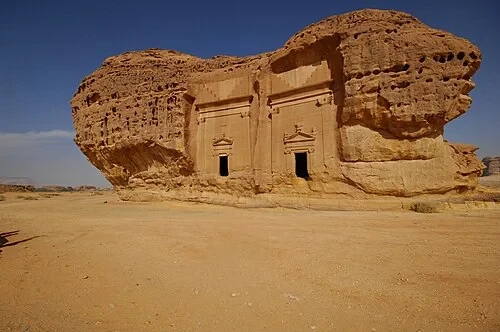 Jabal al-Ahmar (The Red Mountain)The Legal Deeds in Stone
The inscriptions you see carved just above the doors of these side-by-side tombs are far more than religious prayers or simple epitaphs. They are formal legal documents, essentially deeds of ownership frozen in stone for two millennia. These texts specify the name of the individual who commissioned the tomb and list the specific family members who were legally permitted to be buried within the chamber. More importantly, they contain precise legal penalties. They often list specific fines, frequently measured in silver drachmas, to be paid directly to the temple or the local authority if anyone attempted to sell the tomb or secretly inter an unauthorized body. These carvings prove that Nabataean society was highly structured and governed by strict property laws and a functioning judicial system. The permanence of the stone ensured that these laws could not be easily altered or ignored. It’s a fascinating glimpse into a civilization that valued legal clarity as much as architectural beauty. Even today, the clarity of the script allows historians to trace family lineages and understand the economic values of the era, where a family’s final resting place was protected by the full weight of the Nabataean legal system.
Listen in the appPhoto: سعید مسعودیان · CC BY-SA 4.0
05Qasr al-Bint (The Daughter's Castle)Jabal al-Banat
Notice the largest cluster of tombs in this area, traditionally known as Qasr al-Bint. A local legend tells the story of a beautiful girl who lived in a palace and was eventually buried here, giving the site its name, which translates to 'Palace of the Daughter.' However, archaeological evidence tells a more grounded story. These were actually the private burial sites for the city’s most prominent and wealthy families. The facades here are particularly ornate, showcasing the height of Nabataean artistic achievement. Look for the intricate carvings of eagles and rosettes positioned carefully above the entrances. These weren't merely decorative flourishes; they were powerful symbols believed to offer protection and guide the soul into the afterlife. The eagle, often associated with the main Nabataean deity Dushara, was a common motif signifying divine guardianship. The rosettes, reminiscent of those found in Hellenistic and Roman architecture, reflect the cosmopolitan nature of this desert trade capital. Despite the legendary tales of a lonely palace, the reality reveals a status-conscious society that invested heavily in these permanent monuments to ensure their family's legacy remained visible to all who passed through the valley, even long after the city itself had faded.
Listen in the appPhoto: MrJoker07 · CC BY-SA 4.0
06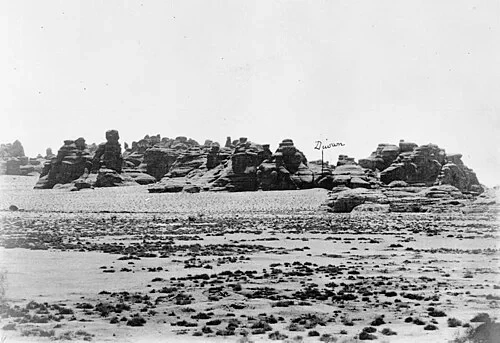 Al-SiqThe Diwan Meeting Hall
Deep within the narrow gorge of Jabal Athlab, you will find the Diwan. Unlike the hundreds of tombs scattered across the site, this large rectangular chamber was a space designed strictly for the living. It served as a sacred banquet hall where the Nabataean elite would gather for important social and religious occasions. Inside, three stone benches are carved into the walls, forming a 'triclinium' where guests would recline to feast, drink, and discuss matters of city governance and trade. The high ceilings and open entrance allowed for natural light to fill the space, creating a cool refuge from the desert heat. This particular site carries layers of more recent history as well. An archival photograph from 1917 captures the Diwan exactly as it appeared when T.E. Lawrence and his allies passed through these mountains during the Arab Revolt. While the Nabataeans had been gone for centuries, the site remained a recognizable landmark and a place of shelter for travelers and warriors alike. Standing here, you can see how the natural acoustics of the rock chamber would have amplified the voices of the leaders as they made decisions that shaped the fate of this desert kingdom.
Listen in the appHalladjian J H · Public domain
07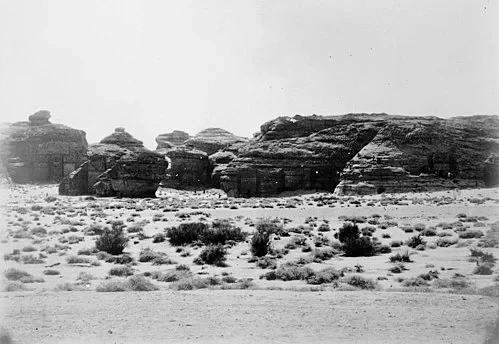 Diwan of Jabal AthlabEarly Explorers of Hegra
For much of the modern era, the monumental necropolis of Hegra was virtually unknown outside the local region. Its 'rediscovery' by Western scholars began in the late 19th century, led by intrepid explorers like Charles Doughty. Traveling to such a remote area was an incredibly dangerous undertaking. These early visitors often had to travel in disguise, joining large pilgrim caravans, or hiring heavy armed protection to navigate the lawless stretches of the desert. Doughty’s detailed accounts provided the first glimpse of these ancient carvings to an international audience, sparking a wave of archaeological interest that continues today. Early photographs from this period show the necropolis in its rugged, untouched state, long before it was designated as a UNESCO World Heritage site. You can see how the desert sands had partially buried many of the entrances, and the stone faces were weathered by centuries of wind. These explorers weren't just recording buildings; they were documenting a civilization that had been lost to history for nearly two thousand years. Their work laid the foundation for the preservation efforts that now protect these delicate sandstone structures from further erosion, ensuring they remain accessible for study today.
Listen in the appHalladjian J H · Public domain
08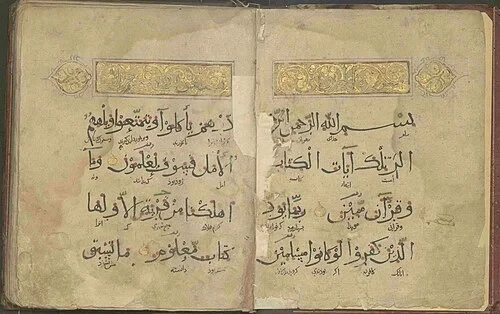 Al-Hijr Cultural ContextHegra Archaeological Site
The physical site of Hegra is deeply connected to ancient religious traditions. In the Quran, it is referred to as 'Al-Hijr,' or 'The Rocky Tract.' This is the location for the story of the Prophet Salih and the ancient people of Thamud. According to the tradition, the Thamud were a mighty people who carved their homes into the mountains, but they were eventually destroyed by a divine storm after rejecting the Prophet’s message. Because of these haunting stories, many travelers and pilgrims avoided the area for centuries, viewing it as a forbidden place. This long period of avoidance ironically served as a form of unintentional conservation. By keeping human interference to a minimum, the intricate carvings and inscriptions were protected from the looting and vandalism that damaged many other ancient sites in the region. For generations, the only people who saw these tombs were the Bedouins and the few who braved the path during the Hajj pilgrimage. Today, the site is viewed through a lens of historical significance, but the religious narratives remain an essential part of the landscape’s identity. The manuscript shown here illustrates how the stories of this place have been preserved through written tradition just as the stone has preserved its carvings.
Listen in the appUnknown author · Public domain
09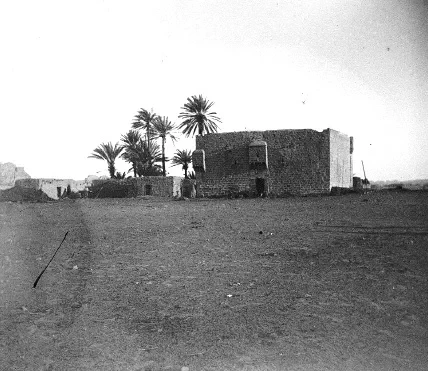 Al-Hijr FortHegra Fort
Near the ancient tombs stands a significant structure from a much later era: a stone fort built in the 18th century. Its primary purpose was to safeguard the 'Dar al-Hajj,' the traditional pilgrim route that connected Damascus to Medina. Before the advent of the railway, pilgrims traveled in massive caravans consisting of thousands of camels, braving the harsh desert for weeks. This fort provided a rare and essential sanctuary, offering a safe place to rest and, most importantly, access to water. Inside the central courtyard, you can find a massive well, reaching nearly 30 meters deep. This well tapped into the same ancient Nabataean aquifers that had sustained the city two thousand years earlier, proving the lasting value of the region's hidden water resources. The fort's thick, defensive walls and small, fortified windows reflect the dangers of desert travel during the Ottoman period, when protection from raids was as necessary as protection from the sun. It stands as a reminder that Hegra was never truly abandoned; it simply shifted from a permanent capital to a critical waypoint for those on the move. The surrounding date palms still mark the presence of this life-giving water source in an otherwise arid world.
Listen in the appA. Jaussen and R. Savignac (photographers) · Public domain
10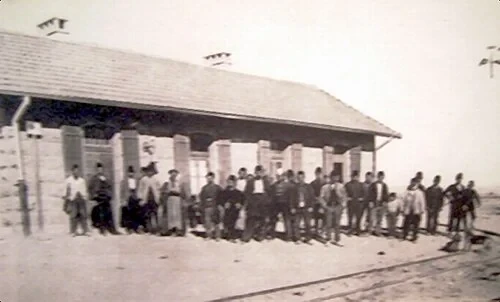 Al-Hijr Station (Hejaz Railway)Hejaz Railway
Modernity arrived at Hegra in 1907 with the completion of the Hejaz Railway. Built by the Ottoman Empire, this ambitious project was designed to transport pilgrims from Damascus to the Holy Cities of Medina and Mecca with unprecedented speed. Before the train, the journey was a grueling 40-day trek by camel through some of the most difficult terrain on earth; the railway cut that time down to just four days. This station became a key stop along the line. The stone buildings you see were part of a larger complex that included workshops, living quarters, and water towers. These structures were designed by German engineers and constructed using local labor, resulting in a unique architectural style that blends European industrial design with desert sandstone. Despite the high-tech nature of the project for its time, the buildings were made to withstand the extreme temperatures and sandstorms of the region. The arrival of the railway temporarily brought new life and strategic importance to Hegra, transforming it once again into a bustling hub of movement. It marked a brief but significant era where ancient history and twentieth-century technology stood side-by-side in the middle of the desert.
Listen in the appUnknown probably dead the photo was taken 99 years ago · Public domain
Hegra
Frequently asked questions
How much does the guide cost?
Free app download. Listed guide price: $3.99. Guide price shown in the app. Audio guide only. Venue admission is separate.
Can I listen without internet?
Yes. Download the guide’s audio, images, and maps in the app before your visit. Your downloaded content is then available offline.
Can I listen in my language?
Stanza supports 15 languages. Check the app for the languages available for this guide.
Do I need to follow a schedule?
No. This is a self-guided experience. Choose your stops, pause whenever you like, and return to a story at your own pace.
At your own pace
Explore Hegra.
Download Stanza, then search for “Hegra”.
Free app download · Guide price shown in the app