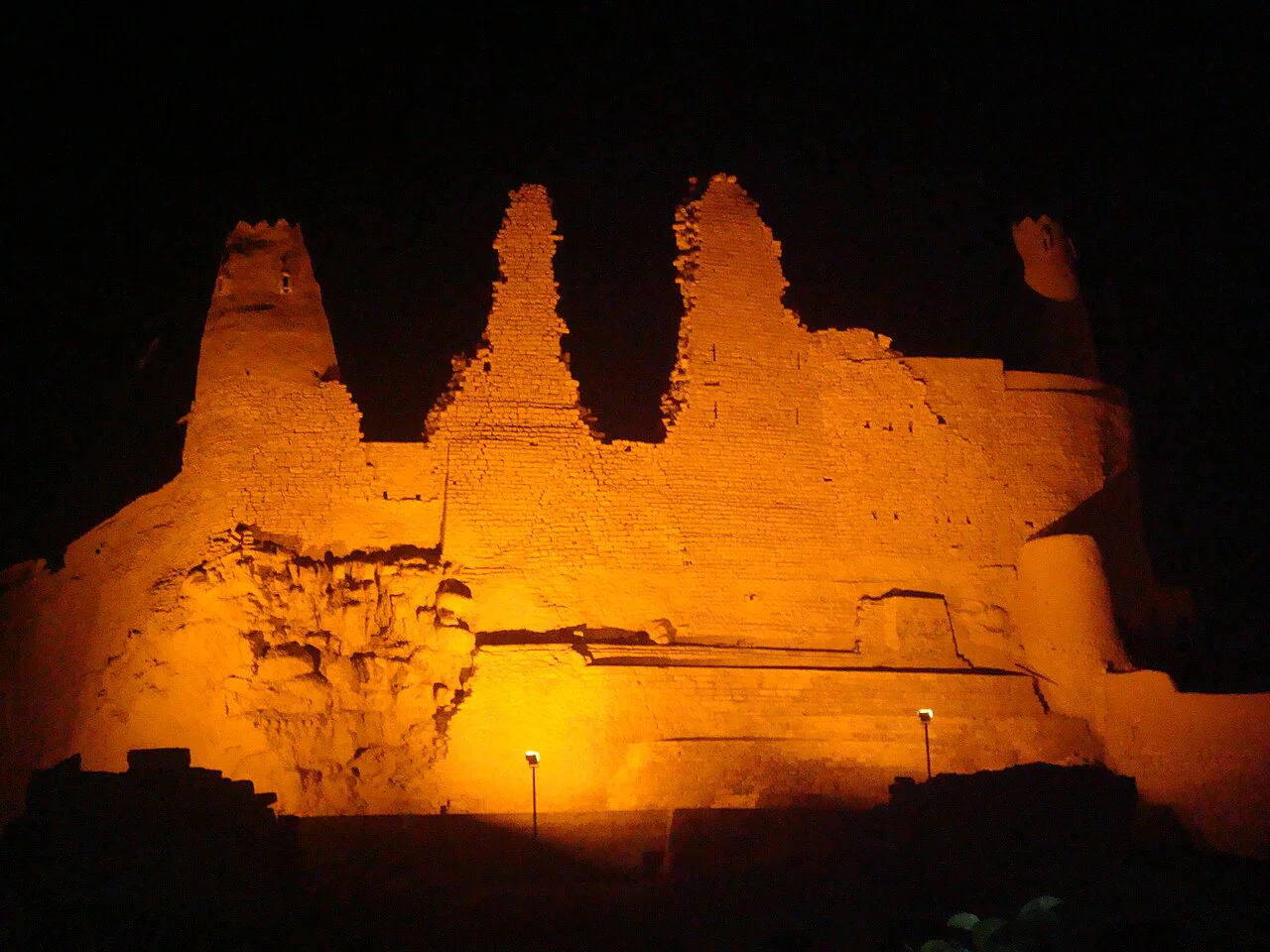
Stanza · Audio guide
Dumat al-Jandal Audio Guide
A place to remember. A story to take with you.
Dumat al-Jandal is an ancient city of ruins located in northwestern Saudi Arabia. It served as the historical capital of the region that is now al-Jouf Province.
Download Stanza, then search for “Dumat al-Jandal”.
About the tour
One guide. Your kind of visit.
Dumat al-Jandal is an ancient city of ruins located in northwestern Saudi Arabia. It served as the historical capital of the region that is now al-Jouf Province.
Ready when you are.
- 01Get the free Stanza app.
iOS & Android
- 02Find your guide.
“Dumat al-Jandal”
- 03Download before you go.
Works offline
Audio guide / 9 narrated stops
Inside the guide
Get to know a few of the stories before you go. Open a stop to read more.
01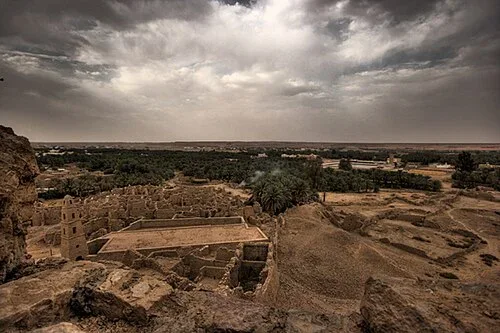 Heritage Plaza and Oasis Panorama
Dumat al-Jandal: Panorama of the Ancient Oasis
Dumat al-Jandal means 'Dumah of the Stone', and the Assyrian scribes who wrote about this town knew it as Adummatu. Welcome to the story of a desert oasis that has carried people for thousands of years. One thread runs through everything here: water. Springs made this place possible, and the mosque, the stone quarter, the castle and the wall all exist because of that water and the trade that passed it. The town sits at a junction of the incense routes. One branch carried goods from India and South Arabia toward Lower Mesopotamia. Another linked the Persian Gulf, through Wadi Sirhan, with southern Syria. Caravans crossing the northern desert needed exactly what this oasis offered: water, dates, and a safe place to trade. The site is on UNESCO's tentative list as part of the Ancient Walled Oases of Northern Arabia. The ruined old town, with its palm belt stretching to the horizon, shows why they stayed.
Nora Ali at English Wikipedia · CC BY-SA 3.0
02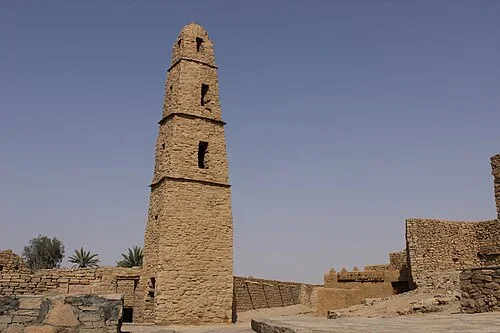 Umar ibn al-Khattab Mosque
A slender tower of stone rises from the southwest corner of the mosque's prayer hall, bridging over an ancient street. It belongs to the Umar ibn al-Khattab Mosque, built between 634 and 644 and traditionally credited to the caliph Umar himself. Scholars doubt that attribution. The mosque may simply be named for the Banu Umar, a tribe that settled in Dumat al-Jandal, and some believe the structure had an earlier life, perhaps as a church. Whatever its origin, the minaret is often described as one of the oldest in the Islamic world. Its rectangular shaft tapers as it climbs and ends in a pyramidal cap, with a small window on each side lighting the four inner floors. A stone staircase runs up the outside of the qibla wall and reaches the roof. Inside, the prayer hall holds three rows of stone pillars carrying wooden lintels, roofed with acacia and palm trunks. From here the call to prayer carried across the oasis.
Photo: Mojackjutaily · CC BY-SA 4.0
03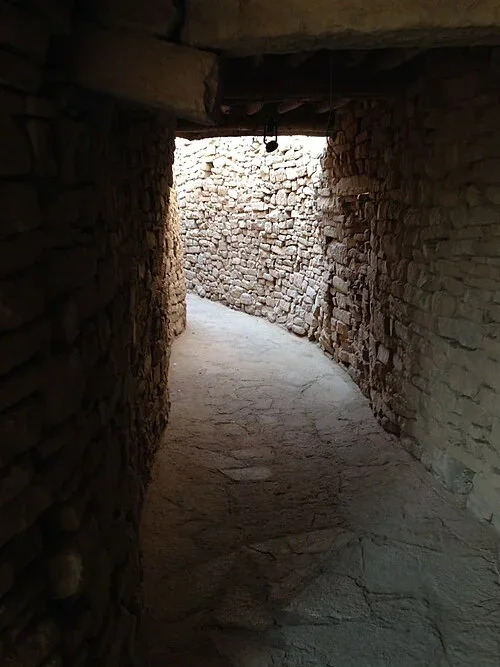 Al-Dar'i Quarter Stone Alleys
Al-Dar'i Quarter: Covered Stone Lane
The lane narrows until its stone walls nearly touch both shoulders, and a roof of palm trunks keeps the passage cool. This covered alley belongs to the Al-Dar'i Quarter, the old town of Dumat al-Jandal, wedged between the Umar Mosque and Marid fortress. Its buildings date to the middle Islamic period. Beneath them, the archaeologist Khaleel al-Muaikel identified layers reaching back to the mid-first millennium BC. The quarter is also a survivor. The historic market of Dumat al-Jandal was demolished in recent decades, and this neighbourhood escaped the demolition shovels. Streets built low and narrow like this one stay cool in the heat and turn aside the desert wind. Many houses now wait for care, and archaeologists hope they will yet be restored.
Listen in the appPhoto: Mojackjutaily · CC BY-SA 4.0
04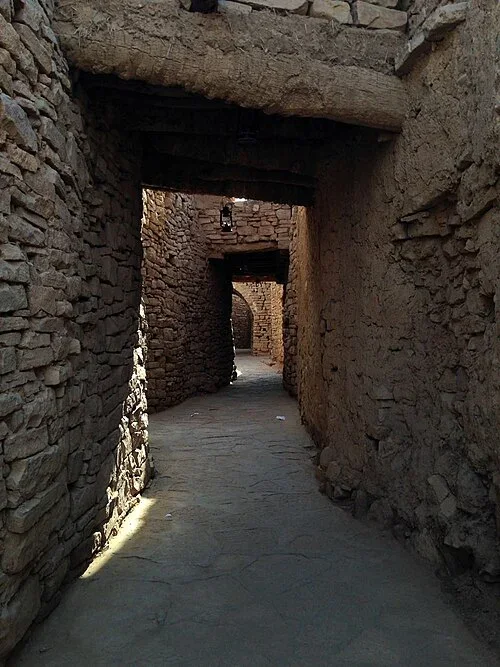 Al-Dar'i Quarter Stone Alleys
Al-Dar'i Quarter: Lanes to the Gardens and Springs
These stone lanes run between the gardens and the water. Life in the Al-Dar'i Quarter was possible because families lived close to the springs that fed the oasis. Every house here is built from the two materials the land offered: stone for the walls, and wood from acacia and palm for the lintels and roofs. The heavy timber beams spanning the lane show it plainly. Rain is scarce in Dumat al-Jandal, about sixty millimetres a year, and most of it falls in winter. That thin supply had to stretch across palm groves, plots and households. The lanes, the gardens and the springs worked as one system.
Listen in the appPhoto: Mojackjutaily · CC BY-SA 4.0
05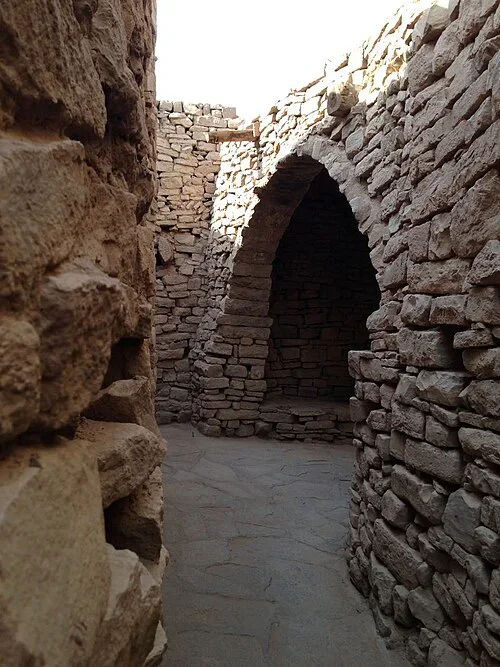 Al-Dar'i Quarter Stone Alleys
Al-Dar'i Quarter: Arched Alcove
Long before Islam reached this oasis, Duma was a city of fairs. The arched alcove in these stone walls makes a fitting backdrop for that chapter, though it marks no single event. Each year, pre-Islamic Arabs travelled a circuit of market cities, and Duma was one of their stops. Its politics were contested. Arab clients of the Byzantines and of the Sasanians both claimed the city, and its loyalties shifted between them. The Banu Kalb, the dominant tribe of the area, anchored that world. Because of its strategic position, Duma drew no fewer than three armed expeditions in this era. In 630 the commander Khalid ibn al-Walid captured the city, and Dumat al-Jandal joined the early Islamic state. The following April he led an expedition, ordered by Muhammad, to demolish an idol called Wadd, worshipped by the Banu Kalb.
Listen in the appPhoto: Mojackjutaily · CC BY-SA 4.0
06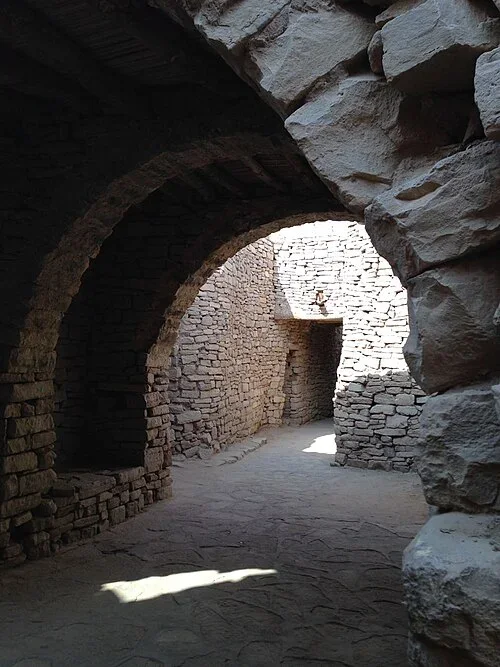 Al-Dar'i Quarter Stone Alleys
Al-Dar'i Quarter: Deep Foundations of a Kingdom
Beneath these medieval houses lie the traces of a kingdom. The quarter's buildings stand on ancient layers, and those deep foundations carry the city's oldest written record. In Assyrian inscriptions from 845 BC, the town appears as Adummatu, capital of an Arab kingdom often identified with Qedar. A clay prism of King Esarhaddon, from 673 to 672 BC, calls it 'the stronghold of the Arabians'. What makes Adummatu remarkable is who ruled it. The names of five powerful Arab queens who ruled the city are known, among them Zabibe, Samsi, Tabua and Te'elhunu. Te'elhunu also held the title of high priestess of Atarsamain, a deity of fertility, love and war linked to Ishtar. Nearly fifteen centuries before the mosque went up, this oasis was already a seat of power, ruled by women whose names survive in cuneiform.
Listen in the appPhoto: Mojackjutaily · CC BY-SA 4.0
07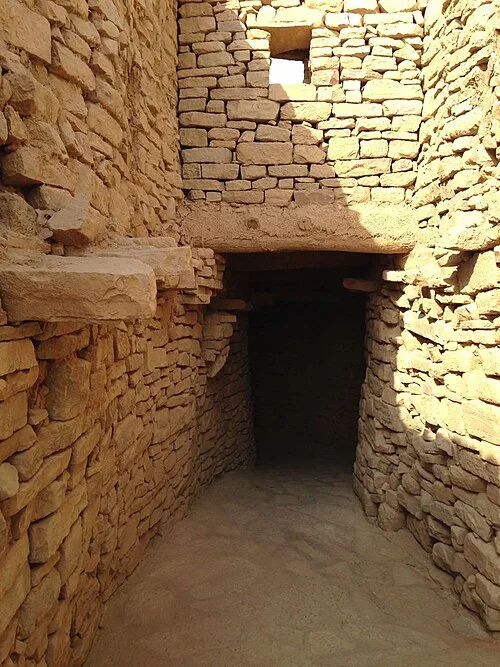 Al-Dar'i Quarter Stone Alleys
Al-Dar'i Quarter: Stone House Interior
Thick stone walls, a small window, a dark doorway: this is the building tradition that runs through the whole oasis. Excavations here tell of a prosperous age. In 1986 the archaeologist Khaleel Ibrahim al-Muaikel dug in the town, adding to observations made ten years earlier. His team found a single, homogeneous layer of Roman-Nabataean pottery, evidence of a flourishing community under the Nabataeans, whose realm probably included this region. That world changed in AD 106, when the emperor Trajan annexed the Nabataean kingdom and Dumah became part of the Roman province of Arabia Petraea. The most vivid trace of Nabataean life came to light in 2011, when excavators uncovered an open-air banqueting hall on a rocky promontory in the western oasis. Archaeologists call such a hall a triclinium. It was built of U-shaped stone benches instead of walls, and used from the late first century BC into the second century AD. Across its surface lay serving bowls, fireplaces, cereal grains, dates, figs, olives and grapevine charcoal, the remains of gatherings held long before the mosque was built.
Listen in the appPhoto: Mojackjutaily · CC BY-SA 4.0
08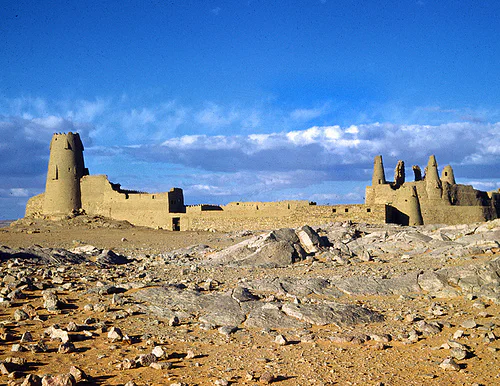 Marid Castle
 (Qasr Marid) in 1949
Marid Castle was already ancient when the most famous story of its life took place. Tradition holds that the first fortress rose here in the second or third millennium BC. The rocky rise it stands on sits about two thousand feet above sea level. Because the site was used for so long, later generations rebuilt parts of it while much of the old fabric remained. In 1949, before modern restoration, the castle looked much as those centuries of rebuilding had left it. Its defining moment came in AD 269. Zenobia, Queen of Palmyra, was in revolt against Rome, and her forces attacked Dumat al-Jandal. Accounts differ on whether the town fell, but the castle itself withstood the attack. Its design explains why. Four watchtowers commanded the approaches, and a deep well inside the walls kept defenders alive through a siege. The building worked in layers: a level for the guards, a level for the archers, a lookout at the top.
Listen in the appTim Barger · Public domain
09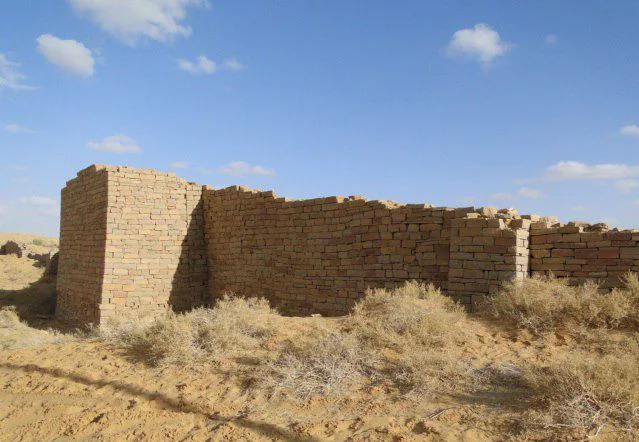 The Ancient Oasis Wall
The Ancient Wall of Dumat al-Jandal
A long stretch of stone wall crosses the desert sand, and once it enclosed the entire oasis. This is the historic wall of Dumat al-Jandal. It ran roughly two kilometres around the community it protected. In places the surviving masonry rises close to four and a half metres. The wall was the counterpart to Marid Castle on its rock: the castle watched the horizon, while the wall shielded the fields, the springs and the houses from raiders. Behind it, an agricultural community could keep its water and its palms safe. The story here runs deeper than any of the buildings. In 2020 archaeologists reported a megalithic stone platform near the oasis, thirty-five metres long and surrounded by burials. It dates back to the sixth millennium BC, and researchers believe it served ritual practices. From that distant beginning to the wall, the castle, the quarter and the mosque, this oasis has held a settled community for thousands of years.
Listen in the appAlmersal · CC BY-SA 4.0
Dumat al-Jandal
Frequently asked questions
How much does the guide cost?
Free app download. Listed guide price: $0.99. Guide price shown in the app. Audio guide only. Venue admission is separate.
Can I listen without internet?
Yes. Download the guide’s audio, images, and maps in the app before your visit. Your downloaded content is then available offline.
Can I listen in my language?
This audio guide is available in 15 languages, including English.
Do I need to follow a schedule?
No. This is a self-guided experience. Choose your stops, pause whenever you like, and return to a story at your own pace.
At your own pace
Explore Dumat al-Jandal.
Download Stanza, then search for “Dumat al-Jandal”.
Free app download · Guide price shown in the app
Keep exploring
Audio guides — Saudi Arabia
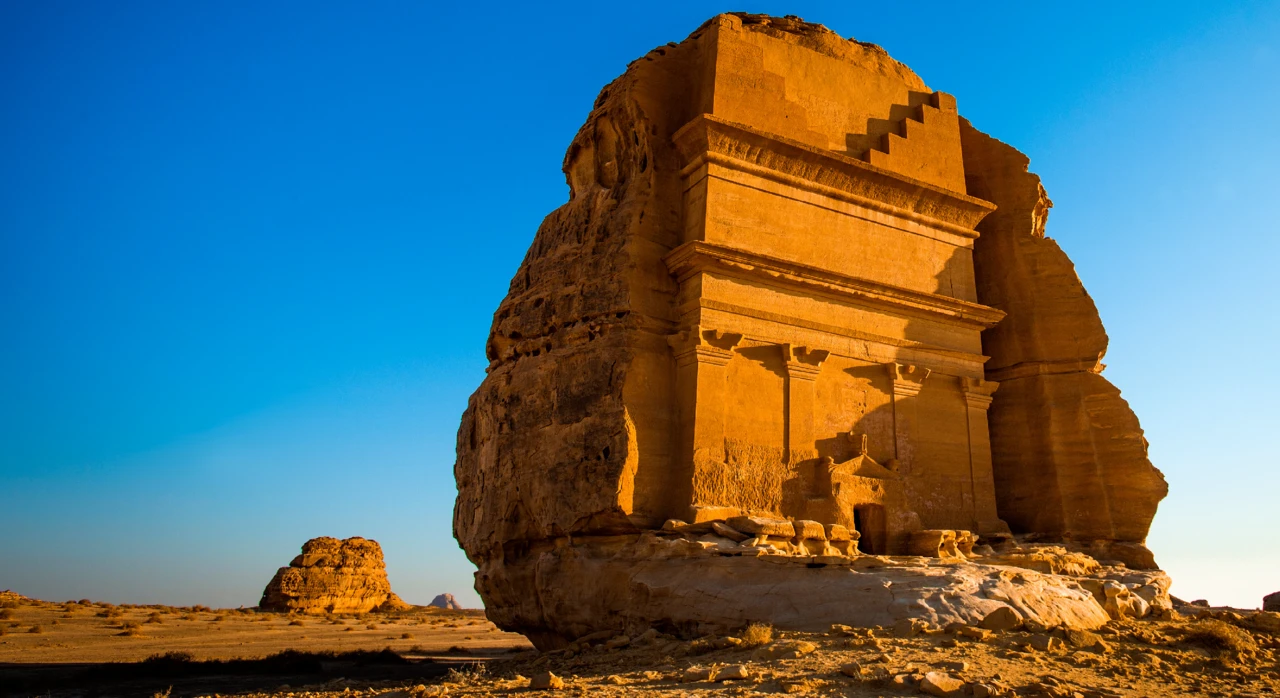
AlUla
Hegra
Content & sources
Ali Lajami · CC0