Languages
15Grand Palace Audio Guide
Grand Palace is an archaeological site in Bangkok, Thailand. Explore it with Stanza's guided offline audio tour — narrated in 15 languages.
Quick Facts
46
Stops
15
Languages
100%
Offline
📍 Bangkok, Thailand · 13.7501°N, 100.4920°E
About Grand Palace
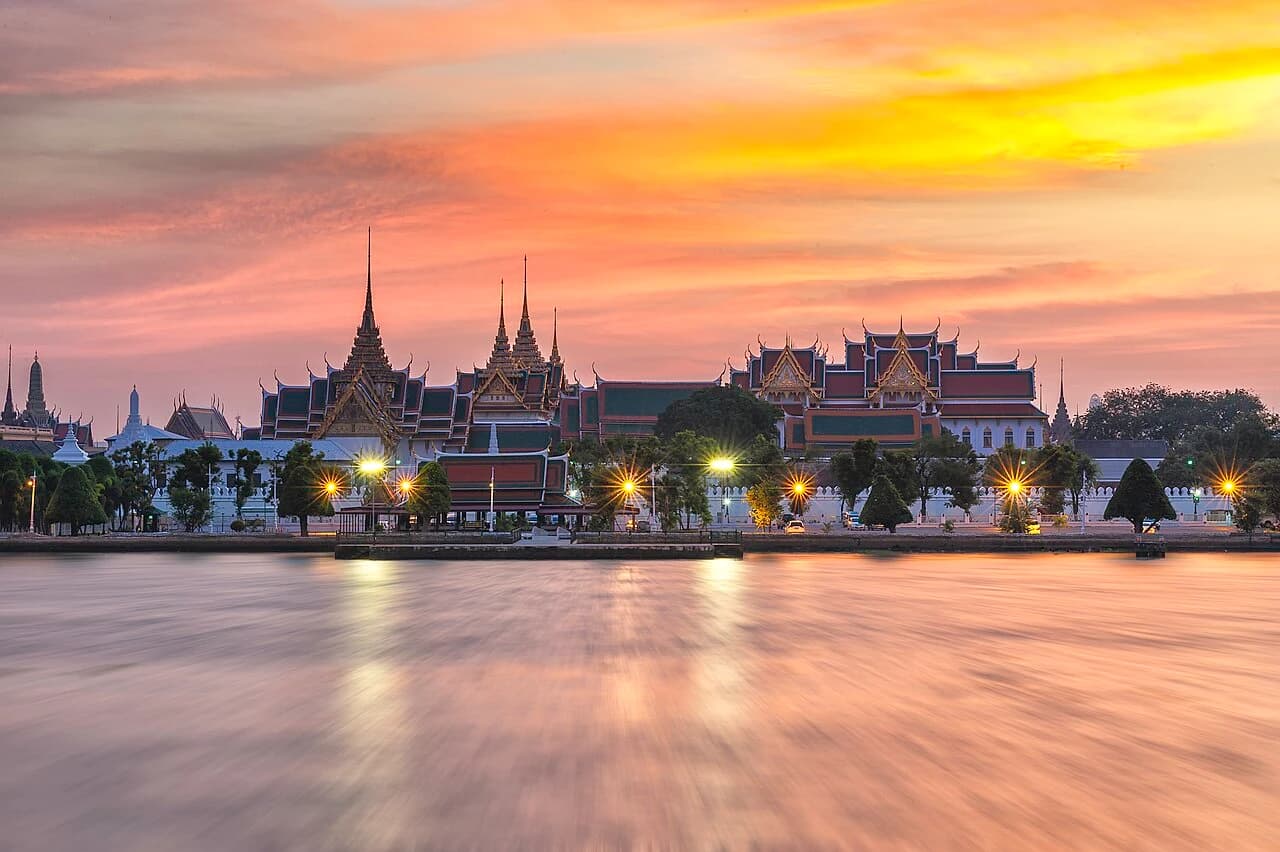
The Grand Palace has been the official residence of the Kings of Siam since 1782. It is a complex of buildings located in the heart of Bangkok that serves as a major site for royal ceremonies and tourism.
This self-guided audio tour features 46 narrated stops organized across 7 sections. As a royal palace, Grand Palace offers a unique cultural experience in the heart of Bangkok, Thailand.
The Stanza audio guide is available in 15 languages and works entirely offline — download the complete tour including audio narration, maps, and images before your visit. As you walk through Grand Palace, GPS-triggered narration plays automatically at each point of interest.
Last updated:
What you will hear
Museum of the Emerald Buddha Temple
Housed in a former barracks, this museum provides essential context on the temple's history, featuring architectural models and rescued artifacts.
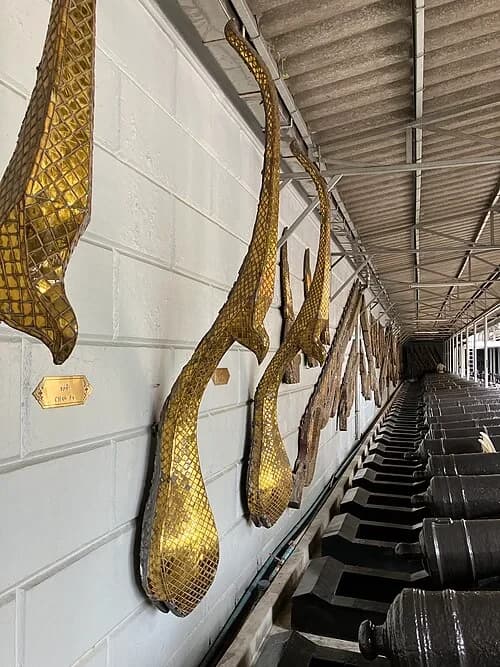
The Horned Chofa
The long, horn-like sculptures mounted on the wall are 'Chofa,' a critical element in Thai sacred architecture. These are decorative finials that traditionally sit at the very highest points of temple gables. Their shape is rich with symbolic meaning, representing the head of the Garuda—the mythical mount of the god Vishnu—or a stylized swan. In Buddhist and Hindu belief, the presence of the Chofa is intended to transform the building into a celestial chariot. This symbolic vehicle is seen as descending from the heavens to the earthly realm, signaling that the space within is divine and separated from the mundane world. When seen atop a building, the Chofa creates a sense of upward movement, drawing the eye toward the sky. Many of these pieces are crafted from wood and covered in gold leaf or shimmering glass mosaics, as seen in the examples here. Because they are exposed to the elements at great heights, they must be replaced periodically during temple renovations. Displaying them at eye level allows you to appreciate the intricate carving and the sheer scale of these roof ornaments, which often appear much smaller from the ground.
Wat Phra Kaew (Temple of the Emerald Buddha)
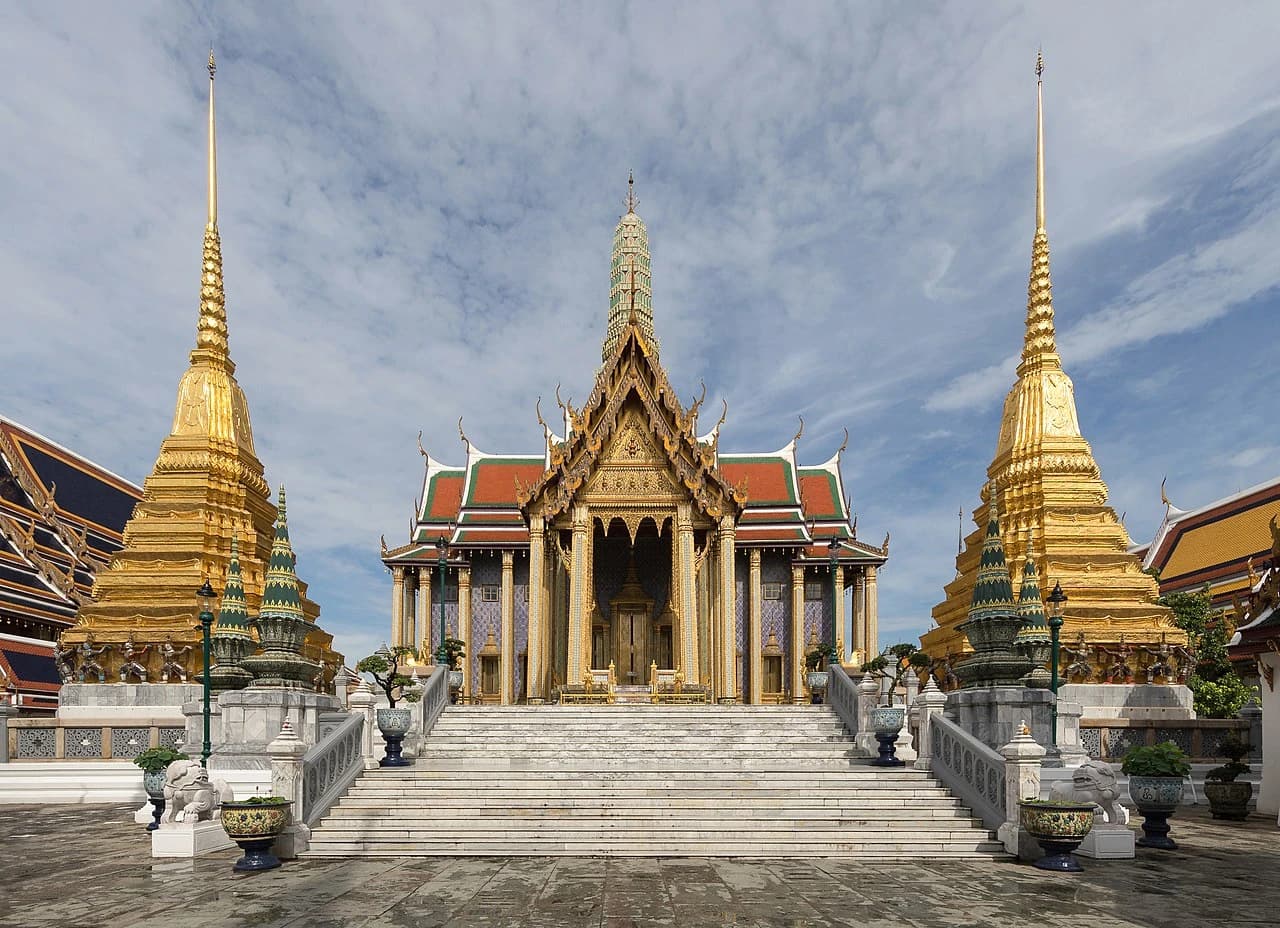
The most sacred Buddhist temple in Thailand, designed as a physical representation of Buddhist and Hindu cosmology.
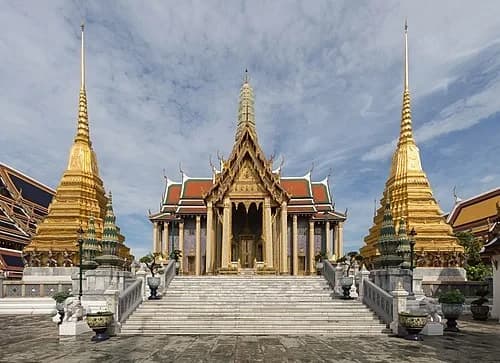
Temple of the Emerald Buddha
This is the heart of the kingdom's spiritual life. Wat Phra Kaew, or the Temple of the Emerald Buddha, was founded by King Rama I in 1782 at the same time he moved the capital to Bangkok and established the Grand Palace. The layout of the temple is far from accidental; it follows a precise 'Cosmological Layout.' The various spires, chapels, and stupas are arranged to represent Mount Meru, which in Buddhist and Hindu cosmology is the sacred mountain at the center of the universe. By walking through these grounds, visitors are metaphorically traveling through the different layers of existence toward the most divine center. Unlike most Thai temples, Wat Phra Kaew does not have a residential area for monks; it is exclusively a royal chapel used for state ceremonies and the housing of the Emerald Buddha. The density of gold, porcelain, and glass ornamentation is intended to create an atmosphere of heavenly splendor on earth. Every surface is designed to catch and reflect light, symbolizing the radiance of Buddhist teachings. As you look around, you see the culmination of centuries of Thai art, architecture, and religious devotion concentrated into this single complex.
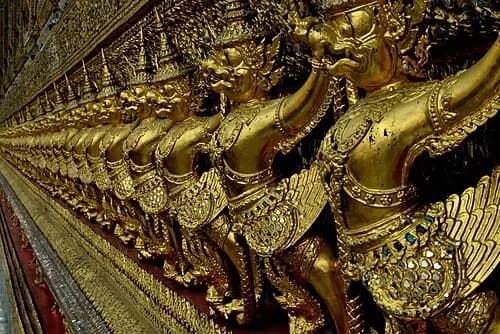
The Golden Garudas
A rhythmic, repeating pattern of 112 identical golden Garudas lines the exterior base of the main chapel. Each of these mythical half-man, half-bird creatures is depicted clutching two Nagas, or serpents, by their tails. This specific imagery is deeply rooted in Hindu-Buddhist mythology and carries a significant political message. In these traditions, the Garuda is the celestial mount of the god Vishnu. Because the Thai monarch is traditionally viewed as a reincarnation of Vishnu on earth, the presence of the Garuda serves as a direct symbol of royal power and divine right. The sheer number of these figures creates a sense of overwhelming spiritual protection and majesty. Notice how their wings are spread and their expressions are fierce, emphasizing their roles as active defenders of the sacred space within. The use of gold across all 112 figures ensures that the entire foundation of the chapel appears to glow, especially during the early morning or late afternoon. This repetition was a common feature in royal architecture, used to demonstrate the unlimited resources and the unwavering devotion of the crown. The Nagas they hold represent the spirits of the earth and water.
Phra Mondop
An exquisite library built to house the Tripitaka (sacred Buddhist scriptures), featuring walls covered in tiny green glass mosaics.
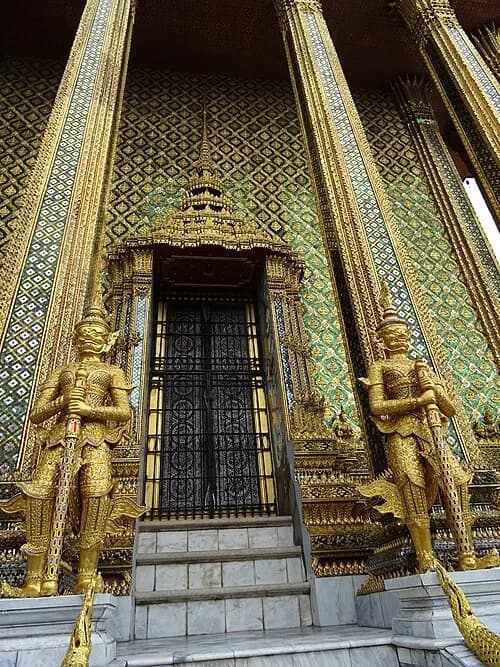
Entrance of the Library
Guarding the stairs to the royal library are two large, golden statues known as 'Apsara-singha.' These mythical creatures are half-lion and half-human, combining the strength of the king of beasts with the grace and intelligence of a celestial nymph. Unlike the colorful, fierce demons found elsewhere in the complex, these figures are rendered entirely in gold, giving them a more serene and refined appearance befitting the entrance to a place of learning. Take a look at the base of the platform they stand upon. It is decorated with 'Benjarong' porcelain tiles. The term 'Benjarong' literally means 'five colors.' This unique ceramic style was traditionally imported from China but created using designs sent from the Siamese court, making it a true fusion of regional artistic traditions. The intricate floral patterns on these tiles are characteristic of the 18th and 19th centuries, when such porcelain was a prized luxury item. The combination of the golden mythical guardians and the colorful porcelain base creates a rich visual frame for the stairs leading into the sacred library. These figures are poised as if ready to defend the wisdom inside, their hands held in a traditional gesture of greeting.
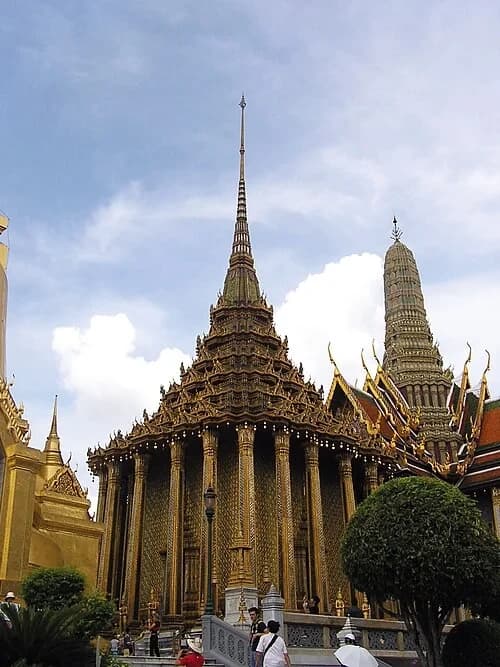
Royal Library
Direct your attention to Phra Mondop, the exquisite library built by King Rama I to house the 'Tripitaka.' These are the sacred Buddhist scriptures, meticulously transcribed onto palm-leaf manuscripts and kept within beautifully crafted cabinets. This building is a masterpiece of Thai decorative art, intended to be a secure and magnificent home for the religion's most important texts. One of its most striking features is the use of 'sea-green' glass mosaics that cover the columns and walls, creating a cool, iridescent glow that contrasts with the surrounding gold. The doors are equally impressive, featuring intricate 'mother-of-pearl' inlays that depict celestial beings and guardian spirits. Because of the extreme fragility and holiness of the manuscripts inside, the library is rarely opened to the public, remaining a silent and sacred space for much of the year. The structure rests on a high, tiered base decorated with rows of small statues, intended to elevate the scriptures literally and figuratively above the mundane world. The roof is topped with a slender, multi-tiered spire that echoes the shape of a royal crown. Each element, from the mosaic tiles to the mother-of-pearl, was chosen to reflect the infinite value of the wisdom contained within.
The Royal Pantheon (Prasat Phra Thep Bidon)
This pavilion houses life-sized statues of the kings of the Chakri Dynasty and is only opened to the public on specific holidays.
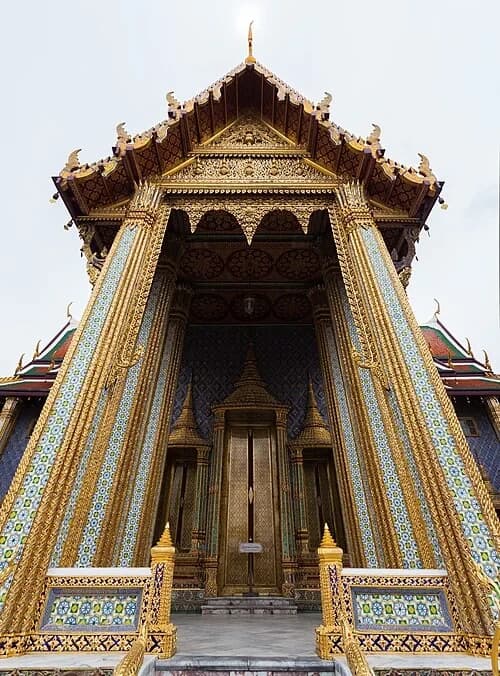
The Royal Pantheon
This cross-shaped structure is the Royal Pantheon, known in Thai as Prasat Phra Thep Bidon. It serves a deeply significant role as the memorial for the reigning Chakri Dynasty, housing life-sized statues of the past kings. Because of its sensitive function, the building remains closed to the public for nearly the entire year. The doors are only opened on April 6th, which is Chakri Day, a national holiday commemorating the founding of the dynasty. From the outside, you can appreciate the unique blue-and-gold color palette of the exterior walls, which distinguishes it from the more gold-heavy buildings nearby. The architectural style blends traditional Thai forms with a cross-shaped floor plan, creating a spacious and dignified interior for the royal portraits. The surrounding terrace is often quiet, providing a space for reflection on the historical lineage that has shaped modern Thailand. The exterior is a masterpiece of decorative masonry, with every inch of the wall covered in patterns that reflect light differently as the sun moves throughout the day.
Model of Angkor Wat
Commissioned by King Rama IV, this detailed stone model serves as a historical reminder of the Khmer empire's influence and Siamese history.
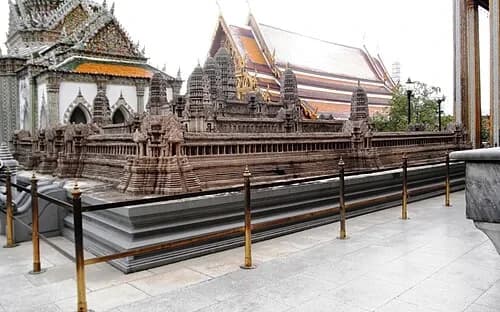
Model of Angkor Wat
This detailed stone model represents the famous Cambodian temple of Angkor Wat. It was commissioned in the 1860s by King Rama IV, during a period when Cambodia was under Siamese suzerainty. The model serves as a historical reminder of the deep architectural and cultural ties shared between the Khmer and Thai civilizations. It is a precise miniature, capturing the central towers, the surrounding galleries, and the intricate layout of the original temple complex. By placing it within the grounds of the Temple of the Emerald Buddha, the King brought a piece of Khmer history into the heart of Bangkok. This allowed the court and the public to appreciate the scale and beauty of Angkor without undertaking a long and difficult journey. The model is carved from stone, giving it a weathered, monumental feel that stands in contrast to the brightly gilded and tiled buildings nearby. It remains one of the most popular features of the upper terrace, inviting visitors to compare the different styles of sacred architecture found within the region. The carving has been preserved carefully to maintain the sharp details of the towers and stairs.
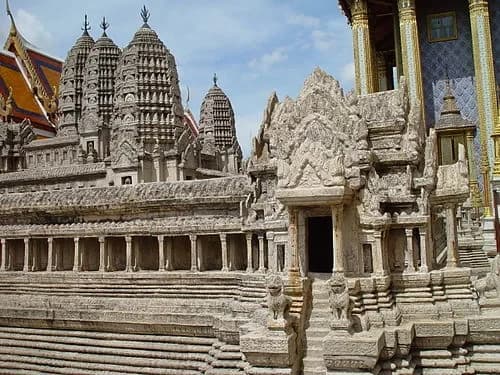
Stone Carvings of Angkor
Examine the precision of this stone model, which mirrors the layout of Angkor Wat. King Rama IV wanted his subjects to witness the greatness of the Khmer Empire’s architecture firsthand, despite the vast distance to the actual site. The gray sandstone texture used for the model provides a stark visual contrast to the bright, gilded buildings that surround it on this terrace. While the nearby temples shimmer with gold leaf and glass mosaics, this model relies on the play of light and shadow over carved stone surfaces. You can see individual staircases, window frames, and the iconic 'quincunx' arrangement of the five central towers. This stone miniature is a testament to the skill of the 19th-century artisans who studied the original temple to create such a faithful reproduction. Its location near the Royal Library emphasizes the value placed on historical knowledge and cross-cultural exchange within the Siamese court. The muted tones of the sandstone highlight the structural complexity of the Khmer style, offering a quiet moment of architectural study amidst the colorful splendor of the rest of the complex.
The Supplementary Library (Ho Phra Monthien Dharma)
Considered the most beautiful secular building in the complex, it serves as a library for Buddhist texts and features stunning mother-of-pearl doors.
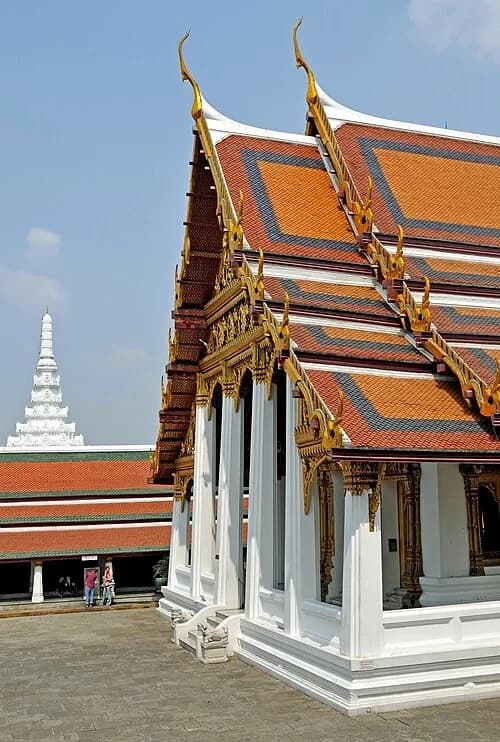
Scripture Hall
The Ho Phra Monthien Dharma, or the Supplementary Library, is notable for its exquisite black lacquer doors. These are inlaid with iridescent mother-of-pearl, forming intricate patterns that shimmer as you move past them. These doors are historically significant because they were salvaged from a temple in Ayutthaya, the former capital of Siam that was destroyed in 1767. By incorporating these pieces into the new palace in Bangkok, the early Chakri kings established a physical and spiritual link to the nation's ancient past. This mother-of-pearl inlay represents the highest level of Thai decorative art, requiring immense precision to cut and fit the thin shells into the lacquered wood. The library itself was built to house sacred Buddhist texts and stands as a fine example of traditional architecture. The columns are decorated with sea-green glass mosaics, a color choice that complements the dark, reflective doors. This building is typically reserved for sacred use and is not generally open to the public, but its exterior provides a wealth of detail for visitors to admire, from the gilded gables to the finely carved eaves.
The Belfry
This colorful tower houses a bell that is rung only on special occasions, such as the appointment of a new Supreme Patriarch.
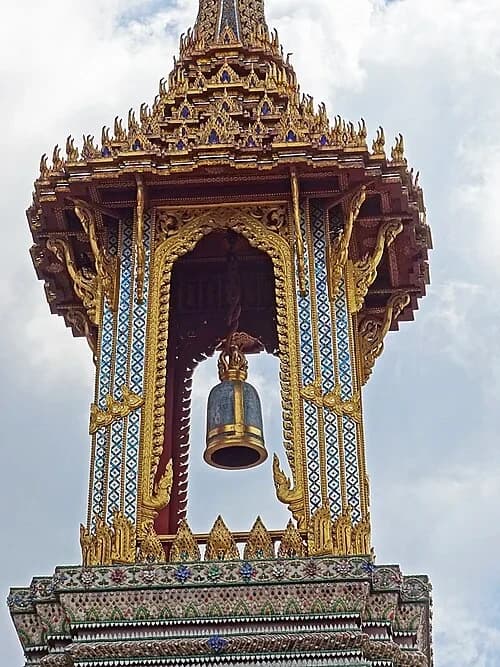
Bell Tower Spire
Look at the top of the Belfry to see its distinctive 'Prang' style spire. This corn-cob shape is derived from ancient Khmer architecture, which the early Chakri kings integrated into a new, unified style known today as the Bangkok or Rattanakosin style. This architectural blending was a deliberate effort to honor the diverse historical influences of the region, including the Sukhothai and Ayutthaya periods. The spire is divided into several horizontal tiers, each decorated with small niches and sculptures of celestial beings. This tapering form is meant to represent the peaks of sacred mountains in Buddhist cosmology. The vibrant mosaics covering the spire ensure that it remains a focal point against the blue sky. This fusion of Khmer structural forms with Thai decorative techniques created buildings that felt both familiar and modern to the 19th-century residents of Bangkok. The spire's intricate silhouette is achieved through the use of brick and stucco, which is then clad in thousands of tiny pieces of colored glass and ceramic, reflecting the light in a way that solid stone never could.
Want to hear the rest?
Download the Stanza app to unlock all 46 stops and the complete guided audio tour.
Frequently Asked Questions
How long does the Grand Palace audio tour take?
The Grand Palace audio guide includes 46 narrated stops. Most visitors spend 45 minutes to 1.5 hours exploring the complete tour, though you can listen at your own pace and skip or revisit any stop.
Is the Grand Palace audio guide available in my language?
Stanza supports 15 languages: English, Spanish, French, German, Italian, Portuguese, Russian, Japanese, Chinese, Korean, Arabic, Hindi, Polish, Dutch, Hebrew. Check the guide in the app to confirm the languages currently available for this tour.
Can I use the audio guide offline at Grand Palace?
Yes! Download the complete Grand Palace tour — including all audio, maps, and images — before your visit. The Stanza app works completely offline, so you don't need WiFi or mobile data at the venue.
How much does the Grand Palace audio guide cost?
The Stanza app is free to download. Free and paid audio guides are available; current prices are shown in the app.
How do I use the Stanza audio guide at Grand Palace?
Download the free Stanza app, search for "Grand Palace", and download the tour. When you arrive at the venue, the app uses GPS to detect your location and automatically plays the relevant narration as you move between points of interest — completely hands-free.
What makes the Stanza audio guide different from other Grand Palace tours?
Stanza offers GPS-triggered narration that plays automatically as you walk through Grand Palace — no need to manually select stops. The tour is available in 15 languages, works fully offline, and includes 46 expertly narrated stops with images and historical context.
What other audio guides are available near Grand Palace?
Stanza offers multiple audio guides in Bangkok, Thailand and nearby areas. After downloading the app, browse the map to discover all available tours near Grand Palace. Each guide can be downloaded for offline use.