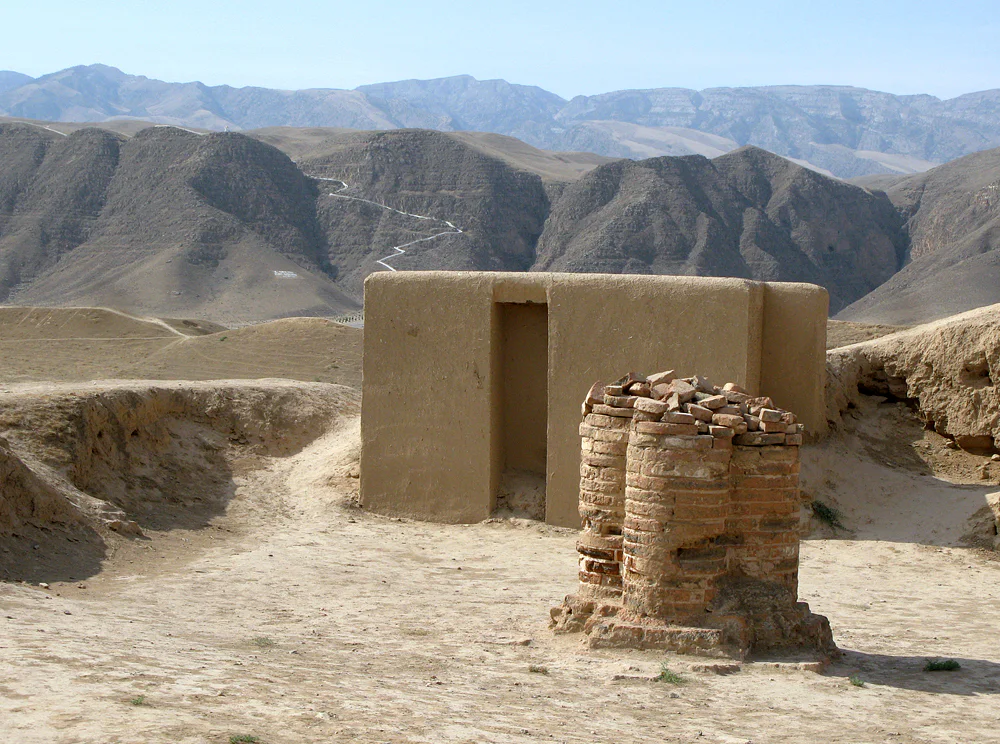
Stanza · Audio guide
Nisa, Turkmenistan Audio Guide
A place to remember. A story to take with you.
Nisa was an ancient settlement of the Parthians located near Ashgabat. It is described by some as the first seat of the Arsacid Empire.
Download Stanza, then search for “Nisa, Turkmenistan”.
About the tour
One guide. Your kind of visit.
Nisa was an ancient settlement of the Parthians located near Ashgabat. It is described by some as the first seat of the Arsacid Empire.
Ready when you are.
- 01Get the free Stanza app.
iOS & Android
- 02Find your guide.
“Nisa, Turkmenistan”
- 03Download before you go.
Works offline
Audio guide / 14 narrated stops
Inside the guide
Get to know a few of the stories before you go. Open a stop to read more.
01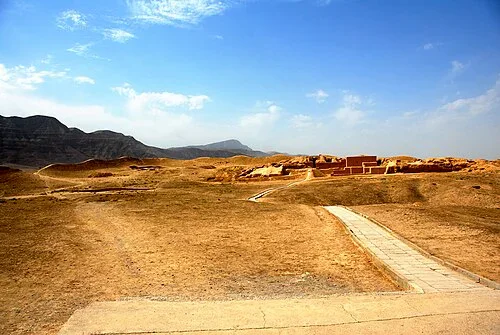 Citadel Approach and Outer Mud-Brick Ramparts
Old Nisa: Approach to the Arsacid Stronghold
Welcome to Nisa, the ancient stronghold of the Parthians. The settlement lies near the village of Bagyr, about eighteen kilometres west of central Ashgabat. Tradition holds it as the first seat of the Arsacid dynasty, the royal house that rose from these foothills. Whether the fortress actually served the kings as a residence or as a tomb, no one has managed to establish. Its importance is not in doubt. In 2007, UNESCO inscribed the Parthian Fortresses of Nisa as a World Heritage Site. The protected core zone covers nearly seventy-eight hectares of ruins.
Dave Proffer · CC BY 2.0
02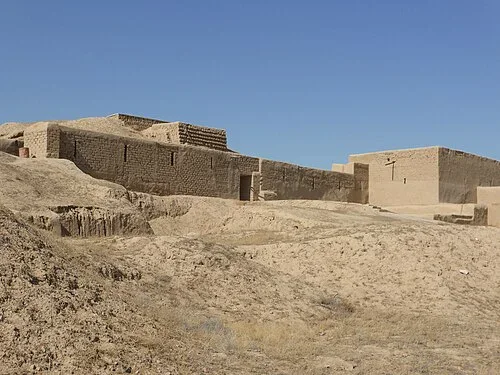 Citadel Approach and Outer Mud-Brick Ramparts
The Mud-Brick Ramparts of Mithradatkert
The ramparts rise straight out of the natural mound, massive walls of mud-brick and rammed earth. In this arid frontier zone, earth was the material Parthian builders trusted, and they raised a defensive perimeter of real ambition from it. The fortress also carries a name of its own. It was called Mithradatkert, the fortress of Mithradates. The name honours Mithridates the First of Parthia, who reigned from about 171 to 138 BC. Under his rule the stronghold took shape as a royal centre. Nisa was more than a garrison, too. It stood as a major trading hub of the Parthian Empire.
Hans Birger Nilsen · CC BY-SA 2.0
03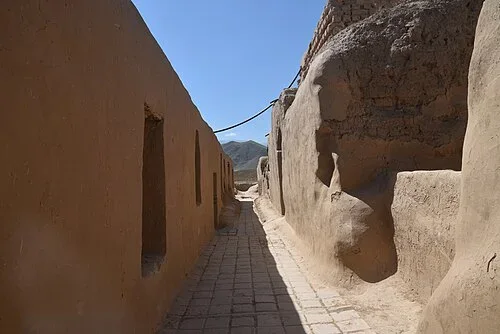 Fortress Corridors and Architectural Facades
Into the Royal Citadel
In 247 BC, a chieftain named Arsaces led his tribe, the Parni, out of the Karakum desert. He seized Partawa, the local seat of power, and the Seleucid satrap Andragoras was killed in the takeover. Arsaces proclaimed himself king of an independent Parthia, and the Arsacid dynasty was born. From then on, this place, known as Parthaunisa, served as the administrative and economic centre of the dynasty's lands. A paved lane flanked by tall earthen walls, with niches opening along one side, leads into the heart of the royal precinct. Every king who ruled Parthia after Arsaces traced his line back to that desert rebellion.
Listen in the appHans Birger Nilsen · CC BY 2.5
04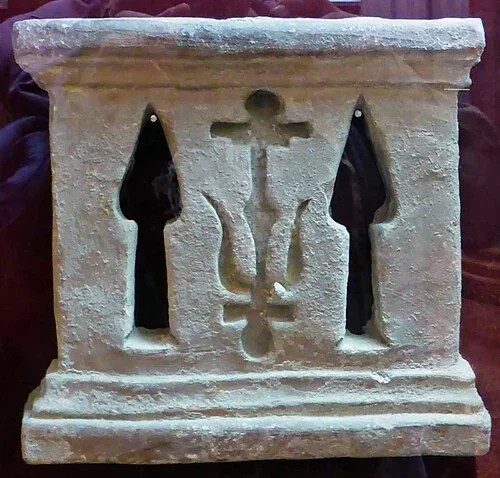 Fortress Corridors and Architectural Facades
Metope with Seleucid Anchor
The panel shows an anchor flanked by two spearheads, the device known as the Seleucid anchor. It comes from the facade of the Red Building at Nisa, a piece of terracotta carved for display high on a royal facade. It is kept today in the National Museum of Turkmenistan in Ashgabat. Parthian builders here adopted the vocabulary of Hellenistic architecture, with metopes, sculpted facades and classical ornament. But they executed it all in local materials. Across the successor kingdoms of Alexander's empire, such decorative schemes were the shared language of prestige. At Nisa, that language was spoken in earth and clay.
Listen in the appHans Birger Nilsen · CC BY 2.5
05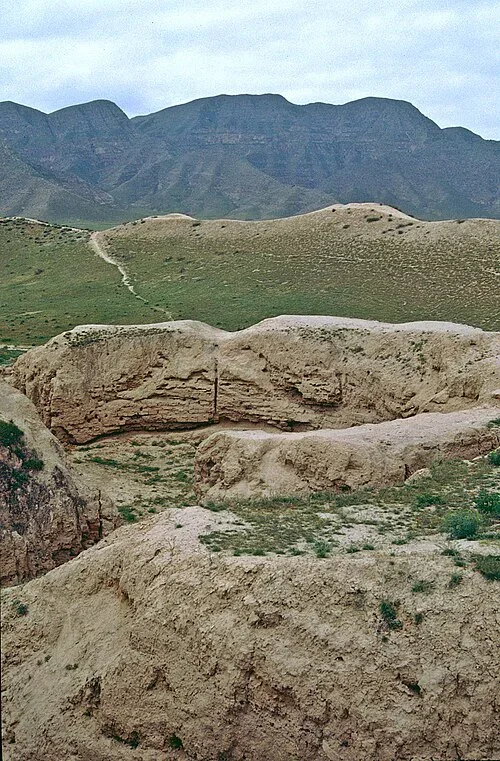 Southern Complex: The Monumental Round Hall
The Round Hall
The Southern Complex of the citadel holds three great structures. Excavators distinguish a tower-like building, a Square Hall, and the Round Hall. Even in ruin, the circular chamber's eroded mass rises against the Kopet Dag foothills. Monumental circular and square chambers in Parthian royal complexes are associated with ceremony and cult. What rituals exactly took place inside this one remains an open question for scholars. The scale alone says something. Whoever built it meant this room to impress, and two thousand years of wind have not erased that.
Listen in the appPhoto: Ziegler175 · CC BY-SA 4.0
06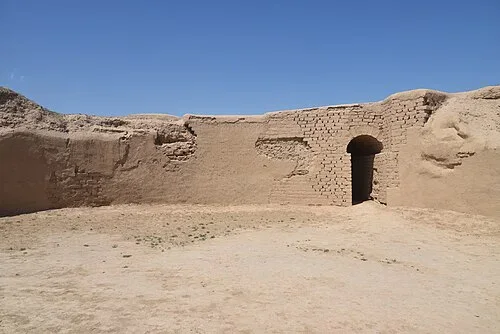 Southern Complex: The Monumental Round Hall
Mud-Brick Walls of the Southern Complex
The builders of Nisa worked in earth, and they worked with care. The surviving walls show courses of mud-brick laid in neat, disciplined rows. Set into the earthen fabric is an arch of fired brick, a more durable material reserved for the openings that mattered. The wall around the arch has slowly melted back toward the plain. The arch itself still holds its curve.
Listen in the appCarole Raddato from FRANKFURT, Germany · CC BY-SA 2.0
07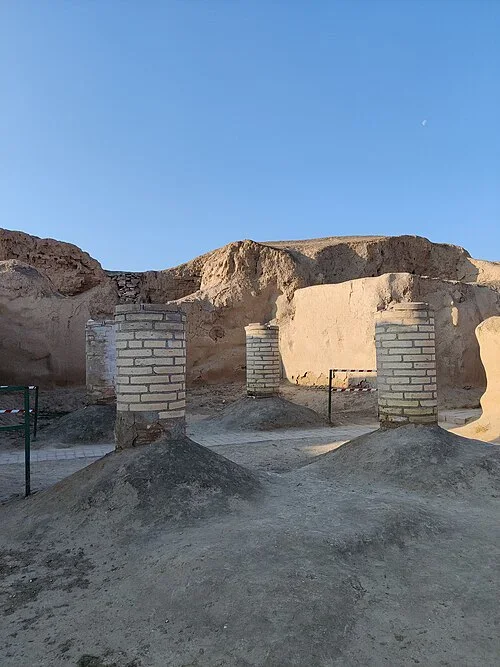 Southern Complex: The Royal Square Hall
The Square Hall
Column bases rise from the excavated floor of the Square Hall, marching across the ruin under the desert sky. In its day this was a grand columned chamber, built entirely of mud-brick. It echoed the peristyle halls of the Greek world, but no stone was used anywhere in it. Halls of this scale in Parthian royal complexes are associated with state ceremony and banqueting. How many columns once stood here, and what roof covered them, no one has been able to say. The bases are enough to show that this was a room for gathering people of consequence.
Listen in the appPhoto: Ananari · CC BY-SA 4.0
08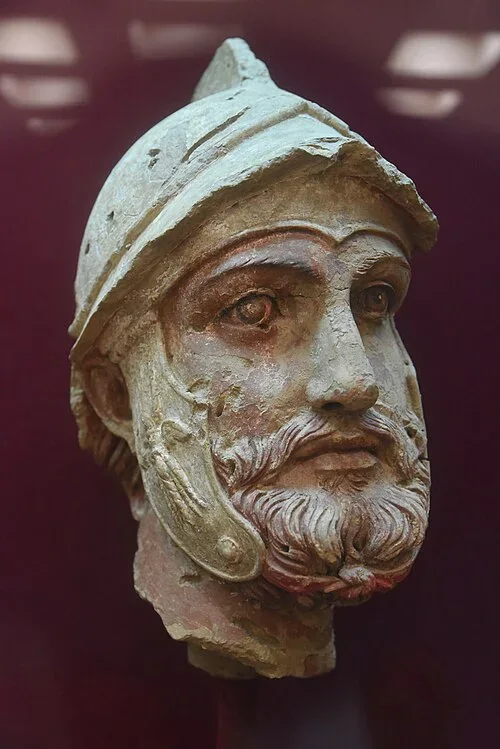 Southern Complex: The Royal Square Hall
Head of a Parthian Warrior
A sculpted clay head of a Parthian soldier, made in the second century BC, was found at the fortress and now sits in the National Museum of Turkmenistan in Ashgabat. He wears a Hellenistic-style helmet, and his face is modelled with Greek sculptural technique. The subject, though, is a Parthian warrior of the kind who served the Arsacid kings. Behind such imagery stood a local tradition. The region around Nisa was famous for the beauty, agility and strength of its horses.
Listen in the appCarole Raddato · CC BY-SA 2.0
09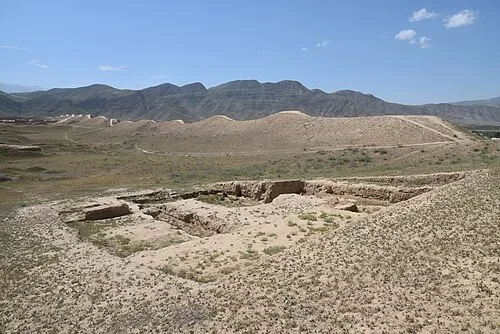 Northern Complex: Royal Treasury and Wine Stores
The Northern Complex Treasury
Old Nisa divides into two great sectors, the Northern Complex and the Southern. The low exposed walls ahead belong to the northern one, home to the site's famous treasury. Excavations here revealed substantial buildings, shrines, and many inscribed documents. The treasury itself had been looted long before the archaeologists arrived. Even so, in 1948, excavators working in the Northern Complex uncovered a cache of carved ivory rhytons that made Nisa famous around the world.
Listen in the appCarole Raddato from FRANKFURT, Germany · CC BY-SA 2.0
10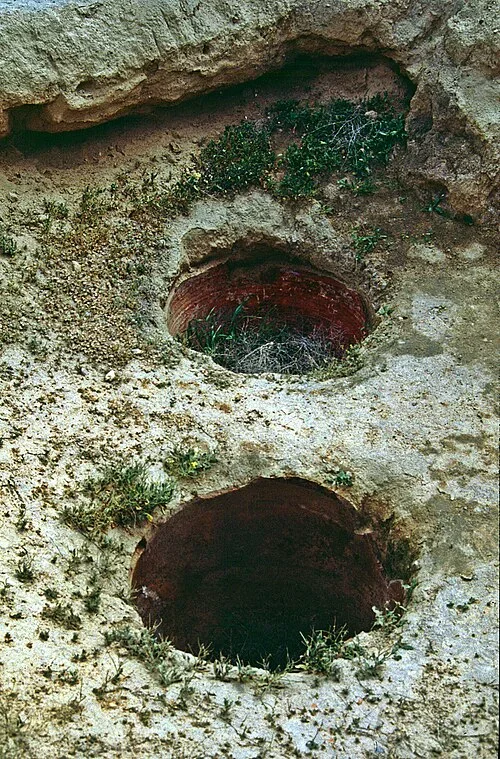 Northern Complex: Royal Treasury and Wine Stores
The Wine Cellars
Deep pits sunk into the earth held the fortress's wine. Provisioning a royal court took infrastructure like this, cellar after cellar laid in below ground. The inscribed documents recovered from the excavations show that the site ran on careful record-keeping. Nisa was never only a ceremonial sanctuary. It was a working economic centre, one that fed, supplied and stocked the elite who lived and served here.
Listen in the appPhoto: Ziegler175 · CC BY-SA 4.0
- 11
Ivory Rhyton
An ivory rhyton from the treasury: a ceremonial drinking horn ringed with carved figures.
- 12
The Griffin Terminal
The winged griffin at the rhyton's base, where Greek mythology meets the art of the steppe.
- 13
Ramparts View over the Ruins
The earthquake in the first decade BC that destroyed Nisa and sealed its treasures under the collapsed walls.
- 14
New Nisa and the Parthian Legacy
New Nisa, the neighbouring settlement mound, and the five-century Parthian legacy that began at Old Nisa.
Nisa, Turkmenistan
Frequently asked questions
How much does the guide cost?
Free app download. Listed guide price: $1.99. Guide price shown in the app. Audio guide only. Venue admission is separate.
Can I listen without internet?
Yes. Download the guide’s audio, images, and maps in the app before your visit. Your downloaded content is then available offline.
Can I listen in my language?
This audio guide is available in 15 languages, including English.
Do I need to follow a schedule?
No. This is a self-guided experience. Choose your stops, pause whenever you like, and return to a story at your own pace.
At your own pace
Explore Nisa, Turkmenistan.
Download Stanza, then search for “Nisa, Turkmenistan”.
Free app download · Guide price shown in the app
Keep exploring
Audio guides — Turkmenistan
Baýramaly
Merv
Content & sources
Hans Birger Nilsen · CC BY-SA 2.0