Stanza · Audio guide
Merv Audio Guide
A place to remember. A story to take with you.
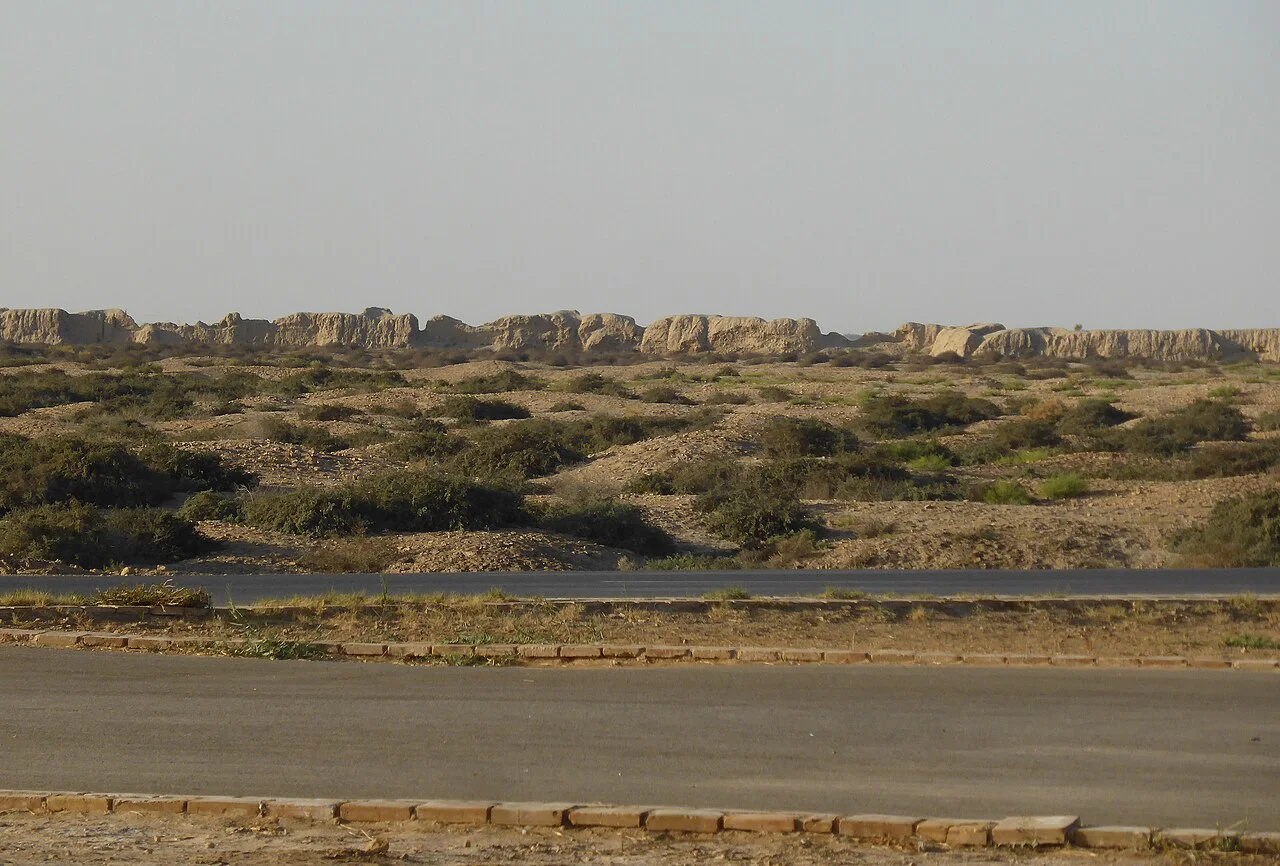
Merv was a major Iranian city in Central Asia located on the historical Silk Road. Human settlements existed on the site from the 3rd millennium BC until the 18th century AD.
Download Stanza, then search for “Merv”.
About the tour
One guide. Your kind of visit.
Merv was a major Iranian city in Central Asia located on the historical Silk Road. Human settlements existed on the site from the 3rd millennium BC until the 18th century AD.
Ready when you are.
- 01Get the free Stanza app.
iOS & Android
- 02Find your guide.
“Merv”
- 03Download before you go.
Works offline
Audio guide / 15 narrated stops
Inside the guide
Get to know a few of the stories before you go. Open a stop to read more.
01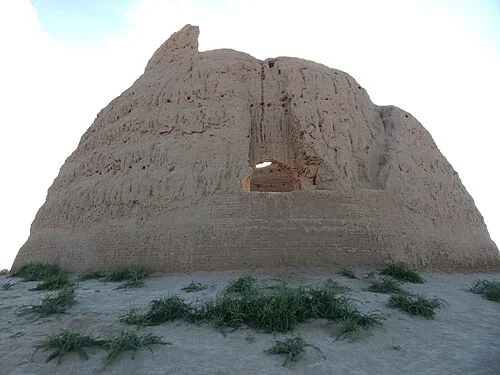 Great Icehouse
Merv owed its life to the Murghab River, which flows from the Hindu Kush and spreads across the Karakum desert in a fan of watered land. Canals cut from that river irrigated the oasis, which became renowned throughout the East for its fertility. Wheat, barley, melons, rice and cotton all grew in abundance. The summers, though, were brutal, and heat could spoil whatever the fields produced. This massive conical mound of mudbrick was built to answer that problem. Across medieval Central Asia, icehouses like this one held ice gathered in winter, packed deep inside thick walls so it lasted into the hot months and kept food cool. However old it is, the shape tells its purpose plainly: sheer bulk, raised to hold the cold. Its exact age is uncertain; it may go back as far as the seventh century.
Photo: 13299achan · CC BY-SA 4.0
02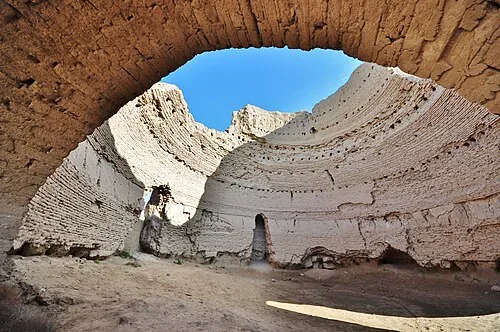 Great Icehouse
Inside the Great Icehouse
From inside, the icehouse explains itself. The walls curve overhead in courses of mudbrick, metres thick, and the deep hollow chamber once sat shaded within all that mass. The thicker the walls and the deeper the space, the slower the warmth crept in. Today the crown of the dome has fallen away, so the sky opens through the top of the ruin. The broken opening shows how much of the structure was pure bulk.
Photo: 13299achan · CC BY-SA 4.0
03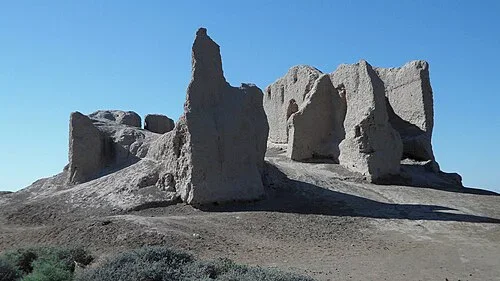 Little Kyz Kala
In Abbasid times, this was a manor house for Merv's elite, one of the fortified country houses the city's grand families raised around the oasis. The building type is called a kushk, from a Persian word for a pavilion. Little Kyz Kala is one of the striking survivors. Its walls are extraordinarily thick, with deep corrugations running up the outside like giant ribs. Inside, multiple stairways climbed to living quarters on the second storey. Mass and corrugation together gave the house both presence and protection. Its larger companion, the Great Kyz Kala, stands nearby with the same pleated walls at grander scale.
Listen in the appHergit · CC BY-SA 3.0
04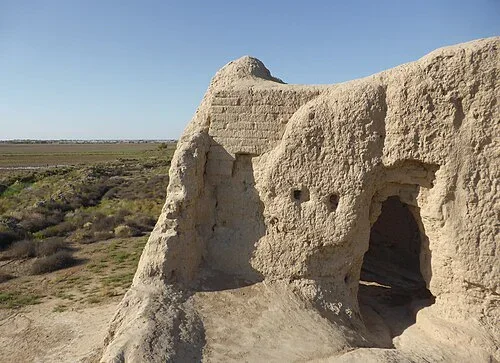 Little Kyz Kala
: Walls and Doorways
The brickwork of Little Kyz Kala shows its semi-fortified character. These were manor houses built to be defensible, with heavy mudbrick walls and a vaulted archway opening at ground level. For Merv's kushks, storage may have been on the ground floor, with life happening above. Parapets lined the roof, which was often used for living as well. Centuries of wind and rain have softened the brick, rounding edges that were once crisp.
Listen in the appHans Birger Nilsen · CC BY-SA 2.0
05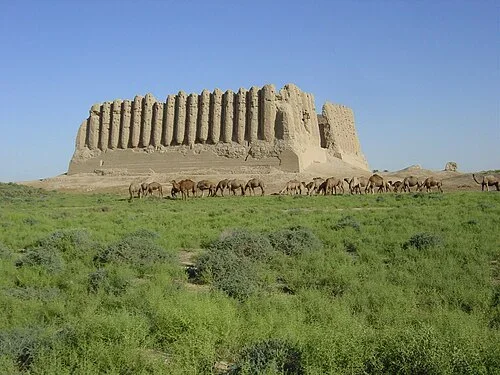 Great Kyz Kala
The corrugated walls of Great Kyz Kala look like a row of packed columns, and that pleated skin is the signature of a building type unique to Central Asia. This one is the largest and best-preserved Abbasid kushk in the city, standing just outside the western wall of Soltangala, the sultan's city. Inside, seventeen rooms surrounded a central courtyard. Camels graze on the green plain before the walls, a fitting sight for an oasis on the Silk Road, where merchants traded for fresh horses and camels.
Listen in the appPhoto: GaiJorayev · CC BY-SA 4.0
06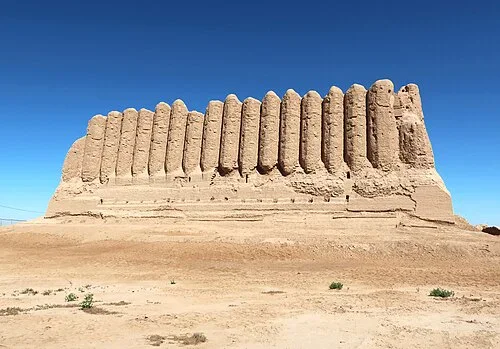 Great Kyz Kala
: The Pleated Facade
The pleats are the point here. Each corrugation is a vertical rib of mudbrick, and together they wrap the palace like tightly packed columns. They were raised course by course with the rest of the wall, shaped while the soft brick was still workable. What the surface looked like when it was new, no one knows.
Listen in the appJohn Pavelka from Austin, TX, USA · CC BY 2.0
07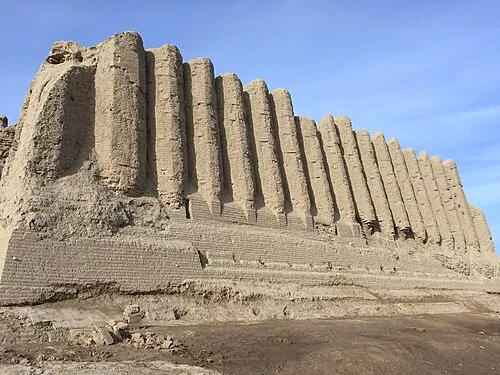 Great Kyz Kala
: Fragile Mudbrick
Mudbrick is generous to build with and merciless to maintain. Rain and wind eat into exposed walls, and every kushk at Merv survives in a precarious state, the corrugations worn soft over the centuries. Since 1992, a joint team of Turkmen and British archaeologists has worked at Ancient Merv, and in 2001 University College London began a new collaboration with the Turkmen authorities. The Ancient Merv Project, as it is called, takes on the conservation and management of the site while continuing archaeological research. The work combines preservation, excavation, and sharing the findings with the widest possible audience.
Listen in the appDr. Alexey Yakovlev · CC BY-SA 2.0
08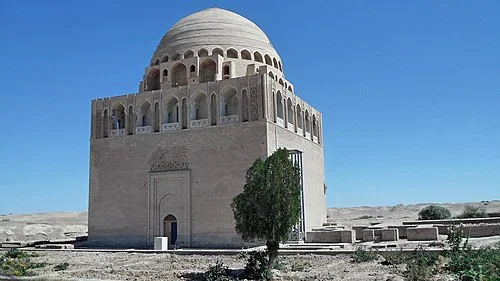 Sultan Sanjar's Mausoleum
In 1037 the Seljuk Turkmens, a clan of Oghuz Turks from the steppes east of the Aral Sea, took Merv peacefully, because the ruling Ghaznavid sultan was deeply unpopular there. Chaghri of the Seljuk house stayed in the city, and Merv became a favourite of the sultans. From 1118, under his great-grandson Ahmad Sanjar, it served as the capital of the whole Seljuk Empire and expanded to its greatest size. Arab and Persian geographers called it the mother of the world and the chief city of Khurasan. Medieval sources put its population at up to half a million, which would have made it among the largest cities in the world. The geographer Yaqut al-Hamawi counted as many as ten giant libraries here. Chaghri was buried at Merv, and so was Sanjar, who ruled until 1157. This domed tomb was built for him.
Listen in the appHergit · CC BY-SA 3.0
09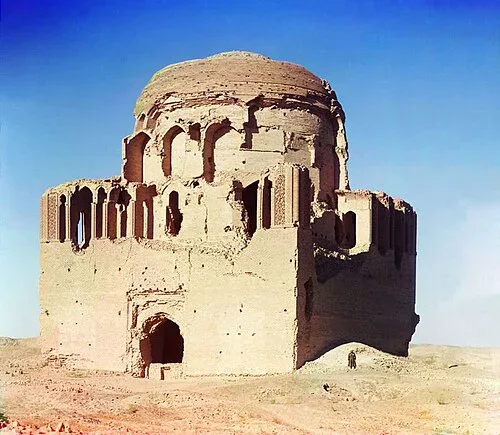 Sultan Sanjar's Mausoleum
The Mausoleum in Ruin, 1911
Merv opened its gates to Tolui, son of Genghis Khan, in 1221. What followed was, as the chroniclers tell it, one of the bloodiest captures of a city in history. The Arab historian Ibn al-Athir gathered the account from refugees. Seized troops were executed before the population, and the people were separated and slaughtered. The chroniclers counted around 700,000 dead, a figure no one can verify today, though one Persian historian put it higher still. The city burned, and the conquerors dug up Sultan Sanjar's grave looking for treasure. Partly rebuilt afterwards, Merv never regained its prosperity. In 1911, Sergey Prokudin-Gorsky came here with an early colour camera and found the dome fallen in and the upper arcades hollowed out. The ruin he saw was the damage of 1221, still plain seven centuries later.
Listen in the appSergei Prokudin-Gorskii · Public domain
10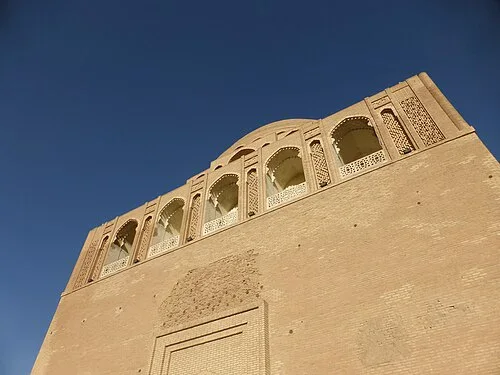 Sultan Sanjar's Mausoleum
The Dome of Sultan Sanjar
The mausoleum of Sultan Sanjar is the largest of the Seljuk mausoleums and the first dated mosque-mausoleum complex, a form that later became common across the Islamic world. The building is square, twenty-seven metres on each side, with entrances on opposite faces. Above them, a great central dome rides on an octagonal system of ribs and arches, a feat of Seljuk brick engineering. In its day, the dome's exterior was turquoise, and it was said that approaching caravans could see it while still a day's march from the city. The decoration was conservative by Seljuk taste, with stucco inside and geometric brickwork outside, much of it now lost. Some of the exterior decoration visible today is a modern reconstruction; the core of the building remains as it was in the twelfth century.
Listen in the appHans Birger Nilsen · CC BY-SA 2.0
- 11
The Last Days of Merv
The final razing of Merv in 1788 and 1789, when its dams were broken and the oasis emptied.
- 12
Shahriar Ark, the Sovereign's Citadel
The Sovereign's citadel: the Seljuk palace with four iwans and a garden lake, where Omar Khayyam worked at the observatory.
- 13
A Holy City of Many Faiths
One oasis held holy by Zoroastrians, Buddhists, Christians and Muslims alike, and home to an Imam and a prophet.
- 14
Erk Gala: The First Merv
Merv is several cities side by side, beginning with a sixth-century BC Persian fortress named in Darius's inscription.
- 15
Erk Gala: The Empty Citadel
Conquerors in succession inside the old ring, and the legend of ten thousand Roman prisoners sent to Merv.
Merv
Frequently asked questions
How much does the guide cost?
Free app download. Listed guide price: $3.99. Guide price shown in the app. Audio guide only. Venue admission is separate.
Can I listen without internet?
Yes. Download the guide’s audio, images, and maps in the app before your visit. Your downloaded content is then available offline.
Can I listen in my language?
This audio guide is available in 15 languages, including English.
Do I need to follow a schedule?
No. This is a self-guided experience. Choose your stops, pause whenever you like, and return to a story at your own pace.
At your own pace
Explore Merv.
Download Stanza, then search for “Merv”.
Free app download · Guide price shown in the app
Keep exploring
Audio guides — Turkmenistan
Ashgabat
Nisa, Turkmenistan
Content & sources
flydime · CC BY 2.0
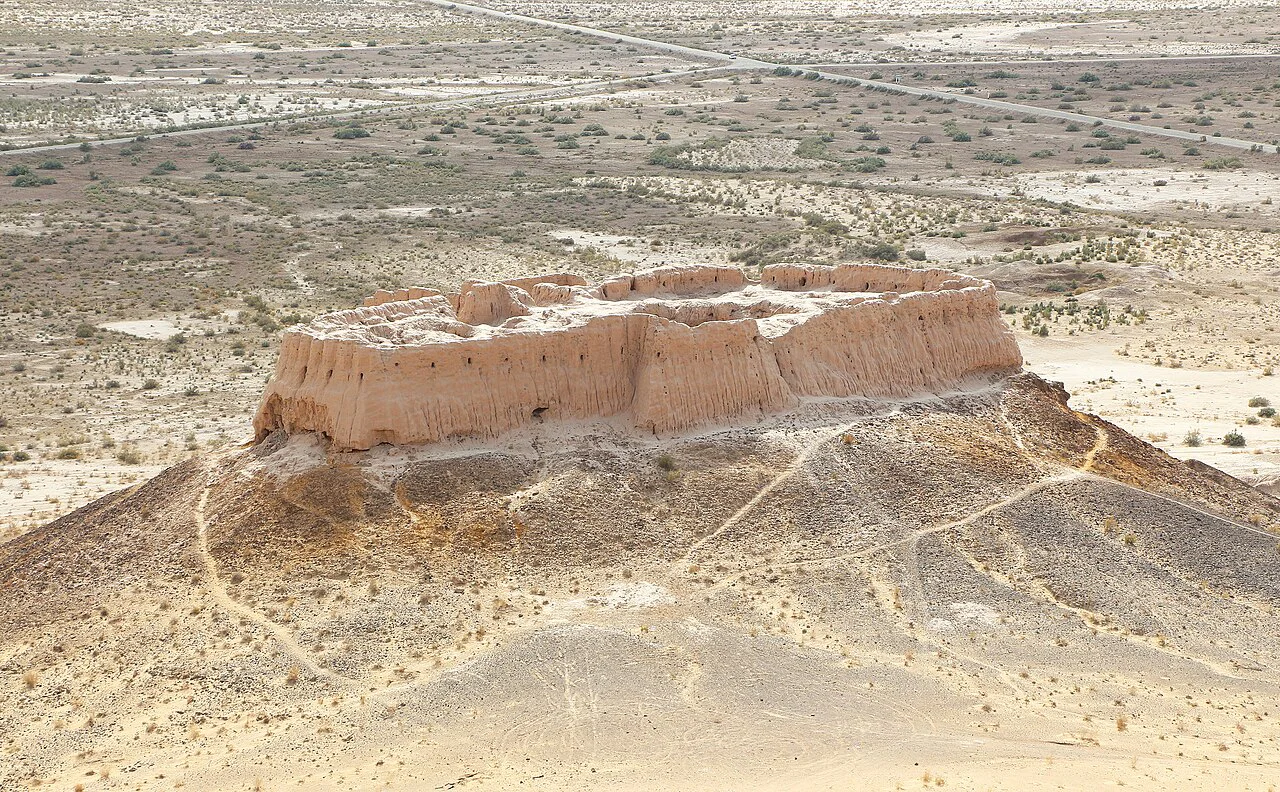
Ellikqala rayonı
Ayaz-Kala
Content & sources
Bernard Gagnon · CC0