Stanza · 语音导览
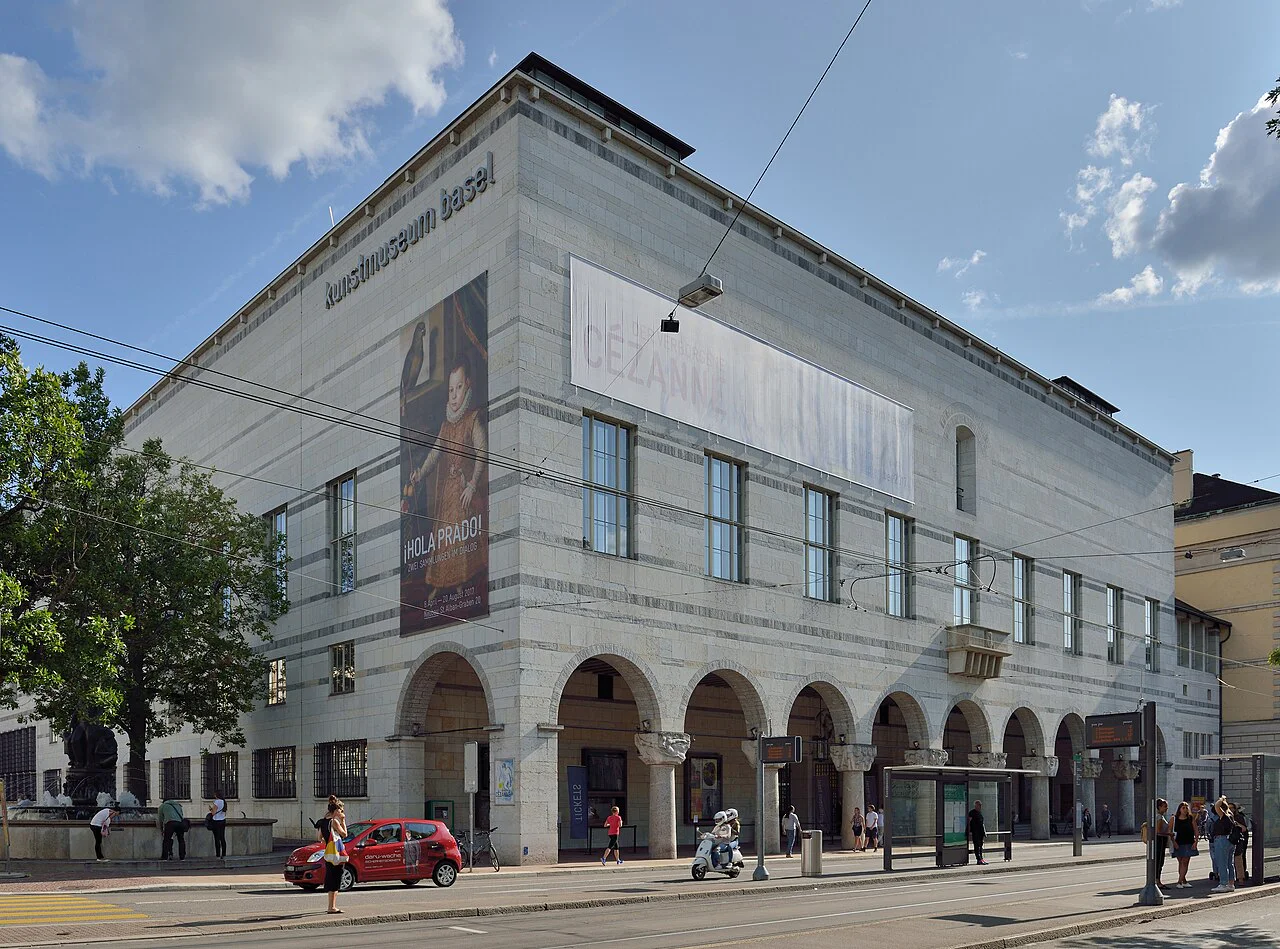
Kunstmuseum Basel 语音导览
值得铭记的地方,值得带走的故事。
The Kunstmuseum Basel houses the oldest public art collection in the world. It is considered the most important museum of art in Switzerland.
目前仅提供英语,更多语言即将推出。
下载Stanza,然后搜索 “Kunstmuseum Basel”.
关于导览
一份导览,你的游览方式。
The Kunstmuseum Basel houses the oldest public art collection in the world. It is considered the most important museum of art in Switzerland.
随时准备好出发。
- 01免费下载Stanza。
iOS & Android
- 02找到你的导览。
“Kunstmuseum Basel”
- 03参观前下载。
离线
语音导览 / 61件作品
导览内容
出发前了解一些故事。展开站点,阅读更多内容。
01
The Body of the Dead Christ in the Tomb
Does he look like he is resting? Flat on his back, stretched along a panel about two metres long and only thirty centimetres high. No halo. No glow. No one weeping beside him. Hans Holbein the Younger painted this Dead Christ between 1520 and 1522. Start with the face. The eyes are open. The mouth is open too. Nobody has closed them. Perhaps even now, he is still looking. And his hair. Dark strands spill over the edge of the cloth, so vivid they seem to break through the surface of the paint. Now the body. Ribs pushed against the skin. The belly sunk. A wound in his side, dark red, with a bruised green edge. Holbein painted dead flesh as dead flesh. Nothing is softened. The skin and the wound have begun to turn. This body may have lain here three days. If so, the Resurrection is very close. Then the hand. A wound marks it, and the fingers are curled. One finger stretches out, the middle one, until it seems to reach out of the picture towards you. A dead hand, reaching for the living. And the feet. Dark, the toes hard and stiff. Holbein shows the Son of God after he has suffered the fate of an ordinary man. Nothing here is spared you. It was meant to stir piety, a reminder of what he went through, and what came after. Now go back to the face. Does he look like he is resting? Dead, and his eyes still open.
在应用中收听Photo: Gsimonov · CC0
02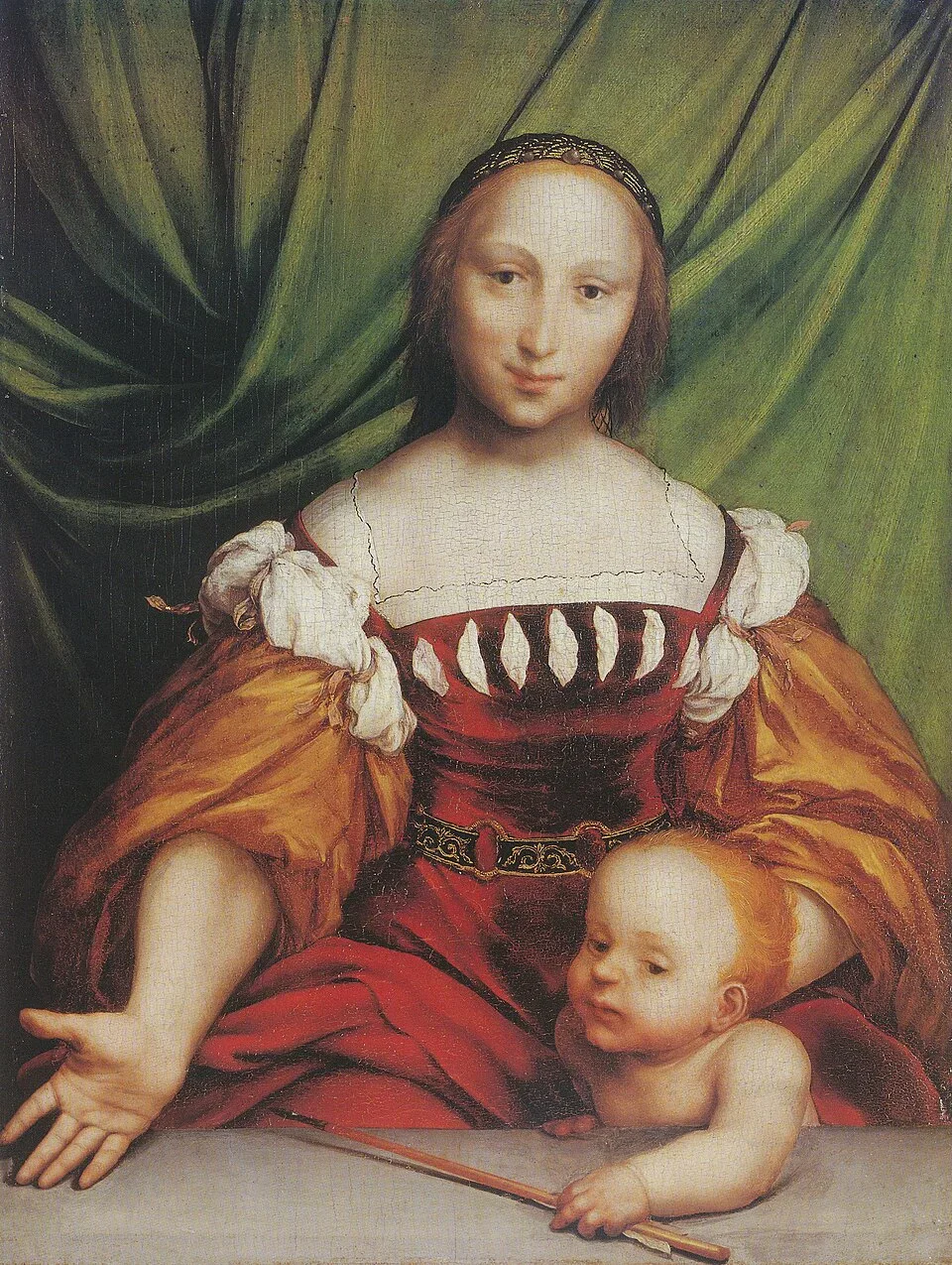
Venus and Cupid
For a long time, this Venus passed as a painting by Hans Holbein's own hand. Then research showed otherwise. The outlines of another woman had been traced from an earlier picture and flipped in reverse, the way you might copy through something like carbon paper. So this is not the master himself, but his workshop, working after him. Knowing that, look at her again. She stands behind a low parapet in front of a green curtain, one hand open toward you, her gaze direct. Her small son Cupid climbs up beside her, holding love's arrow in his hand. The model is believed to be Magdalena Offenburg or perhaps her daughter, and Magdalena may have been the painter's own mistress. And that open hand reaches out to whoever stands here, and to any wealthy collector Holbein hoped to win over. Not his hand after all.
在应用中收听Hans Holbein the Younger and workshop · Public domain
03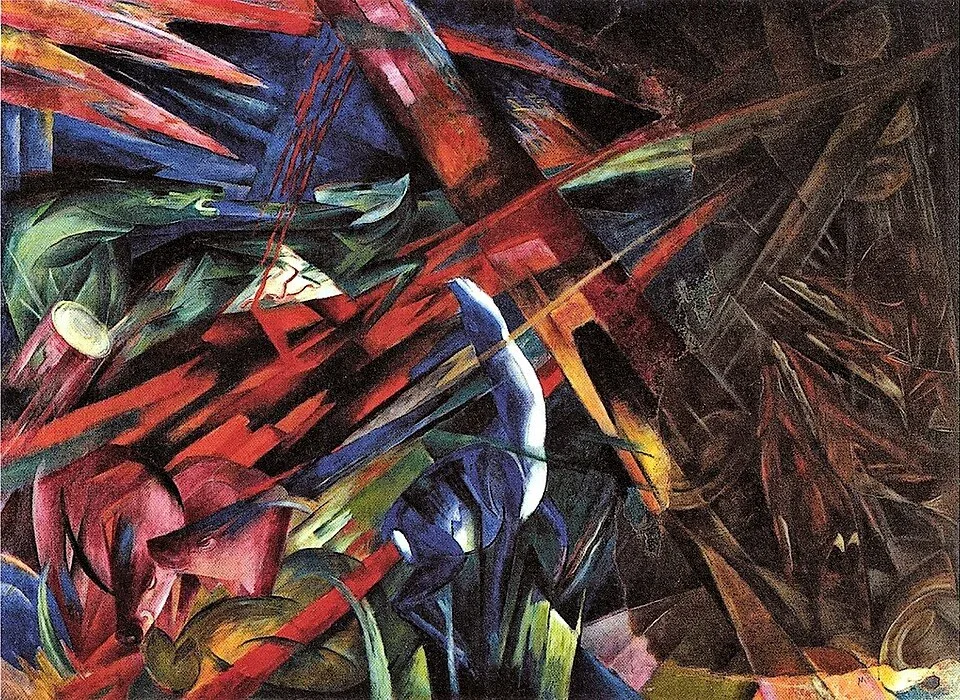
The fate of the animals
A forest is burning. Sparks fall through the air, and a burning trunk is toppling toward the blue deer at the center. The deer has thrown its head up as if crying out. On the left, two horses flee, but the green one has turned the wrong way, into the heart of the fire, its veins showing on its belly. Even the trees are cut open, their rings laid bare at the edges like veins. Marc gave the picture a strange first title, that the trees show their rings and the animals their veins. Then the story caught up with the painting. In 1915, Marc saw a postcard reproduction of it while he was at war. He wrote to his wife that it felt like a premonition of that war, so true it unnerved him. He died at Verdun the next year. After his death, in 1916, the canvas sat in storage in Berlin, and a fire burned away the whole right side. His friend, the painter Paul Klee, repainted the lost part from old photographs, in a dull brown that mutes the color completely. Why he made it so dull, no one has ever agreed.
在应用中收听Franz Marc · Public domain
04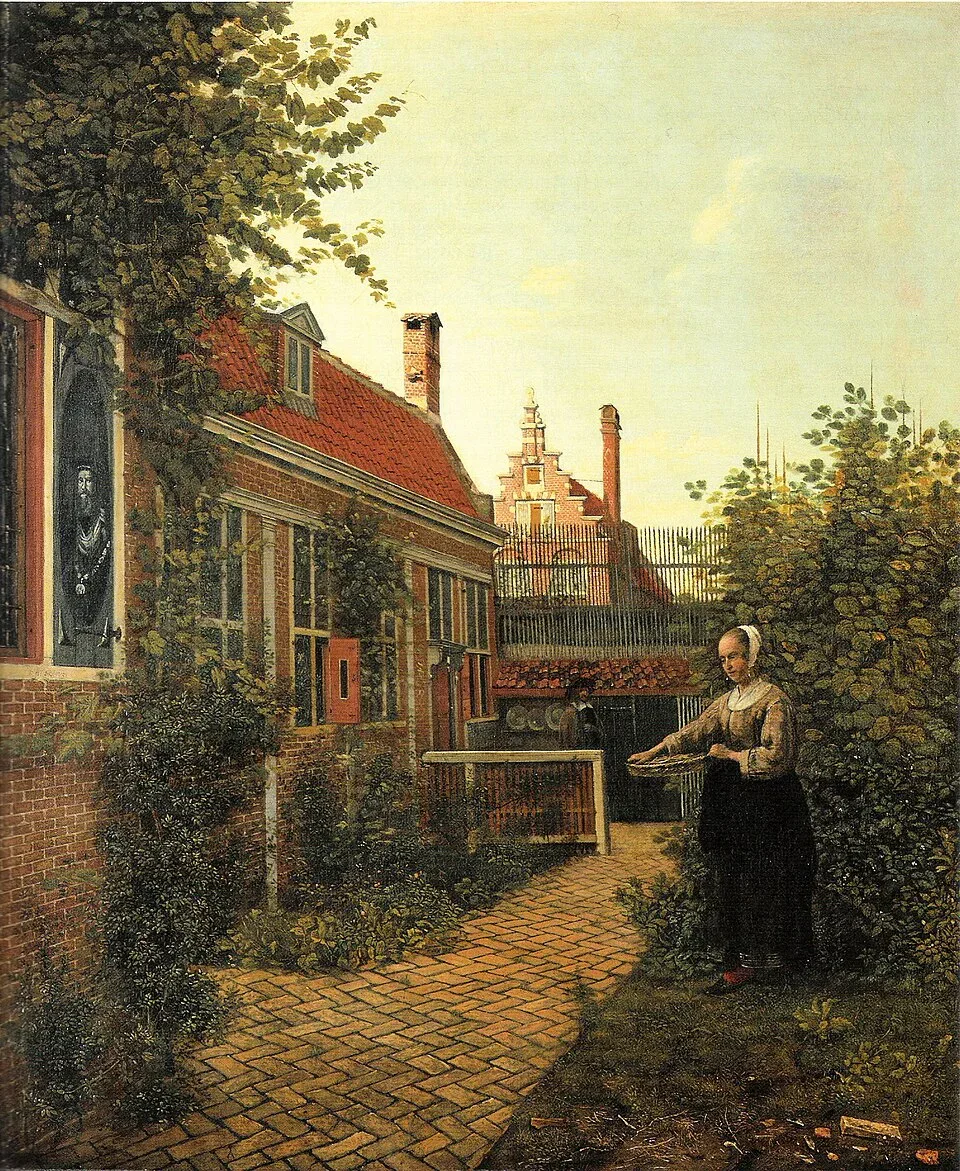
A Woman with a Basket of Beans in a Garden
This garden hides a face that was painted over. A woman stands at the edge of the picture, holding a basket of beans she has probably just picked from the bush behind her. Her plain clothes say servant, but the pearl earrings in her ears could make her the mistress of the house. And here is the hidden man. On the window shutter of the brick house, Pieter de Hooch painted a nobleman wearing the chain of the Order of the Golden Fleece. That nobleman is the Emperor Charles V. An emperor has no business hanging over a bean patch, and that may have been the point. The house looks like a hofje, an almshouse in Leiden, and in Dutch the word hof also means court. Such charity homes were grand enough for rich people to use them as displays of status. De Hooch may be laughing at that gap between charity and showing off. But his livelihood depended on exactly those patrons. Later the emperor was blotted out, maybe by a later owner, maybe by De Hooch himself, who could have thought better of it. Two later versions show the same house, and in both of them the emperor is gone.
在应用中收听Pieter de Hooch · Public domain
05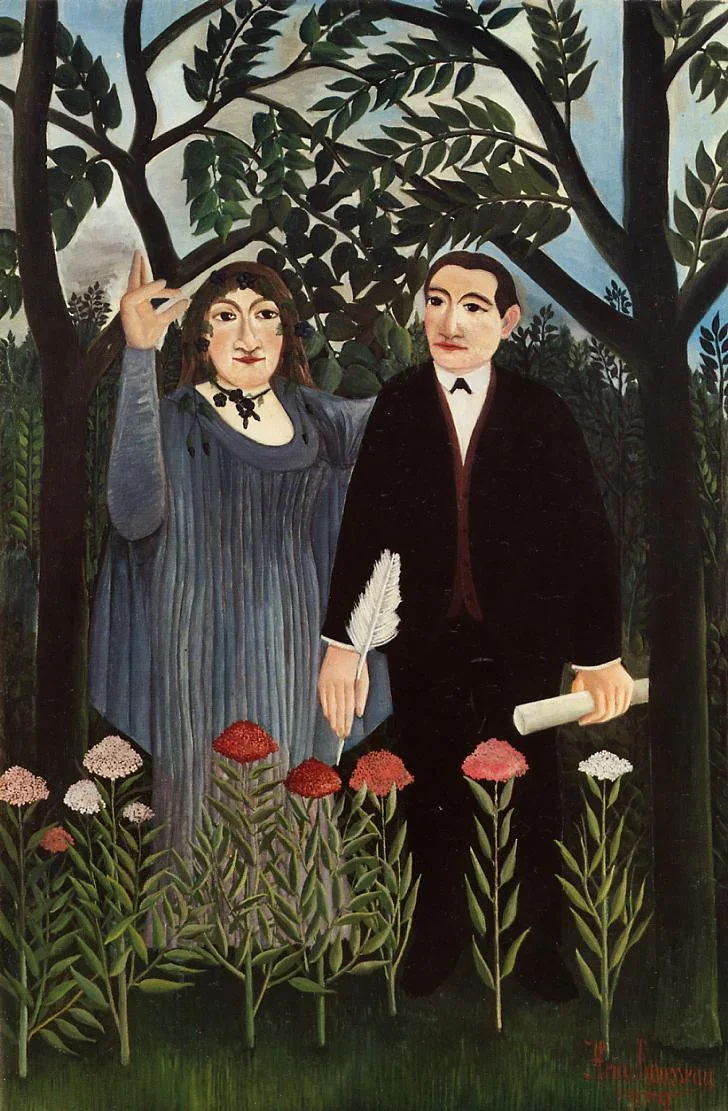
The Muse Inspiring the Poet
Before he painted the man in this picture, Henri Rousseau measured him. His nose, his mouth, his ears, his forehead, his hands, his whole body. The man was the poet Guillaume Apollinaire. Posing was dull work, so Rousseau sang him songs from his own youth while he stood there. The woman beside him is Marie Laurencin, the poet's love, dressed as a muse in an ancient gown, blessing him with a gesture of her hand. In his own hand Apollinaire holds a pen and a roll of paper, the tools of a poet. Behind them grows a jungle, a tropical forest of the imagination. Rousseau planned a row of carnations in the front, flowers for the poet's immortal soul. But while Apollinaire was away, he mixed up the flowers and painted wallflowers instead. Apollinaire told the whole story himself, in a letter to a newspaper in 1909. The wrong flowers stayed.
在应用中收听Henri Rousseau · Public domain
06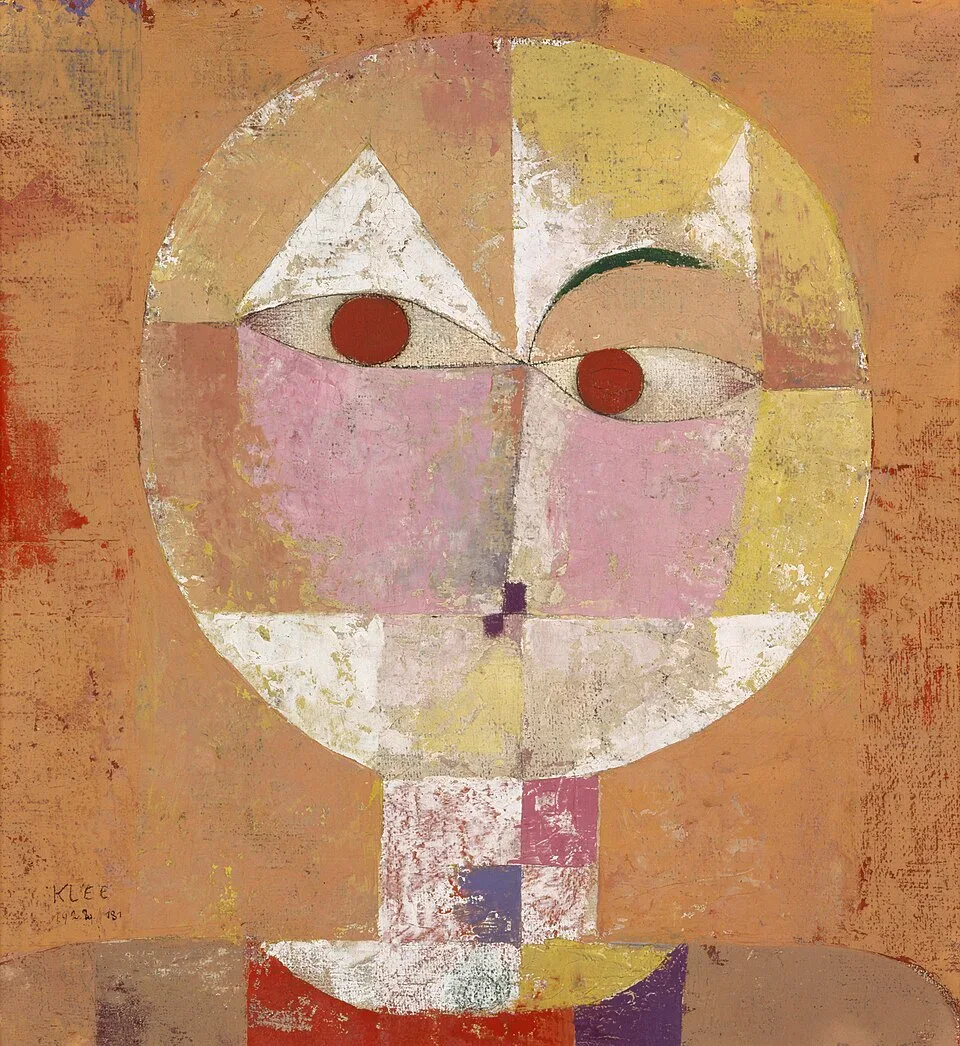
Senecio
Is this a face, or a mask? A round disc, divided into squares of orange, pink, yellow and white, like the patches on a harlequin's costume. The eyes are drawn with sharp lines, so they stand out from the flat pattern around them. Klee painted this in 1922, while he was teaching at the Bauhaus, the art school in Weimar. But the real clue is the name. Senecio may come from a common plant, whose round white seed heads look like small white-haired heads. The German subtitle means something close to soon an old man. So a harlequin face may carry a plant's name. And still, a triangle and a curved line above the eyes raise one eyebrow. A pile of squares, and it stares back at you.
在应用中收听Paul Klee · Public domain
07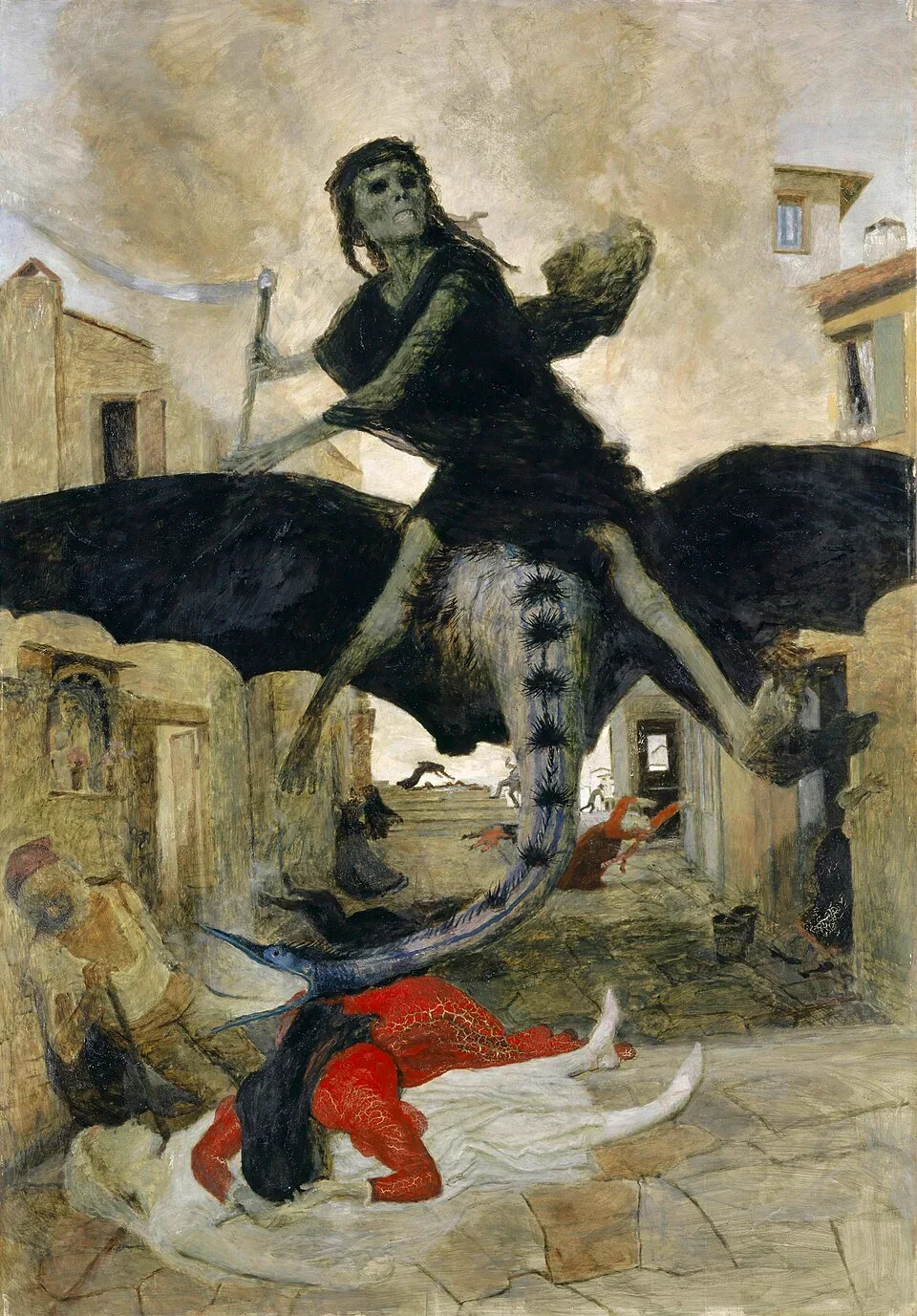
The Plague
Red, in this street, belongs to someone already dead. A woman in a red dress lies fallen in the foreground, and that red is the only vivid colour in the whole picture. Everything around it is pale green, black and dull brown. She lies across the body of another woman, dressed in white, also cut down by the plague. What came for them is riding through the street. Death here is not a skeleton but a corpse with empty eye sockets, swinging a scythe from the back of a flying creature with bat wings and the long neck of a dragon. People dive for cover in its path. Arnold Böcklin painted this in 1898, thinking of news of the plague in India and of the Black Death. The one vivid colour goes to the fallen.
在应用中收听Arnold Böcklin · Public domain
08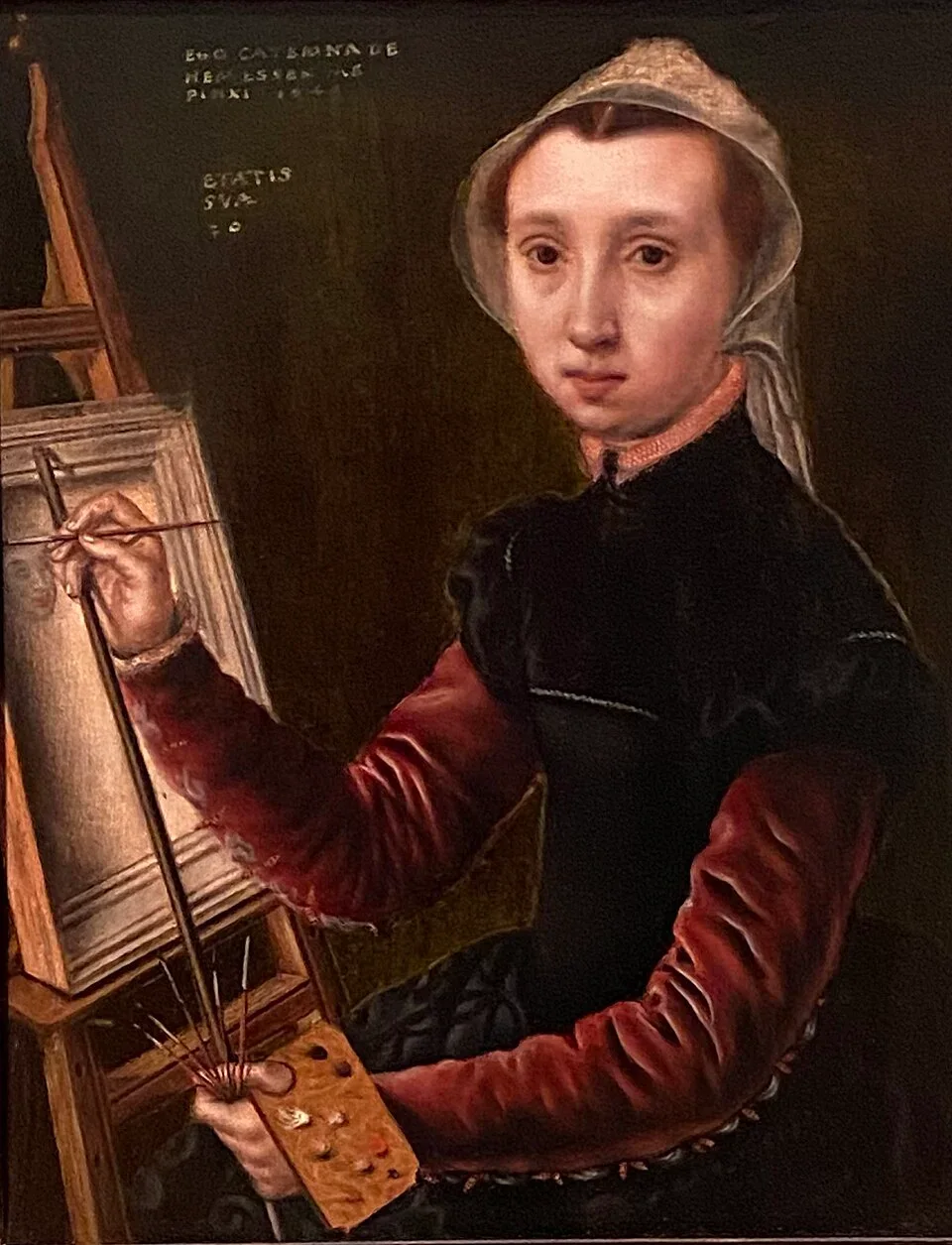
Self-Portrait of Catharina van Hemessen (Kunstmuseum Basel)
A young woman holds a brush in her right hand and looks past you, the way you look at a mirror. She is painting herself, and the picture on her easel has barely begun. Only a small sketch of her head sits on that inner panel, in the corner opposite to where her real head appears. In 1548, painters almost never showed the tools of their trade. She shows brush, palette and easel, and this is probably one of the first portraits to do it. Then she signed the panel in Latin. I, Catharina van Hemessen, painted myself, 1548, her age twenty. Few women could become painters then, because training meant living for years in a master's house. She was taught by her father, a painter in Antwerp. Some have guessed it was his hand, but her prominent signature tells us this picture is her own.
在应用中收听Photo: Paradise Chronicle · Public domain
09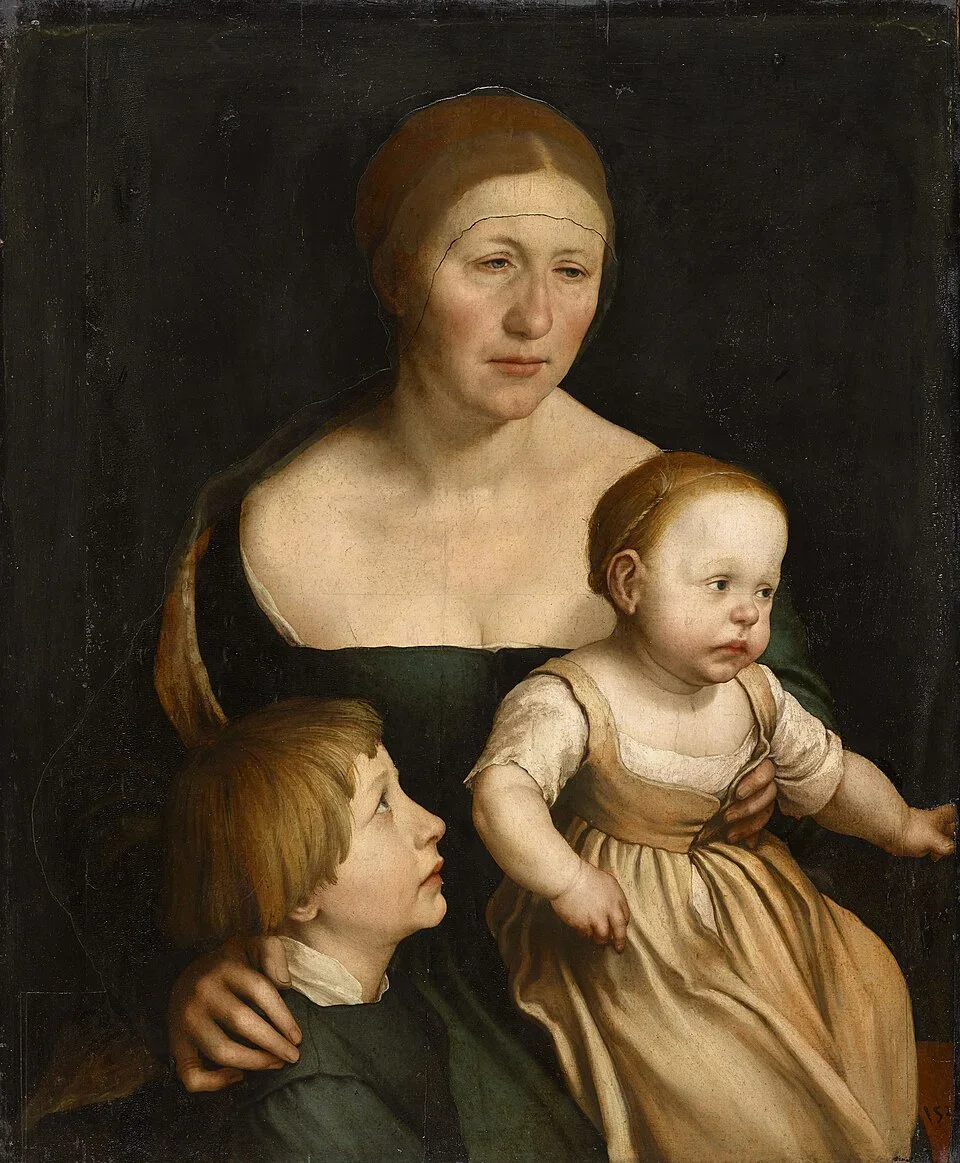
Portrait of the Artist's Family
Someone once cut this family out of its picture. Late in the sixteenth century, the figures were cut out around their outlines and stuck onto a black panel. The cut took the last digit of the date painted on the bench, so the year now breaks off after one, five, two. It also took the fingertips of the little girl's hand. What you see is only part of the picture. Hans Holbein painted his wife Elsbeth with their two eldest children in 1528 and 1529, soon after he came home from England. An early owner, the painter Hans Asper, may have described the work before it was cut, and that description hints that the missing third piece held one more figure. Perhaps Holbein himself, painting his own wife and children. When he went back to England, he left the picture behind in Basel. The boy looks up and to the right, at nothing now. Perhaps he was looking at his father.
在应用中收听Hans Holbein the Younger · Public domain
10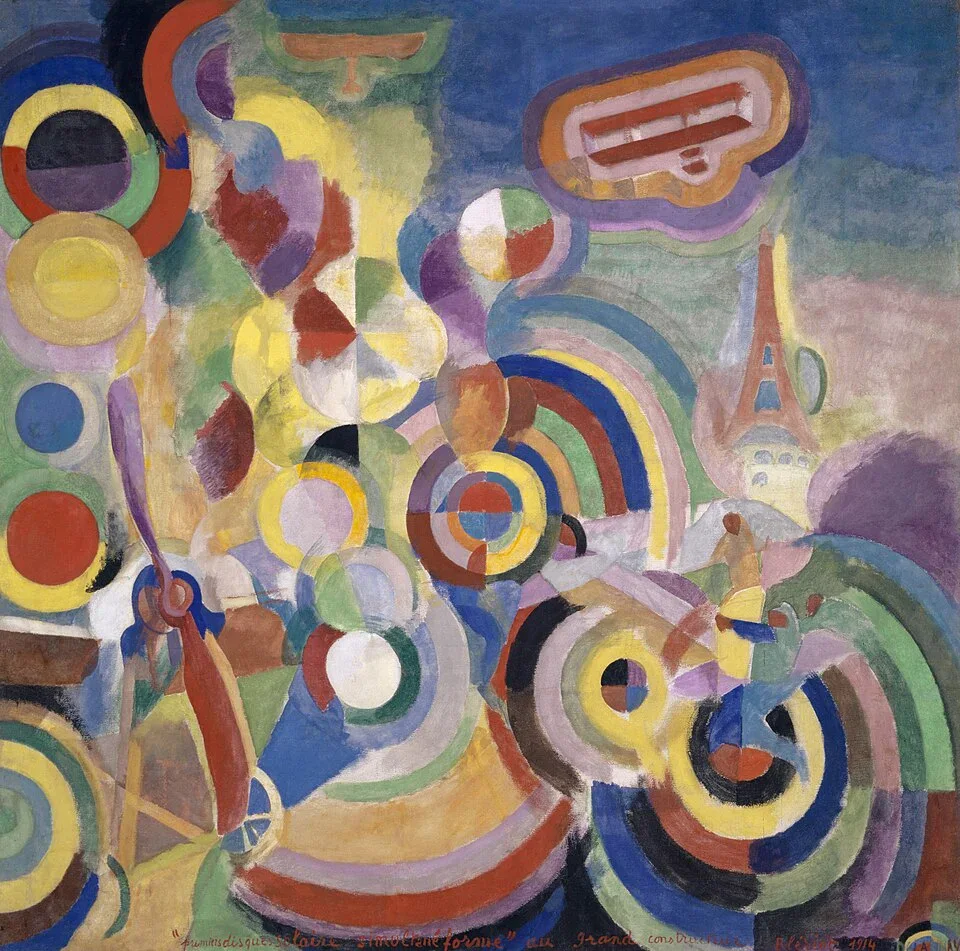
Hommage to Blériot
A biplane flies above the Eiffel Tower in Paris. On the other side of the picture, there is a propeller. And everywhere, circles. Bright solar disks of colour. Delaunay painted this in 1914 for Louis Blériot, the French aviation pioneer. So you would expect a salute to the pilot. Then read the words he left along the bottom. He dedicates the picture to the great constructor Blériot. Not the man who flew. The man who built the machine. The circles come from a colour theory by the chemist Michel Eugène Chevreul, about how colours change each other when they sit side by side. Sun, earth, fire, airplanes. A poem, Delaunay admitted, that no words can really carry.
在应用中收听Robert Delaunay · Public domain
- 11
Marguerite Gachet at the Piano
Vincent van Gogh · 1890
- 12
Double Portrait of Jakob Meyer zum Hasen and Dorothea Kannengießer
Hans Holbein the Younger · 1516
- 13
Villa R
Paul Klee · 1919
- 14
Abishai before David
Konrad Witz · c. 1435
- 15
Portrait of Bonifacius Amerbach
Hans Holbein the Younger · 1519
- 16
Lais of Corinth
Hans Holbein the Younger · 1526
- 17
Death and the Maiden (Baldung)
Hans Baldung Grien · 1517
- 18
Altar of Passion
Hans Holbein the Younger · 1523
- 19
Composition in Half-Tones
Theo van Doesburg · 1928
- 20
David with the Head of Goliath before Saul
Rembrandt · 1627
- 21
Beheading of John the Baptist
Niklaus Manuel · c. 1517
- 22
Le Portrait du père Tanguy
Émile Bernard · 1887
- 23
Shepherdess singing with Shepherd
Johannes Moreelse · c. 1630
- 24
We Shall Not Go to the Market Today
Paul Gauguin · 1892
- 25
Frederick the Wise, Elector of Saxony
Albrecht Durer · 1524
- 26
The volunteer’s return
Frank Buchser · 1867
- 27
The Death of Pietro Aretino
Anselm Feuerbach · 1854
- 28
Composition in dissonances
Theo van Doesburg · 1918
- 29
Composition XII in Black and White
Theo van Doesburg · 1918
- 30
Portrait of Desiderius Erasmus, after Hans Holbein the Younger
Workshop of Hans Holbein the Younger · c. 1530
- 31
Portrait of David Joris
Jan van Scorel · 1540
- 32
St James the Greater
El Greco · c. 1600–1614
- 33
Bathing Gypsies
Johannes Lingelbach · 1700
- 34
Virgin forest with sunset
Henri Rousseau · c. 1910
- 35
Vita somnium breve
Arnold Böcklin · 1888
- 36
The Woman in Blue
Fernand Léger · 1912
- 37
Mont Sainte-Victoire Seen from Les Lauves
Paul Cézanne · 1904–1906
- 38
Interior with Four Figures, Roman
Oskar Schlemmer · 1925
- 39
Judgement of Paris by Niklaus Manuel
Niklaus Manuel · c. 1516–1528
- 40
Venus, Injured by Diomedes, Returns to Olympus
Jean-Auguste-Dominique Ingres · 1805
- 41
Odysseus and Calypso
Arnold Böcklin · 1882
- 42
Play of the Nereides
Arnold Böcklin · 1886
- 43
Death and the Woman
Hans Baldung Grien · c. 1517–1520
- 44
Isle of the Dead
Arnold Böcklin · 1880
- 45
Cardinal Albrecht of Brandenburg - the Large Plate
Albrecht Durer · 1523
- 46
St. Jerome
Hans Memling · c. 1485–1490
- 47
Portrait of Jacob of Savoy
Hans Memling · 1470s
- 48
Portrait of a Lady
School of Fontainebleau · 1590
- 49
Portrait of an Englishman
Hans Holbein the Younger · c. 1540
- 50
Adam and Eve
Hans Holbein the Younger · 1517
- 51
Saint Jerome
Albrecht Durer · 1492
- 52
Last Supper
Hans Holbein the Younger · 1524–1525
- 53
Study of the Head of a Peasant
Lucas Cranach the Elder · 1520–1525
- 54
Wounded Brigand (Roman Shepherd)
Eugène Delacroix · c. 1825
- 55
The Four Elements.
Sebastian Stoskopff · 1630s
- 56
School with school master and children
Ambrosius Holbein · 1516
- 57
Portrait of Erasmus of Rotterdam writing
Hans Holbein the Younger · 1523
- 58
An Angel Appearing to the Wife of Manoah
Carlo Saraceni · c. 1610
- 59
Jeanne de Boulogne, Duchess of Berry
Hans Holbein the Younger · 1524
- 60
The Pensive Christ and the Virgin Mary Grieving
Hans Holbein the Younger · c. 1520
- 61
School Master's Signboard (grown-ups' side)
Hans Holbein the Younger · 1516
Kunstmuseum Basel
常见问题
导览需要多少钱?
免费下载应用. 1月1日前免费. 导览标示价格: $1.99. 仅含语音导览。景点门票需另行购买。
没有网络也能收听吗?
可以。在参观前通过应用下载音频、图片和地图。已下载的内容可离线使用。
可以用我的语言收听吗?
目前仅提供英语,更多语言即将推出。
需要按固定时间参观吗?
不需要。这是自助导览。你可以选择站点、随时暂停,并按自己的节奏重听故事。
按自己的节奏
探索Kunstmuseum Basel。
下载Stanza,然后搜索 “Kunstmuseum Basel”.
免费下载应用 · 导览价格以应用内显示为准
继续探索
附近的语音导览
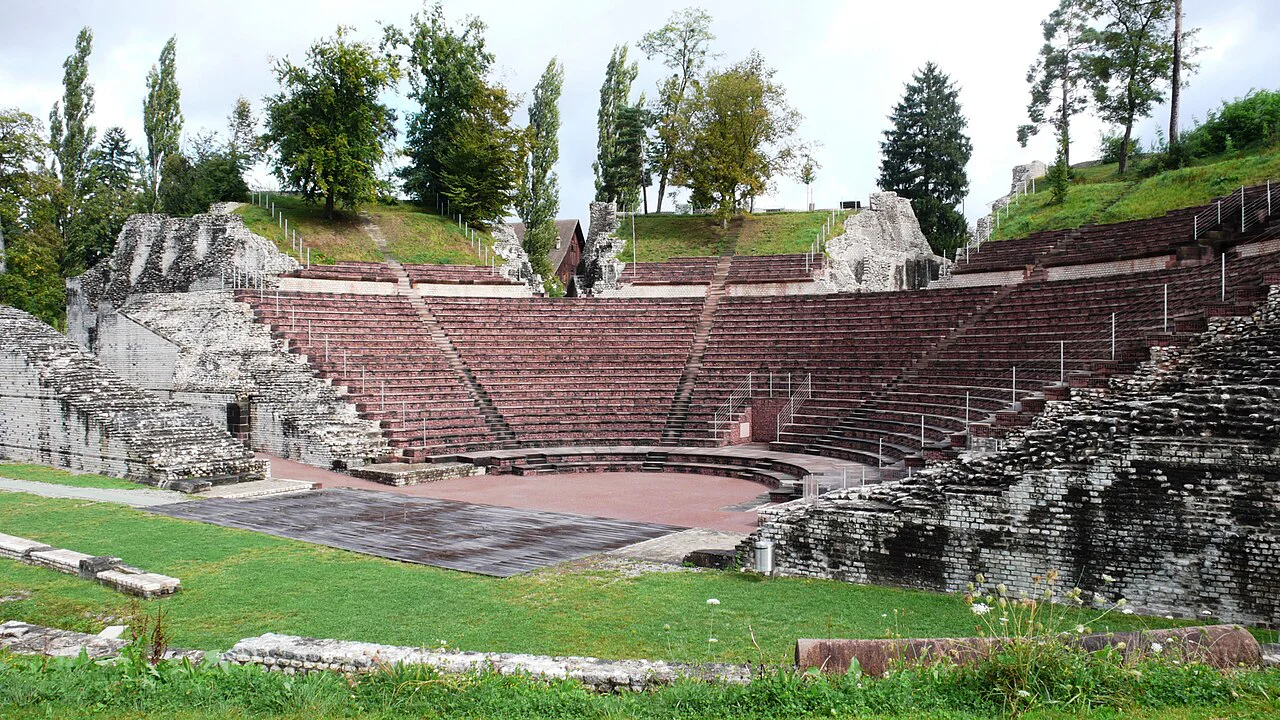
奥格斯特 · 10公里
奥古斯塔·劳里卡
内容与来源
Guido Radig · CC BY-SA 3.0
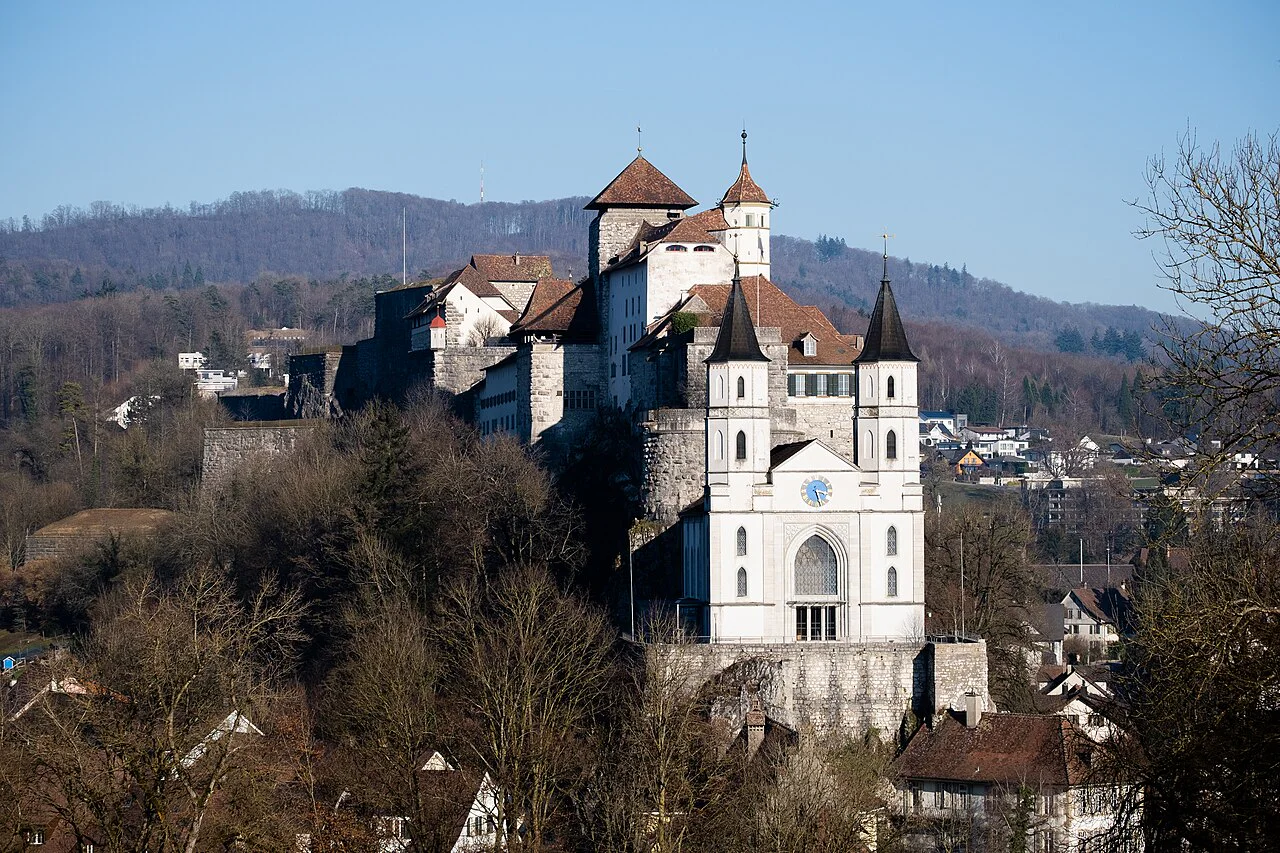
阿尔堡 · 35公里
阿尔堡城堡
内容与来源
Christian David · CC BY-SA 4.0
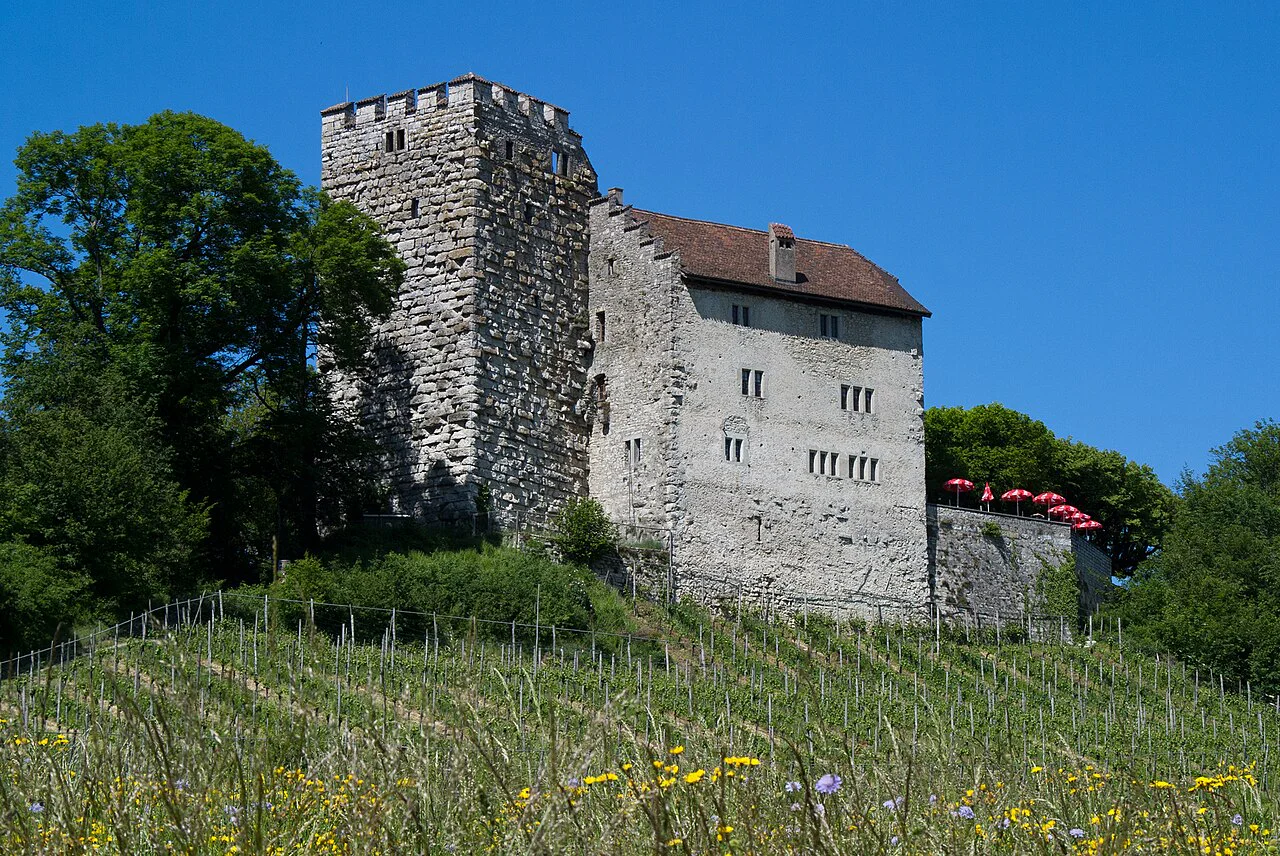
Habsburg · 45公里
哈布斯堡城堡
内容与来源
Photo: Roland Zumbuehl · CC BY-SA 3.0
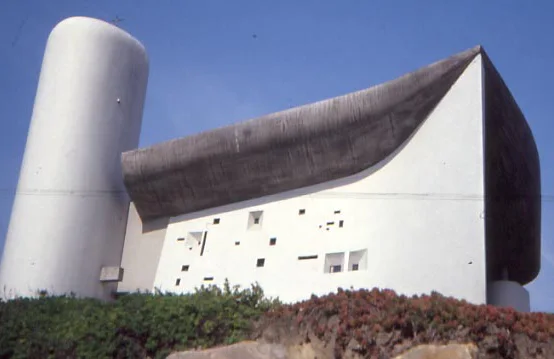
龙尚 · 75公里
廊香教堂
内容与来源
Immanuel Giel · CC BY-SA 3.0