Travel tips/Phaistos, Crete, Greece
Phaistos Palace: what to see and when an audio guide helps
A palace can still tell a story without its roof. At Phaistos, start with the spaces between the walls, and the landscape beyond them.
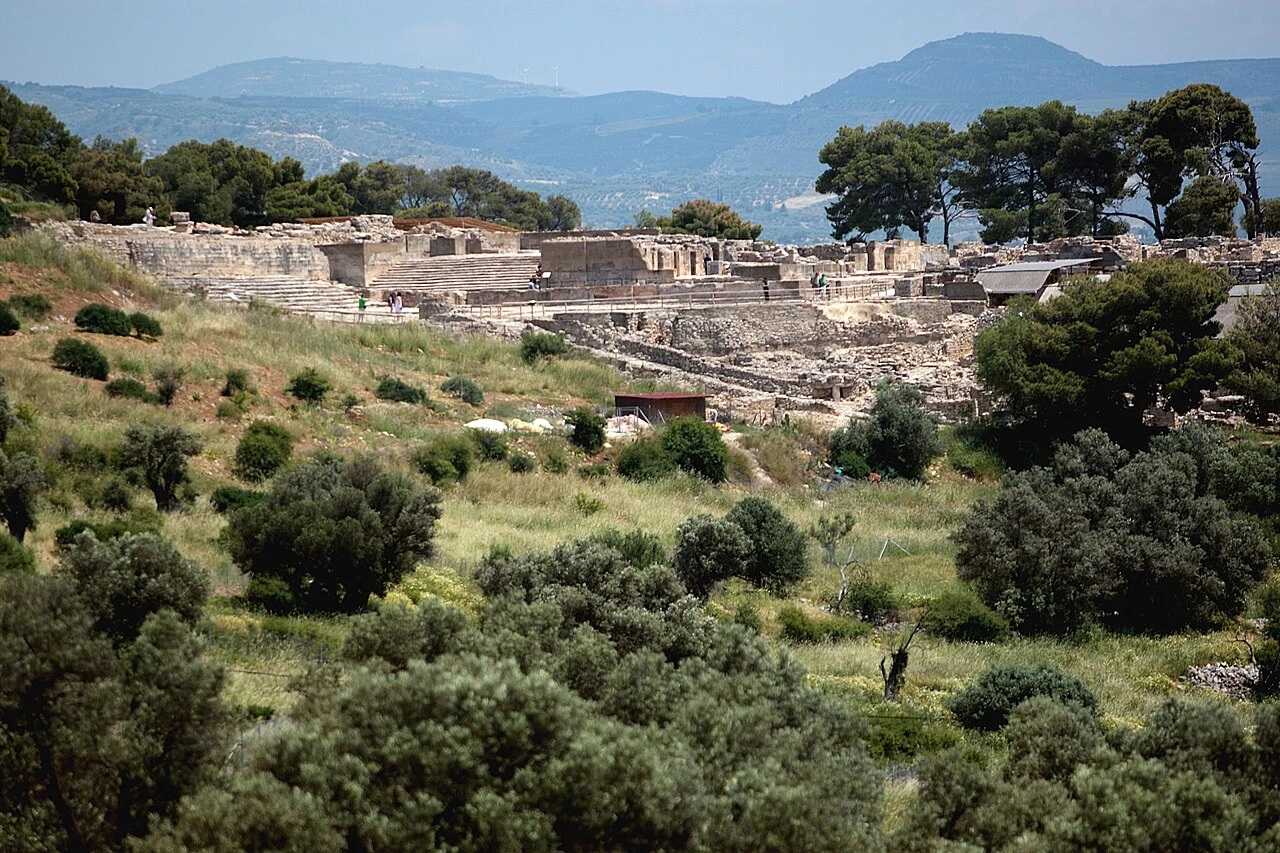
At Phaistos, the difficult part is not finding ancient stone. It is turning that stone into a place people used. A court can look empty until you notice how rooms face it; a row of small chambers becomes more interesting when you ask what moved through them. This is a visit for looking at relationships. A little preparation can help, whether you choose a guide or explore independently.
Think beyond a royal home
Phaistos stands above the Messara plain in southern Crete. Hellenic Heritage dates its first palace to around 1900 BCE, followed by destruction and rebuilding. The remains include different phases, so do not read every wall as part of one moment.
In 2025, Phaistos became part of UNESCO’s six-site Minoan Palatial Centres property. UNESCO describes these centres as administrative, economic and religious hubs. That changes the question: instead of trying to imagine only a royal household, look for spaces that organised people, goods and movement.
Three clues that make the plan readable
Use the site’s signs and any available plan to identify these features from permitted viewpoints. They are a way of looking, not a guaranteed walking route through every room. The Region of Crete’s visitor account describes the western paved area, monumental entrance, central court and western storerooms.
- The western court and stepped area: trace the paved lines and look at the broad tiers. Traditionally described as a theatral area, this prompts a question about gathering and watching; it does not prove that a particular performance took place here.
- The monumental staircase and gateway: compare the width of the approach with the openings beyond. Notice how an entrance can make arrival feel important and channel movement, even when the upper parts no longer survive.
- The central court and storerooms: first see how the wings relate to the open court, then identify the storage area on the west. Repeated small rooms help explain why a palace was also an economic centre, not simply a grand house.
The Disc is a separate museum visit
The Phaistos Disc was found at the palace in 1908. It is a clay object with stamped signs spiralling across both faces, now in the collection of Heraklion Archaeological Museum. Seeing its find-place and seeing the object are different visits; check the museum’s current displays and admission separately.
The museum’s account says experts have reached no definitive conclusion about the inscription’s contents. Treat confident claims of a solved translation with caution. The uncertainty is part of the object’s interest: compare repeated groups of signs rather than expecting a guide to deliver a settled message.
Is an audio guide worth it? Try this test
Before buying, ask whether a guide will solve your particular problem. Can you match its stops to what you can actually see? Does it explain how a court or storeroom functioned, rather than just supply names? Does it distinguish an interpretation from a proven fact? A guide that does those things can add more than another paragraph of dates.
Stanza’s independent Phaistos guide has an audio preview on the venue page. Listen before deciding, check the current price and languages, and download before arrival if you want offline use. You can choose a few stories rather than listen to every stop. Audio does not include admission or a personal guide; signs and independent reading remain a reasonable choice.
Build a visit around the palace, not last entry
Consider about 90 minutes at the site for orientation, the three architectural clues and a pause over the landscape. This is a flexible planning allowance, not an official duration. Add travel and breaks separately; shorten or extend the visit to suit your attention, mobility and the weather.
When checked, Hellenic Heritage listed €15 full admission and €8 reduced, with last entry 20 minutes before closing. Opening changes seasonally, with holiday exceptions. Follow its official booking link and confirm eligibility and your date. The final admission time is a cutoff, not a recommended arrival.
The same official page estimates roughly one hour by car or one hour forty minutes by intercity bus from Heraklion. Those are indicative journeys, not a verified timetable. If using a bus, confirm the actual Phaistos stop and return service for your date before committing; do not substitute a timetable to a nearby town.
Arrive ready to look
Bring water, sun protection, shoes with grip and a charged phone. Check current notices before setting off; heat can change access arrangements. Stay on permitted paths and ask the site about the precise route if steps or uneven surfaces matter (+30 28920 42315). Do not infer that every excavated room is accessible.
Finish by looking back from a permitted viewpoint at the plain below. The court, the stores and the wider agricultural landscape belong in the same thought. That connection is a better souvenir than remembering every room name.
A few more questions before you go
Do I need to visit Knossos before Phaistos?
No. Phaistos can be understood as its own visit. If you see both, compare how courts, entrances and storage organise each complex; avoid treating every difference in the visible ruins as a difference in ancient use.
Can I see the Disc with a palace ticket?
Do not assume so. The palace and Heraklion Archaeological Museum are separate venues. Check each ticket’s coverage and the museum’s current exhibition information; a palace audio guide does not include museum admission.
Sources & further reading
Visitor information checked .
Hellenic Heritage, UNESCO, Region of Crete visitor information and the Heraklion museum’s official indexed exhibit account checked on 18 October 2026. Confirm current admission, opening, transport and accessible routes. The suggested visit time is an editorial allowance, not a tested itinerary. Archaeological interpretations are distinguished from visible features.
- Hellenic Heritage: Phaistos visitor information
- UNESCO: Minoan Palatial Centres
- Region of Crete: the Phaistos Palace
- Heraklion Archaeological Museum: the Phaistos Disc
Questions or a correction? Let us know. Our content standards (English).