Travel tips/Cairo, Egypt
Giza and Cairo in one or two days: the Pyramids, the Citadel and Islamic Cairo
One day for the kings who built at Giza, one for the city that grew up later on the other bank. How to split the two, and which tickets to check first.
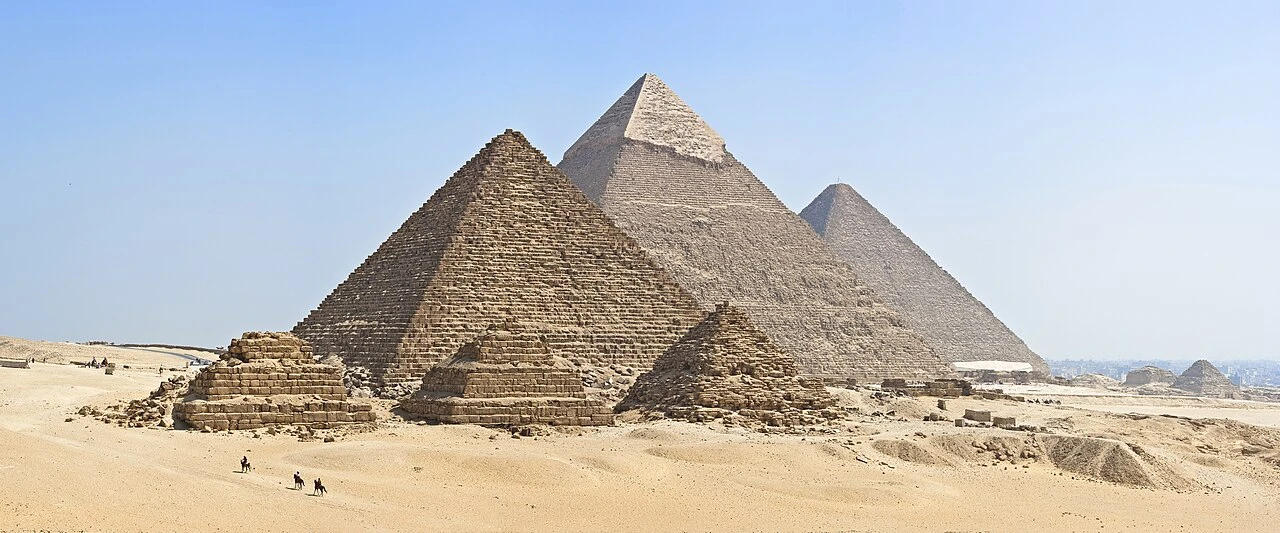
Giza and the Citadel sit on opposite sides of Cairo and more than 3,500 years apart. One is the burial ground of 4th Dynasty kings; the other is a medieval fortress on the Muqattam Hills above the mosques of Islamic Cairo. Together they show two very different Egypts. The trick is not to treat them as one long checklist.
At Giza, see a complex, not three pyramids
The ministry dates the three main pyramids to the 4th Dynasty (c. 2613–2494 BC): the Great Pyramid for Khufu, the others for Khafre and Menkaure, his son and grandson. Each pyramid was one part of a larger complex, with queens' pyramids, a satellite pyramid, mastaba tombs, boat burials, and a valley temple linked by a causeway to a temple at the pyramid's base. Looking for those pieces makes the plateau easier to read. Start early: it is open, exposed ground.
The Great Sphinx was carved from the bedrock beside Khafre's valley temple, and the ministry says the evidence points to his reign; Thutmose IV later set a monumental stela between its paws. UNESCO lists Giza within Memphis and its Necropolis, inscribed in 1979, pyramid fields that run south to Saqqara and Dahshur.
How Giza tickets work
Think of it in layers. An area entry ticket gets you onto the plateau. Going inside the Great Pyramid, the Pyramid of Khafre or the Pyramid of Menkaure, the Tomb of Meresankh III or the Workers' Cemetery each needs its own ticket on top. At the time of writing (November 2026), the ministry's page shows area entry for foreign adults at EGP 700 (students EGP 350), and the Great Pyramid's own page shows EGP 1,000 for foreign adults (students EGP 500), with the area ticket also required.
Inside the Great Pyramid, the ministry describes the Grand Gallery rising to the King's Chamber, where Khufu's sarcophagus can still be seen. The two ministry pages showed different opening hours at the time of writing, so confirm hours and which interiors are open on your date.
The Citadel of Saladin: a fortress that became a palace
Salah al-Din ordered a fortress on the Muqattam Hills in 1176. It was finished under Sultan al-Kamil, who made it the rulers' residence around 1207, and it stayed so until Khedive Ismail moved to Abdeen Palace in the mid-19th century. The Mosque of Muhammad Ali dominates the site. Look also for the Mamluk mosque of al-Nasir Muhammad ibn Qalawun and the Ottoman-era Mosque of Sulayman Pasha al-Khadim, and pick one museum, such as the Military Museum or Al-Jawhara Palace, rather than all of them.
At the time of writing (November 2026), the ministry lists the Citadel as open 08:00–17:00 daily, with area entry for foreign adults at EGP 550 (students EGP 275).
Islamic Cairo: pick two or three, not ten
UNESCO describes Historic Cairo as layers of four Islamic capitals. The city was founded as the seat of the Fatimid Caliphate in 969, and Al-Azhar and Al-Hakim are among its Fatimid mosques. Older still is the Mosque of Ibn Tulun (876–879), with its spiral minaret and vast courtyard. The Mamluk sultans added complexes such as the Madrasa of Sultan Hassan, which UNESCO names among the buildings that still dominate the skyline.
A good second-day plan is the Citadel in the morning, then one large mosque nearby and one in the old city, such as Al-Azhar. Mosques are working places of prayer: dress modestly and check visiting arrangements, especially around prayer times and on Fridays. Stanza has guides for several of these; download them before you set out and they work offline.
If you have a third half-day
The Grand Egyptian Museum's ticketing site lists Khufu's Boats Museum among the spaces in a visit, a good follow-on to the Great Pyramid. Buy tickets only on the official site and check its hours, which vary by day. UNESCO's pyramid fields continue south at Saqqara, with the Step Pyramid of Djoser, which UNESCO calls the first pyramid ever built, and at Dahshur. The Hanging Church, in Coptic Cairo, is another part of the city again.
A few more questions before you go
Can I see the pyramids and the Citadel in one day?
Yes, if you start at Giza early and keep the Citadel to its main mosque and one viewpoint. They are on opposite sides of the city and traffic varies, so check the Citadel's closing time for your date and don't add Islamic Cairo's mosques to the same afternoon.
Does the Giza ticket include going inside a pyramid?
No. The ministry's page says the area entry ticket does not cover the Great Pyramid, the pyramids of Khafre and Menkaure, the Tomb of Meresankh III or the Workers' Cemetery. Each has its own ticket, and you need the area ticket as well.
Where should I check prices and opening hours?
On the Ministry of Tourism and Antiquities site, egymonuments.gov.eg, which has a page for each site and monument, and on the Grand Egyptian Museum's official site. Check close to your visit.
Is the Citadel the same as Islamic Cairo?
It is part of it. UNESCO's Historic Cairo includes the Citadel, seat of government from the Ayyubid period, as well as the older Fatimid city around Al-Azhar.
Sources & further reading
Visitor information checked .
Egyptian Ministry of Tourism and Antiquities, UNESCO and Grand Egyptian Museum pages checked on 4 November 2026. Reconfirm hours, prices and open pyramid interiors for your date. This is an editorial plan, not a timed itinerary.
- Egyptian ministry: Giza Plateau
- Egyptian ministry: The Great Pyramid
- Egyptian ministry: The Great Sphinx
- Egyptian ministry: Cairo Citadel
- UNESCO: Memphis and its Necropolis, the Pyramid Fields from Giza to Dahshur
- UNESCO: Historic Cairo
- Grand Egyptian Museum: official ticketing
Questions or a correction? Let us know. Our content standards (English).